
See all articles
What is a cobot? Complete collaborative robot guide: types, safety standards, applications & how they compare to humanoid robots.
So, what is a cobot? A cobot—short for collaborative robot—is an industrial robot engineered to work safely alongside human workers in a shared workspace, without the need for physical safety barriers. Unlike traditional industrial robots locked behind cages, cobots use advanced sensors, force-limiting joints, and intelligent software to detect human presence, avoid collisions, and stop instantly if contact occurs. In 2026, cobots are the fastest-growing segment of the robotics industry, with the global market projected to reach over $1.4 billion this year and $3.4 billion by 2030, according to MarketsandMarkets.
Whether you're a manufacturing engineer evaluating your first automation investment, a business owner exploring ways to boost productivity, or simply curious about the future of human-robot collaboration, this guide covers everything you need to know about cobots—their definition, how they work, types, safety standards, applications, costs, and where the technology is heading next.
Key Takeaways
- Cobots are collaborative robots that work safely alongside humans without safety cages—using sensors, force-limiting, and AI
- Cost: $25,000–$80,000 for hardware, with total deployment at $37,000–$145,000 (vs $100K-$500K for traditional robots)
- Most deployments achieve ROI within 12–18 months thanks to easy programming and minimal facility changes
- Market growing at 18.9–31.6% CAGR, reaching $3.4+ billion by 2030
- Key applications: machine tending, pick-and-place, assembly, quality inspection, packaging, welding
Related reading: Cobot vs Robot: Top Benefits and Key Differences Explained · What Is a Humanoid? Definition and Examples
Table of Contents
- What Is a Cobot? Definition and Origin
- How Do Cobots Work?
- What Are the Different Types of Cobots?
- How Do Cobots Compare to Industrial Robots and Humanoids?
- What Safety Standards Apply to Cobots?
- What Industries Use Cobots?
- What Are the Benefits of Using Cobots?
- How Much Do Cobots Cost?
- How Do You Program a Cobot?
- Who Are the Top Cobot Manufacturers?
- What Is the Future of Cobots?
- Frequently Asked Questions
What Is a Cobot? Definition and Origin
A cobot (collaborative robot) is a robot specifically designed for direct physical interaction with humans within a shared workspace. The term was coined in 1996 by Northwestern University professors J. Edward Colgate and Michael Peshkin. Cobots differ from traditional industrial robots in that they're built for safe human collaboration—with force-limiting joints, rounded edges, and advanced sensors—rather than operating behind safety cages.
The Cobot Definition
A cobot (collaborative robot) is a robot specifically designed for direct physical interaction with humans within a shared workspace. The term was first coined in 1996 by Northwestern University professors J. Edward Colgate and Michael Peshkin, who defined a cobot as "a device and method for direct physical interaction between a person and a computer-controlled manipulator."
The key distinction between a cobot and a traditional industrial robot lies in their design philosophy: cobots are built from the ground up for safe human-robot collaboration. Every aspect—from their lightweight construction and rounded edges to their force-limiting joints and advanced sensor arrays—is engineered to minimize risk when operating in close proximity to people.
What Is the History of Cobots?
The evolution of cobots traces a fascinating path from academic concept to mainstream industrial tool:
- 1996: Colgate and Peshkin create the first cobot concept at Northwestern University, initially designed as passive devices that guided human motion rather than moving independently.
- 2004: KUKA Robotics releases one of the first commercially available lightweight collaborative robots.
- 2008: Universal Robots launches the UR5, widely considered the breakthrough product that made cobots commercially viable for small and medium enterprises (SMEs).
- 2012–2015: Major robotics companies including ABB, FANUC, and Yaskawa enter the cobot market, driving rapid innovation and price competition.
- 2016: ISO/TS 15066 is published, establishing the first international safety standard specifically for collaborative robot operations.
- 2020–2023: The COVID-19 pandemic accelerates cobot adoption as manufacturers seek flexible automation solutions to address labor shortages and social distancing requirements.
- 2024–2026: AI-powered cobots with integrated vision systems, natural language interfaces, and machine learning capabilities enter the market, pushing the boundaries of what collaborative automation can achieve.
How Do Cobots Work?
Cobots work by combining a sensor-equipped robotic arm, interchangeable end-effectors (grippers/tools), and intelligent software that continuously monitors for human contact. When the cobot detects unexpected force, it stops within milliseconds—making it safe to operate alongside humans without barriers.
What Are the Core Components of a Cobot?
1. Robotic Arm and Joints
A cobot's arm is its most visible feature. Most cobots use a 6-axis articulated arm design, giving them six degrees of freedom (DOF) that closely mimic the range of motion of a human arm. Some newer models feature 7-axis designs for even greater flexibility. Each joint contains precision servo motors with integrated torque sensors that constantly monitor the force being applied.
2. End-Effectors
End-effectors are the interchangeable tools attached to the cobot's wrist—essentially the robot's "hand." Common types include:
- Mechanical grippers (parallel, angular, or adaptive)
- Vacuum grippers for flat or smooth surfaces
- Welding torches and screwdrivers
- Force/torque sensors for precision assembly
- Camera and vision systems for inspection
- Tool changers for automatic swapping between tasks
3. Sensors and Perception Systems
Cobots are equipped with multiple sensor types that give them environmental awareness:
- Force/torque sensors in every joint detect resistance and contact forces
- Proximity sensors (infrared, ultrasonic, capacitive) detect nearby objects and humans
- Vision systems (2D/3D cameras, depth sensors) enable object recognition and localization
- LiDAR for spatial mapping in advanced applications
- Pressure-sensitive skins that detect contact across the entire arm surface
4. Controller and Software
The controller is the cobot's "brain," running real-time operating systems that process sensor data, execute motion plans, and enforce safety limits. Modern cobot controllers support cloud connectivity, enabling remote monitoring, predictive maintenance, and over-the-air software updates.
What Are the Four Collaborative Operation Modes?
The ISO/TS 15066 safety standard defines four methods of collaborative operation that cobots can use:
- Safety-Rated Monitored Stop: The cobot automatically stops when a human enters the collaborative workspace, resuming when the human exits. Best for tasks where the human and robot take turns.
- Hand Guiding: A human operator physically moves the cobot arm to teach it positions and paths. The cobot records these movements and replays them autonomously.
- Speed and Separation Monitoring: The cobot adjusts its speed based on the distance between it and the nearest human. The closer the human, the slower the cobot moves—stopping entirely if the distance becomes too small.
- Power and Force Limiting: The cobot limits its speed, force, and momentum so that any contact with a human is below the pain and injury thresholds defined in ISO/TS 15066. This is the most common mode for true collaborative work.
What Are the Different Types of Cobots?
Cobots come in five main mechanical designs: articulated arm (most common, 6-7 axes), SCARA (fast horizontal movements), Delta/parallel (high-speed pick-and-place), Cartesian/gantry (linear motion), and dual-arm (bimanual tasks). Each type excels at different applications.
By Mechanical Design
- Articulated Arm Cobots: The most common type, with 6 or 7 rotary joints. Examples: Universal Robots UR series, FANUC CR series. Ideal for assembly, pick-and-place, and machine tending.
- SCARA Cobots: Selective Compliance Articulated Robot Arms designed for fast, precise horizontal movements. Excellent for electronics assembly and packaging.
- Delta/Parallel Cobots: Spider-like designs with three or more parallel linkages. Used in high-speed pick-and-place applications in food and pharmaceutical packaging.
- Cartesian/Gantry Cobots: Move along linear X, Y, and Z axes. Used for dispensing, 3D printing, and large-workspace applications.
- Dual-Arm Cobots: Feature two coordinated arms for complex tasks requiring bimanual manipulation. Examples: ABB YuMi, Kawada Nextage.
By Payload Capacity
- Light-duty (1–5 kg): Electronics assembly, lab automation, small part handling
- Medium-duty (5–16 kg): General manufacturing, machine tending, packaging
- Heavy-duty (16–35+ kg): Palletizing, heavy part handling, automotive assembly
How Do Cobots Compare to Industrial Robots and Humanoids?
Cobots cost $25K-$80K (vs $50K-$400K+ for industrial robots), can be deployed in days (vs weeks/months), and work safely alongside humans without cages. Humanoid robots offer even greater versatility with bipedal mobility but are still in early commercial stages.
For a deeper dive into how cobots compare with traditional robots, read our full guide: Cobot vs Robot: Top Benefits and Key Differences Explained.
Interested in humanoid robots? Check out our Best Humanoid Robots hub and Applications of Humanoid Robots guide.
What Safety Standards Apply to Cobots?
Cobots must comply with ISO 10218-1/2 (industrial robot safety), ISO/TS 15066 (collaborative operation), and ISO 13849 (control system safety). These standards define force/pressure limits, collaborative operation modes, and required safety features that allow cobots to work alongside humans without safety cages.
Key Safety Standards
- ISO 10218-1 & 10218-2: The primary safety standards for industrial robots and robot systems. Part 1 covers the robot itself; Part 2 covers the integration and installation of the robot system.
- ISO/TS 15066: The technical specification specifically for collaborative robot operations. It defines permissible force and pressure limits for different body regions, establishes the four collaborative operation modes, and provides guidance for risk assessments.
- ISO 13849 (PL d/e): Covers safety-related parts of control systems, relevant to the reliability of cobot safety functions.
- ANSI/RIA 15.06 (North America): The North American adoption of ISO 10218 with additional requirements.
What Safety Features Do Cobots Have?
Modern cobots incorporate multiple overlapping safety systems:
- Joint torque sensors: Every joint continuously measures force, enabling instant detection of unexpected contact. If force exceeds the safety threshold, the cobot stops within milliseconds.
- Collision detection algorithms: AI-powered software analyzes torque sensor data to distinguish between intentional forces (like picking up a heavy part) and unintentional contact (bumping a human).
- Speed and force limits: Cobots can be configured with speed caps (typically 250–1000 mm/s in collaborative mode) and force limits (typically 50–150 N) to ensure safe operation.
- Rounded, pinch-free designs: Cobot arms are designed with smooth, rounded surfaces and no exposed pinch points that could trap fingers or clothing.
- Emergency stop (E-stop): Physical buttons and software-triggered stops for immediate shutdown.
- Safety-rated I/O: Integration with external safety devices like light curtains, safety mats, and laser scanners for enhanced workspace monitoring.
What Risk Assessment Is Required?
Despite their inherent safety, deploying a cobot still requires a thorough risk assessment per ISO 12100 guidelines. This includes:
- Identifying hazards associated with the specific application (sharp tools, hot surfaces, heavy objects)
- Evaluating the risk of each hazard considering severity and probability
- Implementing risk reduction measures (engineering controls, administrative controls, PPE)
- Documenting and reviewing the assessment regularly
What Industries Use Cobots?
Cobots are deployed across manufacturing, automotive, electronics, food and beverage, pharmaceuticals, logistics, healthcare, and aerospace. The most common applications are machine tending, pick-and-place, assembly, quality inspection, packaging, and welding—with 85% of deployments in small-to-medium enterprises.
Manufacturing and Assembly
Manufacturing is the largest market for cobots. Common applications include:
- Assembly: Cobots handle screwdriving, press-fitting, snap-fitting, and adhesive dispensing with consistent precision.
- Machine tending: Loading and unloading CNC machines, injection molding machines, and presses—one of the most popular cobot applications.
- Pick and place: Moving parts between conveyors, trays, and workstations with speed and accuracy.
- Welding: MIG, TIG, and spot welding with consistent bead quality and reduced rework.
- Sanding and polishing: Cobots maintain consistent pressure and speed for uniform surface finishing.
Automotive
The automotive industry was an early adopter of cobots for:
- Engine and transmission assembly
- Windshield installation and sealing
- Quality inspection using integrated vision systems
- Screw driving and fastening in final assembly
- Collaborative welding in body shops
Electronics
The electronics industry benefits from cobots' precision for:
- PCB (printed circuit board) assembly and soldering
- Component placement and testing
- Screen assembly for smartphones and tablets
- Cable management and connector insertion
Food and Beverage
Cobots with food-grade certifications handle:
- Primary and secondary packaging
- Palletizing and depalletizing
- Quality sorting and inspection
- Food preparation in commercial kitchens (an emerging application)
Pharmaceuticals and Healthcare
In regulated environments, cobots provide:
- Lab sample handling and pipetting
- Medication dispensing and packaging
- Surgical assistance (specialized medical cobots)
- Cleanroom operations with contamination-free designs
Logistics and Warehousing
Cobots mounted on mobile bases (AMRs) are transforming logistics:
- Order picking and sorting
- Bin picking with 3D vision
- Packaging and labeling
- Loading and unloading delivery vehicles
Aerospace
The aerospace industry uses cobots for:
- Composite layup and trimming
- Fastener installation (drilling and riveting)
- Non-destructive testing and inspection
- Surface preparation and coating
What Are the Benefits of Using Cobots?
The seven key benefits of cobots are: cost-effectiveness with 12-18 month ROI, enhanced workplace safety, 85% productivity gains in human-cobot teams (MIT research), improved quality/consistency, flexibility to redeploy in minutes, ability to address labor shortages, and small footprint requiring no safety cages.
1. Cost-Effectiveness and Fast ROI
Cobots typically cost between $25,000 and $80,000—significantly less than traditional industrial robots, which can exceed $400,000 with integration. Most cobot deployments achieve ROI within 12–18 months, and some within as few as 6 months. Lower installation costs, minimal facility modifications (no safety cages), and reduced training expenses contribute to this rapid payback.
2. Enhanced Safety
By handling dangerous, repetitive, or ergonomically challenging tasks, cobots reduce workplace injuries. The U.S. Bureau of Labor Statistics reports that musculoskeletal disorders account for over 30% of workplace injuries in manufacturing—exactly the types of repetitive strain injuries that cobots help prevent.
3. Increased Productivity
Cobots work 24/7 without breaks, fatigue, or quality degradation. Studies show that human-cobot teams can be 85% more productive than all-human or all-robot teams, according to research by MIT. The cobot handles repetitive portions of a task while the human manages complex decision-making.
4. Improved Quality and Consistency
Cobots perform tasks with repeatability of ±0.01 to ±0.05 mm, virtually eliminating human error in precision tasks. This consistency translates to fewer defects, less scrap, and higher customer satisfaction.
5. Flexibility and Scalability
Unlike fixed automation systems, cobots can be redeployed to different tasks in minutes or hours. This makes them ideal for:
- High-mix, low-volume production environments
- Seasonal demand fluctuations
- Rapid product changeovers
- Small and medium-sized businesses with diverse product lines
6. Addressing Labor Shortages
With manufacturing facing a projected shortfall of 2.1 million workers by 2030 (per Deloitte/Manufacturing Institute), cobots provide a practical solution. They don't replace workers—they fill gaps where hiring is difficult, allowing existing staff to focus on higher-value tasks.
7. Small Footprint
Cobots are compact and can be mounted on tables, walls, ceilings, or mobile platforms. They don't require the large footprint of safety-caged robot cells, making them viable even in space-constrained facilities.
How Much Do Cobots Cost? (2026 Pricing Guide)
Cobot hardware costs $25,000-$80,000, with total first-year deployment costs (including end-effectors, integration, safety assessment, and training) ranging from $37,000-$145,000. This compares favorably to traditional robot cells at $100,000-$500,000+.
Compare this to traditional industrial robot cells that typically cost $100,000–$500,000+ including safety infrastructure, and it's clear why cobots are the preferred choice for many businesses.
How Do You Program a Cobot?
Cobots can be programmed three ways: hand guiding (physically moving the arm through tasks—no coding required), graphical tablet interfaces with drag-and-drop blocks, or traditional coding (Python, ROS, C++). Most simple tasks can be taught via hand guiding in under 30 minutes.
1. Hand Guiding (Lead-Through Programming)
The operator physically grasps the cobot arm and moves it through the desired path. The cobot records each position and movement, then replays the sequence autonomously. This is the most intuitive method and requires zero coding knowledge. Most simple tasks can be taught in under 30 minutes.
2. Graphical Programming Interfaces
Modern cobots come with tablet-based interfaces featuring drag-and-drop flowchart-style programming. Operators build programs by connecting visual blocks representing actions (move, grip, wait, inspect, etc.). Universal Robots' PolyScope and Techman Robot's TMflow are popular examples. Training typically takes just 1–2 days.
3. Traditional Coding and APIs
For advanced applications, cobots support programming in Python, C++, ROS (Robot Operating System), and proprietary scripting languages. This enables complex behaviors like adaptive assembly, machine learning-driven quality inspection, and multi-robot coordination. API access also allows integration with MES, ERP, and IoT platforms.
4. AI-Powered Programming (Emerging)
The latest cobots from companies like Covariant and Machina Labs are incorporating large language model (LLM) interfaces that allow operators to program robots using natural language commands. While still maturing, this technology promises to make cobot programming accessible to anyone who can describe a task in words.
Who Are the Top Cobot Manufacturers in 2026?
The leading cobot manufacturers are Universal Robots (50%+ market share), FANUC, ABB, Techman Robot, Doosan Robotics, and KUKA. Universal Robots dominates with its UR+ ecosystem of 300+ compatible accessories, while competitors differentiate through vision integration (Techman) and heavy payloads (UR30, Doosan).
Universal Robots (UR)
The market leader with approximately 50%+ global market share. Their product line includes the UR3e (3 kg payload), UR5e (5 kg), UR10e (12.5 kg), UR16e (16 kg), UR20 (20 kg), and UR30 (30 kg). Known for the largest ecosystem of third-party accessories via the UR+ platform and the intuitive PolyScope programming interface.
FANUC
Japanese robotics giant offering the CR (Collaborative Robot) and CRX series. The CRX-10iA and CRX-25iA are notable for their lightweight design and tablet-based programming. FANUC's industrial heritage provides excellent reliability and integration with existing FANUC automation systems.
ABB
Offers the GoFa and SWIFTI cobot families. GoFa provides up to 5 kg payload with excellent ease of use, while SWIFTI offers higher speeds for applications where humans are nearby but not in constant contact. ABB's dual-arm YuMi was one of the first cobots designed for small parts assembly.
Techman Robot (TM Robot)
A subsidiary of Quanta Computer, Techman is known for integrating vision systems directly into the robot arm, eliminating the need for external cameras. Their TM series cobots feature built-in smart vision for landmark recognition, object detection, and barcode reading.
Doosan Robotics
South Korean manufacturer offering the A-Series, H-Series, and M-Series cobots with payloads from 5 to 25 kg. Known for their six built-in torque sensors (one per joint) and the Dart-Suite software platform. Doosan has been expanding aggressively into food service robotics.
Other Notable Manufacturers
- KUKA: LBR iiwa series with 7-axis design for maximum flexibility
- Yaskawa: HC series cobots integrated with the MOTOMAN ecosystem
- Franka Emika: The Panda cobot, popular in research and education
- Omron: TM series (through partnership with Techman) for manufacturing automation
What Is the Future of Cobots?
The cobot market is projected to reach $3.4+ billion by 2030, driven by five key trends: AI and machine learning integration, mobile cobots (cobot arms on AMR bases), cloud robotics and fleet management, enhanced sensing with digital twins, and convergence with humanoid robots for general-purpose automation.
Market Growth Projections
The collaborative robot market is experiencing explosive growth:
- 2025: $1.42 billion (MarketsandMarkets) / $2.14 billion (Grand View Research)
- 2030: $3.38 billion at 18.9% CAGR (MarketsandMarkets) / significantly higher per Grand View Research at 31.6% CAGR
- Asia-Pacific is the fastest-growing region, driven by manufacturing automation in China, Japan, and South Korea
Key Technology Trends
1. AI and Machine Learning Integration
Cobots are becoming smarter. AI enables them to learn from experience, adapt to new objects without reprogramming, and make real-time decisions about optimal grasp strategies, path planning, and quality classification. Computer vision powered by deep learning allows cobots to handle previously unseen objects.
2. Mobile Cobots (MoCobots)
The convergence of cobots and autonomous mobile robots (AMRs) is creating mobile cobots—robotic arms mounted on mobile bases that can navigate facilities autonomously. These systems combine manipulation and mobility, enabling them to tend multiple machines, deliver parts between stations, and adapt to changing layouts.
3. Cloud Robotics and Fleet Management
Cloud-connected cobots can share learned behaviors, receive software updates, and be monitored remotely. Fleet management platforms allow companies with multiple cobots to orchestrate operations across facilities from a single dashboard.
4. Enhanced Sensing and Digital Twins
Next-generation cobots will feature more sophisticated sensors including tactile "e-skins," advanced 3D vision, and environmental sensors. Digital twin technology allows entire cobot workcells to be simulated virtually before physical deployment, reducing commissioning time and risk.
5. The Convergence of Cobots and Humanoid Robots
The line between cobots and humanoid robots is beginning to blur. Companies like Figure, Unitree, and Apptronik are developing humanoid robots that can operate in the same collaborative manner as cobots but with human-like mobility and dexterity. These platforms represent the next evolution of collaborative automation—robots that can navigate human environments, manipulate diverse objects, and adapt to unstructured tasks without specialized tooling.
Explore the full range of humanoid robots at Robozaps Humanoid Robots for Sale, or browse our complete robotics shop for the latest in collaborative and humanoid robot technology.
Frequently Asked Questions About Cobots
What is a cobot?
A cobot (collaborative robot) is an industrial robot designed to work safely alongside humans in a shared workspace without safety cages. Cobots use force-limiting joints, advanced sensors, and intelligent software to detect human presence, avoid collisions, and stop instantly upon unexpected contact. They are easier to program, more affordable, and more flexible than traditional industrial robots.
What is the difference between a cobot and a robot?
Traditional industrial robots operate behind safety barriers at high speeds for maximum throughput. Cobots are designed for direct collaboration with humans—they're slower but safer, easier to program (often via hand guiding), more affordable ($25K–$80K vs $50K–$400K+), and faster to deploy. For a detailed comparison, see our guide: Cobot vs Robot: Key Differences Explained.
How much does a cobot cost?
Cobot hardware typically costs $25,000–$80,000 depending on payload capacity and reach. Total deployment costs including end-effectors, integration, safety assessment, and training range from $37,000 to $145,000. Most businesses achieve ROI within 12–18 months.
Are cobots safe to work with?
Yes. Cobots comply with ISO 10218 and ISO/TS 15066 safety standards. They feature multiple safety systems including joint torque sensors, collision detection, speed and force limiting, and emergency stop mechanisms. However, a proper risk assessment is still required for every deployment, as the safety of the overall application depends on the end-effector and workpiece as well.
What industries use cobots?
Cobots are deployed across manufacturing, automotive, electronics, food and beverage, pharmaceuticals, logistics, healthcare, aerospace, and more. The most common applications are machine tending, pick and place, assembly, quality inspection, packaging, and welding.
How do you program a cobot?
Cobots can be programmed through hand guiding (physically moving the arm), graphical drag-and-drop interfaces on a tablet, or traditional coding (Python, ROS, etc.). Most simple tasks can be taught through hand guiding in under 30 minutes. No robotics expertise is required for basic programming.
What is the cobot market size?
The global collaborative robot market was valued at approximately $1.26–$2.14 billion in 2024 (estimates vary by research firm) and is projected to reach $3.4+ billion by 2030, growing at a CAGR of 18.9–31.6%. Asia-Pacific is the fastest-growing region.
Will cobots replace human workers?
Cobots augment human workers rather than replace them. They handle repetitive, dangerous, or ergonomically challenging tasks while humans focus on complex problem-solving, quality oversight, and creative work. Research shows human-cobot teams are more productive than either working alone.
How do cobots compare to humanoid robots?
Cobots are typically single-arm robots optimized for specific industrial tasks. Humanoid robots have a human-like form with bipedal locomotion, designed for general-purpose tasks in unstructured environments. Cobots are mature and widely deployed; humanoid robots like the Unitree G1 and Agility Digit are in early commercial stages but represent the future of versatile automation.
What are the best cobot brands?
The leading cobot manufacturers are Universal Robots (largest market share), FANUC, ABB, Techman Robot, Doosan Robotics, and KUKA. Universal Robots dominates with its UR+ ecosystem and intuitive programming, though competition is intensifying as more companies enter the market.
Summary
Cobots are transforming industries worldwide by enabling safe, flexible, and cost-effective human-robot collaboration. From their humble origins in a 1996 university lab to the AI-powered collaborative systems of 2026, cobots have evolved into indispensable tools for businesses of all sizes. With the market expected to more than double by 2030, now is the ideal time to explore how collaborative robots can enhance your operations.
As the boundaries between cobots and humanoid robots continue to blur, we're entering an era where robots don't just work beside humans—they work like humans. Whether you're looking for a focused cobot arm for your production line or exploring the next generation of humanoid automation, the future of collaborative robotics is here.
Ready to explore the future of robotics? Browse our complete robotics shop or check out humanoid robots for sale at Robozaps.
Related articles:
Unitree H1 review: enterprise humanoid robot with 3.3m/s speed, $90K+ price. Full specs, real performance data & industrial applications.
⚡ Quick Answer
The Unitree H1 costs ~$90,000 and holds the world record for humanoid running speed at 3.3 m/s (7.4 mph). With 360 N·m knee torque, 180 cm height, and full ROS2 support, it's the best-value full-size humanoid for locomotion research available today.
The Unitree H1 is a $90,000 full-size humanoid robot that achieved the world record for bipedal running at 3.3 m/s (7.4 mph), making it the fastest commercially available humanoid and one of the most affordable options for research institutions and robotics teams. Built by Unitree Robotics, this 180 cm (5 ft 11 in) humanoid delivers 360 N·m of knee joint torque, weighs just 47 kg (104 lbs), and supports the full ROS2 ecosystem—combining elite locomotion performance with practical affordability for embodied AI research and bipedal locomotion studies.
The Unitree H1 once held the world record for bipedal running speed at 3.3 m/s (7.4 mph) — and it costs under $90,000. In a market where full-size humanoid robots routinely exceed six figures, Unitree's flagship humanoid delivers 360 N·m of joint torque, 180 cm (5 ft 11 in) of height, and a weight of just 47 kg (104 lbs). But raw specs don't tell the whole story. In this comprehensive Unitree H1 review, Dean Fankhauser from Robozaps breaks down real-world performance, pricing, sensor capabilities, software ecosystem, and how it stacks up against competitors like the Tesla Optimus and Apptronik Apollo in 2026.
Key Takeaways
- Price: The Unitree H1 costs approximately $90,000, making it one of the most affordable full-size humanoid robots available for purchase today.
- World-Record Speed: At launch, the H1 achieved 3.3 m/s (7.4 mph / 11.9 km/h) bipedal running — a world record for full-size humanoids at the time, with potential mobility exceeding 5 m/s (11.2 mph).
- Peak Joint Torque: 360 N·m at the knee joint, with a peak torque density of 189 N·m/kg — among the highest in the industry for electric-actuated humanoids.
- Battery: 864 Wh quickly-replaceable battery providing approximately 1.5–2 hours of runtime depending on activity level.
- Best For: Research labs, universities, and robotics R&D teams focused on bipedal locomotion, reinforcement learning, and embodied AI research.
- Key Limitation: Limited upper-body manipulation with only 4 DOF per arm in the base H1 model — the upgraded H1-2 addresses this with 7 DOF per arm.
What are the Unitree H1 specifications?
The Unitree H1 — Unitree Robotics' first full-size universal humanoid robot, designed for locomotion research and development.
How much does the Unitree H1 cost?
Unitree lists the H1 with a "contact us for the real price" approach on their official store, but they've publicly stated the price falls below $90,000 — a figure confirmed by multiple resellers and industry sources. The upgraded H1-2 variant with enhanced arm manipulation reportedly costs approximately $150,000.
For a full-size humanoid robot with this level of locomotion capability, that price point is remarkably competitive. To put it in context, here's how the Unitree H1 compares to the broader humanoid robot market:
At $90,000, the Unitree H1 occupies a sweet spot: it's the most affordable full-size humanoid robot you can actually buy today with proven locomotion capabilities. While the Tesla Optimus targets a much lower price point, it's not yet available for purchase. For research teams that need a platform now, the H1's value proposition is compelling.
What is the Unitree H1's real-world performance?
The Unitree H1's defining feature is its locomotion performance. Powered by Unitree's proprietary M107 joint motors — low-inertia, high-speed internal rotor permanent magnet synchronous motors (PMSM) — the H1 achieves performance figures that rival robots costing several times more.
Based on our analysis of published demo footage and official specifications from Unitree Robotics, the H1 demonstrates:
- Bipedal Running: 3.3 m/s (11.9 km/h / 7.4 mph) confirmed — a world record for full-size humanoids at the time of release, with demonstrated potential exceeding 5 m/s (18 km/h / 11.2 mph).
- Stable Walking: Approximately 1.5 m/s (5.4 km/h / 3.4 mph) on flat terrain with real-time balance correction.
- Terrain Adaptation: Successfully navigates uneven ground, slopes, and outdoor environments using real-time sensor fusion and reinforcement learning-based gait control.
- Dynamic Recovery: Demonstrated ability to recover from external perturbations (pushes) while maintaining balance, enabled by high-bandwidth torque control at 360 N·m knee output.
- Stair Navigation: Capable of ascending and descending standard staircases using depth perception and adaptive gait planning.
The M107 motors deserve special attention. With a peak torque density of 189 N·m/kg, they represent some of the highest-performing electric actuators in the humanoid robotics industry. The use of industrial-grade crossed roller bearings ensures precision and durability under high-load conditions. This engineering choice allows the H1 to achieve hydraulic-like performance from an all-electric drivetrain — a significant advantage in terms of maintenance, noise, and operational complexity.
What sensors does the Unitree H1 use?
The Unitree H1's sensor suite is designed for autonomous navigation and environmental awareness in complex terrains:
- 3D LiDAR: Provides 360-degree spatial mapping with high-precision distance measurements, enabling real-time obstacle detection and terrain classification at ranges up to 100+ meters.
- Intel RealSense D435i Depth Camera: Delivers stereoscopic depth data with an integrated IMU for visual-inertial odometry. The D435i is an industry-standard depth sensor used across robotics, providing up to 90 fps depth streaming at 1280×720 resolution.
- Inertial Measurement Unit (IMU): High-frequency orientation and acceleration data for real-time balance control and gait stabilization.
- Joint Encoders: Precise position feedback on all actuated joints for closed-loop motor control.
- Force Sensors: Ground reaction force sensing for adaptive foot placement and terrain compliance.
The combination of 3D LiDAR and depth camera provides what Unitree calls "360° depth perception" — a comprehensive environmental model that fuses point cloud data with structured depth maps. This dual-sensor approach gives the H1 redundancy: the LiDAR excels at long-range mapping and outdoor use, while the RealSense camera provides dense, close-range depth data ideal for obstacle avoidance and manipulation tasks. Compared to robots that rely solely on cameras (like Tesla Optimus), the H1's LiDAR-first approach trades some cost efficiency for more reliable spatial awareness in varied lighting conditions.
What AI capabilities does the Unitree H1 have?
The Unitree H1 employs a modern AI-driven control architecture that sets it apart from traditional pre-programmed humanoid systems:
- Reinforcement Learning (RL) Locomotion: The H1's gait generation uses RL policies trained in simulation and deployed on hardware. This sim-to-real pipeline enables the robot to learn dynamic locomotion behaviors — including running, turning, and terrain adaptation — that would be impractical to hand-engineer.
- Real-Time Balance Control: A high-frequency control loop processes IMU and force sensor data to maintain stability during dynamic movements, even when subjected to external disturbances.
- Vision-Based Navigation: Fused LiDAR and camera data feeds into neural network-based perception modules for autonomous path planning and obstacle avoidance.
From a development perspective, the H1 runs on Unitree's proprietary SDK with full ROS2 (Robot Operating System 2) compatibility. This means researchers can leverage the extensive ROS ecosystem — including Gazebo simulation, MoveIt motion planning, and Nav2 navigation stack — to develop and test algorithms before deploying them on hardware. The SDK provides low-level motor control access, sensor data streaming, and high-level behavior APIs.
Unitree has committed to continuous OTA (over-the-air) software updates, meaning the H1's capabilities can improve post-purchase. Videos labeled V1.0 through V4.0 on Unitree's website demonstrate progressive improvements in locomotion fluidity, speed, and stability — a tangible benefit of the software-defined robotics approach.
Design and Build Quality
The Unitree H1 features a sleek, industrial design with a predominantly white and black color scheme. At 180 cm (5 ft 11 in) tall, it has a human-proportioned form factor with dimensions of (1520+285) × 570 × 220 mm. The slim 220 mm (8.7 in) depth gives it a lean profile compared to bulkier competitors.
The frame uses lightweight alloy construction to achieve its impressive 47 kg (104 lbs) weight — substantially lighter than comparable full-size humanoids. For reference, the Tesla Optimus weighs 57 kg (126 lbs) and the Apptronik Apollo comes in at 73 kg (161 lbs). This weight advantage directly translates to better energy efficiency and more agile movement.
The 864 Wh lithium-ion battery pack is quickly replaceable — a critical design choice for research applications where continuous operation matters. Rather than waiting 2–3 hours for a recharge, teams can swap batteries and resume experiments in minutes. Unitree does not disclose an IP rating for the H1, which suggests it's primarily designed for controlled indoor environments and mild outdoor conditions rather than harsh industrial settings.
Build quality, based on available teardown information and user reports from the research community, is solid for the price point. The industrial-grade crossed roller bearings in every joint and the PMSM motor architecture indicate a design built for sustained research use rather than consumer-grade demonstration. The modular actuator design also simplifies maintenance and component replacement.
Real-World Use Cases
1. Locomotion Research & Academia
The H1's primary strength lies in bipedal locomotion research. Universities and research institutions studying gait generation, balance control, and reinforcement learning for legged robots will find the H1 an ideal testbed. Its ROS2 compatibility, open SDK, and world-class locomotion performance provide a hardware platform that matches the latest simulation-to-real transfer research. Institutions studying sim-to-real RL policies now have an affordable full-size platform to validate their work.
2. Embodied AI Development
As the field of embodied AI — training large models that interact with the physical world — accelerates, the H1 provides a capable physical platform. Its combination of vision, LiDAR, and locomotion capabilities makes it suitable for research into general-purpose robotic agents that need to navigate and interact with real-world environments. The OTA update pipeline means researchers can iterate on software rapidly.
3. Industrial Inspection & Patrol
The H1's ability to navigate complex terrain, climb stairs, and operate autonomously makes it a candidate for industrial inspection applications — walking through factories, construction sites, or infrastructure facilities that aren't accessible to wheeled robots. The 360° LiDAR perception enables comprehensive environmental scanning during patrols.
4. Entertainment & Demonstration
Unitree has demonstrated the H1 at numerous trade shows and events, where its dynamic running and recovery abilities make a strong visual impression. Corporate innovation labs and technology showcases benefit from having a full-size humanoid that can reliably demonstrate advanced locomotion capabilities to stakeholders and the public.
5. Multi-Robot Systems Research
With multiple H1 units, research teams can explore multi-agent coordination, formation control, and collaborative task execution. The standardized ROS2 interface makes it straightforward to network multiple robots for swarm or team-based research scenarios.
Unitree H1: Pros and Cons
✅ Pros
- Industry-leading locomotion speed — 3.3 m/s confirmed running speed with potential beyond 5 m/s puts it ahead of most commercial humanoids in pure mobility.
- Exceptional torque-to-weight ratio — 360 N·m knee torque at just 47 kg body weight (189 N·m/kg peak torque density) delivers hydraulic-class performance from electric actuators.
- Competitive pricing — At ~$90,000, it costs a fraction of competitors like Agility Digit (~$250,000+) while offering superior locomotion capabilities.
- Full ROS2 ecosystem support — Researchers can leverage the entire ROS2 toolchain, dramatically reducing development time compared to proprietary-only platforms.
- Hot-swappable 864 Wh battery — Quick battery replacement minimizes downtime during research sessions, a practical advantage over fixed-battery competitors.
- Continuous OTA updates — Post-purchase software improvements mean the robot gets better over time, with demonstrated V1.0 through V4.0 progression.
- Lightweight design — At 47 kg, it's 18% lighter than Tesla Optimus and 36% lighter than Apptronik Apollo, improving safety and energy efficiency.
❌ Cons
- Limited arm manipulation (base H1) — Only 4 DOF per arm in the standard model restricts dexterous manipulation tasks; the H1-2 upgrade addresses this but costs ~$60,000 more.
- No integrated hands — Unlike competitors such as the Tesla Optimus or Figure 02, the H1 ships without dexterous end effectors, requiring third-party or custom solutions.
- 1.5–2 hour battery life — While the hot-swap design mitigates this, the runtime is below the 4-hour mark offered by Apptronik Apollo for continuous-operation use cases.
- No IP rating disclosed — The lack of a published ingress protection rating limits confidence in outdoor or industrial deployment scenarios.
- Primarily locomotion-focused — Teams needing advanced manipulation, object handling, or human interaction capabilities may find the H1 insufficient without significant customization.
- Limited commercial support ecosystem — While Unitree's community is growing, the support network is smaller than established players like Boston Dynamics or ABB.
How does Unitree H1 compare to competitors?
About Unitree Robotics
Unitree Robotics was founded in 2016 by Wang Xingxing in Hangzhou, China. The company first gained international recognition with its affordable quadruped robots — the A1, Go1, and Go2 — which disrupted the legged robotics market by offering Boston Dynamics-class capabilities at a fraction of the price.
Unitree entered the humanoid market in 2023 with the H1, followed by the compact G1 in 2024. The company has raised over $100 million in funding and maintains R&D facilities in Hangzhou with over 200 engineers. Their vertically integrated approach — designing proprietary motors, actuators, and control systems in-house — enables aggressive pricing.
As of 2026, Unitree is one of the few companies shipping both quadruped and humanoid robots commercially, a key player in the best humanoid robots landscape.
Frequently Asked Questions
How much does the Unitree H1 cost?
The Unitree H1 costs approximately $90,000 for the base model. Unitree's official store lists it as "contact us for the real price," but the company has publicly stated pricing falls below $90,000. The upgraded H1-2 variant with 7-DOF arms and enhanced manipulation capabilities is estimated at approximately $150,000. Pricing may vary by region and configuration. You can inquire directly through Unitree's official store or explore the listing on Robozaps.
What is the difference between Unitree H1 and H1-2?
The H1-2 is the upgraded variant of the H1 with significantly enhanced manipulation capabilities. Key differences include: 7 DOF per arm (vs. 4 on the H1), 120 N·m arm joint torque (vs. 75 N·m), 6 DOF per leg with dual ankle joints (vs. 5 DOF), and a heavier 70 kg body weight to accommodate the additional actuators. The H1-2 costs approximately $60,000 more than the base H1.
Can the Unitree H1 run?
Yes, the Unitree H1 can run at a confirmed speed of 3.3 m/s (7.4 mph / 11.9 km/h), which was a world record for full-size humanoid robots at launch. Unitree has demonstrated potential mobility exceeding 5 m/s (11.2 mph / 18 km/h) in testing. The running capability is powered by reinforcement learning-based gait control and the high-torque M107 PMSM motors delivering up to 360 N·m at the knee.
Is the Unitree H1 available for purchase?
Yes, the Unitree H1 is commercially available. Unlike many humanoid robots that are limited to enterprise partnerships or pre-orders, the H1 can be purchased directly through Unitree Robotics by contacting their sales team. It's available globally, including in the United States, Europe, and Asia. Resellers like Roboworks also offer the H1 with additional support options.
What software does the Unitree H1 support?
The Unitree H1 runs on Unitree's proprietary SDK with full ROS2 (Robot Operating System 2) compatibility. This means developers can use the entire ROS ecosystem including Gazebo for simulation, MoveIt for motion planning, and Nav2 for navigation. The SDK provides low-level motor control, sensor data streaming APIs, and high-level behavior interfaces. Unitree also supports OTA software updates for continuous improvement.
How does the Unitree H1 compare to Tesla Optimus?
The Unitree H1 and Tesla Optimus target different market segments. The H1 is available now at ~$90,000 and excels in locomotion speed (3.3 m/s vs. ~2.2 m/s for Optimus). However, Tesla Optimus targets a mass-market price of $20,000–$30,000, has better manipulation capabilities with dexterous hands, and benefits from Tesla's AI and manufacturing ecosystem. The key difference: you can buy an H1 today, while the Optimus remains commercially unavailable. For a detailed comparison, see our Unitree H1 vs. competitors guide.
What is the battery life of the Unitree H1?
The Unitree H1 has a battery life of approximately 1.5 to 2 hours, powered by an 864 Wh lithium-ion battery pack. Runtime varies based on activity level — walking conserves more energy than running or dynamic movements. A key advantage is the quickly replaceable battery design, allowing operators to swap depleted packs in minutes rather than waiting 2–3 hours for a recharge.
Is the Unitree H1 worth buying in 2026?
For research institutions and R&D teams focused on bipedal locomotion and embodied AI, the Unitree H1 remains one of the best values in full-size humanoid robotics in 2026. At ~$90,000, no other commercially available robot matches its combination of running speed, torque performance, and ROS2 ecosystem support. However, if your primary need is manipulation rather than locomotion, consider the Unitree G1 ($16,000, 43 DOF) or wait for upcoming models with better dexterous capabilities.
Verdict: Should You Buy the Unitree H1?
The Unitree H1 is a genuinely impressive piece of robotics engineering. Its locomotion capabilities — 3.3 m/s running, 360 N·m knee torque, 189 N·m/kg torque density — place it at the top of the commercially available humanoid robot market for mobility-focused applications. At ~$90,000, it delivers performance that was exclusive to multi-million-dollar research platforms just a few years ago. The ROS2 compatibility and OTA update pipeline add long-term value that extends well beyond the initial purchase.
Buy the H1 if: You're a research lab, university, or R&D team that needs a full-size humanoid platform for locomotion research, reinforcement learning, or embodied AI development — and you need it now. The H1 is one of the few full-size humanoids you can actually purchase and receive. Skip the H1 if: Your primary need is dexterous manipulation, object handling, or human-robot interaction — the base H1's 4-DOF arms are a bottleneck. Consider the Unitree G1 for a more manipulation-capable (and much cheaper) alternative, or the H1-2 if budget allows.
Looking ahead, Unitree's aggressive iteration cycle — visible in the progression from H1 to H1-2 and the continuous OTA improvements — suggests the platform will continue to improve. The company's track record with quadruped robots (Go1, Go2, B2) demonstrates a pattern of rapid, cost-effective iteration. For teams that want to start building on a proven locomotion platform today rather than waiting for vaporware, the Unitree H1 is a strong investment.
Ready to explore the Unitree H1? View the full Unitree H1 listing on Robozaps or browse all humanoid robots. Check out our best humanoid robots of 2026 guide for more options.
Last updated: March 20, 2026. Specs sourced from Unitree Robotics official product pages and documentation, verified against third-party data from Roboworks, RobotsGuide, and Origin of Bots. Robozaps is a humanoid robot marketplace — we maintain hands-on product databases and may earn referral fees from qualifying purchases. Review by Dean Fankhauser.
Unitree Go2 review: upgraded robot dog specs, pricing & real-world performance. How it compares to Go1 & whether it's worth the upgrade.
What Is the Unitree Go2?
The Unitree Go2 is a quadruped robot—commonly called a "robot dog"—manufactured by Shenzhen-based Unitree Robotics. Launched in mid-2023 and iteratively updated through 2025 and into 2026, it remains the most accessible high-performance legged robot on the market. Starting at roughly $1,600 for the Air variant and $2,800 for the Pro, the Go2 undercuts Boston Dynamics' Spot by an order of magnitude while delivering surprisingly competitive locomotion, sensing, and AI capabilities.
Whether you're a robotics researcher who needs an affordable development platform, an educator building a STEM curriculum, or an enthusiast who simply wants a cutting-edge robot in the living room, the Go2 occupies a unique niche. This review covers every variant, dives into real-world performance data, and helps you decide whether the Go2 is worth the investment in 2026.
Unitree Go2 Model Lineup & Pricing [2026]
Unitree sells the Go2 in several configurations. Prices below reflect direct-from-manufacturer pricing as of early 2026; third-party resellers like Airpuria and Robostore may charge a premium but offer financing.
Note: Shipping adds $399–$1,000 depending on your location. Customs duties are the buyer's responsibility.
Full Technical Specifications
Design & Build Quality
The Go2 feels like a genuine engineering product, not a toy. The aluminum-alloy frame is rigid and well-machined, and the engineering plastic panels clip securely into place. At 16 kg (35 lb) for the Pro, it's heavy enough to feel substantial but still manageable for one person to carry to a deployment site.
A few durability notes worth calling out:
- Knee scraping: The knee joints inevitably grind against concrete during startup positioning. After a few weeks of sidewalk use, expect visible scratches. Consider adding aftermarket silicone knee pads.
- Neck fragility: iFixit's 2025 teardown revealed that repeated falls can crack the internal neck structure. The Go2 will fall—especially during stair tests—so this is a legitimate concern for long-term ownership.
- Battery swap: The removable battery design is excellent. Swapping takes under 30 seconds, and carrying a spare 15,000 mAh pack essentially eliminates range anxiety for field work.
Real-World Performance Analysis
Locomotion & Stability
The Go2's reinforcement-learning-trained gait engine is genuinely impressive. On flat pavement, it walks with a smooth, natural cadence that draws comparisons to biological quadrupeds. The foot-force-sensing system dynamically adjusts to gravel, grass, carpet, and even wet tile without intervention.
Key performance observations:
- Flat terrain: Stable at all speeds up to 13 km/h. Cornering is responsive, with minimal body roll.
- Stairs: Dedicated Climb/Descend modes work, but require careful alignment. The robot can handle standard indoor staircases (7-inch rise) reliably. Outdoor steps with irregular dimensions are hit-or-miss.
- Rough terrain: Gravel, mulch, and uneven grass are handled well once the robot is upright. The startup requirement for a flat surface is the main limitation—you can't cold-start on a rocky hillside.
- Rage Mode: A 2024 firmware update unlocked faster acceleration and sharper turning by pushing motor limits. It's noticeably more agile but burns battery roughly 40% faster.
AI & Autonomy Features
The Pro's ChatGPT voice integration lets you issue natural-language commands ("walk to the kitchen," "do a handstand"). The robot responds with a synthesized voice and attempts to execute. It works about 80% of the time for simple commands; complex multi-step instructions often require the app's drag-and-drop programming interface instead.
The 3D LiDAR mapping feature is one of the Go2 Pro's strongest capabilities. You can manually walk the robot through a space, build a point cloud map, then designate waypoints for autonomous patrol routes. For warehouse monitoring, property tours, or research data collection, this is genuinely useful.
Advanced AI Mode (2025+ Firmware)
Through large-scale simulation training, Unitree has pushed the Go2's capabilities well beyond basic locomotion. The Advanced AI Mode enables:
- Upside-down walking recovery (the robot can right itself from an inverted position)
- Adaptive roll-over for obstacle traversal
- Climbing over obstacles up to ~20 cm tall
These aren't gimmicks—they represent meaningful progress in sim-to-real transfer learning, and they make the Go2 EDU a legitimate research platform.
Tricks & Entertainment
The Go2 ships with a library of pre-programmed actions: handstands, bipedal standing (which genuinely unsettles onlookers), forward leaps, two dance routines, sit/stretch/shake sequences, and more. They're crowd-pleasers, and for content creators or event exhibitors, they justify the purchase on their own.
Control Methods & Software
The Go2 offers three control interfaces:
- Mobile App (iOS/Android): The primary interface. Live camera feed, trick buttons, programming interface, mapping tools, and settings. The UX is functional but not polished—expect to pause instructional videos frequently and take notes.
- Joystick Remote: Included with the Pro package (~$3,050 bundle). Features dual sticks, function buttons, and a smartphone bracket. More intuitive for real-time locomotion control than the app.
- Mini Key-Fob Remote: Basic movement commands and a wearable homing beacon mode. Clip it to your belt, and the Go2 follows you autonomously while avoiding obstacles.
For EDU owners, the full SDK opens up Python scripting, ROS 2 integration, and direct motor control. This is where the Go2 transforms from a consumer product into a serious development platform comparable to robots costing 5–10× more.
Competitor Comparison
Key takeaway: The Go2 Pro offers roughly 70% of Spot's locomotion capability at 3.7% of the price. For anyone who doesn't need Spot's 14 kg payload capacity or industrial certifications, the Go2 is the rational choice.
Who Should Buy the Unitree Go2?
Buy the Go2 Air ($1,600) if:
- You want an entry point into quadruped robotics
- Budget is the primary constraint
- You don't need LiDAR mapping or advanced AI features
Buy the Go2 Pro ($2,800) if:
- You want the full experience: LiDAR, ChatGPT, autonomous mapping
- You're a content creator, educator, or tech demonstrator
- You want a robot that genuinely impresses at events and trade shows
Buy the Go2 EDU ($14,500+) if:
- You need ROS 2 and full SDK access for research
- Your lab or university requires a programmable quadruped platform
- You're developing custom payloads, gaits, or autonomous behaviors
Skip the Go2 if:
- You need a robot for genuine industrial work (get Spot instead)
- You expect a "pet"—the novelty fades after a few weeks without a purpose
- You need outdoor all-weather operation (no IP rating)
Pros & Cons
Pros
- Best price-to-performance ratio in quadruped robotics
- Genuinely impressive locomotion powered by reinforcement learning
- 4D LiDAR L2 provides autonomous mapping at a consumer price point
- Removable, swappable battery with optional 15,000 mAh extended pack
- Active firmware updates with meaningful capability additions
- ChatGPT voice integration works surprisingly well
- Strong community and growing third-party ecosystem
- EDU variant is a legitimate research platform
Cons
- 720p camera is underwhelming in 2026—1080p should be standard
- Requires flat surface for startup; can't cold-boot on rough terrain
- Neck assembly is fragile; falls risk internal cracking
- App UX needs significant polish; documentation is video-only
- No official IP rating—rain and dust exposure at your own risk
- Shipping costs ($399–$1,000) and customs add significantly to total cost
- Pro model lacks SDK access—EDU pricing jump is steep
- Still searching for a killer consumer use case beyond entertainment
Battery Life & Charging
The standard 8,000 mAh battery delivers 1–2 hours depending on activity level. Casual walking on flat surfaces pushes toward the 2-hour mark; aggressive use of Rage Mode, tricks, and stair climbing drops it closer to 60 minutes.
The optional 15,000 mAh extended battery nearly doubles runtime and is worth the investment for anyone planning field deployments or extended demonstrations. Charging from empty takes approximately 2.5 hours for the standard pack and 4 hours for the extended version via the included DC charger.
Frequently Asked Questions
How much does the Unitree Go2 cost in 2026?
The Go2 Air starts at approximately $1,600, the Pro at $2,800, and EDU models range from $14,500 to $22,500. Add $399–$1,000 for shipping plus applicable customs duties. Total landed cost for a Pro in the US is typically $3,200–$3,800.
Is the Unitree Go2 worth it?
For robotics enthusiasts, educators, and researchers, absolutely. The Go2 Pro delivers capabilities that cost $50,000+ just five years ago. For casual consumers expecting a "robot pet," the novelty may wear off unless you have a specific use case like content creation, STEM education, or property monitoring.
Can the Unitree Go2 go outside?
Yes—it handles pavement, gravel, grass, and moderate slopes well. However, it has no official IP rating, so avoid rain, standing water, and dusty environments. The startup procedure also requires a flat, smooth surface.
How does the Go2 compare to Boston Dynamics Spot?
Spot is an industrial-grade platform with 14 kg payload capacity, IP54 rating, and enterprise support. The Go2 is faster, lighter, and 96% cheaper, but lacks Spot's ruggedness, payload capacity, and certified industrial autonomy features. For research and education, the Go2 EDU is competitive. For industrial deployment, Spot remains the standard.
What can you actually do with the Unitree Go2?
Practical applications include: 3D LiDAR mapping of indoor/outdoor spaces, autonomous patrol routes, STEM education and robotics courses, robotics research and algorithm development (EDU models), content creation and event demonstrations, and remote visual inspection via the onboard camera.
Does the Unitree Go2 have a warranty?
Unitree offers a limited warranty covering manufacturing defects. Third-party resellers like Airpuria may offer extended coverage. Given the neck fragility concerns raised by iFixit, considering extended protection is advisable.
Can I program the Unitree Go2?
The Pro model supports basic drag-and-drop programming through the app. For full programmatic control (Python SDK, ROS 2, custom gait development), you need the EDU or EDU Plus model, which includes NVIDIA Jetson Orin compute and comprehensive development tools.
Final Verdict
The Unitree Go2 is the democratization of quadruped robotics. At $2,800 for the Pro, you get a robot with genuine LiDAR-based autonomy, reinforcement-learning locomotion, and voice AI integration—capabilities that were exclusive to six-figure industrial robots just a few years ago.
Its weaknesses are real: the 720p camera feels dated, the neck assembly needs reinforcement, and the software experience could be more polished. But none of these are dealbreakers. The Go2's combination of price, performance, and continuous firmware improvement makes it the clear leader in the consumer and education quadruped market heading into 2026.
If you have a specific use case—research, education, content creation, or simply a deep appreciation for robotics engineering—the Go2 Pro is an easy recommendation. If you're buying it purely as a novelty, the excitement may not justify the $3,000+ total cost. Choose accordingly.
Rating: 8.5/10 — Best-in-class value for a quadruped robot, held back by camera quality, documentation, and the Pro-to-EDU pricing gap.
Unitree Go1 review: affordable robot dog specs, pricing & real performance. How it compares to Go2 & whether it's worth buying in 2026.
The Unitree Go1 robot dog burst onto the consumer robotics scene in 2021 as the world's first intelligent quadruped robot priced under $3,000. Developed by Chinese robotics powerhouse Unitree Robotics, the Go1 promised to bring Unitree Go2 on the market, how does the original Go1 hold up? This comprehensive review examines the Go1's real-world performance, technical capabilities, and whether it still represents good value for money.Boston Dynamics-level agility and AI to researchers, educators, and tech enthusiasts at a fraction of the cost. Now in 2026, with newer models like the
Unitree Go1 Specifications (2026 Update)
What's in the Box: Unboxing Experience
The Unitree Go1 arrives in robust, well-designed packaging that reflects its premium positioning. Our review unit (Go1 standard) included:
- Go1 robot dog — Fully assembled and ready to power on
- Battery pack (6300 mAh, 21.6V Li-Ion) — Pre-installed
- Charger and power cable — 2-3 hour full charge time
- Remote control — Wireless handheld controller for manual operation
- Extra rubber feet (set of 4) — Replacements for wear and tear
- User manual — Comprehensive setup and safety guidelines
- Quick start guide — Step-by-step activation instructions
First Impressions: The Go1 feels remarkably sturdy for its price point. The build quality is excellent, with high-strength materials (carbon fiber, CNC aluminum, steel, and Spectra fiber) creating a lightweight yet durable chassis. The craftsmanship rivals robots costing 5-10× more.
Setup Process: Simpler Than Expected
Setting up the Unitree Go1 is straightforward, even for robotics newcomers:
- Physical Assembly (5 minutes): The Go1 arrives pre-assembled. Simply remove protective packaging and attach the rubber feet if not already installed.
- Battery Check (2 minutes): Ensure the battery is fully charged (green indicator light). If not, charge for 2-3 hours before first use.
- Power On (1 minute): Press and hold the power button on the back. The Go1 will stand up automatically and enter standby mode—a genuinely impressive first boot experience.
- Controller Pairing (3 minutes): The remote control pairs automatically. Test basic movements (walk forward, turn, sit, lie down).
- App Installation (10 minutes): Download the Unitree app (iOS/Android) and connect via WiFi. This unlocks advanced features like side-following mode and camera feeds.
- Software Updates (15-30 minutes): Check for firmware updates. Unitree regularly releases improvements for stability and features.
Total Setup Time: 30-45 minutes from box to full operation. The user-friendly design ensures minimal frustration.
Design and Build Quality: Engineering Excellence
The Go1's design is a masterclass in balancing aesthetics, functionality, and durability.
Materials and Construction
- Frame: Carbon fiber and CNC aluminum provide exceptional strength-to-weight ratio
- Joints: C1-8 body and thigh joints deliver high torque (up to 23.7 Nm) while remaining lightweight and adaptive
- Cooling System: Patented heat pipe-assisted heat dissipation in knee joints ensures reliable performance during intense tasks
- Exterior Shell: Durable polymer housing protects internal components from dust, debris, and minor impacts
- Feet: Replaceable rubber pads with excellent grip on various surfaces (tile, concrete, grass, gravel)
Aesthetic Appeal
With sleek lines and a compact form factor, the Go1 looks every bit the futuristic robot companion. The black-and-yellow color scheme (standard model) strikes a balance between professional and approachable. The design language is clearly inspired by Boston Dynamics' Spot but with Unitree's own identity.
The SSS Super-Sensing System: How Go1 "Sees"
One of the Go1's standout features is its SSS (Super-Sensing System), which combines multiple sensors for environmental awareness:
Vision System
- Fisheye Stereo Depth Camera: Wide-angle 3D vision for navigation and obstacle detection
- Additional Cameras (Go1 and Edu): Multi-angle depth sensing provides 360° environmental mapping
- Real-Time Processing: The 16-core CPU and 384-core GPU analyze camera feeds in real-time, enabling dynamic path planning
Other Sensors
- Ultrasonic Sensors: Detect nearby obstacles and measure distances (note: can experience interference in environments with multiple ultrasonic sources)
- IMU (Inertial Measurement Unit): Tracks orientation, acceleration, and angular velocity for balance and coordination
- LiDAR (Go1 Edu only): Optional 3D LiDAR provides high-resolution environmental mapping for advanced applications
The ISS Intelligent Side-Following System: Walk Your Robot
The Go1's ISS (Intelligent Concomitant System) uses patented wireless vector positioning to enable lateral following—a feature that makes the Go1 feel like a genuine companion rather than just a remote-controlled toy.
How It Works
- User Detection: The Go1's cameras and AI processor identify and lock onto the user via visual recognition and radio signal tracking
- Position Calculation: Wireless vector positioning determines the user's location relative to the robot in 3D space
- Adaptive Movement: The Go1 adjusts its speed and path to stay harmoniously by the user's side, navigating obstacles automatically
Real-World Performance
Works Well:
- Open parks, sidewalks, and large indoor spaces
- Consistent walking speed (slow to moderate pace)
- Clear line of sight between user and robot
Limitations:
- Radio signal interference from large obstacles (walls, vehicles) can cause tracking loss
- Crowded environments trigger frequent obstacle avoidance, making following erratic
- Best suited for open routes with minimal obstructions
Real-World Performance Testing: What Can the Go1 Actually Do?
We put the Unitree Go1 through extensive real-world testing across various scenarios:
Speed and Agility
Claim: Top speed of 17 km/h (10.6 mph), breaking the previous record held by MIT's Mini Cheetah (3.7 m/s).
Reality: The Go1 can indeed reach 17 km/h in sprint mode on flat, open terrain. However, for safety and stability, the default speed is limited to around 5-8 km/h during normal operation. At full speed, the Go1 is genuinely impressive—fast enough to keep up with a jogging human but still controllable.
Terrain Handling
- Flat Surfaces (asphalt, tile, hardwood): Excellent. The Go1 moves smoothly and confidently.
- Grass and Gravel: Very good. The Go1 adapts to uneven surfaces with minimal stumbling.
- Stairs: Good (ascending), moderate (descending). The Go1 can climb stairs but requires careful monitoring. Descending is slower and less confident.
- Rough Terrain (rocks, dirt trails): Moderate. The Go1 handles light off-road conditions but struggles with large obstacles or steep inclines.
- Wet/Slippery Surfaces: Caution advised. The Go1 is not waterproof (IP rating not specified) and can lose footing on wet tile or ice.
Battery Life
Advertised: 2-3 hours (standard Go1)
Actual: In mixed use (walking, standing, occasional sprints), we averaged 2-2.5 hours before the low battery warning. Continuous walking at moderate speed yielded approximately 2 hours. Sprint mode drains the battery significantly faster (~1-1.5 hours). The user-replaceable battery design is a major plus, allowing for extended sessions with spare packs.
Payload Capacity
Advertised: 3 kg (Go1 Air), 5 kg (Go1/Go1 Edu)
Actual: We successfully tested the Go1 with a 5 kg payload (small backpack with equipment). The robot's gait stability decreased slightly, and battery life reduced by ~15-20%. Payloads above 5 kg are not recommended—the Go1 becomes unstable and prone to tipping.
Advanced AI Capabilities: The Brain Behind the Bot
The Go1's 16-core CPU and 384-core GPU (1.5 TFLOPS) make it one of the most computationally powerful consumer quadrupeds available.
What the AI Enables
- Real-Time Obstacle Detection: The Go1 uses computer vision to identify and avoid obstacles dynamically
- Terrain Adaptation: Machine learning algorithms adjust gait and posture based on surface type
- Path Planning: The robot calculates optimal routes to destinations, avoiding obstacles and choosing stable footing
- God View Mode: Multi-camera feed transmitted to the app for remote monitoring and control
Limitations
While impressive, the Go1's AI is not fully autonomous. It requires:
- Good lighting conditions for camera-based navigation (struggles in low light)
- Textured surfaces for depth sensing (plain white walls or floors can confuse the system)
- Open environments to minimize obstacle avoidance triggering
Unitree Go1 vs. Go2: Should You Upgrade?
Unitree released the Go2 in 2023, integrating advanced technologies like 4D LiDAR L1 and GPT-4 integration. Here's how the Go1 stacks up:
Verdict: If you're buying new in 2026, the Go2 offers better value with superior AI, LiDAR, and a lower entry price. However, the Go1 remains a solid choice for those seeking a proven, mature platform with extensive community support and documentation.
Unitree Go1 vs. Boston Dynamics Spot: David vs. Goliath
The inevitable comparison: how does the Go1 stack up against the industry leader?
Bottom Line: The Go1 is not a direct Spot competitor. Spot is an industrial workhorse; the Go1 is an educational/research platform. For applications requiring ruggedness, heavy payloads, or extreme environments, Spot wins. For academic research, STEM education, or personal exploration, the Go1 offers 95% of the functionality at 5% of the price.
Who Should Buy the Unitree Go1?
Ideal For:
- University Researchers: Affordable platform for robotics, AI, and locomotion research
- Educators: Engaging teaching tool for STEM programs (robotics, computer science, engineering)
- Tech Enthusiasts: Hands-on exploration of quadruped robotics and AI
- Developers: Go1 Edu provides full SDK for custom applications and experiments
- Robotics Hobbyists: Impressive capabilities at a consumer-friendly price point
Not Recommended For:
- Industrial Applications: Limited payload, no weatherproofing, not built for harsh environments
- Pet Replacement: The Go1 is a robot, not a companion animal—lacks emotional intelligence
- Home Security: No security-specific features, and battery life limits patrol duration
- Construction Sites: Lacks the ruggedness and payload capacity of industrial robots like Spot
Pros and Cons: The Honest Verdict
Pros
- Exceptional Value: $2,700 entry point for advanced quadruped robotics is unprecedented
- Impressive Speed: 17 km/h top speed rivals robots costing 10× more
- Robust Build Quality: Premium materials and engineering exceed price expectations
- Advanced AI: 16-core CPU and 384-core GPU enable sophisticated real-time processing
- User-Friendly: Intuitive setup, app control, and comprehensive documentation
- Active Community: Growing user base provides tutorials, mods, and troubleshooting support
- Replaceable Battery: Swap packs for extended use without downtime
- Educational Potential: Full SDK (Edu model) unlocks deep learning opportunities
Cons
- Limited Autonomy: Requires manual control or simple pre-programmed routines—not fully autonomous
- Environmental Sensitivity: Vision system struggles in low light or featureless spaces
- Side-Following Reliability: Can lose tracking in crowded or obstructed environments
- No Weatherproofing: Not suitable for rain, snow, or wet conditions
- Moderate Payload: 5 kg max limits practical applications (carrying equipment, tools, etc.)
- Edu Model Expensive: $8,500 for full SDK access puts advanced features out of reach for many
- Being Phased Out: Unitree is focusing on Go2, so Go1 availability may become limited
Pricing and Value Analysis (2026)
Recommendation: The standard Go1 at $3,500 offers the best balance of features, performance, and price. The Air model's limitations (basic AI, limited sensors, no side-following) make the $800 upgrade worthwhile. The Edu model is harder to justify in 2026 given the Go2's superior capabilities at a lower price.
Where to Buy in 2026
As of 2026, Unitree Go1 availability is limited due to the transition to Go2:
- Official Unitree Shop: shop.unitree.com (check stock—often sold out)
- Robotics Retailers: Specialized robotics distributors may have remaining inventory
- Used Market: eBay, robotics forums, and university equipment sales offer secondhand units
- Recommended Alternative: Unitree G1 (humanoid) or Unitree Go2 (quadruped successor)
Frequently Asked Questions
Is the Unitree Go1 worth it in 2026?
If you can find one at or below MSRP, yes—the Go1 remains an excellent value for education and research. However, the Go2 offers superior features at a lower entry price ($1,600 vs. $2,700), making it the better choice for new buyers unless you specifically need the Go1's mature ecosystem and extensive documentation.
Can the Go1 climb stairs?
Yes, the Go1 can ascend and descend stairs, though performance varies with stair dimensions and surface material. Ascending is more reliable than descending. Always monitor the robot during stair navigation to prevent falls.
Is the Go1 waterproof?
No. Unitree has not specified an IP rating, and the Go1 is not designed for wet conditions. Avoid using the robot in rain, snow, or on wet surfaces. For outdoor use, stick to dry weather.
How loud is the Unitree Go1?
The Go1's power joints are designed to be quiet, but the robot is not silent. At walking speed, it produces a low hum (approximately 50-60 dB, similar to normal conversation). At sprint speeds or when climbing stairs, noise increases to ~70-80 dB (vacuum cleaner level).
Can I program the Go1 myself?
Yes, if you purchase the Go1 Edu ($8,500), which includes full SDK access and source code. The Go1 Air and standard Go1 have limited API access for basic control commands but do not provide low-level programming capabilities.
What's the difference between Go1 and Go2?
The Go2 (2023) offers 4D LiDAR, GPT-4 integration, improved obstacle avoidance, longer battery life, and a lower starting price ($1,600 vs. $2,700). The Go1 has a larger, more established community and more extensive third-party documentation. See our detailed Go1 vs. Go2 comparison.
Can the Go1 be used for security or patrol applications?
Not practically. The 2-3 hour battery life limits patrol duration, and the Go1 lacks security-specific features like thermal imaging, two-way audio, or alarm integration. For security, consider purpose-built robots or the more capable (but expensive) Boston Dynamics Spot with security modules.
Does the Go1 work with ROS (Robot Operating System)?
Yes, the Go1 Edu model supports ROS integration, enabling advanced robotics research and custom application development. The Air and standard models do not officially support ROS, though community-developed workarounds exist.
How long does the battery take to charge?
A full charge from empty takes approximately 2-3 hours using the included charger. Partial charges are faster (e.g., 50-80% in 60-90 minutes).
Is the Go1 safe around children and pets?
Unitree explicitly warns to keep minors away from powered-on robots. The Go1's motors are powerful, and unexpected movements could cause injury. Pets may react unpredictably (fear, aggression, curiosity). Supervised use only, with safety as the top priority.
Final Verdict: Should You Buy the Unitree Go1 in 2026?
The Unitree Go1 was a game-changer when it launched in 2021, democratizing advanced quadruped robotics. Even in 2026, it remains an impressive machine—fast, agile, and remarkably capable for its price.
However, the robotics landscape has evolved. The Unitree Go2 offers superior technology at a lower entry price, making it the smarter choice for most buyers. If you can find a Go1 at a steep discount (e.g., used or clearance), it's still worth considering, especially if you value the mature ecosystem and extensive community resources.
Our Recommendation:
- For New Buyers: Get the Go2 or explore humanoid robots like the Unitree G1
- For Go1 Owners: Keep using it—it's still a fantastic platform, and upgrades may not justify the cost
- For Researchers: The Go1 Edu's established SDK and community make it viable if you already have one, but new projects should consider Go2
The Unitree Go1 earns 4/5 stars for what it is—a pioneering, affordable quadruped robot that opened the door for consumer robotics. But in the rapidly evolving world of robotics, newer options now offer better value.
Related: Unitree Go1 vs. Go2: Which Robot Dog is Best for You? · Unitree Go2 Review: Quadruped Robot In-Depth Analysis · Unitree G1 Review: Humanoid Robot Analysis
Ready to buy? Browse humanoid and quadruped robots for sale on Robozaps.
Unitree Go1 vs Go2: complete robot dog comparison. Specs, pricing, performance differences & which model is best for your needs in 2026.
Are you wondering about “Unitree Go1 vs. Go2” and which one is the right robot dog for you? This article compares these two models, highlighting the key differences, improvements, and best use cases for each. By the end, you’ll have a clear understanding of which robot dog in the Unitree Go1 vs Go2 debate meets your needs.
Key Takeaways
- The Unitree Go2 features significant technological advancements over the Go1, including 4D LIDAR technology and GPT empowerment, enhancing its navigation, obstacle avoidance, and AI capabilities.
- The Go2 boasts improved motor performance and efficiency, with a 30% increase in motor performance and better thermal management, ensuring smooth operation even during intensive tasks.
- Priced at $13,900.00, the Go2 offers substantial value with its advanced features, robust performance, and enhanced user experience, making it suitable for various applications, including household, industrial, and educational use.
Key Differences Between Unitree Go1 and Go2
Unitree Robotics has significantly advanced with the launch of the Unitree Go2. This model boasts substantial technological improvements over its predecessor, the Unitree Go1, augmenting its functionality and adaptability. One of the most notable upgrades is the integration of 4D Ultra-wide LIDAR technology, which provides a 360°x90° hemispherical recognition system. This advancement allows the Go2 to navigate and avoid obstacles with unprecedented accuracy.
The Go2 also introduces a revolutionary feature: the big model GPT empowerment, utilizing advanced AI to refine the robot’s decision-making and responsiveness to intricate commands. The integration of GPT not only enhances the robot’s interaction with its environment but also makes it more intuitive and user-friendly compared to the Go1.
Navigation and Obstacle Avoidance
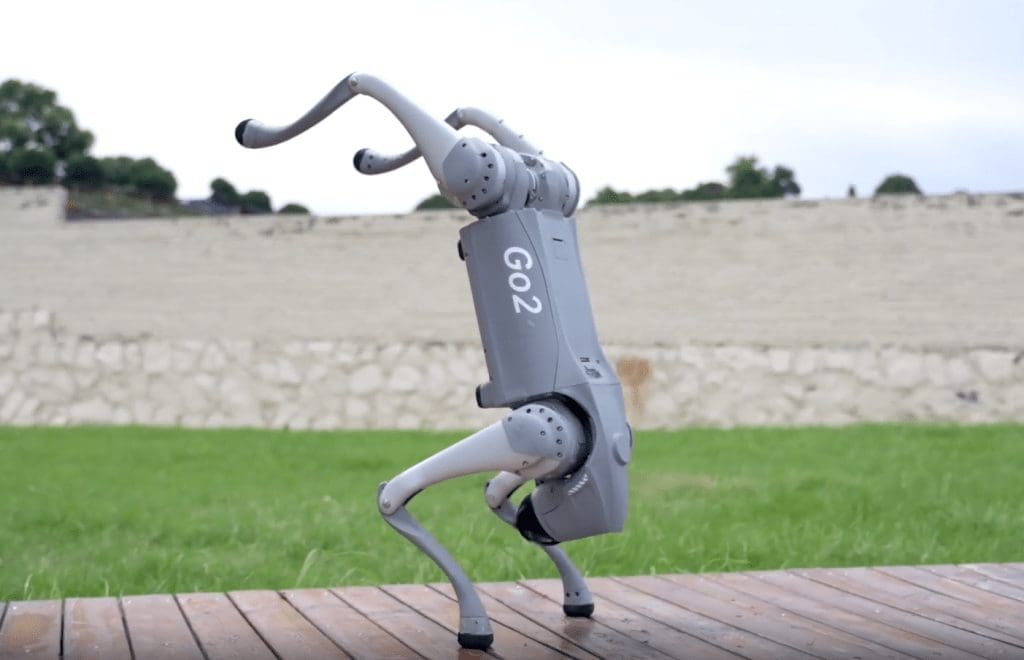
A standout feature of the Unitree Go2 is its advanced navigation system, which is markedly different from its predecessor. Utilizing an AI-powered hemispherical recognition system, the Go2 enhances obstacle avoidance efficiency by 200% compared to the Go1. This significant improvement ensures that the robot can navigate complex terrains with ease and precision.
The Go2 robot features:
- Enhanced navigation system
- Advanced AI modes, including large-scale simulation training
- Improved gaits and an optimized obstacle avoidance strategy
- Versatility and capability in various environments
- Intelligent interaction and programming capabilities provided by the Go2 app
- Precise control and AI-driven obstacle avoidance
These features enhance the user experience and make the Go2 robot a powerful tool.
4D LIDAR Technology
The enhanced navigation capabilities of the Unitree Go2 are primarily due to the integration of 4D LIDAR L1 technology and wireless vector positioning. This high-tech device offers a range of features that make it stand out among other high-tech devices:
- 360×90 degree hemispherical recognition
- significantly improves navigation accuracy and obstacle avoidance
- super small blind spot
- can detect and avoid obstacles with remarkable precision
One of the standout features of the 4D LIDAR L1 in the Go2 is its minimum detection distance of just 0.05 meters. This capability allows the robot to detect even the smallest obstacles, ensuring safe and efficient navigation in various environments. The integration of such advanced technology makes the Go2 a reliable companion for traversing complex terrains.
ISS2.0 Intelligent Side-follow System
The ISS2.0 Intelligent Side-follow System in the Unitree Go2 represents a significant upgrade over the previous model’s system. This advanced system achieves a 50% improvement in positioning accuracy, allowing the robot to avoid obstacles more effectively. This improvement ensures that the Go2 can navigate complex environments with greater precision and safety.
Another notable enhancement in the ISS2.0 system is the extended remote control distance, which now exceeds 30 meters. This increased range provides users with greater flexibility and control over the robot’s movements. Additionally, the system’s optimized obstacle avoidance strategy ensures that the Go2 can handle various tasks and terrains with ease.
Performance and Motor Efficiency
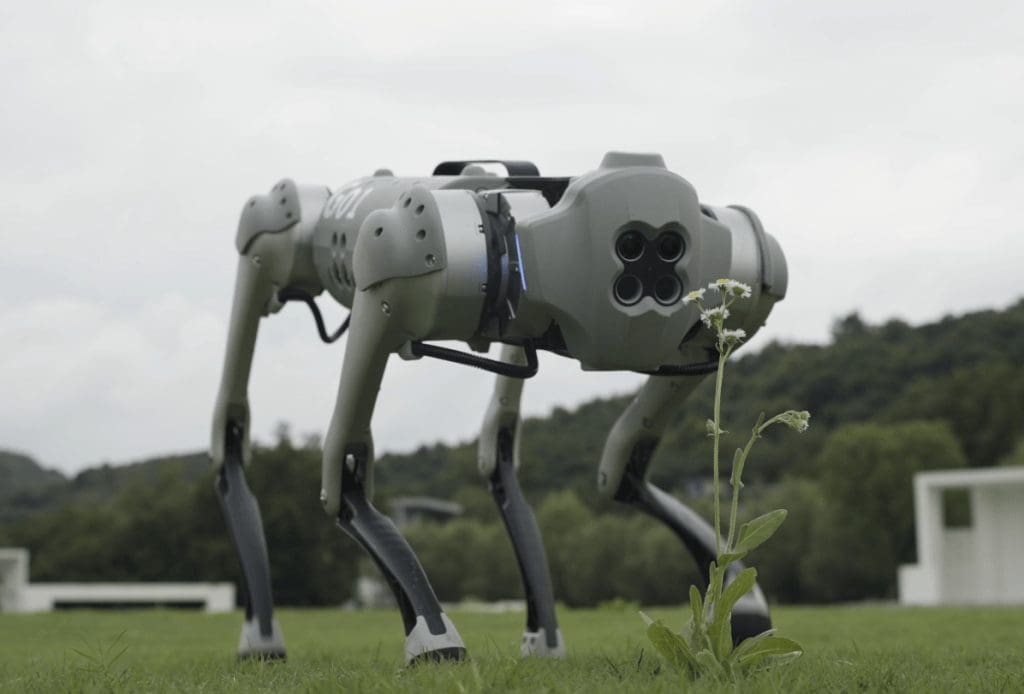
The Unitree Go2 excels in two fundamental aspects of any robot dog: performance and motor efficiency. Compared to its predecessor, the Go2 presents a 30% improvement in motor performance, boasting a peak joint torque of 45 Nm. An intra-joint circuit design, which helps to increase motor efficiency, further supports this improvement.
To ensure optimal performance, the joint motors in the Go2 feature heat pipe coolers. These coolers enhance thermal management, preventing overheating and ensuring that the robot operates smoothly even during intensive tasks. These advancements make the Go2 a powerful and reliable quadriceps robot.
Speed and Stability
With exceptional speed and stability, the Unitree Go2 proves to be a versatile and agile robot. Here are some of its key features:
- Maximum running speed of approximately 5 meters per second
- Can move swiftly across various terrains
- Maintains a speed of 2.5 meters per second even when carrying a 7-kilogram payload
These features demonstrate the Go2’s robust performance.
The advanced gaits of the Go2, such as upside-down walking, adaptive roll-over, and obstacle climbing, enhance its flexibility and stability. These features ensure that the robot can traverse complex terrain and perform a wide range of tasks with ease and precision.
Battery Capacity and Endurance
For any robot dog to maintain its performance, battery capacity and endurance are pivotal. The Unitree Go2 features an increased battery capacity of 8,000 mAh, with an optional ultra-long-life battery available at 15,000 mAh. This significant upgrade ensures that the Go2 can operate for extended periods without requiring frequent recharges.
The voltage in the Go2 has been increased to 28.8 volts, which contributes to improved motor efficiency, power, and stability. With these enhancements, the Go2 model offers an optional ultra-long battery life of up to 4 hours, making it ideal for long-term tasks and missions. This extended battery life is a result of the battery capacity increased in the Go2.
AI and Programming Capabilities
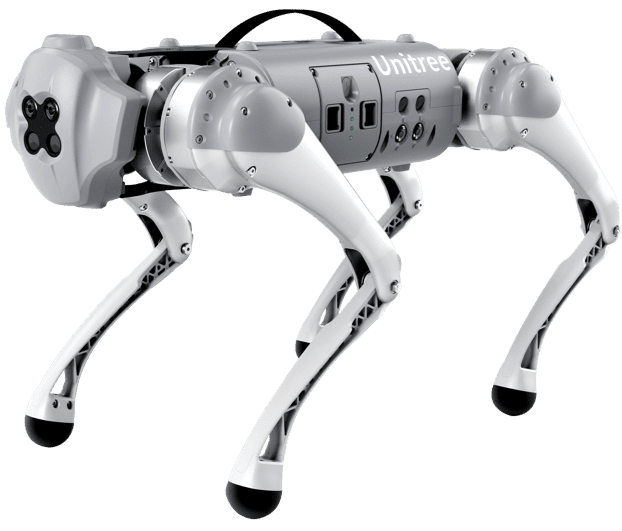
Advanced AI and programming capabilities distinguish the Unitree Go2. The Go2 offers the following features:
- Integrating cutting-edge AI functionalities
- Enhancing autonomous navigation and decision-making abilities
- Exceptionally adept at detailed inspections and mapping tasks in hazardous environments.
The Go2 robot has several key features:
- It supports over-the-air (OTA) upgrades, allowing it to improve and evolve its programs automatically by connecting to a cloud-based service.
- Users can simulate their code in the Go2 app before deploying it to the robot, ensuring accuracy and functionality.
- The Go2 is highly adaptable and user-friendly.
These features make the Go2 a versatile and easy-to-use robot.
GPT Empowerment
The big model GPT empowerment in the Unitree Go2 is a groundbreaking feature that sets it apart from the Go1. This advanced AI capability enhances the robot’s decision-making and responsiveness to complex commands. With GPT empowerment, the Go2 can understand and interact with its environment more effectively, making it a highly intuitive and intelligent robot.
By leveraging GPT models, the Go2 improves its natural language processing capabilities, allowing for better user interaction and control. This makes the Go2 not only a powerful machine but also a user-friendly companion.
App Graphical Programming
The Unitree Go2’s graphical programming feature is designed to make programming more accessible and intuitive for users. Utilizing a block-based interface, users can easily drag and drop elements to create custom commands and programs. This approach simplifies the programming process, making it more user-friendly, especially for those who may not have extensive coding experience.
The app’s graphical programming feature allows users to create and simulate their own programs before deploying them to the robot, ensuring that everything works as intended. This capability enhances the overall user experience, making the Go2 a versatile and customizable robot.
Physical Design and Sensors
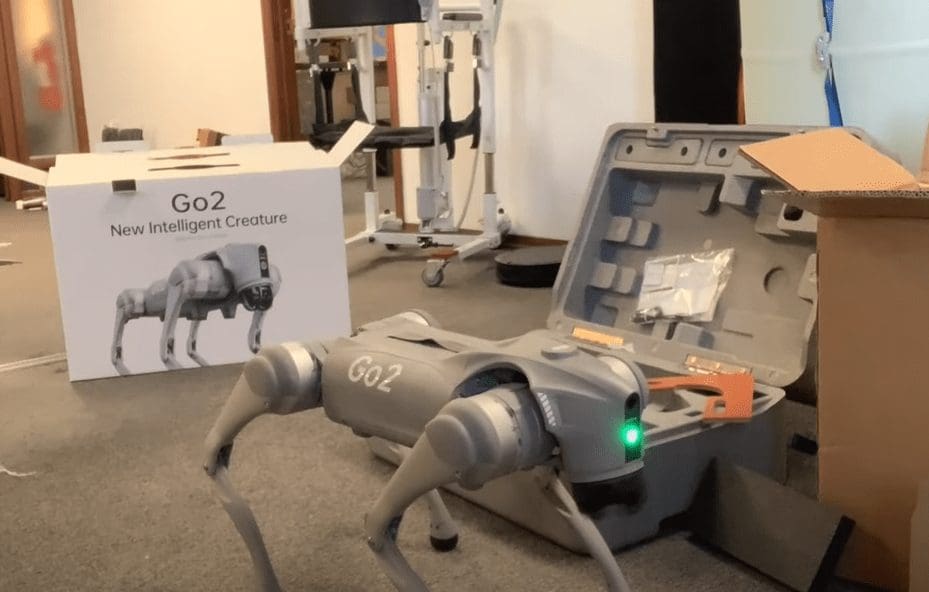
The Unitree Go2 features:
- A design that is as robust as it is functional
- Constructed from aluminum alloy and high-strength engineering plastic
- Built to withstand rigorous use
- Dimensions of 70x31x40 cm when standing
- A weight of around 15 kg, including the battery
- Compact yet powerful
The design enhancements in the Go2, including the use of advanced materials, ensure that the robot is both durable and lightweight. These features make the Go2 suitable for various applications, from household tasks to industrial inspections.
HD Cameras and Force Sensors
The Unitree Go2 is equipped with:
- HD wide-angle cameras that significantly enhance its visual perception capabilities
- These cameras provide a clear and comprehensive view of the robot’s surroundings
- This enables it to navigate and interact with its environment more effectively.
In addition to the HD cameras, the Go2 features foot-end force sensors that improve its gait and balance control. These sensors enhance the robot’s movement precision and stability, making it more reliable in various tasks and terrains.
Additional Sensors and Customization
The Unitree Go2 offers extensive customization options, including the addition of high-performance computing modules such as NVIDIA Jetson Orin for advanced processing needs. These modules enhance the robot’s capabilities, making it suitable for more complex tasks and applications.
Furthermore, the Go2 can be equipped with additional sensors that provide enhanced functionality and performance. These add-ons make the Go2 a versatile and adaptable robot, capable of meeting various user requirements.
Practical Applications and Use-Cases
From household chores to industrial and research uses, the Unitree Go1 and Go2 cater to a broad spectrum of practical applications, making them more high tech devices than just simple robots. In household environments, these robots can assist with activities such as surveillance, delivery of items, and aiding elderly or disabled individuals.
In industrial settings, the Go2 can be employed in areas like petrochemical, transportation, and emergency services. Its advanced AI and programming capabilities make it a valuable tool for detailed inspections, hazardous material handling, and first response support.
Household and Industrial Uses
In both household and industrial settings, the Go1 and Go2 models prove helpful across a variety of tasks. For example, the Go1 can help with cleaning, security, and elder care. The Go2, with its advanced AI and programming capabilities, can perform more complex tasks such as inspecting hazardous areas and carrying tools and materials.
In industrial applications, Unitree robots are employed for tasks like inspection and data collection in environments that may be dangerous for humans. This makes them invaluable in sectors such as petrochemical and transportation.
R&D and Education
The Unitree Go2 Edu model is specially designed for educational and research purposes. It includes extensive software development kits (SDKs) and curriculum resources tailored for educational institutions. These resources make it easier for students and researchers to explore and develop new technologies using the Go2 Edu.
The Go2 Edu’s advanced AI capabilities and programmable features make it an excellent tool for computational research and educational projects, even surpassing the needs of basic computing power. With built-in 4G connectivity and eSIM, it can easily integrate into research projects requiring remote monitoring and control.
Price and Value
The price tag of $13,900.00 for the Unitree Go2 is a testament to its advanced features and capabilities. Shipping costs vary depending on the country, ranging from $399 to $1000. Additionally, customers must consider customs duties, which are not included in the price.
Despite the higher price tag, the Go2 offers significant value with its advanced AI, enhanced navigation, and robust performance. For those looking for a versatile and powerful robot dog, the Go2 is a worthwhile investment.
User Experience and Feedback
Mixed user feedback on the Unitree Go1 Pro underscores the potential and challenges inherent in this advanced technology. Some users found the Go1 Pro complex difficult to set up due to the lack of startup instructions. However, many appreciated the helpful tutorials available on the Unitree Support YouTube channel, which provided valuable guidance for getting started.
The Go2, with its technically upgraded AI and programming capabilities, promises a better user experience. The advanced features and intuitive design make it more accessible and user-friendly, addressing many of the issues highlighted by Go1 Pro users. This upgrade ensures that the Go2 is not just a powerful machine but also an enjoyable and practical tool for a wide range of applications.
Summary
In summary, the Unitree Go2 represents a significant advancement over the Go1, offering enhanced navigation, performance, AI capabilities, and user experience. Its integration of 4D ultra-wide LIDAR and big model GPT empowerment sets it apart, making it a highly adaptable and intelligent robot dog suitable for various applications.
Whether you’re looking for a robot to assist with household tasks, industrial inspections, or educational research, the Unitree Go2 offers unparalleled value and functionality. Its advanced features and robust design make it a worthwhile investment for anyone seeking cutting-edge robotic technology.
Frequently Asked Questions
What are the key differences between Unitree Go1 and Go2?
The Unitree Go2 has significant upgrades, such as 4D ultra-wide LIDAR and big model GPT empowerment, making it more functional and adaptable than the Go1.
How does the Go2 navigate and avoid obstacles?
The Go2 navigates and avoids obstacles by using an AI-powered recognition system and advanced AI modes for real-time navigation, which improves efficiency by 200% compared to the Go1.
What is the battery life of the Unitree Go2?
The Unitree Go2 has an increased battery capacity of 8,000 mAh and can provide up to 4 hours of operation. The optional ultra-long life battery of 15,000 mAh can extend the battery life further.
Can the Go2 be used for educational purposes?
Yes, the Go2 Edu model is specifically designed for educational use, offering extensive SDKs and curriculum resources, making it an ideal choice for research and learning.
What is the price of the Unitree Go2?
The price of the Unitree Go2 is $13,900.00, with additional shipping costs and customs duties varying by country.
Related: Unitree Go1 Review: Robot Dog · Unitree Go2 Review: Quadruped Robot In-Depth Analysis
Ready to buy? Browse humanoid robots for sale on Robozaps.
Unitree G1 vs Boston Dynamics Atlas — complete comparison of specs, price ($16K vs $420K), capabilities, and which humanoid robot is right for you in 2026.
Unitree G1 vs Boston Dynamics Atlas — these two humanoid robots couldn't be more different in price, positioning, and philosophy. The G1 starts at $16,000 and ships today; Atlas costs around $420,000 and represents decades of DARPA-funded research. One democratizes humanoid robotics for researchers and developers; the other pushes the absolute boundaries of what's mechanically possible. This comprehensive 2026 comparison breaks down every spec, capability, and trade-off to help you understand which robot serves your needs.
Key Takeaways
- Unitree G1 wins on accessibility: $16,000 vs $420,000, available now, ROS2 compatible, 43 DOF for research and education.
- Boston Dynamics Atlas wins on raw capability: world's most advanced locomotion, Google DeepMind AI partnership, premium industrial positioning.
- Different categories entirely: G1 is a research platform for universities and developers; Atlas is an enterprise industrial robot for Hyundai/Fortune 500 deployments.
- Price difference: 26x — you could buy 26 Unitree G1s for the price of one Atlas.
- For most buyers: Unitree G1 is the practical choice. Atlas is for organizations with seven-figure robotics budgets.
Head-to-Head Comparison
Unitree G1: Complete Overview
The Unitree G1 represents a paradigm shift in humanoid robotics accessibility. Unveiled at ICRA 2024, it brought full humanoid capabilities to researchers and developers at a fraction of what competitors charge. At $16,000 (with configurations from $16,000), the G1 is the most affordable complete humanoid robot on the market — and one of the few you can actually purchase and receive within weeks.
Design Philosophy
Standing just 127 cm (4 ft 2 in) tall and weighing 35 kg (77 lbs), the G1 was designed for lab environments, not factory floors. Its compact size means it fits through standard doorways, works safely alongside researchers, and requires minimal infrastructure. The robot folds from 1270x450x200mm to just 690x450x300mm for transport — a practical consideration that larger humanoids simply can't match.
Unitree built the G1 for iterative research, not production deployment. That philosophy shows in the open SDK, ROS2 compatibility, and imitation learning capabilities. Researchers can train new behaviors, modify control algorithms, and push updates without waiting for manufacturer approval.
Technical Capabilities
With 43 degrees of freedom, the G1 offers remarkable articulation for its price point. The hands feature force-torque sensing for manipulation tasks, though the 3 kg (6.6 lb) payload capacity limits heavy-duty applications. Walking speed maxes out at 2 km/h (1.2 mph) — sufficient for indoor navigation but not dynamic tasks.
The sensor suite includes 3D LiDAR (Intel RealSense D435), depth cameras, IMU, and force-torque sensors across the joints. This enables spatial mapping, obstacle avoidance, and basic manipulation without additional hardware.
Limitations
The G1 is explicitly a research platform, not a deployable worker. Battery life around 2 hours limits continuous operation. The 3 kg payload means it can't lift meaningful objects. And while the imitation learning framework is powerful for training, out-of-the-box autonomous capabilities are limited compared to enterprise systems.
Boston Dynamics Atlas: Complete Overview
The Boston Dynamics Atlas is arguably the most famous humanoid robot in history — and for good reason. Decades of DARPA funding, MIT spinout engineering, and viral YouTube videos have made Atlas synonymous with humanoid capability. The 2024 all-electric redesign (replacing the previous hydraulic version) represents the platform's commercial debut under Hyundai ownership.
Design Philosophy
At 150 cm (4 ft 11 in) and 89 kg (196 lbs), Atlas is built for power, not portability. The electric redesign prioritizes safety over raw hydraulic force — featuring body padding, minimal pinch points, and human-safe operating modes. But make no mistake: Atlas remains the most dynamically capable humanoid ever built, now packaged for industrial deployment.
The Google DeepMind partnership signals Boston Dynamics' AI strategy. Rather than building AI internally, they're leveraging the world's leading AI research lab to develop Atlas's cognitive capabilities. This combination of Boston Dynamics' mechanical expertise and DeepMind's AI prowess is formidable.
Technical Capabilities
Atlas's capabilities are legendary. Parkour runs, backflips, 180-degree jumps, and recovery from pushes that would topple any competitor — Atlas has demonstrated all of these publicly. The electric redesign maintains this athletic capability while enabling commercial deployment.
Precise specifications for the electric Atlas remain under wraps, but estimated payload capacity exceeds 25 kg (55 lbs), walking speed surpasses 5.5 km/h (3.4 mph), and the platform can navigate unstructured environments that would stump other humanoids. The sensor suite includes LiDAR, RGB cameras, depth sensors, and proprioceptive feedback across all joints.
Limitations
Price is the obvious constraint. At approximately $420,000 per unit, Atlas is exclusively for organizations with substantial robotics budgets — Hyundai facilities, select manufacturing partners, and Fortune 500 logistics operations. Availability is also limited; Boston Dynamics carefully controls who can purchase Atlas, prioritizing partners who advance the platform's commercial viability.
Category-by-Category Comparison
1. Mobility and Locomotion
Winner: Boston Dynamics Atlas
This category isn't close. Atlas can perform parkour, execute backflips, recover from dynamic pushes, and navigate terrain that would be impossible for the G1. Where the G1 walks at 2 km/h on flat surfaces, Atlas runs, jumps, and maintains balance through aggressive perturbations.
The G1's compact form and 35 kg weight do offer advantages in constrained lab environments — it's less likely to cause damage if it falls, and it navigates tight spaces more easily. But for raw locomotive capability, Atlas represents the state of the art.
2. Dexterity and Manipulation
Winner: Tie (context-dependent)
The G1's 43 degrees of freedom actually exceed Atlas's estimated 28 DOF, enabling finer articulation for research purposes. The G1's force-torque sensing in the hands supports delicate manipulation tasks like cracking walnuts or handling soft objects.
However, Atlas's greater payload capacity (~25 kg vs 3 kg) means it can manipulate objects the G1 simply cannot lift. For industrial tasks involving heavy parts, Atlas wins decisively. For research requiring fine motor control development, the G1's higher DOF is advantageous.
3. AI and Software
Winner: Boston Dynamics Atlas (capability) / Unitree G1 (accessibility)
Atlas benefits from the Google DeepMind partnership — representing arguably the world's most advanced AI research applied to humanoid robotics. The Boston Dynamics Orbit platform integrates fleet management, learning, and autonomous operation at enterprise scale.
But the G1's open SDK and ROS2 compatibility make it infinitely more accessible for researchers developing their own AI systems. You can modify the G1's control stack, implement custom algorithms, and iterate rapidly. Atlas's software is largely a black box.
For cutting-edge autonomous capability, Atlas leads. For AI research and development, the G1's openness is the decisive advantage.
4. Sensors and Perception
Winner: Boston Dynamics Atlas
Both robots feature capable sensor suites — LiDAR, depth cameras, IMU, force-torque sensing. But Atlas's perception system has been refined through decades of development and real-world deployment. The integration between sensing and dynamic control is tighter, enabling Atlas's remarkable reactive behaviors.
The G1's Intel RealSense D435 and 3D LiDAR are standard research-grade sensors. Capable for R&D purposes, but not optimized for the aggressive real-world conditions Atlas handles.
5. Price and Value
Winner: Unitree G1
The math is simple: $16,000 versus $420,000. You could purchase 26 Unitree G1 robots for the price of a single Atlas. For universities, research labs, and developers, the G1 offers extraordinary value. It's the only full humanoid robot accessible to small teams and individual researchers.
Atlas's price reflects its capabilities — it's genuinely 10x more capable in many dimensions. But for most use cases outside Fortune 500 manufacturing, that premium is impossible to justify.
6. Build Quality and Durability
Winner: Boston Dynamics Atlas
Atlas was designed for abuse. Early demonstrations showed Atlas being pushed, kicked, and knocked down — recovering flawlessly. The electric redesign adds safety padding while maintaining structural integrity for demanding industrial environments.
The G1 is built for research labs, not rough handling. It's durable for its intended purpose but would not survive the treatment Atlas routinely absorbs in demonstrations and deployments.
7. Availability and Deployment Readiness
Winner: Unitree G1
You can order a Unitree G1 today and receive it within weeks. It ships globally, requires minimal infrastructure, and can be operational in a lab setting immediately after delivery. Unitree has proven supply chain capability through massive robot dog production.
Atlas is pre-order only, with 2026 shipping to select partners. Boston Dynamics controls who can purchase, prioritizing strategic manufacturing partners over general buyers. For most organizations, Atlas isn't actually available regardless of budget.
Which Should You Choose?
Choose Unitree G1 if you:
- Have a research or development focus — The G1's open SDK and ROS2 compatibility make it ideal for AI research, control algorithm development, and academic projects. You can modify everything.
- Budget under $50,000 — At $16,000, the G1 is the only realistic option for small teams, startups, and university labs. Nothing else comes close at this price point.
- Need a robot this year — G1 ships now. You can have a working humanoid in your lab within weeks, not years.
- Want to train your own AI systems — The imitation learning framework and open architecture let you develop custom behaviors from scratch.
- Value compact form factor — For tight lab spaces, the G1's 127 cm height and 35 kg weight are significant practical advantages.
Choose Boston Dynamics Atlas if you:
- Have a seven-figure robotics budget — Atlas requires ~$420,000 upfront plus ongoing partnership with Boston Dynamics. This is Fortune 500 territory.
- Need maximum physical capability — For heavy payloads, dynamic environments, and tasks requiring athletic locomotion, nothing else compares.
- Want enterprise-grade AI integration — The Google DeepMind partnership means Atlas's cognitive capabilities will continue advancing rapidly.
- Are a strategic partner for Hyundai/Boston Dynamics — Atlas availability is restricted. You need to be the right kind of customer.
- Require industrial-grade durability — Atlas is built to survive real-world manufacturing environments.
Frequently Asked Questions
How much cheaper is Unitree G1 than Boston Dynamics Atlas?
Unitree G1 costs approximately $16,000 while Boston Dynamics Atlas costs around $420,000 — making Atlas 26 times more expensive. For the price of one Atlas, you could purchase an entire fleet of 26 G1 robots. This price difference reflects their different target markets: G1 for research and education, Atlas for industrial manufacturing.
Can Unitree G1 do backflips like Atlas?
No. Boston Dynamics Atlas remains the only humanoid robot capable of performing backflips and parkour-level athletic movements. The Unitree G1 is designed for controlled lab environments with walking speeds around 2 km/h (1.2 mph). For dynamic locomotion research, Atlas is in a class of its own.
Which robot is better for university research?
Unitree G1 is vastly better for university research. Its $16,000 price point fits academic budgets, the open SDK enables custom algorithm development, ROS2 compatibility integrates with standard research tools, and it's actually available for purchase. Atlas's restricted availability and $420,000 price make it inaccessible for most academic institutions.
Is Boston Dynamics Atlas available to buy?
Boston Dynamics Atlas is currently pre-order only, with deliveries expected in 2026. However, availability is restricted — Boston Dynamics prioritizes strategic partners (primarily Hyundai facilities and select manufacturing partners) over general buyers. Even with a $420,000 budget, you may not be able to purchase an Atlas.
What can Unitree G1 actually do?
The Unitree G1 can walk, navigate obstacles, perform manipulation tasks with its 43-DOF arms, and serve as a platform for AI training and research. It has demonstrated tasks like cracking walnuts, handling delicate objects, and basic locomotion. However, it's primarily a research platform — not a deployable worker. Battery life is about 2 hours, payload is 3 kg, and autonomous capabilities require developer implementation.
Why is Atlas so expensive?
Atlas's $420,000 price reflects decades of R&D (including DARPA funding), state-of-the-art actuators and sensors, limited production volume, and premium positioning for industrial deployment. Boston Dynamics isn't optimizing for price — they're building the most capable humanoid possible and pricing for enterprise buyers who need maximum performance. The Google DeepMind AI partnership adds further value.
Can I use Unitree G1 for commercial applications?
Technically yes, but the G1 is primarily designed for research and development rather than production deployment. Its 3 kg payload capacity, 2-hour battery life, and limited autonomous capabilities make it impractical for most commercial applications. For commercial humanoid deployments, consider Unitree R1 or enterprise-focused robots.
Which robot has better AI?
Boston Dynamics Atlas has more advanced built-in AI, especially with the Google DeepMind partnership. However, Unitree G1's open architecture makes it superior for developing AI systems. If you want state-of-the-art autonomous capability out of the box, Atlas wins. If you want to build and train your own AI, the G1's accessibility wins.
Final Verdict
For 99% of buyers: Unitree G1 wins.
The Unitree G1 democratizes humanoid robotics in a way no other robot has. At $16,000, it brings full humanoid capabilities to researchers, developers, and educators who could never afford previous-generation platforms. The open SDK, ROS2 compatibility, and immediate availability make it the practical choice for almost everyone seriously interested in humanoid robotics.
Boston Dynamics Atlas is genuinely more capable — dramatically so in locomotion, durability, and integrated AI. If you have a seven-figure robotics budget and qualify as a strategic partner for Boston Dynamics, Atlas represents the pinnacle of humanoid engineering. But for most organizations, it's simply not accessible.
The honest comparison isn't "which is better" — it's "which can you actually get and use?" For researchers, developers, universities, and startups, that answer is Unitree G1.
Compare both robots: Unitree G1 on Robozaps | Boston Dynamics Atlas on Robozaps
Related comparisons: Tesla Optimus vs Unitree G1 | Unitree R1 vs G1 | Unitree G1 Review
Last updated: February 16, 2026. Specifications sourced from official Unitree Robotics and Boston Dynamics documentation.
Compare Unitree H1 and Boston Dynamics Atlas: features, performance, and capabilities. Which advanced robot suits your needs better?
Trying to decide between the Unitree H1 and Boston Dynamics Atlas? In this article, we will discuss the “unitree h1 vs boston dynamics atlas” comparison in terms of design, mobility, sensors, and task performance. Learn which robot excels in different scenarios and make an informed decision.
Key Takeaways
- Both Unitree H1 and Boston Dynamics Atlas showcase impressive engineering and versatility, with Unitree H1 focused on affordability and agility through electric motors, while Boston Dynamics Atlas emphasizes dynamic movement and precision with its hydraulic system.
- Unitree H1’s advanced sensor suite, including an Intel RealSense D435i depth camera and 3D MID360 LiDAR sensor, enhances its spatial awareness and navigation capabilities, whereas Boston Dynamics Atlas leverages sophisticated algorithms and control systems for mobility and balance.
- Unitree H1 is priced significantly lower at $90,000, making it more accessible for various applications, including education and healthcare, while Boston Dynamics Atlas remains a high-cost option mainly suited for well-funded enterprises and research institutions due to its advanced capabilities and intricate construction.
Overview of Unitree H1 and Boston Dynamics Atlas
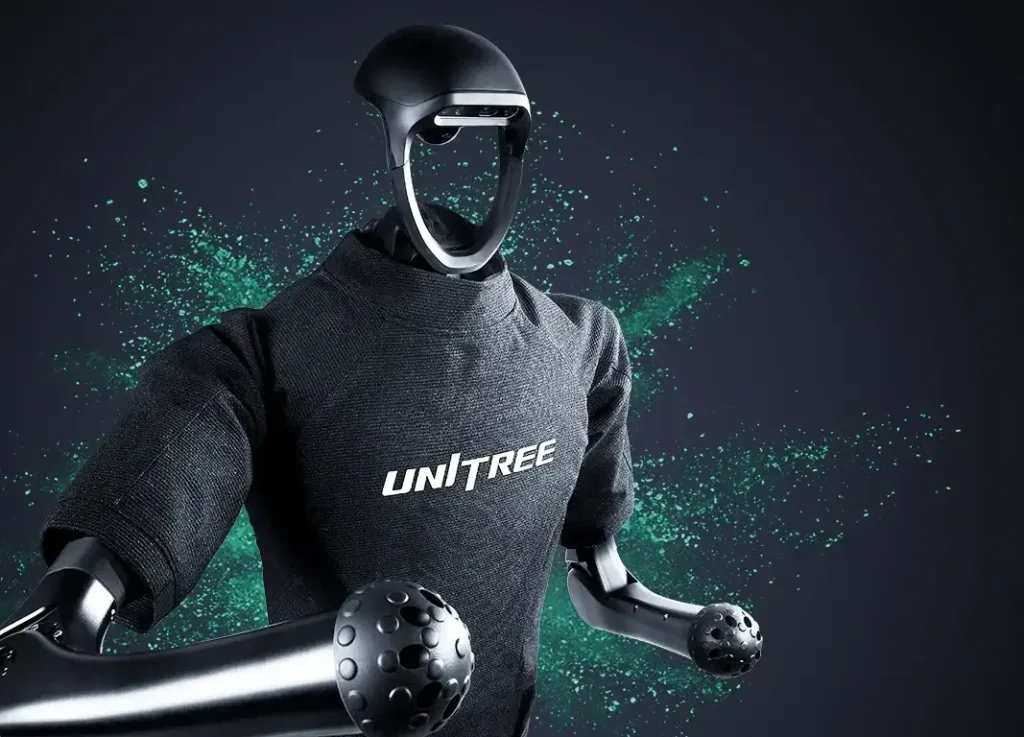
Unitree Robotics and Boston Dynamics have both made significant contributions to the field of robotics, each with a distinct approach. Unitree Robotics, known for its budget-friendly and versatile robots, introduced the H1, the world’s first mass-produced full-size electric-driven humanoid robot. Standing at approximately 180 cm and weighing about 47 kg, the Unitree H1 is designed for agility and versatility, making it suitable for a wide range of tasks and environments.
On the other hand, Boston Dynamics has been a pioneer in showcasing the potential of robotics through its Atlas model. The Boston Dynamics Atlas is renowned for its dynamic capabilities, including obstacle navigation and dexterous manipulation. These demonstrations have not only captivated audiences worldwide but have also highlighted the robot’s potential in various challenging environments.
Design and Build Quality
Functionality and versatility of humanoid robots hinge significantly on their design and build quality. Both the Unitree H1 and Boston Dynamics Atlas showcase impressive engineering and material selection, which we will explore in detail through their structural design, mobility, and the choice between hydraulic systems and fully electric motors.
Structural Design
The Unitree H1 features:
- Advanced carbon fiber and aluminum alloy materials for a lightweight yet robust structure
- Enhanced durability, agility, and speed
- Sleek, modern design with streamlined limbs and a white finish
- Futuristic appearance
- Easy component swaps due to its modular design
In contrast, the Boston Dynamics Atlas features:
- A frame made from lightweight, high-strength materials such as aluminum and titanium
- Construction designed to withstand significant physical stress and impact
- Robust and resilient design for challenging environments
- Advanced structural designs that enhance durability and agility
- Ability to perform dynamic tasks with precision
Mobility and Balance
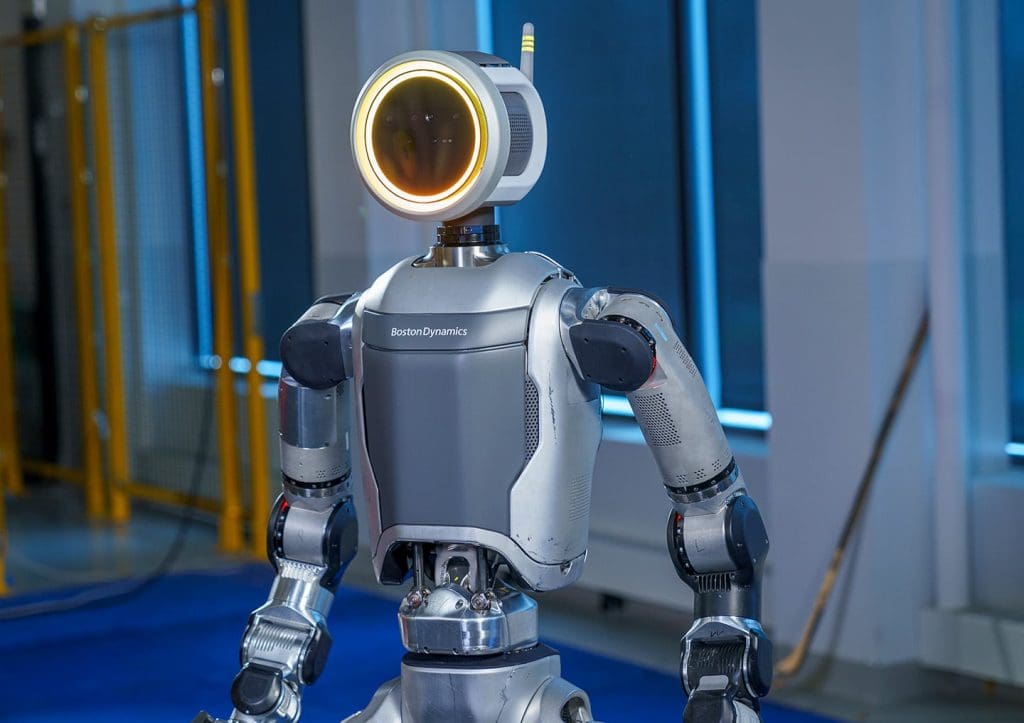
Showcasing exceptional mobility and balance, the Unitree H1 can perform backflips, achieve speeds of 3.3 meters per second, and handle dynamic activities like speed-walking, stair climbing, standing jumps, and dancing. Holding the world record for the fastest full-size humanoid robot, the H1 can walk at speeds up to 5.4 km/h and maintain dynamic balance even on uneven surfaces.
Boston Dynamics Atlas, known for its dynamic and agile movement capabilities, showcases impressive feats such as:
- Parkour
- Backflips
- Navigating diverse terrains
- Performing dynamic motions like jumping and running
An advanced control system that ensures balance and accuracy facilitates its ability to carry out these actions. The Atlas leverages its whole body to move with grace and dexterity, making it a highly versatile platform for various tasks.
Both robots utilize an array of IMUs to maintain balance and orientation during complex movements. The Atlas, in particular, demonstrates highly dynamic and agile locomotion abilities, making it an impressive contender in the field of humanoid robotics.
Hydraulic Systems vs Fully Electric Motors
The choice between hydraulic systems and fully electric motors has a significant impact on a robot’s performance and capabilities. Boston Dynamics Atlas employs a hydraulic system, which enables powerful and precise movements. This system is particularly advantageous for tasks that require significant force and control, such as lifting heavy objects or performing complex maneuvers.
In contrast, the Unitree H1 uses fully electric motors, specifically the M107 joint motors, which provide high agility and speed. These fully electric motors are designed to optimize the robot’s performance in dynamic activities, offering more efficient and responsive movement compared to traditional hydraulic systems.
Sensors and Perception
Humanoid robots rely on sensors to perceive and interact with their environment. Both Unitree H1 and Boston Dynamics Atlas are equipped with advanced sensor technologies that enhance their navigation and perception capabilities.
Depth Cameras
The Unitree H1 is equipped with an Intel RealSense D435i depth camera, which significantly enhances its perception capabilities. This camera has a depth field of view of 86° x 57° and can capture depth images at a resolution of up to 1280 x 720. With a frame rate of up to 90 frames per second, the Intel RealSense D435i provides real-time, high-precision spatial data, allowing the H1 to navigate and interact with its surroundings effectively.
This depth camera technology is crucial for tasks that require detailed environmental mapping and object recognition, making the Unitree H1 a formidable player in scenarios that demand high levels of spatial awareness and precision.
Other Sensors
In addition to its depth camera, the Unitree H1 utilizes a 3D MID360 LiDAR sensor to enhance its spatial awareness. This sensor provides 360° depth perception and real-time acquisition of spatial data, which is essential for navigating complex environments. The H1 also integrates a Bosch IMU with 6 degrees of freedom for motion sensing, further improving its ability to maintain balance and orientation during dynamic tasks.
These advanced sensors collectively enhance the H1’s ability to analyze and interact with its surroundings, making it a highly capable robot in terms of perception and navigation. The combination of LiDAR and depth-sensing cameras allows the H1 to perform complex maneuvers with precision and agility.
Computing Power and Control Systems
A humanoid robot’s performance and functionality are deeply reliant on its computing power and control systems. The Unitree H1 is equipped with an Intel Core i5 for platform functions and an Intel Core i7 for user development, with optional configurations including Intel Core i7 or Jetson Orin NX. This robust computing setup ensures that the H1 can handle complex tasks and applications with ease.
Boston Dynamics leverages decades of research to develop the Atlas robot’s computing power, focusing on three key areas:
- Mobility: The Atlas uses an advanced control system and state-of-the-art hardware that enables it to achieve power, balance, and agility, making it a highly versatile platform for various tasks.
- Perception: The Atlas is equipped with advanced sensors and cameras that allow it to perceive its environment and make informed decisions.
- Intelligent: The Atlas has sophisticated algorithms and machine learning capabilities that allow it to learn and adapt to various situations.
This combination of mobility, perception, and intelligence makes the Atlas capable of performing dynamic and complex maneuvers with precision.
Performance in Various Tasks
Capabilities and versatility of humanoid robots are reflected in their performance across various tasks. Both the Unitree H1 and Boston Dynamics Atlas excel in different applications, showcasing their potential to transform industries and improve efficiency.
Specific Tasks
In industrial settings, the Unitree H1 conducts routine maintenance and inspection tasks, handling complex maneuvers in confined spaces. Its agility and versatility make it ideal for navigating through tight environments and performing detailed inspections. Additionally, the H1 excels in emergency response scenarios, where it can navigate through debris and hazardous environments to perform search and rescue operations.
The Boston Dynamics Atlas, on the other hand, is known for its ability to perform tasks such as lifting and carrying objects, demonstrating its utility in manual labor scenarios. Its dynamic movement capabilities and advanced control system make it suitable for a wide range of applications, from industrial tasks to household chores.
Real-World Applications
In real-world applications, the Unitree H1 is used as an educational tool to teach robotics and artificial intelligence. Its advanced capabilities and affordable price make it an attractive option for academic institutions and research facilities. The H1 is also employed in healthcare applications, where it supports patient care and rehabilitation, demonstrating its versatility and potential impact on society.
Boston Dynamics Atlas, the new atlas in the world of robotics, is designed for real-world applications with a control system that allows it to move with athleticism and dexterity. Its ability to navigate complex environments and perform dynamic tasks makes it a valuable asset in various industries, from manufacturing to entertainment.
Innovation and Development
Advancements in humanoid robotics are rooted in innovation and development. Both Unitree Robotics and Boston Dynamics have demonstrated significant recent innovations, pushing the boundaries of what is possible with robotics technology.
Recent Innovations
Unitree Robotics has introduced the G1 humanoid at ICRA 2024. This model stands out for its:
- Smaller size
- Lower cost compared to the H1
- Fast walking speed of 2,000 mm/s
- Ability to be equipped with 3D LiDAR and Intel RealSense D435 cameras
These advancements reflect Unitree’s commitment to making advanced robotics technology more accessible and versatile.
Additionally, Unitree Robotics is rapidly iterating AI-driven programs for the H1, introducing several major version upgrades within six months. These continuous improvements in AI algorithms for motor control and agility highlight Unitree’s dedication to pushing the envelope in robotics development.
Future Developments
Looking ahead, Unitree plans to continue supporting the H1 robot while developing new features for the G1 model. This includes integrating advanced AI features and improved agility to enhance user interaction and adaptability. The focus on continuous development ensures that Unitree remains at the forefront of robotics innovation.
Future developments at Boston Dynamics are expected to include more sophisticated mobile manipulation capabilities and enhanced autonomous functions. These advancements will enable the Atlas to perform even more complex tasks with greater efficiency, further solidifying its position as a leader in the field of humanoid robotics.
Community and User Engagement
The success and advancement of robotics companies hinge heavily on community and user engagement. Both Unitree and Boston Dynamics understand the importance of engaging with the public and fostering a sense of excitement and anticipation within the robotics community.
Social Media Presence
Boston Dynamics utilizes platforms like YouTube to demonstrate the advanced capabilities of Atlas, garnering significant media attention and public interest. These high-profile demonstrations not only showcase the robot’s agility and balance but also attract both fascination and skepticism from the public. By frequently releasing content featuring Atlas performing complex maneuvers, Boston Dynamics effectively boosts its online presence and public engagement.
Unitree Robotics promotes its products through social media by:
- Highlighting the affordability and accessibility of their robots
- Engaging with a wide audience on platforms like Twitter, YouTube, Facebook, and Bilibili
- Building a strong community of robot enthusiasts and professionals
This strategic use of social media helps Unitree, one of the innovative Chinese companies, build a strong presence and reach within the Chinese market.
Developer Support
A comprehensive software development kit (SDK) that supports Boston Dynamics’ Atlas robot enables programmers to control and program the robot’s advanced functionalities. This includes a range of developer tools and resources, such as SDKs and APIs, to support the integration and customization of their robots for various applications. This level of support ensures that developers can fully leverage the capabilities of Atlas in their projects.
Similarly, Unitree Robotics provides multiple SDK packages, such as unitree_legged_sdk and unitree_sdk2, to facilitate the development of their robots in real environments. Unitree also offers extensive documentation and software support, making it easier for developers to integrate their robots into different projects. Additionally, a Python interface is available for the unitree_sdk2, allowing developers to use Python for robot development, further enhancing the versatility of Unitree’s platform.
Cost and Accessibility
The cost and accessibility of humanoid robots have a big impact on their adoption in various industries. The Unitree H1 is positioned as a more affordable humanoid robot compared to many of its counterparts. Priced at $90,000, it offers advanced capabilities at a fraction of the cost of other high-end robots, making it accessible to a broader range of consumers and industries.
In contrast, Boston Dynamics’ Atlas is known to be one of the most expensive humanoid robots, with costs reportedly over $1 million per unit. This high price reflects the advanced control systems and state-of-the-art hardware used in its construction. While the Atlas provides exceptional performance and capabilities, its high cost may limit its accessibility to only well-funded enterprises and research institutions.
Environmental Impact
When developing new technologies, the environmental impact of advanced robotics warrants significant consideration. Some of the environmental impacts of robotic automation include:
- Faster resource depletion
- Increased waste from planned obsolescence
- Contribution to environmental hazards, particularly in countries with high levels of robotic implementation like the US and Japan.
Green robotics initiatives are essential to mitigate some of the negative environmental impacts of AI and robotics. By focusing on sustainable practices and reducing resource consumption, companies can develop technologies that benefit both humans and the environment. This approach is crucial for ensuring that the advancements in robotics do not come at the expense of our planet’s health.
Summary
In summary, both the Unitree H1 and Boston Dynamics Atlas represent significant advancements in the field of humanoid robotics. The Unitree H1 stands out for its affordability, agility, and versatility, making it suitable for a wide range of applications, from industrial maintenance to healthcare. On the other hand, the Boston Dynamics Atlas showcases exceptional dynamic capabilities and a robust design, making it ideal for complex and demanding tasks.
While the Unitree H1 offers a cost-effective solution with advanced features, the Atlas provides unparalleled performance at a higher cost. Each robot has its own strengths and is suited to different applications and environments, reflecting the diverse needs of the robotics industry.
As we look to the future, continued innovation and development in humanoid robotics will undoubtedly lead to even more remarkable advancements. The potential for these robots to transform industries and improve our daily lives is immense, and it will be exciting to see how they continue to evolve and integrate into society.
Frequently Asked Questions
How tall and heavy is the Unitree H1?
The Unitree H1 is about 180 cm tall and weighs around 47 kg.
What kind of movements can the Boston Dynamics Atlas perform?
The Boston Dynamics Atlas can perform dynamic and agile movements such as parkour, backflips, and navigating diverse terrains.
What sensors does the Unitree H1 use for perception?
The Unitree H1 uses a 3D LiDAR sensor and an Intel RealSense D435i depth camera for its perception capabilities. These sensors enable 360° depth perception and real-time spatial data acquisition.
How does the cost of the Unitree H1 compare to the Boston Dynamics Atlas?
The Unitree H1 is more affordable than the Boston Dynamics Atlas, as it is priced at $90,000 compared to the reported cost of over $1 million for the Atlas.
What are some real-world applications of the Unitree H1?
The Unitree H1 is used in various real-world applications such as industrial maintenance, emergency response, healthcare, entertainment, robotics, and AI education. These applications showcase its versatility and wide range of uses.
Related: Unitree H1 Review 2026: Specs, Price, Performance & Competitor Comparison · Boston Dynamics Atlas Review
Ready to buy? Browse humanoid robots for sale on Robozaps.
Tesla Optimus vs Unitree G1: $25K vs $13.5K humanoid showdown. Full specs, availability & which robot offers better value. Expert comparison.
The Tesla Optimus and Unitree G1 represent two fundamentally different approaches to building humanoid robots. One is backed by the world's most valuable automaker and its ambitious CEO; the other comes from a scrappy Chinese robotics startup that has already shipped thousands of units. As of March 2026, the gap between these two robots — in availability, pricing, and real-world deployment — tells an important story about the state of humanoid robotics.
This comprehensive comparison covers every meaningful difference between the Tesla Optimus and Unitree G1: specifications, pricing, AI capabilities, real-world applications, and the latest 2025–2026 developments. Whether you're a researcher, business buyer, or robotics enthusiast, this guide will help you understand exactly where each robot stands today.
Key Takeaways
- Unitree G1 is available now starting at ~$16,000. Tesla Optimus is not yet commercially available — Musk has estimated a ~$30,000 price point when it eventually ships.
- Tesla Optimus Gen 2 stands 5'8" (173 cm) and weighs 57 kg. The Unitree G1 is significantly smaller at 127 cm and 35 kg, designed as a compact research and light-duty platform.
- Unitree G1 features up to 43 degrees of freedom with force-controlled three-finger hands. Tesla Optimus Gen 3 hands (2024) have 22 degrees of freedom.
- Unitree G1 is faster: 12 km/h max speed vs. Tesla Optimus at ~8 km/h (5 mph).
- Tesla Optimus leverages Tesla's FSD AI stack and massive data pipeline. Unitree G1 uses reinforcement learning and imitation learning but lacks a comparable AI ecosystem.
- Security concerns have emerged around Unitree products, with backdoor vulnerabilities discovered in 2025 and a U.S. congressional investigation into alleged PLA ties.
- Tesla plans to deploy 1,000+ Optimus units internally in 2025 and explore external sales in 2026. Musk has also announced sending an Optimus to Mars in 2026.
Tesla Optimus vs Unitree G1: Complete Specs Comparison
Before diving into the details, here's a side-by-side comparison of every key specification:
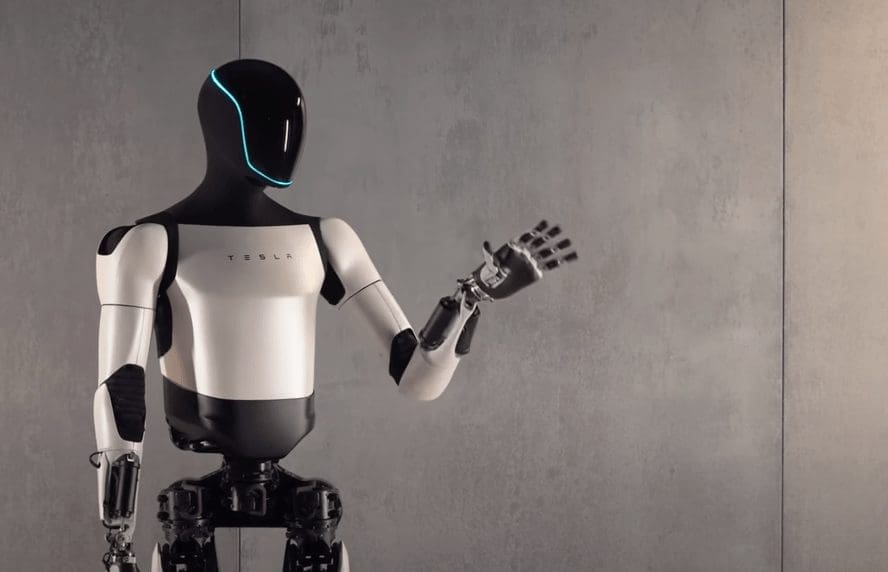
Design Philosophy: Two Very Different Robots
Tesla Optimus and Unitree G1 are built around fundamentally different design philosophies, and understanding this context is crucial for any comparison.
Tesla Optimus: Full-Size Factory Worker
Tesla Optimus is designed to be a full-size humanoid that can operate in human-scale environments — factories, warehouses, and eventually homes. At 173 cm tall, it's roughly the height of an average adult human. Tesla's approach is to leverage its existing AI stack from Full Self-Driving (FSD) and its massive compute infrastructure (Dojo supercomputer) to create a general-purpose robot that can learn new tasks through neural network training.
The Gen 2 Optimus (December 2023) featured a slimmer, lighter build with improved actuators and Tesla-designed hands with 11 degrees of freedom. By late 2024, Tesla showcased Gen 3 hands with 22 degrees of freedom — a significant leap in dexterity that brings Optimus closer to human-like manipulation capabilities.
However, it's critical to note: as of March 2026, Tesla Optimus is not commercially available. Tesla has been deploying small numbers internally in its factories, and Musk announced plans for 1,000+ units to be used at Tesla facilities. But you cannot buy one.
Unitree G1: Compact, Affordable, Available Now
Unitree G1 takes a completely different approach. At just 127 cm tall and 35 kg, it's a compact humanoid designed primarily for research institutions, universities, and developers who need a capable, affordable bipedal platform. It sacrifices the full human-scale form factor for portability, safety, and — critically — a price point that actually makes purchase feasible.
Released in August 2024 at a starting price of $13,500, the G1 was a breakthrough moment for accessible humanoid robotics. Its predecessor, the Unitree H1, sold for over $90,000. The G1 brought the cost down by more than 80% while retaining impressive capabilities: up to 43 degrees of freedom, force-controlled three-finger hands (optional), and advanced locomotion that can handle uneven terrain.
The G1 is an evolution of the H1 platform, optimized for mass production. Unitree has deep experience in volume manufacturing from its popular Go1 and Go2 quadruped robots, and that expertise shows in the G1's polished, production-ready design.
Limb Articulation and Movement
The number of degrees of freedom (DOF) directly determines how fluidly and precisely a humanoid robot can move. This is one area where the Unitree G1 has a clear numerical advantage.
The Unitree G1, in its advanced configuration, features 43 joint motors across its body. This gives it exceptional range of motion — it can perform complex movements like crossing uneven terrain, stepping over 40 cm obstacles, and recovering from physical disturbances (being pushed or kicked). Unitree has demonstrated the G1 performing backflips (on the H1 platform) and navigating messy woodpiles, showcasing impressive agility for a humanoid.
Tesla Optimus Gen 2 has approximately 28 degrees of freedom in its body, with the newer Gen 3 hands adding 22 DOF for a total hand dexterity that's approaching the G1's three-finger system. Tesla's approach focuses on smooth, deliberate movements optimized for factory tasks — picking up items, sorting, carrying loads — rather than the dynamic acrobatics Unitree demonstrates.
In practical terms: the G1 is more agile; the Optimus is designed for heavier-duty, sustained work.
Hand Capabilities and Dexterity
Hands are arguably the most important component of a humanoid robot for real-world usefulness. Both companies have invested heavily here.
The Unitree G1's optional three-finger hands are force-controlled, meaning they can sense and adjust grip pressure in real time. Unitree has demonstrated the G1 performing tasks like cracking walnuts, opening bottles, flipping food in a pan, and handling delicate objects. The three-finger design provides a good balance between simplicity and capability — fewer actuators than a five-finger hand, but enough articulation for most manipulation tasks.
Tesla's Gen 3 Optimus hands (showcased in late 2024) represent a major upgrade: 22 degrees of freedom with improved tactile sensing. Tesla demonstrated egg handling without breaking — a classic robotics benchmark. Earlier demos showed wire soldering and shirt folding (though the latter was later revealed to involve teleoperation). The five-finger design theoretically allows for more human-like grasping, but it also introduces greater mechanical complexity.
The key difference: Tesla's hands are more ambitious in design, but the Optimus isn't available for purchase. Unitree's G1 hands are less complex but are shipping in a real product today.
Speed and Locomotion
Speed matters for practical applications, especially in dynamic environments like warehouses, emergency response, or outdoor settings.
The Unitree G1 is 50% faster than Tesla Optimus at maximum speed. It also handles rough terrain more capably, thanks to its lighter weight and lower center of gravity. The G1's compact size (127 cm) and 35 kg weight make it inherently more stable and easier to balance dynamically.
Tesla Optimus, being taller and heavier, is designed for a more deliberate pace suited to factory environments where speed is less important than precision and payload capacity.
AI and Learning Capabilities
This is where Tesla's vision diverges most dramatically from Unitree's current offering.
Tesla's AI Advantage
Tesla's single greatest asset in robotics is its AI infrastructure. The Optimus robot is controlled by the same neural network architecture that powers Tesla's Full Self-Driving (FSD) system — the same end-to-end AI that processes camera inputs and makes driving decisions in millions of Tesla vehicles on the road.
This gives Tesla several unique advantages:
- Massive training data: Tesla's fleet of vehicles generates enormous amounts of real-world visual and spatial data that can be repurposed for robot training.
- Dojo supercomputer: Tesla's custom AI training hardware can process robot training workloads at scale.
- End-to-end neural networks: Rather than relying on hand-coded behaviors, Tesla aims to train Optimus to learn tasks through observation, similar to how FSD learns driving.
- Simulation-to-real transfer: Tesla has invested heavily in simulated environments for training Optimus before deploying in the real world.
The promise is enormous: a robot that can learn almost any task by watching humans do it. But as of March 2026, this vision is largely unrealized. Many of Tesla's impressive Optimus demos have relied on teleoperation (human remote control) rather than autonomous behavior — a fact competitors and critics have repeatedly highlighted.
Unitree G1's AI Approach
Unitree G1 uses a combination of reinforcement learning (RL) and imitation learning for locomotion and basic task execution. The robot ships with a capable sensor suite including 3D LiDAR, depth cameras, and IMU sensors that enable spatial awareness and navigation.
The G1 is designed as an open platform for researchers and developers. This means users can program custom behaviors, integrate their own AI models, and build on top of Unitree's base capabilities. For the academic and research market, this flexibility is extremely valuable — it's why you see Unitree robots in universities worldwide.
However, Unitree doesn't have anything approaching Tesla's AI infrastructure. The G1's learning capabilities are more conventional: effective for specific tasks, but lacking the grand vision of a general-purpose AI-driven humanoid.
Pricing and Availability (March 2026 Update)
This is the single most important practical difference between these two robots.
Tesla Optimus Pricing History
Elon Musk's price estimates for Optimus have shifted over time:
- 2022: Musk initially suggested $20,000–$25,000, positioning it as "less than half the price of a car."
- October 2024 ("We, Robot" event): Musk revised the estimate upward to approximately $30,000.
- 2025: Tesla deployed 1,000+ units internally but made no commercial sales. The head of the Optimus program, Milan Kovac, resigned in June 2025 and was replaced by Ashok Elluswamy from the Autopilot team.
- March 2026: No commercial availability. External sales may begin in 2026 or later.
Unitree G1 Pricing
The Unitree G1 has been available since August 2024 at a starting price of approximately $16,000. The base model includes the standard body and basic hands. The advanced version with force-controlled three-finger hands, additional sensors, and enhanced software commands a premium but remains far below what Tesla Optimus is expected to cost.
For context, the G1's predecessor — the Unitree H1 — sold for over $90,000, making the G1's pricing a genuine industry disruption. You can check current G1 pricing and availability on Robozaps.
Latest Developments (2025–2026)
Both robots have seen significant developments since their initial launches. Here's what's happened through early 2026:
Tesla Optimus: 2025–2026 Timeline
- March 2025: Elon Musk announced that an Optimus robot would be sent to Mars in 2026 aboard a SpaceX Starship — an audacious claim that underscores Tesla's long-term vision but has drawn skepticism.
- May 2025: Tesla shared footage of Optimus performing factory tasks including battery cell sorting and parts transport.
- June 2025: Milan Kovac, who had led the Optimus program since its inception in 2022, left Tesla. He was replaced by Ashok Elluswamy, the head of Tesla's Autopilot team — a signal that Tesla is more tightly integrating its vehicle AI and robotics efforts.
- Late 2024: Gen 3 Optimus hands with 22 degrees of freedom were demonstrated, a major improvement in manipulation capability.
- October 2024: At the "We, Robot" event, Optimus robots interacted with crowds but critics noted heavy reliance on teleoperation.
Unitree G1 and Unitree Robotics: 2025–2026 Timeline
- January 2025: Unitree showcased the G1, H1, Go2, and B2-W at CES 2025 in Las Vegas, signaling expanded international ambitions.
- 2025 product line expansion: Unitree introduced three new robots in 2025: the R1, A2, and H2 — expanding beyond the G1 into additional form factors.
- April 2025: Security researchers discovered backdoors in Unitree products allowing potential remote access to devices on the same network. Unitree claimed it was an unintentional vulnerability and patched it.
- May 2025: The U.S. House Select Committee on Strategic Competition requested investigations into Unitree's alleged connections to the People's Liberation Army and China's military-civil fusion programs. Unitree has denied selling products to the PLA.
- July 2025: Unitree began IPO tutoring with CITIC Securities, signaling preparations for a potential Hong Kong stock listing.
- September 2025: Security researchers published findings that the G1 collects and transmits multi-modal sensor data without notifying operators. A separate wormable BLE vulnerability was discovered that could allow nearby attackers to gain full control of Unitree robots.
- July 2025: Unitree won a WIPO Global Award for information and communications technology.
Security and Privacy Concerns
The security issues around Unitree products deserve their own section, as they may significantly impact purchasing decisions — particularly for government, military, or sensitive commercial buyers.
In 2025, multiple security research teams found serious vulnerabilities in Unitree robots:
- Backdoor access (April 2025): Researchers alleged Unitree had embedded backdoors that allowed the company to remotely access devices — and potentially other devices on the same network. Unitree claimed this was unintentional.
- Data exfiltration (September 2025): The G1 humanoid was found to collect and transmit multi-modal sensor data without operator notification — a serious concern for any deployment in sensitive environments.
- Wormable BLE vulnerability (September 2025): A critical vulnerability allowed attackers in physical proximity to gain full control of Unitree Go2, B2, G1, and H1 robots via Bluetooth Low Energy. Compromised robots could then infect other nearby robots. As of late September 2025, Unitree had not commented on this vulnerability.
Additionally, the U.S. Congress has raised concerns about Unitree's potential ties to the Chinese military, requesting federal investigations in May 2025.
Tesla Optimus, being manufactured in the United States and not yet commercially available, has not faced comparable security scrutiny — though any networked robot will eventually face similar concerns.
Real-World Applications
Where Tesla Optimus Fits
Tesla's vision for Optimus is ambitious:
- Factory automation: The primary near-term use case. Optimus is being tested in Tesla's own factories for tasks like battery cell sorting, parts transport, and assembly assistance.
- Warehouse logistics: Picking, packing, and organizing goods.
- Home assistance: Musk's long-term vision includes household tasks — cooking, cleaning, caregiving — though this is years away from practical reality.
- Space exploration: Musk has announced plans to send Optimus to Mars, which would make it the first humanoid robot deployed on another planet (if it happens).
Where Unitree G1 Fits
The G1's current market is more defined and practical:
- Academic research: Universities use the G1 for locomotion research, AI development, human-robot interaction studies, and computer vision experiments.
- Robotics education: The $13,500 price point makes it accessible for educational institutions that previously couldn't afford humanoid platforms.
- Light commercial tasks: Reception, guided tours, customer assistance, and demonstrations.
- Developer platform: The G1 serves as a foundation for developers building custom humanoid applications.
- Entertainment and events: Trade shows, exhibitions, and technology demonstrations.
Competitors to Consider
The Tesla Optimus and Unitree G1 don't exist in isolation. The humanoid robotics market is rapidly expanding. Here are the key competitors:
- Boston Dynamics Atlas: The most advanced humanoid robot in terms of athletic capability. The new electric Atlas (2024) is designed for commercial deployment but carries a premium price far above the G1.
- Figure 02: Figure AI's second-generation humanoid integrates OpenAI models for conversational AI and task planning. Recently secured massive funding and BMW factory deployments.
- Agility Robotics Digit: Purpose-built for warehouse logistics, Digit is already in pilot deployments at Amazon facilities.
- Astribot S1: A Chinese humanoid focused on upper-body dexterity and manipulation tasks.
- Unitree H2: Unitree's own next-generation full-size humanoid, launched in 2025, offering a larger form factor than the G1.
For a complete overview, see our guide to Tesla Optimus alternatives and competitors.
Which Should You Choose?
The honest answer depends on what you need — and when you need it.
The Bottom Line
As of March 2026, the Tesla Optimus vs Unitree G1 comparison is less about which robot is "better" and more about which robot exists as a purchasable product. The Unitree G1 is real, shipping, and affordable at $16,000. The Tesla Optimus is a compelling vision backed by enormous resources, but it remains an internal prototype with no commercial availability and a history of missed timelines.
For researchers, educators, and developers who need a humanoid robot today, the Unitree G1 is the clear practical choice — provided you're comfortable with the security concerns that emerged in 2025. For those waiting for the most capable general-purpose humanoid, Tesla Optimus represents the highest ceiling, but requires patience and a willingness to bet on Elon Musk's timeline promises.
The humanoid robotics race is accelerating rapidly. By the end of 2026, we'll likely see commercial availability from multiple players — Tesla, Figure AI, Agility Robotics, and Unitree's own H2. The best time to enter this market is now; the best robot to buy depends entirely on your timeline and use case.
Frequently Asked Questions
Can you buy the Tesla Optimus robot right now?
No. As of March 2026, Tesla Optimus is not available for commercial purchase. Tesla is using Optimus internally in its own factories and has discussed potential external sales beginning in 2026, but no firm date or ordering process has been announced. Elon Musk estimated a price of approximately $30,000 at the October 2024 "We, Robot" event.
How much does the Unitree G1 cost?
The Unitree G1 starts at approximately $16,000 for the base model. The advanced version — which includes force-controlled three-finger hands, additional sensors, and enhanced software — costs more. You can check current pricing on Robozaps. Optional accessories, international shipping, and taxes may add to the total cost.
Is the Unitree G1 safe to use? What about the security issues?
In 2025, security researchers discovered multiple vulnerabilities in Unitree products, including potential backdoors, unauthorized data collection, and a wormable Bluetooth vulnerability. Unitree patched the initial backdoor issue but had not addressed all concerns as of late 2025. If you're deploying a G1 in a sensitive environment, isolate it from your network and monitor for firmware updates. Government and defense buyers should exercise particular caution given the ongoing U.S. congressional investigation.
What is the difference between Unitree G1 and Unitree H1?
The Unitree H1 is a full-size humanoid (180 cm tall) that sold for over $90,000. The G1 is a smaller (127 cm), lighter (35 kg), and vastly cheaper ($16,000) humanoid designed for research and light-duty applications. The G1 retains many of the H1's capabilities in a more accessible package. In 2025, Unitree also introduced the H2, a next-generation full-size humanoid.
How does Tesla Optimus compare to Boston Dynamics Atlas?
Boston Dynamics' new electric Atlas (2024) is arguably the most physically capable humanoid robot in terms of athleticism and dynamic movement. Unlike Tesla Optimus, Atlas is designed by a company with decades of bipedal robotics experience. However, Atlas is not being marketed as a consumer or mass-market product — it targets commercial and industrial applications at a premium price point. For a detailed breakdown, see our Tesla Optimus vs Boston Dynamics Atlas comparison.
Will Tesla Optimus be sent to Mars?
In March 2025, Elon Musk announced plans to send an Optimus robot to Mars in 2026 aboard a SpaceX Starship rocket. If this happens, Optimus would be the first humanoid robot deployed on another planet. However, given Tesla's history of ambitious timeline announcements that often face delays, many observers remain skeptical about the 2026 target.
Which robot is better for university research?
The Unitree G1 is the clear choice for university research as of March 2026. It's available, affordable ($16,000), compact, and designed as an open development platform. Tesla Optimus isn't available for purchase and isn't designed as an open research platform. Many universities worldwide already use Unitree robots for locomotion research, AI development, and human-robot interaction studies.
What new Unitree robots were released in 2025?
Unitree expanded its product line in 2025 with three new robots: the R1, A2, and H2. The H2 is particularly notable as a next-generation full-size humanoid that succeeds the H1. Unitree also continued development of its popular Go2 quadruped platform and showcased its full lineup at CES 2025.
Related: Tesla Optimus Gen 2 Review · Unitree G1 Review: Pros, Cons and How it Compares · Figure 01 vs Unitree G1 · Tesla Optimus Alternatives
Ready to buy? Browse humanoid robots for sale on Robozaps.
Complete guide to humanoid robot applications: healthcare, manufacturing, retail, logistics & more. Real use cases and ROI data for each industry.
From threading needles on factory floors to guiding patients through rehabilitation exercises, humanoid robots crossed a critical threshold in 2025: 16,000 units deployed globally, with over $7 billion invested in China's robotics sector alone. As we enter 2026, the question has shifted from "can humanoid robots work in the real world?" to "which industries will they transform first?"
This is the most comprehensive guide to humanoid robot applications available anywhere—covering 12 major industries with real deployment data, specific robots in use, named companies, measurable results, and expert projections for what comes next. Whether you're evaluating humanoid automation for your business or tracking the industry's trajectory, this is your definitive resource.
The Rise of Humanoid Robot Applications Across Industries
The applications of humanoid robots have expanded at a breathtaking pace. In 2025, global installations reached an estimated 16,000 units according to Counterpoint Research, with projections exceeding 100,000 cumulative units by 2027. What was once confined to research labs and science fiction now spans manufacturing floors, hospital corridors, classrooms, and even outer space.
This comprehensive guide examines every major application area for humanoid robots in 2026, featuring real-world deployments, specific robots in use, measurable results, and expert analysis on where the technology is headed next.
Manufacturing and Industrial Automation
Manufacturing represents the largest near-term opportunity for humanoid robot applications. The human form factor allows these robots to operate in facilities designed for people—navigating doorways, climbing stairs, and using standard tools—without costly facility redesigns.
Automotive Assembly Lines
The automotive sector leads adoption. BMW is piloting Figure 02 robots at its Spartanburg, South Carolina plant for material handling and parts delivery. Mercedes-Benz has partnered with Apptronik to deploy Apollo humanoids for assembly line support tasks. Tesla uses its own Optimus Gen 2 robots internally at the Fremont factory, handling component delivery to human assembly workers.
Chinese automaker BYD plans to scale from 1,500 humanoid robots in 2025 to 20,000 by 2026, integrating them across its EV production lines. UBTECH's Walker S robots are already performing quality inspection tasks on automotive factory floors.
Warehouse and Logistics Operations
Agility Robotics' Digit represents the most commercially advanced warehouse humanoid. Deployed at Amazon, GXO Logistics, and a Spanx warehouse in Georgia—the first documented revenue-generating commercial humanoid deployment—Digit handles material movement, moves totes and bins along mapped routes, and manages payloads up to 35 pounds across a six-foot reach range.
Agility Robotics operates a factory in Oregon capable of building over 10,000 Digit units per year. Figure AI announced its BotQ manufacturing facility in Austin, Texas, with 12,000-unit initial capacity scaling to 100,000 annually.
Key Manufacturing Data
- Manufacturing costs declined 40% year-over-year, from $50,000–$250,000 per unit in 2023 to $30,000–$150,000 in 2024
- Unitree Robotics launched the R1 humanoid at just $5,900 in mid-2025
- Target uptime for commercial deployments: 85–95% availability
- Typical ROI payback period: 18–36 months
Healthcare and Medical Applications
The uses of humanoid robots in healthcare range from surgical assistance to patient interaction and rehabilitation support. Their human-like form makes them uniquely suited for environments where patient comfort and trust matter.
Surgical and Clinical Support
Moxi by Diligent Robotics handles routine hospital logistics—delivering lab samples, medications, and supplies—freeing nurses to focus on patient care. In clinical trials, Moxi reduced nurse walking time by up to 30% during shifts. Humanoid platforms are also being tested for telemedicine, allowing remote physicians to physically examine patients through robotic intermediaries.
Rehabilitation and Therapy
Humanoid robots serve as physical rehabilitation coaches, guiding patients through exercises with consistent form correction and motivational interaction. Japan's Pepper robot has been deployed in over 2,000 healthcare facilities for patient engagement, providing cognitive stimulation exercises for dementia patients and companionship during long hospital stays.
France's Mirokaï robot assists nursing staff at Broca Hospital (AP-HP), supporting both patient interaction and care coordination tasks.
Education and Academic Research
Humanoid robots in education are transforming how students learn STEM subjects, languages, and social skills. Their human-like appearance creates natural engagement that screens and traditional teaching tools cannot match.
Classroom Integration
SoftBank's NAO robot is used in thousands of schools worldwide for interactive language instruction, mathematics tutoring, and programming education. Students can program NAO using visual block-based interfaces or Python, making it an effective bridge between abstract coding concepts and tangible, physical results.
Poppy Humanoid, an open-source platform, is widely adopted in engineering schools, FabLabs, and secondary education. Its fully customizable design allows student groups to build, modify, and program specific robot components—from designing mechanical parts to adding sensors and programming behaviors.
Research Platforms
Booster Robotics' K1 (95 cm tall, 19.5 kg) serves as a portable research and education platform—transportable in a suitcase—ideal for robotics competitions like RoboCup. The Booster T1 provides an open-source humanoid for advanced research, including testing navigation algorithms and human-robot interaction paradigms.
Boston Dynamics' Atlas (now fully electric) continues as a premier research platform, pushing boundaries in dynamic movement, whole-body manipulation, and AI-driven autonomous behavior.
Elderly Care and Assisted Living
With aging populations worldwide, humanoid robots in elderly care address a growing labor shortage in caregiving. Japan alone faces a projected shortfall of 380,000 care workers by 2025.
Companionship and Monitoring
Pepper and NAO are deployed in Japanese and European care homes for daily companionship, medication reminders, cognitive exercises, and fall detection alerts. Studies published in the International Journal of Social Robotics show elderly residents interacting with humanoid robots report reduced loneliness and improved mood over 12-week periods.
Physical Assistance
Toyota's Human Support Robot (HSR) helps elderly individuals with limited mobility by retrieving objects, opening doors, and supporting daily tasks. Reachy by Pollen Robotics demonstrates kitchen assistance capabilities—opening refrigerators, cleaning surfaces—offering a glimpse of future domestic care robots.
Robot-as-a-Service (RaaS) models are gaining traction in elderly care, lowering the barrier to adoption for care facilities that cannot afford upfront capital expenditure on robotics.
Military and Defense
Humanoid robots in military and defense applications focus on reducing risk to human soldiers in dangerous environments while leveraging the human form factor to operate equipment and navigate structures built for people.
Active Programs
DARPA's Robotics Challenge catalyzed military humanoid development, testing robots' ability to drive vehicles, open doors, use power tools, and traverse rubble. Boston Dynamics' Atlas emerged from this program and remains the benchmark for military-relevant mobility and manipulation.
South Korea's KAIST HUBO won the DARPA challenge and continues development for disaster response and military logistics. China's PLA has demonstrated humanoid robots performing reconnaissance and equipment operation in field exercises.
Explosive Ordnance and Reconnaissance
Humanoid robots can enter buildings, climb stairs, and manipulate objects in ways that wheeled robots cannot—critical advantages for bomb disposal, hostage scenarios, and urban combat reconnaissance. Their ability to use human tools and equipment without modification reduces the logistics burden of specialized robotic attachments.
Retail and Customer Service
Humanoid robots in retail serve as interactive store assistants, product demonstrators, and customer engagement tools. Their novelty factor drives foot traffic while their AI capabilities provide genuine utility.
Deployments in Action
Pepper operates in over 2,000 retail locations across Japan, Europe, and the United States as a greeter, product guide, and information kiosk. SoftBank reports that stores deploying Pepper see increased customer dwell time and higher engagement with promoted products.
In China, humanoid robots from AgiBot (the global market leader by installations in 2025 with 31% share) are deployed in retail environments, shopping malls, and promotional events. RaaS rental models allow retailers to deploy humanoids for seasonal campaigns or special events without long-term capital commitments.
Hospitality and Tourism
Hotels, airports, museums, and entertainment venues increasingly deploy humanoid robots for guest services. Their multilingual capabilities and tireless availability make them ideal for high-traffic hospitality environments.
Notable Deployments
Japan's Henn-na Hotel chain pioneered humanoid robot staff, using robots for check-in, concierge services, and luggage assistance. Airports including Tokyo Haneda and Munich Airport deploy humanoid robots for wayfinding, flight information, and passenger assistance.
Museums worldwide use Pepper and custom humanoid platforms as interactive guides, delivering exhibit information in multiple languages while collecting visitor analytics. Booster Robotics demonstrated humanoid robots collecting waste at live events, showcasing hospitality applications beyond guest interaction.
Agriculture and Food Production
While traditional agricultural robots are purpose-built machines, humanoid robots offer unique advantages in unstructured farm environments where terrain, crop variety, and task diversity demand human-level adaptability.
Emerging Applications
Humanoid robots are being tested for fruit harvesting, where their dexterous hands and bipedal mobility allow them to navigate uneven orchard terrain and handle delicate produce. Agility Robotics has explored agricultural logistics applications for Digit, including moving harvested goods between collection points.
Greenhouse operations represent a nearer-term opportunity: controlled environments reduce navigation complexity while tasks like pruning, pollination monitoring, and plant inspection leverage humanoid manipulation capabilities.
Disaster Response and Search-and-Rescue
Disaster zones present exactly the kind of unstructured, human-designed environments where humanoid robots excel over wheeled or tracked alternatives. Stairs, ladders, narrow corridors, and rubble fields all favor bipedal mobility.
Real-World Capabilities
Boston Dynamics' Atlas has demonstrated traversing rubble, opening doors and valves, and using power tools in simulated disaster scenarios. Japan's HRP series robots, developed by AIST, are specifically designed for disaster response in earthquake-prone environments.
KAIST's DRC-HUBO proved humanoid viability for disaster response by completing a complex course including driving a vehicle, walking through rubble, cutting through walls, and climbing stairs—all autonomously. These capabilities directly translate to nuclear facility emergencies, building collapses, and hazardous material incidents.
Space Exploration
Space agencies invest heavily in humanoid robots because spacecraft, habitats, and equipment are designed for human operators. A humanoid robot can use the same tools, panels, and controls as astronauts.
Active Space Humanoids
NASA's Robonaut 2 (R2) operated aboard the International Space Station, performing routine maintenance tasks and testing human-robot collaboration in microgravity. Valkyrie (R5), NASA's next-generation humanoid, is designed for deep-space missions where robots must operate autonomously in habitats for months before human arrival.
Russia's Fedor (Skybot F-850) visited the ISS in 2019 for testing. China's space program is developing humanoid robots for its planned lunar base. The European Space Agency funds humanoid research through programs targeting Mars surface operations where communication delays make teleoperation impractical.
Entertainment and Social Interaction
Entertainment remains one of the most visible applications of humanoid robots, from theme park performers to social media personalities.
High-Profile Examples
Sophia by Hanson Robotics became the world's most famous robot, appearing on talk shows, addressing the United Nations, and receiving Saudi Arabian citizenship. While primarily a social AI demonstration platform, Sophia catalyzed public interest in humanoid robotics worldwide.
AgiBot deployed over 5,000 humanoid units in 2025 across entertainment, hospitality, and live performance venues in China. Disney's theme parks use sophisticated animatronic humanoids for character experiences, with increasing AI integration enabling unscripted guest interactions.
Live performance robotics is growing: humanoid robots serve as DJs, stage performers, and event hosts, with RaaS models making them accessible for corporate events and trade shows.
The Global Market Landscape in 2026
Understanding the applications of humanoid robots requires context on the rapidly evolving market:
- 16,000 units installed globally in 2025 (Counterpoint Research)
- China accounts for 80%+ of all installations
- AgiBot leads with 31% market share, followed by Unitree (27%), UBTECH (~5%), Leju (~5%), and Tesla (~5%)
- $7 billion invested across 610+ robotics deals in China in the first nine months of 2025
- Goldman Sachs projects cumulative installations exceeding 100,000 units by 2027
- Logistics, manufacturing, and automotive expected to represent 72% of annual installations by 2027
Application Comparison Table
What Changed at CES 2026
CES 2026 (January 2026) represented a watershed moment for humanoid robot applications. Key announcements that reshape the landscape:
- AgiBot debuted in the U.S. market with the most complete humanoid portfolio shown at any trade show—A2 (service), G2 (industrial/domestic), X2 (entertainment), and D1 (quadruped). Bloomberg confirmed AgiBot as the #1 humanoid producer by shipments.
- Unitree showcased the H2 for industrial applications and confirmed a Robot-as-a-Service model for global commercial deployment, alongside quick-swappable batteries and enhanced payload capacity.
- LG Electronics debuted CLOiD as the centerpiece of its "Zero Labor Home" vision—signaling that major consumer electronics companies are entering the humanoid space.
- 1X Technologies confirmed NEO deliveries to homes, marking the first true consumer humanoid deployment at scale.
- Figure AI continued scaling its BotQ factory, targeting 12,000-unit initial capacity for Figure 02 production.
The consistent theme across CES 2026: humanoid robots are transitioning from pilot programs to production-ready commercial systems with defined pricing, service models, and deployment playbooks.
Frequently Asked Questions
What are the most common applications of humanoid robots in 2026?
The most common applications of humanoid robots are in manufacturing and logistics (warehouse material handling, assembly line support), healthcare (patient interaction, rehabilitation), education (STEM teaching, tutoring), retail (customer service, product demonstration), and entertainment. Manufacturing and logistics dominate commercial deployments, accounting for the majority of the estimated 16,000 units installed globally in 2025.
How much do humanoid robots cost?
Humanoid robot prices vary dramatically based on capability. Entry-level platforms like the Unitree R1 start at approximately $5,900. Mid-range commercial humanoids cost $30,000–$150,000. Advanced research and industrial humanoids can exceed $150,000. Manufacturing costs have declined 40% year-over-year, and Robot-as-a-Service (RaaS) rental models offer access without large capital expenditure.
Which companies lead humanoid robot production?
As of 2025, AgiBot leads global installations with 31% market share, followed by Unitree (27%), UBTECH (~5%), Leju (~5%), and Tesla (~5%). In the Western market, Agility Robotics (Digit), Figure AI (Figure 02), Apptronik (Apollo), and Boston Dynamics (Atlas) are prominent. Tesla plans to scale Optimus production to 100,000 units by 2026.
Can humanoid robots replace human workers?
Current humanoid robots augment rather than replace human workers. They excel at repetitive, physically demanding, or dangerous tasks—freeing humans for complex decision-making and creative work. Companies reporting the highest workforce acceptance emphasize augmentation over replacement. Full labor substitution remains years away due to limitations in dexterity, adaptability, and unstructured problem-solving.
What is the ROI of deploying humanoid robots?
Early commercial deployments report ROI payback periods of 18–36 months, driven by labor cost savings, 24/7 operation capability, reduced workplace injuries, and consistent output quality. ROI improves in high-labor-cost regions and for tasks involving hazardous conditions or severe labor shortages. RaaS models reduce upfront risk further.
How are humanoid robots used in healthcare?
Humanoid robots in healthcare perform hospital logistics (delivering supplies and medications), patient engagement (companionship, cognitive exercises), physical rehabilitation coaching, and telemedicine support. Robots like Moxi reduce nurse walking time by up to 30%, while Pepper provides cognitive stimulation for dementia patients in over 2,000 healthcare facilities.
What does the future hold for humanoid robot applications?
Goldman Sachs projects cumulative humanoid robot installations will exceed 100,000 units by 2027. Near-term growth centers on structured industrial tasks (logistics, manufacturing, automotive). Mid-term expansion (2026–2028) will include more complex pick-and-place operations, multi-step assembly, and broader service-sector adoption. Long-term applications include domestic assistance, construction, and fully autonomous space exploration operations.
Future of humanoid robots: 2026-2035 technology roadmap, market predictions & key milestones. Expert analysis of what's coming next.
Key Takeaways
- The humanoid robot market is projected to grow from $1.8 billion (2023) to over $13.8 billion by 2028, with some analysts forecasting a $5 trillion market by 2050.
- Tesla, Figure AI, Unitree, Agility Robotics, and dozens of Chinese startups are racing to bring commercial humanoid robots to market between 2026 and 2028.
- AI breakthroughs—particularly large language models and embodied AI—are the single biggest accelerator, enabling robots to understand natural language, learn tasks from demonstration, and operate autonomously.
- Global labor shortages driven by population decline (especially in China, Japan, South Korea, and Europe) are creating unprecedented demand for humanoid workers.
- Prices are falling fast: from $1M+ research platforms in 2020 to sub-$100K commercial units in 2026, with targets of $20,000–$30,000 by 2030.
- Key challenges remain: battery life (2–4 hours), dexterous manipulation, regulatory frameworks, and cybersecurity vulnerabilities.
The State of Humanoid Robots in 2026
Humanoid robots have crossed the threshold from lab curiosities to commercial products. At CES 2026 in Las Vegas, humanoid robots dominated the show floor. Nvidia CEO Jensen Huang declared that "the humanoid industry is riding on the work of the AI factories we're building for other AI stuff," while Google DeepMind announced a partnership with Boston Dynamics to develop new AI models for the Atlas robot.
The numbers tell the story. In 2023, the global humanoid robot market was valued at approximately $1.8 billion. By 2028, MarketsandMarkets projects it will reach $13.8 billion—a compound annual growth rate (CAGR) of over 50%. Morgan Stanley's research division goes further, forecasting a potential $5 trillion market by 2050, driven by the assumption that over 3 billion humanoid robots could be integrated into human society by 2060.
What changed? Three forces converged simultaneously:
- AI capability leaps: Large language models (LLMs) and vision-language-action models gave robots the ability to understand context, follow natural language instructions, and learn new tasks from a handful of demonstrations.
- Hardware cost reduction: Advances in actuator design, battery technology, and manufacturing processes brought the cost of a capable humanoid from $1M+ to under $100K.
- Demographic urgency: Global population decline—particularly in China, Japan, South Korea, Germany, and Italy—created a labor shortage that automation alone couldn't solve.
The Demographic Driver: Why the World Needs Humanoid Workers
Understanding why billions of dollars are flowing into humanoid robotics requires grasping one fundamental reality: the global workforce is shrinking.
The Economist reported in September 2025 that humanity will shrink "far sooner than you think." China's population is already declining, having peaked at 1.426 billion in 2022. By 2050, China's working-age population is projected to fall by over 200 million. Japan and South Korea face even steeper per-capita declines. Europe's working-age population is shrinking by roughly 1 million per year.
This isn't a distant problem—it's happening now. Manufacturing plants can't fill shifts. Healthcare systems lack nurses and aides. Warehouses struggle to find workers willing to do repetitive physical labor. Humanoid robots, designed to operate in spaces built for humans—walking through doorways, climbing stairs, using existing tools—are the only scalable solution that doesn't require rebuilding entire infrastructure.
The AI Revolution Powering Humanoid Robots
If demographics create the demand, artificial intelligence provides the supply. The convergence of several AI breakthroughs has made human-like robot behavior achievable for the first time.
Foundation Models for Robotics
Nvidia's Project GR00T (Generalist Robot 00 Technology) is a foundation model specifically designed for humanoid robots. It enables robots to understand natural language, observe human actions, and translate them into real-world movement. Google DeepMind's RT-2 and its successors allow robots to reason about tasks they've never explicitly been trained on.
Vision-Language-Action Models
These models combine computer vision, language understanding, and physical action planning into a single system. A robot can look at a cluttered kitchen counter, hear "clean up the dishes," and plan a sequence of actions—picking up plates, opening the dishwasher, placing items inside—without being explicitly programmed for each step.
Simulation-to-Reality Transfer
Companies like Nvidia (with Isaac Sim) and Google are training robots in massive virtual environments before deploying them in the real world. A robot can practice millions of grasp attempts in simulation overnight, then apply that knowledge in a physical setting the next day. This dramatically accelerates the learning process and reduces the cost of training.
Imitation Learning
Figure AI's Helix system and similar approaches allow robots to learn tasks by watching humans perform them. Rather than programming every motion, engineers demonstrate the task—folding laundry, sorting packages, operating a coffee machine—and the robot learns the underlying policy. This makes humanoid robots far more adaptable than traditional industrial automation.
Companies Leading the Humanoid Robot Race
The competitive landscape has exploded. Here are the major players and where they stand as of early 2026:
China's Dominance Play
China is making a deliberate, state-backed push to dominate humanoid robotics, mirroring its strategy with electric vehicles. Recorded Future's November 2025 analysis noted that speculative forecasts suggest China could field approximately 300 million humanoid robots to compensate for its demographic decline. Beijing has designated specific cities as "humanoid robot capitals" and is channeling billions in subsidies to domestic manufacturers.
Companies like Unitree, AgiBot, Astribot, and Fourier Intelligence are already producing humanoid robots at price points that Western competitors struggle to match. The Unitree G1 at $16,000 and AgiBot A2 at roughly $35,000 represent a fundamentally different cost structure than American or European alternatives.
Where Humanoid Robots Are Working Today
Manufacturing and Logistics
This is where the money is right now. Amazon has deployed Agility Robotics' Digit in its fulfillment centers for tote handling. BMW is piloting Figure's robots on assembly lines. Tesla is using Optimus internally in its Fremont and Austin factories for parts sorting and battery cell handling.
Healthcare and Eldercare
Fourier's GR-1 is actively used in rehabilitation centers across China, guiding patients through physical therapy routines. Japan's eldercare facilities are experimenting with companion robots that can help seniors with mobility, medication reminders, and social interaction. The global nursing shortage—projected at 13 million by 2030 according to the WHO—makes this sector increasingly urgent.
Retail and Hospitality
SoftBank's Pepper has been deployed in over 2,000 locations worldwide for customer service. Sanctuary AI's Phoenix is being piloted in retail environments, performing tasks like shelf stocking, inventory checking, and customer assistance. Hotels in Japan and South Korea use humanoid concierges for check-in and information services.
Construction and Inspection
Boston Dynamics' Atlas has demonstrated capabilities in construction-site inspection and manipulation tasks. Startups are developing humanoid robots specifically for dangerous inspection tasks—bridges, tunnels, power plants—where human access is risky or expensive.
Defense and Security
Military applications remain controversial but are advancing rapidly. China has demonstrated armed humanoid robot prototypes, while DARPA continues to fund research into humanoid systems for logistics, bomb disposal, and disaster response. The 2025 Robot Olympics in Beijing included events specifically designed to test military-relevant capabilities.
The Technology Roadmap: What's Coming Next
2026–2027: Commercial Scale-Up
- Tesla targets consumer Optimus sales by late 2027 (Elon Musk, January 2026)
- Figure AI expands from pilot to full commercial deployment
- Chinese manufacturers hit 10,000+ units annual production
- Battery life improves from 2–4 hours to 6–8 hours with solid-state battery integration
2028–2030: Mass Adoption Phase
- Prices drop below $30,000 for capable general-purpose humanoids
- Humanoid robots become standard in large warehouses and manufacturing plants
- First meaningful home deployments begin (cooking, cleaning, eldercare assistance)
- Regulatory frameworks established in major markets (US, EU, China, Japan)
2030–2040: Integration Era
- Humanoid robots become as common as industrial robots are today (~3.5M industrial robots installed worldwide as of 2023)
- AI reaches sufficient capability for most household tasks
- Robot-as-a-Service (RaaS) models make humanoids accessible to small businesses
- Morgan Stanley's projection: hundreds of millions of units deployed globally
2040–2060: Ubiquity
- 3+ billion humanoid robots integrated into society (analyst projections)
- Humanoid robots handle majority of physical labor in developed economies
- Human workforce shifts predominantly to creative, supervisory, and interpersonal roles
Key Challenges and Risks
Technical Barriers
Battery life remains the biggest constraint. Current lithium-ion batteries give most humanoid robots 2–4 hours of active operation. Solid-state batteries promise significant improvements but aren't yet in mass production for robotics applications.
Dexterous manipulation—the ability to handle fragile objects, operate tools with precision, tie knots, thread needles—is still significantly behind human capability. Most robots can pick up and place objects but struggle with truly dexterous tasks.
Robustness and reliability in unstructured environments remains difficult. A factory floor is far more predictable than a typical home or outdoor environment.
Cybersecurity
Recorded Future's 2025 analysis highlighted that humanoid robots will be vulnerable to cyberattacks, including hijacking, data leaks, and botnet formation. A humanoid robot with cameras, microphones, and physical manipulation capabilities represents a uniquely dangerous attack surface. Robust cybersecurity standards will be essential.
Economic Disruption
The potential displacement of human workers raises serious questions. While humanoid robots are positioned to fill roles where workers are scarce, they could also eliminate jobs in sectors where workers are abundant. Policy responses—from retraining programs to new social safety nets—will be critical.
Ethical and Regulatory Questions
Who is liable when a humanoid robot causes injury? How do we prevent surveillance overreach from always-on cameras and microphones? What data do these robots collect, and who owns it? These questions don't have clear answers yet, and regulatory frameworks are lagging well behind the technology.
The Investment Landscape
Investment in humanoid robotics has exploded:
- Figure AI: Raised $675M in a Series B at a $2.6B valuation (2024), with investors including Microsoft, OpenAI, Nvidia, and Jeff Bezos.
- 1X Technologies: Backed by OpenAI's startup fund; raised $100M+ for NEO development.
- Agility Robotics: $150M Series B led by Amazon's Industrial Innovation Fund.
- Hyundai/Boston Dynamics: Hyundai acquired Boston Dynamics for $1.1B and committed to buying thousands of robots for its own factories.
- Chinese government funding: Billions in subsidies flowing to domestic humanoid robot companies through national and provincial programs.
Morgan Stanley, Goldman Sachs, and Citi have all published major research reports labeling humanoid robotics as one of the top investment themes of the decade.
Humanoid Robots vs. Traditional Industrial Robots
What This Means for You
If you're a business owner: Start evaluating humanoid robot pilots now. Companies like Agility Robotics and Figure AI offer pilot programs. The ROI calculation is straightforward—compare the annual cost of a robot ($30K–$60K including maintenance) against a human worker's salary plus benefits ($50K–$80K) for repetitive physical tasks.
If you're a worker: Focus on skills that complement robots—supervision, programming, maintenance, creative problem-solving, and interpersonal tasks. The transition will take decades, but it's starting now.
If you're an investor: The humanoid robotics sector is in its "early iPhone" moment. The major public plays include Tesla (TSLA), Nvidia (NVDA), and Hyundai. Private market opportunities exist through Figure AI, 1X Technologies, and Agility Robotics.
If you're a consumer: The first home humanoid robots will likely arrive between 2027 and 2030. Expect initial pricing between $20,000 and $50,000, similar to the early days of personal computers or electric vehicles. Over time, prices will fall dramatically.
Frequently Asked Questions
When will humanoid robots be available for consumers?
Tesla's Elon Musk stated in January 2026 that Optimus robots could be available for public purchase by late 2027. Figure AI has discussed home deployments starting in 2025–2026 for limited use cases. Realistically, the first broadly available consumer humanoid robots will likely arrive between 2027 and 2030, with initial prices between $20,000 and $50,000.
How much will a humanoid robot cost?
As of 2026, commercial humanoid robots range from $16,000 (Unitree G1) to $250,000+ (Agility Robotics Digit). Tesla targets a sub-$20,000 price point for future Optimus consumer models. Most industry analysts expect general-purpose humanoid robots to reach the $20,000–$30,000 range by 2030 through manufacturing scale and component cost reductions.
Will humanoid robots take everyone's jobs?
Not imminently. Humanoid robots are initially filling roles where workers are scarce—warehouse logistics, manufacturing, eldercare. The World Economic Forum projects that while robots will displace some jobs, they'll create new categories of employment in robot maintenance, programming, supervision, and AI training. The transition will be gradual, spanning decades rather than years.
Which company is leading the humanoid robot race?
There's no single leader. Tesla has the manufacturing scale advantage. Boston Dynamics has the most advanced mobility technology. Figure AI has the strongest AI partnerships (OpenAI, Microsoft). Unitree and AgiBot lead on price. Agility Robotics has the most real-world commercial deployment experience. China as a country is investing most aggressively in the sector overall.
Are humanoid robots safe?
Current humanoid robots include multiple safety systems—force-limited actuators, emergency stop buttons, proximity sensors, and speed restrictions near humans. However, cybersecurity researchers have flagged concerns about hacking risks. As robots become more autonomous and physically capable, safety standards and regulatory oversight will need to keep pace.
What can humanoid robots actually do today?
In 2026, humanoid robots can reliably walk on flat surfaces, navigate obstacles, pick up and place objects, follow verbal commands, perform repetitive manufacturing tasks, and interact conversationally using AI. They struggle with highly dexterous tasks (like tying shoelaces), operating in cluttered/unpredictable environments, and working for more than 2–4 hours on a single charge.
How will humanoid robots be different from Alexa or smart home devices?
The key difference is physical capability. Smart speakers and virtual assistants can only process information and control connected devices. Humanoid robots can physically interact with the world—opening doors, carrying groceries, doing laundry, assisting with mobility. They combine the AI brain of a virtual assistant with a physical body that can actually do things.
Key challenges in humanoid robotics: battery life, dexterity, AI limitations & cost barriers. What manufacturers are solving & what's next.
The humanoid robotics industry has exploded with investment, innovation, and bold promises. But behind the viral demos and billion-dollar valuations lie serious engineering, economic, and regulatory challenges that every company in this space must overcome. This comprehensive guide examines the key challenges in humanoid robotics as of 2026, what leading companies are doing to solve them, and what the future holds for general-purpose humanoid robots.
Key Takeaways
- Reliability is the #1 barrier: Industrial customers expect 95-99% uptime, but most humanoid robots can only operate for 30–90 minutes before needing a recharge or intervention.
- Battery technology limits deployment: Current lithium-ion batteries restrict humanoid robots to 1–4 hours of active use, making 24/7 industrial operation impractical without charging infrastructure.
- AI isn't ready for real-world autonomy: Despite advances in large language and behavior models, current AI struggles with edge cases, novel environments, and the long-tail of physical tasks.
- Safety standards are still being written: ISO standards for dynamically balancing humanoid robots don't yet exist, creating regulatory uncertainty for deployments.
- Cost vs. value remains unproven at scale: While unit costs are dropping, no company has demonstrated profitable humanoid robot deployments at thousands-of-units scale.
- The demand question: It's unclear whether any single application requires thousands of humanoids per facility, challenging the massive deployment projections.
Table of Contents
- Power and Battery Life Constraints
- Bipedal Mobility and Balance
- Dexterous Manipulation
- AI and Autonomy Limitations
- Reliability and Uptime
- Safety Standards and Regulation
- Cost and Economic Viability
- Market Demand Reality Check
- Manufacturing at Scale
- Human-Robot Interaction and Trust
- Future Outlook: How These Challenges Will Be Solved
- Frequently Asked Questions
Power and Battery Life: The Fundamental Constraint
Battery life is arguably the single most critical bottleneck preventing humanoid robots from achieving industrial-scale deployment. As IEEE Spectrum's October 2025 investigation revealed, the numbers are sobering:
- Agility Digit: 90 minutes of operation, followed by a 9-minute fast charge. In practice, Digit operates in 30-minute intervals at Amazon warehouses.
- Figure 02: Approximately 2–3 hours of active operation.
- Tesla Optimus Gen 2: Estimated 4–5 hours, though Tesla has not disclosed official runtime figures.
- Sanctuary AI Phoenix: Approximately 4 hours per charge, with 43.5 hours of cumulative operation demonstrated across Hannover Messe 2025 (with charging breaks).
Compare this to an 8-hour factory shift—let alone 24/7 operation. The physics are unforgiving: bipedal walking consumes enormous energy just to maintain balance, leaving less power for actual work tasks. This is why Sanctuary AI switched Phoenix to a wheeled base—energy efficiency matters more than bipedal aesthetics in industrial settings.
Why Better Batteries Alone Won't Solve This
Lithium-ion energy density improves at roughly 5–8% per year. Even with solid-state batteries (expected commercial availability 2027–2029), a doubling of energy density would still leave most humanoid robots short of a full 8-hour shift under heavy workloads. The industry needs a combination of:
- More efficient actuators and motor designs
- Better power management software that reduces energy waste during idle moments
- Hot-swappable battery packs for zero-downtime operation
- Charging infrastructure designed into factory layouts from the start
Bipedal Mobility and Balance: Harder Than It Looks
Walking on two legs is something humans do effortlessly, but it remains one of the hardest problems in robotics. The challenge isn't making a robot walk in a lab—it's making it walk reliably in unpredictable real-world environments for months without falling.
The Balance Problem
Bipedal robots are inherently unstable—they're essentially inverted pendulums that must constantly correct their balance. This requires:
- High-frequency sensor feedback (IMUs, force/torque sensors in feet)
- Real-time control loops running at 500–1000 Hz
- Significant computational resources dedicated solely to balance
- Robust recovery behaviors for slips, trips, and external pushes
Boston Dynamics Atlas is the gold standard for dynamic bipedal locomotion, demonstrating backflips, parkour, and recovery from pushes. But Atlas has been in development for over a decade with hundreds of millions in R&D funding. Newer entrants like Unitree H1 and Figure 02 are making rapid progress, but industrial-grade reliability on uneven surfaces, wet floors, or environments with obstacles remains an unsolved problem.
The Pragmatic Alternative
Some companies have acknowledged this challenge by choosing wheels over legs. Sanctuary AI's Phoenix Generation 8 uses a wheeled base, and several logistics robots use hybrid wheel-leg designs. This trade-off sacrifices stair-climbing ability but dramatically improves reliability, energy efficiency, and payload capacity.
Dexterous Manipulation: The Hand Problem
If bipedal walking is hard, dexterous manipulation with robotic hands is harder. The human hand has 27 degrees of freedom, thousands of tactile sensors, and is controlled by one of the largest regions of the motor cortex. Replicating this capability is one of the greatest challenges in robotics.
The Gap Between Demo and Deployment
Viral videos show robots handling eggs, making coffee, or folding laundry. But these demos often represent best-case scenarios after many attempts. In industrial settings, robots need to handle thousands of different objects—varying in size, weight, texture, temperature, and fragility—with near-zero failure rates. This requires:
- Tactile sensing: Knowing grip force in real-time to avoid crushing or dropping objects. Sanctuary AI leads here with multi-modal sensors detecting pressure, temperature, vibration, and slip.
- Sim-to-real transfer: Training manipulation skills in simulation (e.g., NVIDIA Isaac Lab) and transferring them to physical robots. This is scaling rapidly but still struggles with deformable objects and novel geometries.
- Adaptive grasping: Adjusting grip strategy on the fly based on sensory feedback, not pre-programmed motion paths.
AI and Autonomy: The Software Challenge
Hardware is only half the equation. The AI systems controlling humanoid robots face their own set of formidable challenges that may be even harder to solve than the mechanical ones.
The Long Tail of Physical Tasks
Language AI can handle most text tasks because language is structured and rule-governed. Physical tasks have no such luxury. A warehouse might present thousands of edge cases: oddly shaped packages, items stuck together, unexpected obstacles, spilled liquids, or objects in unfamiliar orientations. Each edge case requires either pre-programmed handling or genuine intelligence—and current AI has neither at scale.
As former Agility Robotics CPO Melonee Wise stated in IEEE Spectrum's October 2025 investigation: "I think what a lot of people are hoping for is they're going to AI their way out of this. But the reality of the situation is that currently AI is not robust enough to meet the requirements of the market."
Large Behavior Models: Promise and Limitations
Multiple companies are developing "Large Behavior Models" (LBMs)—the physical AI equivalent of Large Language Models:
- Sanctuary AI is training LBMs on Microsoft Azure using data from Phoenix deployments
- Boston Dynamics is working with Toyota Research Institute on behavior models for Atlas
- Figure AI has partnered with OpenAI to bring language understanding to physical actions
- NVIDIA provides Isaac Lab infrastructure used across the industry for sim-to-real training
These are promising approaches, but they face a fundamental data challenge: unlike internet text data (abundant, cheap, standardized), physical behavior data is expensive to collect, hard to standardize, and environment-specific. Training a robot to work in one warehouse doesn't automatically transfer to a different warehouse layout.
The Teleoperation Crutch
Many "autonomous" robot demonstrations actually rely heavily on teleoperation—a human operator controlling the robot remotely. While teleoperation is a valid data-collection strategy (the robot learns from human demonstrations), it's not scalable as a deployment model. True autonomy requires the robot to handle novel situations independently, and we're still years away from that for most physical tasks.
Reliability: The 99.99% Problem
Industrial automation has a simple requirement: it must work reliably, all the time. Traditional industrial robots from FANUC, ABB, and KUKA typically achieve 95-99% uptime in well-maintained environments. Humanoid robots are nowhere near this benchmark.
Why Humanoids Break
- Mechanical complexity: A humanoid robot has hundreds of joints, actuators, sensors, and moving parts. Each is a potential failure point. Traditional industrial arms have 6 joints.
- Software failures: AI-driven control systems can encounter unexpected states, sensor misreadings, or computation timeouts that cause the robot to freeze, fall, or behave unpredictably.
- Environmental sensitivity: Dust, moisture, temperature extremes, electromagnetic interference, and vibration all affect performance in ways that clean-room demos don't reveal.
- Battery degradation: Lithium-ion batteries lose capacity over charge cycles, reducing runtime over months of operation.
The Path to Reliability
Achieving industrial-grade reliability requires:
- Thousands of hours of real-world operation data to identify and fix failure modes
- Redundant sensor systems so single-point failures don't cause shutdowns
- Predictive maintenance using sensor data to replace parts before they fail
- Graceful degradation—robots that can safely stop and request help rather than crash
Sanctuary AI's 43.5 hours of cumulative operation at Hannover Messe 2025 is a promising data point, and Agility Robotics has accumulated the most real-world operational hours through Amazon warehouse pilots. But sustained months of reliable factory operation remains undemonstrated by any humanoid company.
Safety Standards: Writing the Rules for a New Industry
When a traditional industrial robot arm operates, it does so behind safety cages or with clearly defined collaborative zones governed by ISO 10218 and ISO/TS 15066. Humanoid robots—which walk through human workspaces, make autonomous decisions, and interact physically with people—need entirely new safety frameworks.
Current Regulatory Gaps
- No ISO standard exists for dynamically balancing legged robots. Boston Dynamics, Agility Robotics, and Figure AI are contributing to development of these standards, but they're years from finalization.
- Liability questions are unresolved: If a humanoid robot injures a worker, who is liable—the manufacturer, the deploying company, the AI training provider, or the operator?
- Country-by-country variation: The EU, US, China, Japan, and South Korea are all developing different regulatory approaches, creating compliance complexity for global deployments.
What Companies Are Doing
In the absence of formal standards, leading companies are self-regulating:
- Boston Dynamics publishes responsible AI principles and contributes to ISO working groups
- Agility Robotics designed Digit with force-limited joints to reduce injury risk
- Sanctuary AI's Carbon system includes safety monitoring layers
- Figure AI includes emergency stop systems and operational boundary enforcement
However, self-regulation isn't enough for enterprise buyers who need regulatory certainty before large-scale deployments. This creates a chicken-and-egg problem: standards bodies need deployment data to write good standards, but companies need standards to deploy at scale.
Cost and Economic Viability: Can Humanoids Be Profitable?
The economics of humanoid robots are still largely theoretical. While the vision is compelling—replace expensive, scarce human labor with tireless robots—the math hasn't been proven at scale.
The Price Trajectory
Robot prices are falling rapidly:
- Tesla targets $20,000–$30,000 for Optimus (widely questioned by analysts)
- Sanctuary AI Phoenix is priced at approximately $40,000
- Unitree G1 starts at $16,000—the most affordable humanoid available
- Agility Digit is estimated at $250,000 per unit at current volumes
However, the purchase price is just the beginning. Total cost of ownership includes maintenance, software updates, charging infrastructure, integration costs, on-site technical support, and the human operators who supervise robot fleets. These costs are poorly understood because no company has operated humanoid robots at scale long enough to generate reliable TCO data.
For a detailed price breakdown, see our complete humanoid robot cost guide.
Market Demand: Do We Actually Need Millions of Humanoids?
The humanoid robotics market is projected to reach $5 trillion by 2050 (Morgan Stanley) with 18,000 units shipping in 2025 (Bank of America). But these projections deserve scrutiny.
The Demand Question
As Melonee Wise pointed out: "I don't think anyone has found an application for humanoids that would require several thousand robots per facility." This challenges the narrative of millions of humanoid robots replacing human workers en masse.
The reality is more nuanced:
- Labor shortages are real: Manufacturing, warehousing, and elder care face genuine worker shortages that automation can address.
- But specialized robots often work better: For many tasks, purpose-built robots (conveyor systems, robotic arms, AGVs) are more reliable and cost-effective than general-purpose humanoids.
- The humanoid advantage is flexibility: Humanoids make sense when a facility needs one robot that can do many different tasks, rather than buying separate specialized robots for each task.
- Human-designed environments favor human form: Factories, warehouses, and buildings are designed for human bodies—doors, stairs, shelves, tools all assume human proportions.
Where Demand Is Real Today
The most promising near-term markets for humanoid robots include:
- Automotive manufacturing: McKinsey's October 2025 analysis identifies this as the first sector for production-scale humanoid deployment. Both Sanctuary AI (Magna partnership) and Figure AI (BMW partnership) are active here.
- Warehousing and logistics: Amazon's pilots with Agility Digit and its own Vulcan robots demonstrate real demand for automated picking and stowing.
- Electronics manufacturing: High-precision assembly tasks requiring dexterity in controlled environments.
- Elder care: Aging populations in Japan, South Korea, and Europe create demand for assistive robots, though regulatory and cultural barriers remain high.
Manufacturing at Scale: Building Millions of Complex Machines
Even if demand materializes, manufacturing humanoid robots at the scale projections assume (millions of units) presents its own massive challenge. Each humanoid robot contains:
- Dozens of precision actuators and motors
- Hundreds of sensors
- Custom-designed mechanical components
- High-performance computing hardware
- Advanced battery systems
- Specialized materials (carbon fiber, titanium, custom alloys)
The Tesla Manufacturing Thesis
Tesla's strongest argument for Optimus isn't the robot itself—it's Tesla's manufacturing expertise. The company that scaled EV production from thousands to millions of units arguably has the best shot at doing the same for humanoid robots. Elon Musk has stated Tesla could eventually produce millions of Optimus units per year.
However, humanoid robots are more mechanically complex than cars, with tighter tolerances and more custom components. The supply chain for humanoid-specific parts (especially actuators and tactile sensors) doesn't yet exist at automotive scale.
The China Factor
China is investing aggressively in humanoid robotics, with companies like Unitree, XPENG IRON, AgiBot, and Kepler developing humanoid platforms with access to China's deep manufacturing infrastructure and lower labor costs. This gives Chinese companies a potential cost advantage in scaling production—similar to what happened with EVs, drones, and consumer electronics.
Human-Robot Interaction: Building Trust
For humanoid robots to work alongside humans, people need to trust them. This goes beyond safety—it's about predictability, communication, and social acceptance.
The Uncanny Valley
Robots that look almost-but-not-quite human can provoke discomfort—the "uncanny valley" effect. Most current humanoid robots avoid this by using clearly mechanical aesthetics (helmeted heads, visible joints, non-skin materials). But as robots become more capable and present in daily life, designing for appropriate social interaction becomes important.
Workplace Integration
Workers who will share space with humanoid robots have legitimate concerns:
- Job displacement anxiety: "Will this robot replace me?" is the immediate question for many workers.
- Physical safety: Working near a 70kg robot that can lift 12kg with each arm requires trust in the safety systems.
- Workflow disruption: Integrating robots into existing workflows requires retraining human workers and redesigning processes.
- Communication: How does a robot signal its intentions to nearby humans? Clear status indicators, predictable movements, and simple communication interfaces are essential.
Companies deploying humanoid robots will need robust change management programs—not just technical integration. The applications of humanoid robots will expand faster in environments where human-robot collaboration is designed from the start.
Future Outlook: How These Challenges Will Be Solved
Despite the significant obstacles, there are strong reasons for optimism. The convergence of AI, advanced manufacturing, and massive investment is accelerating progress faster than any previous robotics era.
Near-Term Solutions (2026–2028)
- Better battery management: Hot-swappable battery packs and optimized charging infrastructure will mitigate runtime limitations before battery chemistry itself improves dramatically.
- Sim-to-real breakthrough: NVIDIA Isaac Lab and similar platforms are enabling thousands of simulated robots to train simultaneously, accelerating skill acquisition by orders of magnitude. Sanctuary AI has already demonstrated zero-shot sim-to-real transfer for dexterous manipulation.
- Hybrid autonomy: Rather than full autonomy or full teleoperation, robots will operate autonomously on trained tasks and request human guidance for novel situations—a practical middle ground.
- Focused deployments: Instead of trying to do everything, companies will focus humanoid robots on specific high-value tasks where they have clear advantages (e.g., repetitive bin picking in automotive, goods-to-person logistics).
- Wheeled alternatives: More companies may adopt wheeled bases for industrial applications where stairs aren't required, dramatically improving reliability and battery life.
Medium-Term Solutions (2028–2032)
- Solid-state batteries: Expected to reach commercial viability, potentially doubling energy density and enabling full 8-hour shift operation.
- Mature safety standards: ISO and regional bodies will have finalized humanoid-specific safety standards, unlocking enterprise procurement at scale.
- Manufacturing scale: Tesla, Chinese manufacturers, and others will have established production lines capable of producing tens of thousands of units per year, driving costs below $20,000.
- Large Behavior Models at scale: With years of real-world deployment data, LBMs will handle the majority of physical tasks without teleoperation, approaching human-level task flexibility for structured environments.
- Industry-specific solutions: Rather than one-size-fits-all humanoids, expect specialized variants optimized for automotive, logistics, healthcare, and other verticals.
Long-Term Vision (2032+)
- True general-purpose capability: Robots that can learn any physical task from observation or instruction, matching or exceeding human performance across a wide range of activities.
- Home deployment: Once costs drop below $10,000 and reliability reaches consumer-grade levels, humanoid robots will begin entering homes for elder care, household assistance, and companionship.
- Collaborative ecosystems: Fleets of humanoid robots coordinating with each other and with human workers, managed by centralized AI systems that optimize task allocation in real-time.
- Self-improvement: Robots that can identify their own limitations, request training data, and improve their capabilities autonomously through continuous learning.
Frequently Asked Questions
What is the biggest challenge in humanoid robotics?
The biggest challenge is achieving industrial-grade reliability (95-99% uptime) while maintaining the flexibility that makes humanoid robots valuable. Current robots can perform impressive demonstrations but struggle to operate reliably for extended periods in unpredictable real-world environments. This encompasses battery life, mechanical durability, AI robustness, and safety—all of which must be solved simultaneously.
Why can't humanoid robots work a full 8-hour shift?
Current lithium-ion battery technology limits most humanoid robots to 1–4 hours of active operation. Bipedal walking alone consumes enormous energy for balance maintenance. Until solid-state batteries or hot-swappable battery systems become standard, continuous 8-hour operation remains impractical for most humanoid platforms.
Are humanoid robots safe to work around?
Safety is an active area of development. Most humanoid robots include force-limited joints, emergency stop systems, and operational boundary enforcement. However, formal ISO safety standards specifically for humanoid robots are still being developed. Companies like Boston Dynamics, Agility Robotics, and Figure AI are contributing to these standards, but finalization is likely years away.
How much do humanoid robots cost in 2026?
Prices range widely: Unitree G1 starts at $16,000, Sanctuary AI Phoenix costs approximately $40,000, and enterprise-focused robots like Agility Digit are estimated at $250,000. Tesla targets $20,000–$30,000 for Optimus. Total cost of ownership—including maintenance, infrastructure, and support—is significantly higher than purchase price alone. See our full cost guide.
Will humanoid robots replace human workers?
In the near term (2026–2030), humanoid robots will augment human workers rather than replace them wholesale. They're best suited for repetitive, physically demanding, or dangerous tasks in structured environments. The future of humanoid robots likely involves human-robot collaboration rather than full replacement, especially as current AI can't match human judgment, creativity, and adaptability.
Which company is leading in solving humanoid robot challenges?
Different companies lead in different areas: Sanctuary AI leads in hand dexterity and has the longest commercial deployment track record. Boston Dynamics leads in bipedal mobility. Tesla has the strongest manufacturing scaling potential. Agility Robotics has the most warehouse operational data. No single company has solved all challenges. See our ranking of the best humanoid robots for a full comparison.
What role does AI play in humanoid robotics challenges?
AI is both the greatest enabler and one of the biggest challenges. Large Behavior Models, sim-to-real transfer learning, and computer vision are advancing rapidly, but current AI struggles with edge cases, novel environments, and the unpredictability of physical work. The gap between impressive demos and reliable deployment is largely an AI problem—the hardware is often ahead of the software.
When will humanoid robots be reliable enough for factories?
For specific, well-defined tasks in structured environments, humanoid robots are already being piloted in factories (Amazon, BMW, Magna, Hyundai facilities). For broad, flexible deployment at 99.99% reliability, most industry experts estimate 2028–2032 as the realistic timeline. Battery technology, AI maturity, and safety standards all need to advance significantly.
How do humanoid robot challenges compare to early smartphone challenges?
The analogy is apt. Early smartphones (2007–2010) had terrible battery life, limited apps, slow processors, and questionable reliability. Within a decade, they became indispensable. Humanoid robots face similar growing pains—battery life, software maturity, and ecosystem development all need time. The key difference is that physical robots face physics constraints that software products don't, so the timeline will likely be longer.
What's the best humanoid robot to buy in 2026?
It depends on your use case. For industrial dexterity tasks, Sanctuary AI Phoenix offers the best hand technology. For affordability and research, Unitree G1 is unmatched at $16,000. For warehouse logistics, Agility Digit has the most operational experience. Browse all options on Robozaps or read our complete ranking.
Related: Best Humanoid Robots of 2026 · Sanctuary AI Phoenix Review · Future of Humanoid Robots · Humanoid Robot Cost Guide · Applications of Humanoid Robots
Ready to explore? Browse humanoid robots for sale on Robozaps or visit our shop.
The evolution of humanoid robots from science fiction dreams to commercial reality. Key milestones, breakthrough technologies & what comes next.
The evolution of humanoid robots from science fiction to reality has been a fascinating journey. This article explores their progression from imaginative roots in literature and film to today’s advanced technologies. We’ll look at key milestones, technological innovations, and current applications that have turned the evolution of humanoid robots from science fiction to reality.
Key Takeaways
- Humanoid robots have transitioned from ancient myths and early literary visions to significant real-world prototypes like Honda’s ASIMO and Boston Dynamics’ Atlas, showcasing remarkable progress towards lifelike robots.
- Technological advancements such as advanced AI, seamless hardware-software integration, and improved battery life are driving the capabilities and versatility of modern humanoid robots, making them more adaptable and efficient.
- The global humanoid robot market is experiencing rapid growth, projected to reach USD 13.8 billion by 2028, driven by increasing applications in healthcare, education, and various industries, alongside continuous innovations from key market players.
From Fiction to Reality: The Journey of Humanoid Robots
Humanoid robots have long been a staple of science fiction, capturing the imagination of authors, filmmakers, and audiences. These fictional representations have significantly influenced the direction and aspirations of real-world robotics. Human ingenuity and perseverance have guided the transition of bringing humanoid robots from science fiction to reality, with every milestone pushing us closer to the moment a humanoid robot created becomes indistinguishable from lifelike robots.
Early visions and tangible inspirations have shaped the transition from fiction to reality, inspiring engineers and scientists to make those dreams a reality. Key milestones in the development of humanoid robots include notable breakthroughs and prototypes that progressively brought these imagined concepts closer to reality, exhibiting advancements towards lifelike robots. Let’s delve into the fascinating stages of humanoid robots’ evolution.
Early Visions in Science Fiction
The origins of humanoid robots can be traced back to ancient myths and early literary works. Greek myths, such as Hephaestus’ golden handmaidens and Talos, reflect early ideas of humanoid automata, showcasing the human fascination with creating lifelike machines. Similarly, the Liezi, a 3rd century BCE Taoist text, describes a humanoid automaton created by Yan Shi, further illustrating the long-standing human desire to build robots.
In literature, Mary Shelley’s novel ‘Frankenstein’ is one of the early examples where an artificial being is created, reflecting human attempts to assume the role of the creator. Edward S. Ellis introduced a bipedal anthropomorphic mechanism in his 1868 story ‘The Steam Man of the Prairies,’ depicting human-controlled mechanisms without autonomy. The first use of the word ‘robot’ was in Karel Čapek’s play R.U.R. (Rossum’s Universal Robots) in 1920, which introduced the concept of robots laboring for humans and eventually revolting. These formative ideas in science fiction established the foundation for the emergence of humanoid robotics.
Real-World Inspirations
Real-world inspirations and initial efforts to create humanoid robots powered the transition from science fiction to reality. Some examples include:
- Leonardo da Vinci conceptualized a mechanical knight in the 1400s, showcasing the blend of art and early robotics.
- The 13th-century engineer Ismail al-Jazari designed a humanoid waitress robot that served drinks.
- French inventor Jacques de Vaucanson created ‘The Flute Player’ in the 18th century, a robot capable of playing melodies.
These early attempts were driven by the desire to bring lifelike robots into existence, inspired by fictional depictions.
Key Milestones in Development
Significant breakthroughs and prototypes have shaped the development of humanoid robots. WABOT-1, developed by Waseda University in 1972, was the first full-scale humanoid robot capable of walking and grasping. Honda’s ASIMO, introduced in 2000, marked a major breakthrough as a humanoid robot that could walk, climb stairs, and interact with people.
More recently, Boston Dynamics’ Atlas robot has demonstrated remarkable agility and versatility, capable of running, jumping, and climbing. These key achievements have consistently brought the concept of humanoid robots closer to reality.
Technological Innovations Driving Humanoid Robotics
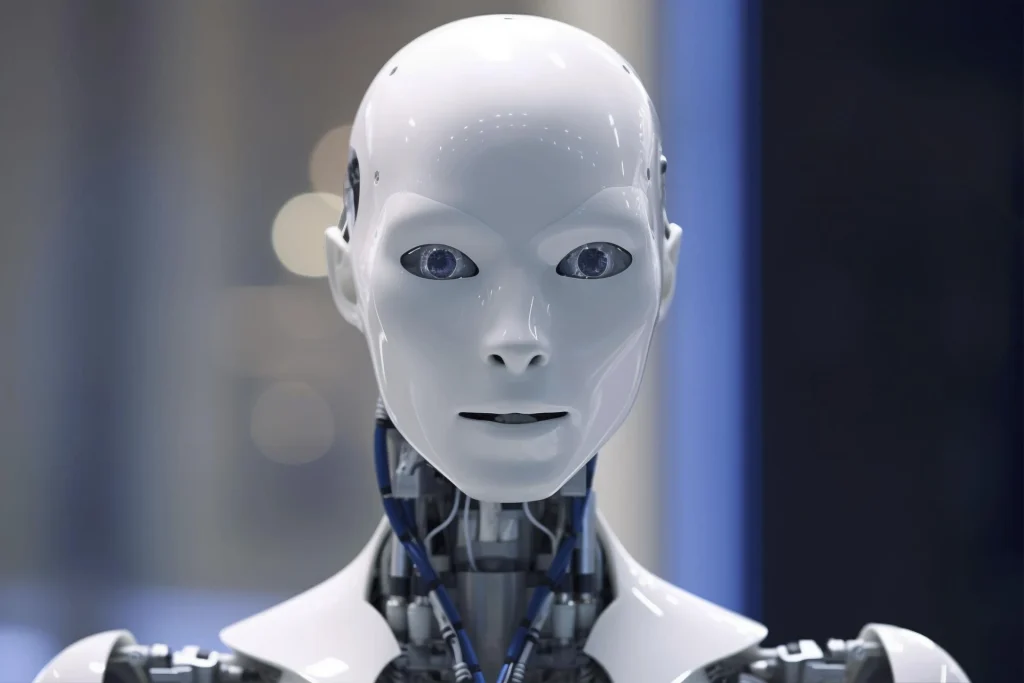
A blend of state-of-the-art technologies propels the progression of humanoid robotics. From artificial intelligence to seamless hardware-software integration and innovative energy solutions, these technological innovations are making humanoid robots more capable and versatile than ever before.
Advanced AI capabilities play a crucial role in enhancing the performance and adaptability of humanoid robots. The seamless integration of hardware and software ensures reliability and functionality, while improved energy solutions and battery life are critical for prolonged operation.
Let’s examine the crucial technological innovations propelling the advancement of humanoid robotics, particularly those that mimic human movements, within the context of a preliminary innovation system.
Advanced AI Capabilities
Advancements in AI and robotics have significantly enhanced humanoid robots’ capability to perform complex tasks with greater efficiency. Tesla’s Optimus robot, for example, uses neural networks to improve its motion and perform tasks autonomously. Boston Dynamics’ ATLAS, introduced in 2013, represents a significant advancement in humanoid robot agility and versatility. These robots blend AI, machine learning, biomechanics, and sensor connectivity with principles from behavioral science and cognitive development.
Generative AI and large language models further enhance humanoid robots’ ability to interact and cooperate with people, making them more adaptable to unstructured situations. AI advancements in computer vision and natural language processing are crucial for enabling versatile and reliable movements in humanoid robots. These advanced AI capabilities are significantly reshaping human production and interaction.
Hardware and Software Integration
The seamless integration of advanced hardware and software is crucial for the reliability and overall functionality of humanoid robots. Figure 01 robot integrates dexterous hands and legs for efficient movement in tasks like climbing stairs and lifting boxes. Unitree’s H1 robot is equipped with 3D lidar and a depth camera for autonomous navigation.
These developments in sensor technology enable humanoid robots to have:
- Better environmental awareness
- More precise physical interactions
- Enhanced facial expressions, allowing for emotional interaction robots
- Agility
Technological convergence ensures that these robots can perform tasks with these enhanced capabilities.
Energy Solutions and Battery Life
Recent improvements in battery technology are crucial for the enhanced functionality and prolonged operation of humanoid robots. Innovative energy solutions are driving the efficiency and operational longevity of these robots in various applications. Robots like Boston Dynamics’ Atlas demonstrate remarkable energy efficiency, allowing complex tasks without rapid power depletion.
Research into alternative energy sources or more efficient batteries is essential to overcome operational time limitations in humanoid robots.
The Current Landscape of Humanoid Robots
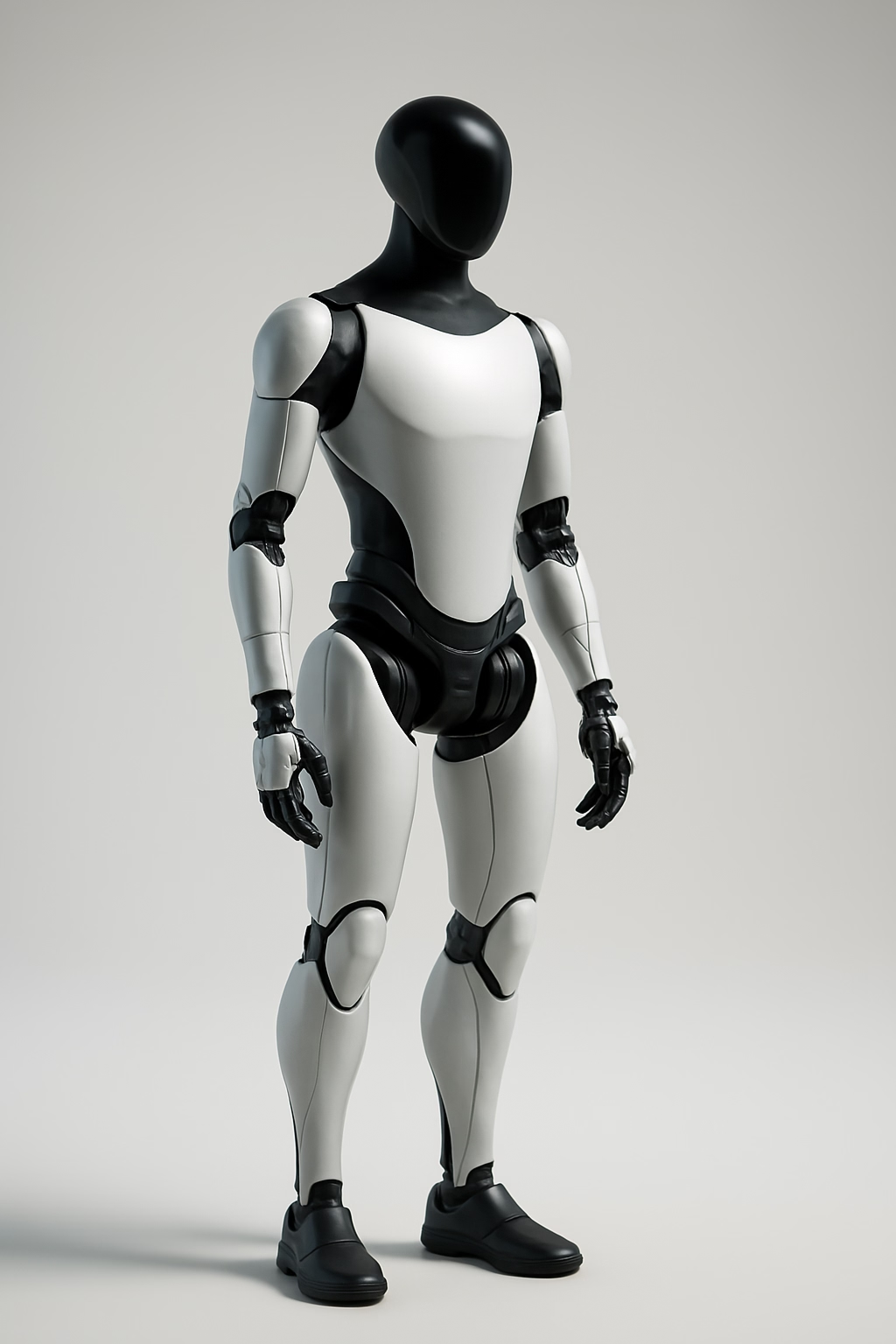
The current landscape of humanoid robots is marked by rapid market growth, driven by technological advancements and increasing demand across various industries. Some key facts about the global humanoid robot market include:
- The market was valued at USD 1.38 billion in 2023
- It is expected to reach USD 13.8 billion by 2028
- The market is growing at a CAGR of around 50.2%
- North America led the global market in 2022, driven by widespread adoption in public relations, personal assistance, caregiving, and education.
Key market leaders and innovators are continuously pushing the boundaries of humanoid robot technology, while regional and global trends shape the market dynamics. Humanoid robots are being increasingly used in healthcare, space exploration, education, and other industries. Let’s explore these aspects in more detail.
Market Leaders and Innovators
Prominent manufacturers contributing to the humanoid robot market’s dominance in North America include:
- Promobot Corp. (US)
- WowWee Group Limited (Canada)
- Kindred Inc. (US)
- Agility Robotics (US)
- NASA (US)
Despite technical challenges, companies like Boston Dynamics, Hanson Robotics, and SoftBank Robotics are continuously innovating in the field of humanoid robot technology. Ameca, a humanoid robot developed by Engineered Arts, uses generative artificial intelligence to respond to questions, commands, and interact with people.
Institutions like Boston Dynamics and MIT’s CSAIL are at the forefront of humanoid robotics research, pushing the boundaries of what these robots can achieve in various industries. These market leaders and innovators are driving the rapid market adoption of humanoid robots across various sectors.
Regional and Global Trends
The Asia Pacific region holds the largest market share for humanoid robots, accounting for 34.9% of market revenue in 2023. Countries like China, India, and Japan are driving the demand for humanoid robots in this region. The Chinese government started a robot fund to support research and development in the humanoid robot sector.
Some Western companies likely have the most sophisticated AI software models, while Asia will probably be the manufacturing hub for humanoid components. These regional and worldwide trends are influencing the future outlook of the humanoid robot market, as showcased in events like the World Intelligence Expo.
Industry Applications
Humanoid robots are increasingly used in healthcare for caregiving and patient monitoring. Some examples include:
- Grace, a humanoid robot developed by Hanson Robotics, is designed specifically to assist in healthcare settings, particularly for tasks related to the COVID-19 pandemic.
- Humanoid robots are also used to provide companionship to the elderly.
- They can support rehabilitation therapies.
NASA’s Valkyrie robot is being developed to assist in future space missions. Humanoids are particularly appealing for tasks that are ‘dangerous, dirty, and dull,’ such as mining and disaster rescue. These industry applications demonstrate the versatility and potential of humanoid robots.
Challenges and Opportunities in Humanoid Robotics
The field of humanoid robotics presents both challenges and opportunities. Key technical hurdles include stable bipedal locomotion, dynamic balance, energy efficiency, robust control systems, and robotic perception. Cognitive and interaction challenges involve real-time visual recognition, human-robot interaction, and adaptive learning.
Despite these challenges, the economic potential of the humanoid robot market is immense, with significant growth prospects and strategic opportunities for companies investing in this field.
Technological Constraints
Achieving dynamic balancing through precise synchronization of actuators, sensors, and control algorithms is crucial for humanoid robots. Managing complex control systems and addressing substantial energy demands are major technical obstacles in humanoid robotics. Control over human-like movements remains a technical challenge, with current battery technology limiting operational time to 1-2 hours before recharge. Present AI systems, including large language models, struggle with new situations that they haven’t been trained for, posing limitations.
There are significant bottlenecks in the development of AI and software for robot manipulation and interaction. Real-time visual recognition capabilities are essential for humanoid robots to interact effectively with their environment.
Economic Potential
The economic potential of the humanoid robot market is immense. Goldman Sachs Research estimates that the global market for humanoid robots could reach $38 billion by 2035. Most of the hardware for humanoid robots is already available or close to maturity for commercial purposes, indicating a promising future for rapid market adoption.
As these robots become more integrated into various industries, their economic impact will continue to grow, potentially expanding the market even further.
Strategic Considerations for Companies
Governments and technology companies are investing heavily in humanoid robotics research and development, leading to more advanced robots. Component makers are recruiting staff and devoting capital and human resources to humanoid robot development. Companies investing in this field must consider strategic partnerships, regulatory compliance, and market readiness to capitalize on the opportunities offered by humanoid robotics.
By harmonizing their resources and strategies, these businesses can tackle the challenges and tap into the economic potential of the humanoid robot market.
Future Prospects and Innovations
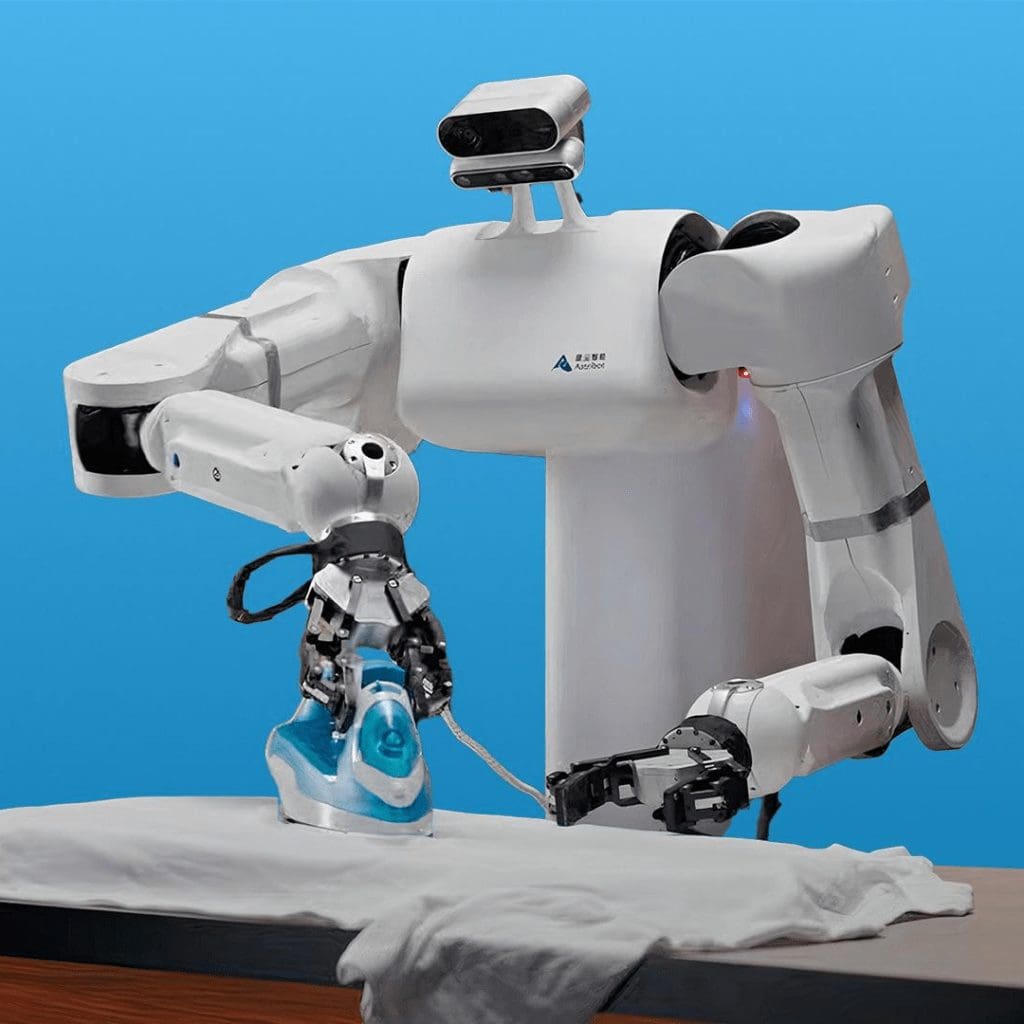
The future outlook and innovations in humanoid robotics are both exhilarating and revolutionary. As technology continues to advance, humanoid robots are expected to become more lifelike with enhanced sensory and cognitive abilities, making them more capable of interacting naturally with humans.
The market for humanoid robots, valued at $1.8 billion in 2023, is projected to exceed $13 billion within the next five years, driven by advances in AI and human-like features. These robots are anticipated to integrate more deeply into sectors such as healthcare, education, and customer service, driven by continuous advancements in technology.
Emerging Technologies
Emerging technologies, such as advanced neural networks and improved machine learning algorithms, are expected to significantly enhance the capabilities of humanoid robots. These technologies will enable robots to make better decisions, learn from their environment, and perform tasks with greater autonomy. The integration of these technologies will drive rapid market adoption and open up broader application scenarios across various industries.
Additionally, the convergence of AI, robotics, and sensor technology will result in more engaging interactions between humanoid robots and humans. This technological convergence will enable robots to perform increasingly complex tasks and adapt to new situations, making them invaluable assets in various tech companies and industries. As these technologies persistently advance, they hold enormous potential for disruptive innovation in the humanoid robot market.
Societal Impact
The societal impact of humanoid robots is multifaceted, encompassing ethical considerations and contributions to sustainable development goals. Humanoid robots like Sophia from Hanson Robotics can mimic human facial expressions and interact socially, which may enhance human-robot relationships but also raise ethical considerations. Ethical considerations include AI transparency, privacy protection, and the social impact on employment.
The AI for Good initiative aims to leverage AI to address the 17 Sustainable Development Goals (SDGs) set out by the United Nations, promoting inclusive growth and societal changes. Humanoid robots can promote gender equality by challenging stereotypes and providing positive role models for women and girls.
Vision for the Future
Imagining the future landscape of humanoid robotics, these robots are poised to revolutionize industries by providing remote work capabilities and enhancing productivity through automation. Elon Musk predicts that the market value of Tesla’s humanoid robots may eventually surpass that of its electric vehicles, indicating significant future market potential.
With the potential to undertake increasingly complex tasks and sophisticated human interactions, humanoid robots are profoundly transforming human production and a range of sectors. The future landscape of humanoid robotics includes expanding into new sectors such as creative arts, where robots are already being used to create original artworks.
Summary
In summary, the evolution of humanoid robots from science fiction to reality is a remarkable journey that highlights human ingenuity and technological advancement. From early visions in ancient myths and literature to real-world inspirations and key developmental milestones, humanoid robots have come a long way. Technological innovations, particularly in AI, hardware-software integration, and energy solutions, have driven the advancement of these robots, making them more capable and versatile.
The current landscape of humanoid robots is marked by rapid market growth, with significant contributions from key market leaders and innovators. Despite the challenges, the economic potential of the humanoid robot market is immense, with promising future prospects and innovations on the horizon. As humanoid robots continue to evolve, they are poised to revolutionize industries, enhance human-robot interactions, and contribute to societal advancements. The journey from fiction to reality is far from over, and the future of humanoid robotics holds limitless possibilities.
Frequently Asked Questions
What are the origins of humanoid robots in literature?
The origins of humanoid robots in literature can be traced back to ancient myths and early science fiction works, such as Greek myths and Mary Shelley’s ‘Frankenstein’. These stories laid the foundation for the development of humanoid robots in literature.
Who are the key players in the humanoid robot market?
The key players in the humanoid robot market include Boston Dynamics, Hanson Robotics, and SoftBank Robotics. These companies are leading the way in developing advanced humanoid robots.
What are the major technological constraints in developing humanoid robots?
The major technological constraints in developing humanoid robots include dynamic balancing, energy efficiency, and real-time visual recognition. These factors pose significant challenges to the development of advanced humanoid robotics.
How are humanoid robots used in healthcare?
Humanoid robots are used in healthcare for caregiving, patient monitoring, and rehabilitation therapies, providing crucial support to medical professionals and improving patient care.
What is the future potential of humanoid robots?
Humanoid robots have a bright future with possibilities for more lifelike interactions, integration into various industries, and significant market growth.
Related: The Future of Humanoid Robots: Innovation and Impact · What Is a Humanoid? Definition and Examples
Ready to buy? Browse humanoid robots for sale on Robozaps.
Humanoid robots in healthcare: patient care, surgery assistance & hospital applications. Real deployments, costs & future potential.
Key Takeaways
- The healthcare robotics market is projected to exceed $44 billion by 2028, with humanoid robots representing the fastest-growing segment.
- Humanoid robots are actively deployed in rehabilitation (Fourier GR-1), surgical assistance (da Vinci systems evolving toward humanoid form), elderly care, hospital logistics, and mental health support.
- A global nursing shortage of 13 million by 2030 (WHO) is the primary driver—humanoid robots can fill gaps without replacing human caregivers.
- Real-world deployments are already happening: Fourier's GR-1 in Chinese rehab centers, Moxi by Diligent Robotics in US hospitals, and Pepper in Japanese elderly care facilities.
- Key challenges include patient data privacy, FDA/CE regulatory approval pathways, integration with electronic health records (EHR), and the irreplaceable human element of empathy.
- The cost-benefit equation is shifting: a humanoid hospital assistant operating 24/7 can cost $50K–$100K/year versus $60K–$80K for a single human worker on one shift.
The Healthcare Crisis That's Driving Robot Adoption
Healthcare systems worldwide are facing a staffing crisis that has no precedent. The World Health Organization projects a global shortage of 13 million healthcare workers by 2030. The American Hospital Association reports that US hospitals lost over 100,000 registered nurses during 2021–2022 alone—the largest decline in four decades. Japan, with the world's oldest population, has a caregiver-to-elderly ratio that's deteriorating every year.
Meanwhile, demand is surging. The global population over 65 is expected to double from 761 million (2021) to 1.6 billion by 2050. These demographics create a mathematical impossibility: there simply won't be enough human healthcare workers to care for aging populations.
This is where humanoid robots enter the picture—not as replacements for doctors and nurses, but as force multipliers that handle routine, physically demanding, and repetitive tasks, freeing human clinicians to focus on complex care, empathy, and decision-making.
How Humanoid Robots Are Used in Healthcare Today
Patient Care and Monitoring
Humanoid robots equipped with cameras, microphones, and biosensors can continuously monitor patients—checking vital signs, detecting falls, and alerting staff to changes in condition. Unlike wearable devices that patients may remove, a humanoid robot can actively observe and respond.
Real-world example: In several Japanese eldercare facilities, SoftBank's Pepper robot conducts daily check-ins with residents, leading exercise routines, reminding patients about medications, and alerting staff when a resident appears distressed. Tencent's Xiaowu robot uses facial recognition and natural conversation to provide emotional support in pediatric and geriatric wards.
Rehabilitation and Physical Therapy
This is one of the most proven applications for humanoid robots in healthcare. Rehabilitation requires repetitive, precise movements—exactly what robots excel at.
Real-world example: Fourier Intelligence's GR-1, with 43 degrees of freedom, is actively deployed in rehabilitation centers across China. It guides patients through physical therapy routines for gait training, upper limb recovery, and balance exercises. The robot provides consistent, tireless support and collects detailed data on patient progress that human therapists can use to optimize treatment plans.
Other rehabilitation robots include Cyberdyne's HAL (Hybrid Assistive Limb), which is used in over 100 facilities in Japan and Europe for walking rehabilitation in stroke and spinal cord injury patients.
Surgical Assistance
While most surgical robots today (like the da Vinci system by Intuitive Surgical) are not humanoid in form, the trend is moving toward more human-like assistants that can work alongside surgeons in the operating room.
Current surgical robots have already demonstrated remarkable outcomes:
- 50% reduction in patient recovery time for robotic-assisted procedures vs. traditional open surgery
- Less blood loss and smaller incisions, reducing infection risk
- Sub-millimeter precision for procedures like prostatectomy, cardiac valve repair, and neurosurgery
The next generation of surgical assistants will combine humanoid form factors with AI-powered decision support, allowing them to hand instruments, retract tissue, and even perform routine suturing autonomously under surgeon supervision.
Hospital Logistics and Supply Chain
Hospitals are complex logistical environments. Nurses spend an estimated 25–30% of their time on non-clinical tasks: fetching supplies, delivering medications, transporting specimens, and restocking rooms.
Real-world example: Diligent Robotics' Moxi, deployed in over a dozen US hospitals, autonomously delivers supplies, lab samples, and medications throughout hospital floors. While Moxi isn't fully humanoid (it has a single arm and wheeled base), it demonstrates the trajectory: the next generation will have humanoid form factors for navigating stairs, opening doors, and operating elevators.
In China, multiple hospitals deployed humanoid-style robots during the COVID-19 pandemic for contactless temperature screening, medication delivery to isolation wards, and UV disinfection—reducing healthcare worker exposure to the virus.
Mental Health and Emotional Support
Perhaps surprisingly, humanoid robots are showing promising results in mental health applications. Their non-judgmental nature and infinite patience make them effective for:
- Autism therapy: Children with autism spectrum disorder often respond more positively to robots than to human therapists. The predictable, consistent behavior of robots reduces anxiety and encourages social interaction.
- Dementia care: Humanoid robots can engage dementia patients in conversation, reminiscence therapy, and cognitive exercises without frustration or impatience.
- Loneliness reduction: For isolated elderly patients, a humanoid companion that can converse, play games, and facilitate video calls with family provides meaningful social engagement.
Medical Training and Simulation
Humanoid robots are increasingly used as standardized patients in medical education. Unlike human actors, robots can consistently replicate specific symptoms, vital signs, and reactions, providing medical students with repeatable training scenarios for physical exams, patient interviews, and emergency response.
Healthcare Robots: A Comparison of Leading Models
The Economics of Healthcare Robots
The financial case for humanoid robots in healthcare is becoming compelling—and it's not primarily about replacing workers.
Cost Comparison
Important caveat: This comparison isn't about replacing nurses. It's about using robots to handle the 25–30% of nursing time spent on logistics and routine tasks, effectively giving hospitals the equivalent of more nursing hours without hiring additional staff in a market where there aren't enough nurses to hire.
ROI Timeline
Hospitals piloting logistics robots typically see ROI within 12–18 months. The primary savings come from:
- Reduced nurse overtime (average savings: $200K–$500K per facility per year)
- Fewer medication delivery errors (estimated cost of drug errors: $42B annually in the US)
- Lower hospital-acquired infection rates from contactless delivery
- Improved nurse retention (less burnout = lower turnover costs)
Ethical Considerations and Challenges
Patient Data Privacy
Humanoid robots equipped with cameras, microphones, and biosensors collect enormous amounts of sensitive health data. HIPAA compliance in the US and GDPR in Europe impose strict requirements on how this data is stored, processed, and shared. Any robot operating in healthcare must be designed with privacy-by-default principles:
- On-device processing where possible (minimizing data transmission)
- End-to-end encryption for all patient data
- Clear patient consent mechanisms
- Regular security audits and penetration testing
The Empathy Gap
Healthcare is fundamentally human. A robot can deliver medication, but it cannot hold a dying patient's hand with genuine compassion. Research consistently shows that patients value human connection in healthcare—particularly during vulnerable moments. The most effective approach is hybrid care models where robots handle routine and physical tasks, and humans provide emotional support, complex decision-making, and compassionate presence.
Regulatory Pathways
Healthcare robots face complex regulatory requirements. In the US, the FDA classifies medical robots differently depending on their function—surgical robots require rigorous premarket approval, while logistics robots may fall under different categories. The EU's Medical Device Regulation (MDR) and AI Act add additional layers. As of 2026, there is no unified global regulatory framework for humanoid robots in healthcare, creating uncertainty for manufacturers and hospitals alike.
Algorithmic Bias
AI systems trained on biased datasets can produce biased outcomes. If a diagnostic AI was trained primarily on data from one demographic group, it may perform poorly for others. In healthcare, bias can be life-threatening. Rigorous testing across diverse patient populations is essential before deploying AI-powered humanoid robots in clinical settings.
Liability and Accountability
If a humanoid robot makes an error that harms a patient—delivers the wrong medication, fails to alert staff to a deteriorating condition—who is liable? The manufacturer? The hospital? The AI developer? Current legal frameworks weren't designed for autonomous agents, and this remains one of the biggest unresolved questions in healthcare robotics.
The Future: What's Coming in Healthcare Robotics
2026–2028: Expansion of Current Applications
- Logistics robots become standard in major hospitals (500+ bed facilities)
- Rehabilitation robots expand beyond specialized centers to community clinics
- AI-powered triage robots deployed in emergency departments to assess patient acuity
- Telepresence humanoids enable specialist consultations in rural and underserved areas
2028–2032: Next-Generation Capabilities
- Humanoid surgical assistants capable of autonomous suturing and routine procedures under supervision
- Emotionally intelligent robots that can detect depression, anxiety, and cognitive decline through behavioral analysis
- Home health robots that monitor chronic conditions (diabetes, heart failure, COPD) and alert physicians to early warning signs
- Integration with genomic data for personalized treatment recommendations
2032+: Transformative Change
- Fully autonomous nursing assistants for elderly care facilities
- Humanoid robots as primary caregivers for routine home health visits
- AI-driven diagnostic capabilities that match or exceed specialist-level accuracy for common conditions
- 24/7 personalized health coaching through humanoid companions
Case Studies: Healthcare Robots in Action
Fourier GR-1 in Chinese Rehabilitation Centers
Fourier Intelligence's GR-1 humanoid robot has been deployed across multiple rehabilitation centers in China since 2024. In clinical settings, the robot guides stroke patients through repetitive gait training exercises—a task that requires consistent timing and positioning that can be exhausting for human therapists. Early clinical data suggests patients using robot-assisted rehabilitation show 15–20% faster recovery in mobility metrics compared to traditional therapy alone, while therapists report significantly reduced physical fatigue.
Moxi at Texas Health Resources
Diligent Robotics deployed its Moxi robots at Texas Health Resources hospitals, where they autonomously deliver lab samples, supplies, and medications to nursing stations. Nurses at the facility reported regaining approximately 30 minutes per shift previously spent on supply runs, which they redirected to patient care. The hospital also saw a measurable improvement in nurse satisfaction scores.
Pepper in Japanese Eldercare
At several Shin-Ai nursing homes in Japan, SoftBank's Pepper conducts daily group exercise sessions, leads sing-alongs, and provides cognitive stimulation activities for dementia patients. Staff report that residents are more engaged and active on days when Pepper leads activities, and the robot's consistent availability (it doesn't call in sick or need breaks) has improved the regularity of therapeutic programming.
How to Evaluate Healthcare Robots for Your Facility
If you're a healthcare administrator considering humanoid robots, here's a practical evaluation framework:
- Identify the pain point: What specific tasks consume the most staff time or cause the most burnout? Start there.
- Assess regulatory requirements: Does the robot's intended use require FDA/CE clearance? Logistics robots typically don't; clinical-use robots do.
- Evaluate integration: Can the robot integrate with your existing EHR, nurse call, and facility management systems?
- Calculate total cost of ownership: Include purchase/lease, maintenance, training, IT infrastructure, and insurance over 5 years.
- Run a pilot: Most manufacturers offer 90-day pilot programs. Measure before-and-after metrics on staff time, patient satisfaction, and error rates.
- Plan for staff buy-in: Healthcare workers may be skeptical. Frame robots as tools that eliminate tedious tasks, not as replacements.
Frequently Asked Questions
Will humanoid robots replace doctors and nurses?
No. Humanoid robots are designed to complement healthcare workers, not replace them. They handle logistics, routine monitoring, physical therapy guidance, and administrative tasks—freeing clinicians to focus on complex care and human connection. The global nursing shortage means there aren't enough healthcare workers to replace even if hospitals wanted to.
Are healthcare robots safe for patients?
Healthcare robots undergo rigorous safety testing. They include force-limited actuators (preventing injury from contact), emergency stop mechanisms, obstacle avoidance, and are designed to operate at slow speeds near patients. Surgical robots have additional safeguards including real-time tremor filtering and range-of-motion limits. However, cybersecurity remains a concern that requires ongoing attention.
How much do healthcare humanoid robots cost?
Prices range widely. A logistics robot like Moxi costs approximately $150,000–$200,000 to purchase or $3,000–$5,000/month to lease. Rehabilitation robots like the GR-1 start around $100,000–$170,000. SoftBank's Pepper is available for approximately $25,000–$30,000 plus monthly service fees. Surgical robot systems (da Vinci) cost $1.5M–$2.5M. Most hospitals pursue lease or Robot-as-a-Service models.
What data do healthcare robots collect, and is it HIPAA-compliant?
Healthcare robots may collect video, audio, vital signs, movement data, and interaction logs. Reputable manufacturers design their systems for HIPAA compliance with on-device processing, encrypted data storage, access controls, and audit trails. Hospitals should conduct a thorough security assessment and ensure a Business Associate Agreement (BAA) is in place with the robot manufacturer.
Can humanoid robots help with mental health treatment?
Yes, and the evidence is growing. Humanoid robots have shown particular promise in autism therapy (where children respond well to predictable, non-judgmental interaction), dementia engagement, and companionship for isolated elderly patients. They're not substitutes for licensed therapists but can provide consistent supplementary support—especially in settings where mental health professionals are scarce.
How long until humanoid robots are common in hospitals?
Logistics and rehabilitation robots are already deployed in hospitals today. By 2028, expect to see humanoid robots routinely in large hospitals (500+ beds) handling supply delivery, patient transport assistance, and rehabilitation. Broader adoption—including home health, surgical assistance, and primary care support—will likely scale between 2030 and 2035.
What happens if a healthcare robot malfunctions?
Healthcare robots are designed with multiple redundancy systems. If a malfunction is detected, the robot typically stops all movement immediately and alerts hospital staff. For surgical robots, the surgeon maintains override control at all times. Liability for robot-related incidents is still evolving legally, but currently falls on a combination of the manufacturer, the hospital, and the supervising clinician depending on the circumstances.
The role of AI in advancing humanoid robots: machine learning, computer vision & natural language. How AI is transforming robot capabilities.
AI is crucial in the development of humanoid robots, allowing them to understand and respond to human emotions, perform intricate tasks, and learn from their surroundings. This article explores the role of AI in advancing humanoid robot technology, making robots more effective in healthcare, education, and other industries.
Key Takeaways
- AI advancements have significantly enhanced humanoid robots, allowing them to mimic human behavior, interact with humans intuitively, and perform tasks autonomously in various sectors such as healthcare, education, and industry.
- Natural Language Processing (NLP) and deep learning algorithms are crucial in improving human-robot interaction, enabling robots to understand and respond to human language and emotions, thereby making interactions more seamless and personalized.
- Despite the potential of AI-enhanced humanoid robots, challenges such as high development costs and ethical considerations regarding autonomy and human oversight must be addressed to ensure their responsible and safe deployment.
AI-Powered Humanoid Robots: An Overview
Humanoid robots, inspired by the science fiction narratives we’ve grown up with, are now a reality, thanks to the relentless efforts of companies like:
- Boston Dynamics
- Hanson Robotics
- Engineered Arts
- UBTech Robotics
The intelligent embodiments of these robots are designed to mimic human behavior. They hold the potential to revolutionize various areas, from healthcare to industry and beyond. The growing need for automation in many industries and significant investments in artificial intelligence (AI) technologies are what are driving the interest in humanoid robots, which is not just academic.
One of the most advanced examples is Ameca by Engineered Arts, a humanoid robot that uses generative AI to interact with people, respond to questions, and exhibit creative abilities. This robot, along with others like Grace and Sophia, is equipped to support health and well-being, provide educational services, and enhance social good. The integration of AI enables robots to make autonomous decisions and adapt to changing situations. Additionally, it allows them to interact with humans more intuitively.
AI’s role in humanoid robotics extends past simple automation; it bolsters the robots’ capacity to comprehend natural language, identify facial expressions, and learn from interactions. This is evident in AI robots like Atlas from Boston Dynamics, which can perform human-like physical tasks such as lifting heavy objects, running, and climbing. With the help of Figure AI, these humanoid robotics are becoming more advanced and efficient.
The future of humanoid robotics looks promising, with continued advancements in AI driving the development of general purpose humanoid robot models that can perform a broader range of tasks with increasing autonomy and sophistication.
Enhancing Human-Robot Interaction with AI
AI’s evolution has significantly enhanced human-robot interaction, equipping humanoid robots with the skills to comprehend and react to human language and emotions. Natural Language Processing (NLP) is at the heart of this transformation, combining computational linguistics with statistical modeling, machine learning, and deep learning. NLP enables robots to understand natural language commands, making interactions more intuitive and seamless.
Speech recognition, a vital component of NLP, converts voice data into text, allowing robots to follow voice commands accurately. Sentiment analysis, which enables robots to recognize attitudes or emotions in human language, further improves this capability by enhancing the context and relevance of their responses. For instance, conversational AI enables robots to engage in meaningful conversations, using NLP and machine learning algorithms to provide human-like responsiveness and personalized interactions.
Moreover, advancements in robotics have led to significant improvements in various areas:
- Machine learning, computer vision, and NLP empower robots to infer user intent and respond intelligently to commands and queries.
- Planning and decision-making algorithms have advanced to autonomously generate and execute complex action sequences.
- Robots can now perform a wide range of tasks with minimal human supervision.
- Humanoid robots are efficient collaborators in various workplace scenarios, bridging communication gaps and meeting the diversified needs of different customers.
AI Algorithms Driving Humanoid Robotics

Deep learning, a machine learning subfield, has played a pivotal role in pushing humanoid robotics forward. Robots can learn complex patterns and relationships from large datasets, enabling them to:
- Make high-level decisions based on intricate information
- Perform advanced tasks with greater accuracy and efficiency
- Adapt to new tasks and environments
- Be more versatile and effective in dynamic settings
This capacity of deep learning is crucial for the development of advanced humanoid robots, as it allows them to mimic human capabilities.
Generative AI and large language models play a significant role in helping humanoid robots perceive and interpret changes in their environment. These AI models enable robots to adapt to unstructured situations, enhancing their ability to perform a variety of tasks with minimal human intervention. Companies and research institutions are continuously refining these technologies to bring robot capabilities closer to everyday applications.
Reinforcement learning algorithms further enhance the adaptability of humanoid robots by allowing them to learn and refine their behaviors through interaction with their surroundings. These algorithms enable robots to develop more sophisticated reasoning and decision-making processes, making them more robust and flexible in performing diverse tasks.
Future humanoid robots will use advanced control algorithms like predictive modeling and optimal control. These algorithms will help them achieve greater autonomy and adaptability.
Vision Models and Visual Perception
The functionality of humanoid robots heavily depends on advanced vision models and visual perception technologies. Technological advancements in cameras, computer vision, and deep learning have led to the development of robots capable of autonomous perception and interaction. These robots use vision sensors like cameras and radar to gather optical images and depth data, which computer vision algorithms then process for tasks like object recognition and navigation.
The integration of advanced sensors like LIDAR, gyroscopes, and accelerometers further enhances their ability to perceive and interact with their environment effectively.
The Role of AI in Motor Skills and Movement
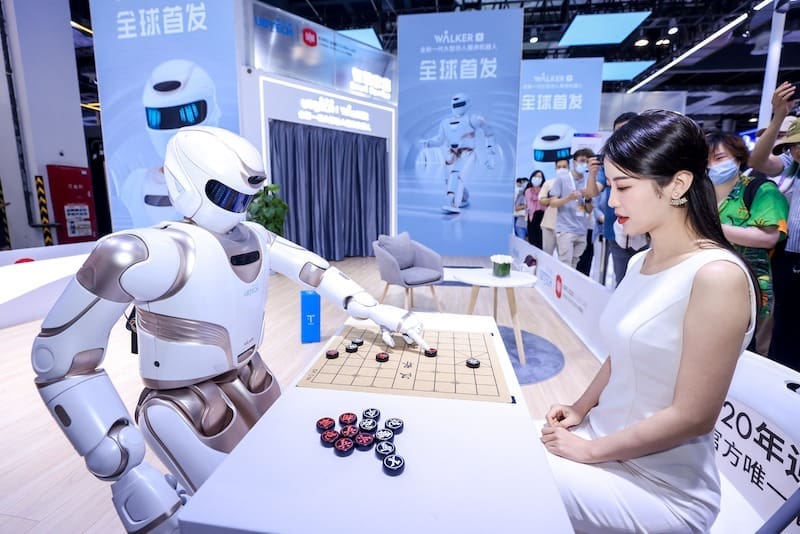
Crafting humanoid robots capable of emulating human-like movements presents a complex challenge, requiring the coordination of numerous actuators and joints, the formulation of intricate control algorithms, and the design of efficient feedback mechanisms. Reinforcement learning algorithms allow these robots to learn and refine their behaviors through interaction with their environment, enabling them to adapt to dynamic and unstructured environments.
Advanced control algorithms like model-based control enable robots to anticipate and respond to dynamic changes in their environment, making their movements more fluid and natural. The integration of advanced actuators and sensors further enhances the robots’ ability to perform tasks requiring fine motor skills, ensuring versatile and reliable movements. These advancements in AI, particularly in computer vision and natural language processing, offer promising avenues for overcoming challenges and creating robots that can work precisely in dynamic environments.
Applications of AI-Enhanced Humanoid Robots
Various sectors have seen significant transformations in task execution due to the applications of AI-enhanced humanoid robots. In healthcare, for instance, these robots can assist in robotic surgery, offering precision and reducing complications in procedures like open-heart surgery. They can also automate administrative tasks such as appointment scheduling and managing patient records, thus improving operational efficiency. Hanson Robotics created robots like Grace with the express purpose of assisting in healthcare settings and carrying out COVID-19 pandemic-related tasks.
In the education sector, humanoid robots can act as interactive tutors, offering customized lessons and tailored learning experiences. These robots can engage students in interactive activities, making learning more engaging and effective. In the entertainment industry, humanoid robots are being used to create dance routines, participate in interactive performances, and even act in films.
In manufacturing, AI-enhanced humanoid robots assist with assembly, picking and packing, and quality control, thereby increasing efficiency and productivity. They can perform repetitive tasks in manufacturing and logistics, enhancing operational efficiency and reducing the burden on human workers. In retail, hospitality, and service industries, humanoid robots interact with customers, providing personalized assistance and improving customer experience.
In addition, humanoid robots can assist caregivers in patient care by providing support and companionship for the elderly, as well as helping people with disabilities in their daily tasks. Robots like Moxie from Diligent Robots support non-clinical tasks in hospitals, such as deliveries, restocking, and collection of samples. These diverse applications highlight the potential of AI-enhanced humanoid robots to transform various workplace scenarios and improve the quality of services provided.
Challenges and Ethical Considerations
Despite the promising advancements in humanoid robotics, considerable challenges and ethical dilemmas need to be addressed. The development of these robots entails substantial costs in research, development, and manufacturing, making scalability and affordability major hurdles. Ensuring that these robots are accessible for various applications requires continuous efforts to reduce costs and improve efficiency.
Ethical considerations also play a crucial role in the development and deployment of humanoid robots. Balancing the autonomy of these robots with human oversight is essential to ensuring their safe and responsible use. Striking the right balance between technological capabilities and ethical oversight is paramount, particularly in applications where safety and societal impacts are significant. These challenges highlight the need for ongoing dialogue and collaboration among stakeholders to address the ethical dilemmas and societal impacts of humanoid robotics.
Future Trends in Humanoid Robotics
The ongoing development of AI technologies, particularly machine learning, computer vision, and natural language processing, has an impact on the direction that humanoid robotics will take in the future. These advancements are expected to enhance the capabilities of robots, making them more intuitive and effective in various applications. Institutions like Carnegie Mellon University and MIT are leading research in this field, pushing the boundaries of what is possible.
One of the significant trends is the integration of humanoid robots with cutting-edge technologies to address global challenges. The United Nations’ AI for Good initiative aims to leverage AI to address the 17 Sustainable Development Goals, showcasing robots designed to tackle these global issues. Companies like Hanson Robotics and UBTech Robotics are at the forefront of building AI-powered humanoid robots, focusing on refining human-robot interaction and promoting social good.
Looking ahead, there is a strong growth outlook for the robotics industry, with AI-enhanced robots playing a crucial role in various sectors. The future will see increased integration of humanoid robots in the workplace, enhancing productivity and opening up new possibilities for human-robot collaboration. These trends underscore the transformative potential of AI-powered humanoid robots and their role in shaping the future of work and society.
Summary
In summary, AI-powered humanoid robots are set to revolutionize various industries, offering unprecedented capabilities in mobility, interaction, and autonomy. These robots, driven by advancements in AI technologies, are becoming more integrated into our workplaces, enhancing productivity and opening up new possibilities for human-robot collaboration.
The role of AI in humanoid robotics is multifaceted, enhancing human-robot interaction, enabling robots to adapt to new tasks and environments, and improving their motor skills and movement. Despite the challenges and ethical considerations, the future of humanoid robotics looks promising, with continuous advancements in AI driving the development of robots that can perform a broader range of tasks with increasing autonomy and sophistication.
As we look to the future, it is clear that AI-powered humanoid robots will play a crucial role in addressing global challenges and promoting social good. By embracing these technologies, we can unlock new opportunities and create a more efficient, productive, and inclusive world. The journey of humanoid robotics is just beginning, and the possibilities are limitless.
Frequently Asked Questions
What are some of the leading companies developing AI-powered humanoid robots?
Some of the leading companies developing AI-powered humanoid robots include Boston Dynamics, Hanson Robotics, Engineered Arts, and UBTech Robotics. These companies are at the forefront of this innovative technology.
How does natural language processing enhance human-robot interaction?
Natural language processing allows robots to understand human language, detect emotions, and engage in meaningful conversations, making interactions more intuitive and seamless. This enhances human-robot interaction significantly.
What role do AI algorithms play in humanoid robotics?
AI algorithms such as deep learning and reinforcement learning allow humanoid robots to adjust to new tasks and environments, make advanced decisions, and improve their behaviors by interacting with their surroundings. This is important for enhancing the capabilities of humanoid robotics.
What are some applications of AI-enhanced humanoid robots?
AI-enhanced humanoid robots have applications in various fields, including healthcare, manufacturing, education, and retail, where they assist in tasks like robotic surgery, customer service, and companionship for the elderly.
What are the ethical considerations in the development of humanoid robots?
The ethical considerations in developing humanoid robots involve balancing robot autonomy with human oversight, ensuring safe deployment, and addressing societal impacts. It is important to carefully consider the implications of this technology.
Related: The Future of Humanoid Robots: Innovation and Impact · Challenges in Humanoid Robotics and How to Overcome Them
Ready to buy? Browse humanoid robots for sale on Robozaps.
Humanoid robots in education: classroom applications, STEM teaching, student engagement & real deployment examples. Complete guide for educators.
Humanoid robots are transforming education in 2026—from AI-powered teaching assistants to autism therapy companions. This comprehensive guide covers every major humanoid robot used in classrooms today, real deployment data from schools worldwide, costs, pros and cons, and a practical implementation guide for educators. Updated with the latest 2026 research and field studies.
Key Takeaways
- Humanoid robots are actively deployed in schools across 40+ countries as teaching assistants, peer tutors, and special education support tools.
- The strongest evidence for learning outcomes is in STEM/coding, language learning, and autism/special education.
- Studies consistently show higher engagement and motivation, though measurable learning gains remain small to moderate.
- Leading classroom robots include NAO, Pepper, QTrobot, Alpha Mini, and Furhat—ranging from $2,000 to $30,000.
- Key challenges include cost ($9,000–$30,000+ per robot), teacher training, Wi-Fi infrastructure, and data privacy.
- Robots supplement but don't replace human teachers—the best outcomes occur in blended human-robot teaching models.
Humanoid Robots Used in Classrooms: Complete Comparison
How Humanoid Robots Are Used in Schools (2026)
1. Teaching Assistants & Co-Teachers
The most common deployment model. Robots like NAO and Pepper work alongside human teachers to:
- Deliver structured lessons: Vocabulary drills, math problems, science demonstrations
- Answer questions: AI-powered responses to student queries in real-time
- Handle repetitive tasks: Attendance, quizzes, practice exercises—freeing teachers for complex instruction
- Provide multilingual support: Pepper supports 20+ languages; NAO supports 9 languages
A study at university level found that NAO-based vocabulary lessons produced learning outcomes at least equal to human-only instruction, with students reporting significantly higher enjoyment.
2. Peer Tutors & Learning Companions
Smaller robots like Alpha Mini and Tega act as "slightly older peers" who:
- Practice reading aloud with reluctant readers
- Work through math problems step-by-step
- Provide patient, judgment-free repetition (robots never get frustrated)
- Encourage hesitant students to participate
A systematic review of social robots in classrooms found the peer/companion role is one of the most effective at raising participation and on-task behavior, particularly for students who avoid engaging with human teachers.
3. Special Education & Autism Support
This is where the evidence is strongest. Robots provide predictable, repeatable interactions that are especially beneficial for:
- Autism spectrum: QTrobot is used in clinical and school settings to train joint attention, turn-taking, and emotion recognition
- Speech therapy: NAO helps children practice pronunciation and conversational skills
- Motor skills: Physical interaction with robots supports fine and gross motor development
- Emotional regulation: Consistent robot responses help children with emotional difficulties develop coping strategies
Multiple systematic reviews report positive trends in engagement and behavioral outcomes for autistic learners, though researchers note the need for larger samples and longer interventions.
4. STEM & Coding Education
Humanoid robots make abstract programming concepts tangible:
- NAO: Programmable in Python, C++, and block-based coding (Choregraphe/Blockly)
- Alpha Mini: UBTECH's affordable entry point with block coding interface
- Marty: Teaches Python and Scratch through physical walking robot movements
- Robotics competitions: Programs like FIRST Robotics and RoboCup Junior use humanoid platforms
Students programming physical robots show higher engagement and deeper understanding of computational thinking compared to screen-only coding exercises.
5. Language Learning
Robots are increasingly used for second-language acquisition:
- Pepper delivers English conversation practice in Japanese schools (e.g., Shibuya Elementary)
- NAO teaches vocabulary and pronunciation across European classrooms
- Furhat provides immersive conversation practice with projected facial expressions
- Students are less anxious speaking to a robot than to a human teacher or native speaker
Real-World Deployments: Schools Using Robots Now
The Evidence: What Research Says About Robot-Assisted Learning
What Works
- Engagement: Nearly all studies report significantly higher student engagement and on-task behavior when robots are present
- Motivation: Hesitant students are more willing to participate; robot interactions reduce performance anxiety
- STEM skills: Programming physical robots produces better computational thinking outcomes than screen-only coding
- Special education: Consistent positive results for autism spectrum support, speech therapy, and social skills training
- Language learning: Reduced anxiety in speaking practice; comparable or better vocabulary retention
What's Still Unclear
- Long-term learning gains: Most studies are short-term; the "novelty effect" may inflate early results
- Academic achievement: While engagement improves, direct impact on test scores is small to moderate
- Scalability: Most evidence comes from small pilots (10–50 students), not district-wide deployments
- Cost-effectiveness: No large-scale studies comparing robot-assisted learning ROI to other EdTech investments
Costs: What Schools Actually Pay
Hardware Costs
- Entry-level: Alpha Mini ($200–$400), Marty ($300–$500)—good for coding introduction
- Mid-range: Sanbot ($3,000–$6,000), QTrobot ($8,000–$12,000)—suitable for daily classroom use
- Full-featured: NAO ($9,000–$13,500), Pepper ($15,000–$25,000), Furhat ($20,000–$30,000)—comprehensive teaching platforms
Hidden Costs (Budget Honestly)
- Software licenses: Annual subscriptions for lesson content and AI features ($500–$3,000/year)
- Maintenance & repairs: Warranty extensions, replacement parts, battery replacements
- Teacher training: 8–20+ hours of PD per teacher to use robots effectively
- Infrastructure: Reliable Wi-Fi (robots need stable connectivity), charging stations, storage
- Curriculum integration: Time to design lessons that meaningfully incorporate robot interactions
Challenges & Ethical Considerations
Practical Challenges
- Novelty effect: Initial excitement fades after 2–4 weeks; sustained integration requires strong pedagogy
- Technical reliability: Robots malfunction—Wi-Fi drops, speech recognition fails in noisy classrooms, batteries die mid-lesson
- Teacher workload: Adding a robot often increases teacher prep time, at least initially
- Vendor lock-in: Schools become dependent on specific hardware/software ecosystems
Ethical Concerns
- Data privacy: Robots with cameras and microphones collect student data—FERPA, GDPR, and local privacy laws apply
- Emotional attachment: Young children may form inappropriate emotional bonds with robots
- Screen time vs. human time: Robot interaction shouldn't replace human social development
- Equity: Wealthy schools adopt robots while under-resourced schools fall further behind
- Algorithmic bias: AI-powered adaptive learning may reinforce existing biases in educational content
Pros and Cons of Humanoid Robots in Education
Implementation Guide: A Practical Checklist for Schools
Step 1: Define Your Purpose
Don't buy a robot because it's cool. Define specific learning objectives:
- Is the goal STEM/coding education? → Alpha Mini or Marty (affordable)
- Language learning? → NAO or Pepper (multilingual)
- Special education/autism? → QTrobot (clinical evidence)
- General engagement & presentations? → Pepper or Sanbot
Step 2: Budget Realistically
Hardware is typically only 50–60% of total cost. Budget for software, training, maintenance, and infrastructure. Start with a 1-year pilot before committing to large-scale deployment.
Step 3: Prepare Infrastructure
- Ensure reliable Wi-Fi in every classroom where robots will operate
- Set up charging stations and secure storage
- Test robot performance in actual classroom conditions (noise, movement, lighting)
Step 4: Train Your Teachers
Allocate 8–20 hours of professional development per teacher. Include:
- Basic robot operation and troubleshooting
- Lesson design integrating robot interactions
- When to use the robot vs. when not to
- Data privacy protocols
Step 5: Address Ethics & Data Privacy
- Conduct a data protection impact assessment (DPIA)
- Get parental consent for camera/microphone use
- Establish clear policies on data storage and deletion
- Review FERPA (US), GDPR (EU), or local equivalents
Step 6: Start Small, Measure, Scale
Pilot with 1–2 classrooms, measure specific outcomes (engagement metrics, learning assessments), and scale only based on evidence.
The Future: What's Coming in 2026–2028
- LLM-powered robots: GPT and other large language models are being integrated into NAO and Pepper, enabling truly conversational teaching interactions
- Lower costs: Chinese manufacturers like UBTECH and Qihan are driving prices down
- More advanced humanoids: Next-generation robots like 1X NEO and Unitree G1 could eventually enter educational environments
- Remote learning: Telepresence robots enabling expert teachers to "be present" in rural classrooms
- AI tutoring at scale: Combining humanoid presence with adaptive AI for truly personalized education
For a full overview of the latest humanoid robots, see our best humanoid robots of 2026 ranking, or browse available models at Robozaps.
Frequently Asked Questions
What humanoid robots are used in schools?
The most widely deployed humanoid robots in education are NAO (Aldebaran/SoftBank), Pepper (SoftBank Robotics), QTrobot (LuxAI), Alpha Mini (UBTECH), Furhat (Furhat Robotics), and Marty (Robotical). NAO and Pepper are the most common in K–12 classrooms globally.
How much do educational robots cost?
Prices range from $200–$500 for entry-level coding robots (Alpha Mini, Marty) to $9,000–$30,000 for full-featured classroom platforms (NAO, Pepper, Furhat). Total cost of ownership including software, training, and maintenance is typically 40–50% higher than hardware alone.
Can robots replace teachers?
No. All research and real-world deployments show robots work best as supplements to human teaching, not replacements. The best outcomes come from blended models where robots handle repetitive tasks while teachers provide complex instruction, emotional support, and creativity.
Are robots effective for children with autism?
Yes—this is one of the strongest evidence areas. Robots like QTrobot and NAO provide predictable, patient, repeatable interactions that help autistic children practice joint attention, turn-taking, emotion recognition, and social skills. Multiple systematic reviews report positive engagement and behavioral outcomes.
What subjects can robots teach?
Humanoid robots are used to teach programming/coding, mathematics, science, languages (especially second-language acquisition), social skills, and reading. The strongest evidence is in STEM/coding education and language learning.
Do students actually learn more with robots?
Students consistently show higher engagement and motivation with robots. However, direct academic achievement gains are small to moderate. The novelty effect may inflate early results, and more long-term studies are needed. Robots appear most effective when integrated into well-designed pedagogy rather than used as standalone teaching tools.
What are the privacy concerns with classroom robots?
Robots equipped with cameras, microphones, and AI collect student data including facial expressions, voice recordings, and behavioral patterns. Schools must comply with FERPA (US), GDPR (EU), or equivalent privacy laws. Parents should be informed and consent obtained. Schools should establish clear data retention and deletion policies.
Which robot is best for coding education?
For budget-conscious schools: Alpha Mini ($200–$400) or Marty ($300–$500). For comprehensive STEM programs: NAO ($9,000–$13,500) supports Python, C++, and block-based coding with 25 degrees of freedom. NAO is the most widely used robot in academic STEM research.
Economic impact of humanoid robots on jobs: displacement risks, new roles & industry shifts. Data-driven 2026 analysis with expert forecasts.
The Economic Landscape: Humanoid Robots in 2026
The humanoid robotics industry is no longer a futuristic fantasy — it's an economic force reshaping labor markets worldwide. Goldman Sachs Research projects the global humanoid robot market will reach $38 billion by 2035, a staggering sixfold increase from their earlier $6 billion estimate. In 2026 alone, industry analysts expect 50,000 to 100,000 humanoid robot shipments, with unit costs dropping rapidly toward the $15,000–$20,000 range as manufacturing scales.
Meanwhile, McKinsey Global Institute estimates that automation — including humanoid robots and AI — could displace between 400 and 800 million jobs worldwide by 2030, forcing up to 375 million workers (roughly 14% of the global workforce) to switch occupations entirely. The convergence of affordable humanoid hardware with increasingly capable AI software is accelerating this timeline faster than most economists predicted even two years ago.
This article examines the economic impact of humanoid robots on the job market: which industries face disruption first, which new careers are emerging, what history teaches us about technological transitions, and how governments worldwide are preparing for this transformation.
Understanding the Humanoid Robot Revolution
What Makes 2026 Different
Previous waves of automation relied on specialized industrial robots — welding arms, conveyor belt systems, and pick-and-place machines bolted to factory floors. Humanoid robots represent a fundamentally different category. Their bipedal, human-shaped design means they can operate in environments built for humans, use human tools, and perform tasks across multiple industries without facility redesign.
Several breakthroughs converged to make 2026 the inflection point:
- Cost reductions exceeding projections: Goldman Sachs reports manufacturing costs declined 40% year-over-year, far surpassing earlier projections of 15–20% annual reductions. Current costs range from $30,000–$150,000 depending on configuration.
- AI-powered dexterity: Large language models and vision-language-action models now enable robots to understand verbal instructions, adapt to novel situations, and handle irregular objects — capabilities that were impossible just three years ago.
- Battery and actuator improvements: Modern humanoid robots can operate 16–20 hour shifts before recharging, making them viable for two-shift factory and warehouse operations.
- Venture capital flood: Over $7 billion in venture capital flowed into humanoid robotics companies between 2023 and 2025, funding rapid iteration and deployment.
Key Players Driving Deployment
The humanoid robotics landscape in 2026 features several major players actively deploying robots in commercial settings:
- Tesla Optimus: Tesla has deployed Optimus robots in its Fremont factory for material handling and assembly assistance tasks. While the company initially targeted 5,000 units in 2025 — a goal it didn't fully achieve — Gen 3 Optimus robots are now performing meaningful work in Tesla's own manufacturing lines.
- Figure AI: Figure's humanoid robots are working shifts at BMW's manufacturing facility in Spartanburg, South Carolina. Their Figure 02 and Figure 03 models handle warehouse logistics, parts sorting, and repetitive assembly tasks.
- Agility Robotics (Digit): Amazon has partnered with Agility Robotics, deploying Digit robots in its fulfillment centers for tote-moving and shelf-stocking operations.
- Apptronik (Apollo): Mercedes-Benz has integrated Apollo robots into its manufacturing operations, focusing on physically demanding tasks that contribute to worker injury.
- Unitree Robotics: Chinese manufacturer Unitree has achieved some of the lowest production costs in the industry, making humanoid robots accessible to small and mid-sized enterprises across Asia.
- 1X Technologies (NEO): The Norwegian company is targeting commercial security and hospitality environments with its NEO humanoid robot platform.
Which Jobs Are Most at Risk
Not all jobs face equal risk from humanoid robots. The most vulnerable roles share common characteristics: they involve repetitive physical tasks, operate in structured environments, and don't require complex social or creative judgment. Here's a sector-by-sector analysis.
Manufacturing
Manufacturing is the front line of humanoid robot adoption. Tesla, BMW, and Mercedes-Benz are already deploying humanoid robots on assembly lines. Goldman Sachs estimates humanoid robots could fill 4% of the U.S. manufacturing labor shortage gap by 2030.
At-risk roles include:
- Assembly line workers performing repetitive tasks
- Material handlers and machine operators
- Quality inspection workers (visual AI now matches human accuracy)
- Packaging and palletizing workers
However, context matters: many manufacturing facilities already struggle with chronic labor shortages. In the U.S., the National Association of Manufacturers reports over 600,000 unfilled manufacturing jobs as of 2025. Humanoid robots may initially fill vacancies rather than displace existing workers.
Warehousing and Logistics
Amazon alone employs over 750,000 warehouse workers in the United States. The company's partnership with Agility Robotics signals where the industry is heading. Warehouse work — picking, packing, sorting, and moving goods — is highly structured and repetitive, making it ideal for humanoid robot deployment.
The economic incentive is stark: a warehouse worker in the U.S. earns approximately $35,000–$45,000 per year plus benefits. A humanoid robot costing $50,000 with a 5-year lifespan and $5,000 annual maintenance works out to roughly $15,000 per year — and operates 20 hours a day without breaks, sick days, or overtime pay.
Agriculture
Agricultural labor faces significant disruption, particularly for harvesting tasks. Seasonal crop picking, fruit sorting, and greenhouse maintenance are all tasks that humanoid robots are being trained to perform. Countries like Japan, where the agricultural workforce average age exceeds 67, see humanoid robots as essential to maintaining food production.
Retail
Retail environments are seeing early deployments in inventory management, shelf stocking, and customer assistance. While fully autonomous retail robots remain limited, humanoid robots handling overnight restocking shifts are already being piloted by major chains. Self-checkout has already reduced cashier jobs by an estimated 30% in stores that adopted it, and humanoid robots will extend automation deeper into retail operations.
Food Service
Fast food chains and commercial kitchens are exploring humanoid robots for food preparation, dishwashing, and serving. Repetitive food assembly tasks — think sandwich making or pizza preparation — are well within current humanoid robot capabilities. Several restaurant chains in China and Japan have deployed robotic kitchen assistants, though most current deployments supplement rather than replace human workers.
Jobs That Are Safe — and Growing
While humanoid robots threaten certain job categories, they're simultaneously creating entirely new career paths and increasing demand in existing ones.
Robot Maintenance and Repair Technicians
Every deployed humanoid robot requires ongoing maintenance, calibration, and repair. Industry estimates suggest one technician per 10–20 robots for currently deployed models, though this ratio will improve as reliability increases. With projections of millions of humanoid robots deployed by 2035, this represents a massive new job category.
AI Training and Data Specialists
Humanoid robots learn through demonstration, simulation, and real-world feedback. Training robots to handle new tasks, environments, and edge cases requires human experts. Roles include:
- Robot behavior trainers (teaching robots new tasks through demonstration)
- Simulation environment designers
- Safety testing and validation engineers
- Human-robot interaction designers
Robotics Engineers and Software Developers
The robotics industry's growth is driving enormous demand for mechanical engineers, control systems engineers, computer vision specialists, and AI/ML researchers. Robotics engineering salaries have increased 25–40% since 2023 due to talent scarcity.
Healthcare and Elder Care Workers
Paradoxically, humanoid robots may increase demand for human healthcare workers. Robots handling routine physical tasks (patient lifting, medication delivery, facility cleaning) allow healthcare professionals to spend more time on patient interaction and complex care — activities where human empathy remains irreplaceable.
Creative and Strategic Roles
Roles requiring creativity, complex problem-solving, emotional intelligence, and strategic thinking remain firmly in human territory. This includes management, design, therapy, education, and the arts. The World Economic Forum consistently identifies these as the most automation-resistant job categories.
The Net Job Creation vs. Destruction Debate
The Optimistic View
Proponents of humanoid robot adoption argue that technology has always created more jobs than it destroyed — it just creates different ones. Key arguments include:
- Productivity gains increase wealth: When robots reduce production costs, goods become cheaper, consumer purchasing power increases, and new industries emerge to serve expanded demand.
- Labor shortage solution: In aging economies like Japan, Germany, and South Korea, there literally aren't enough working-age humans to fill existing jobs. Humanoid robots may prevent economic contraction rather than cause unemployment.
- New industry creation: The automobile didn't just replace horses — it created gas stations, motels, suburbs, highways, drive-through restaurants, and millions of jobs that never existed before. Humanoid robots may similarly spawn industries we can't yet imagine.
- World Economic Forum estimate: The WEF's 2025 Future of Jobs Report projects that technology will create 170 million new jobs while displacing 92 million, for a net gain of 78 million jobs globally by 2030.
The Pessimistic View
Skeptics counter that humanoid robots represent something qualitatively different from previous automation waves:
- Speed of displacement: Previous transitions occurred over decades. Humanoid robots combined with AI could transform entire sectors within 5–10 years, leaving insufficient time for workforce retraining.
- Breadth of capability: Unlike a sewing machine or calculator that automates one task, a humanoid robot can perform thousands of different physical tasks. This means displaced workers can't simply move to adjacent roles — the robots can follow them there.
- McKinsey's stark numbers: Up to 800 million jobs displaced globally by 2030. Even if new jobs are created, the transition will cause significant economic pain for hundreds of millions of workers.
- Wage depression: Even workers who aren't replaced may see wages fall as the labor supply effectively increases. Employers can use the threat of robot replacement to suppress wage demands.
- Concentration of gains: The economic benefits of automation tend to flow to capital owners (robot manufacturers, companies deploying robots) rather than workers, potentially widening inequality.
The Realistic Middle Ground
Most labor economists fall somewhere between these extremes. The consensus view holds that:
- Humanoid robots will displace millions of jobs in specific sectors over the next decade.
- New jobs will be created, but they'll require different skills and may emerge in different locations.
- The transition period (roughly 2026–2035) will be economically painful for affected workers without proactive policy intervention.
- Inequality will likely worsen unless governments actively redistribute the productivity gains from automation.
Historical Parallels: What Past Disruptions Teach Us
The ATM Paradox
When ATMs were widely deployed in the 1970s and 1980s, many predicted the end of bank teller jobs. Surprisingly, the opposite happened — at least initially. The number of bank tellers in the U.S. actually increased from 300,000 in 1970 to 600,000 by 2010. Why? ATMs reduced the cost of operating a bank branch, which led banks to open more branches, which required more tellers for customer service roles that ATMs couldn't handle.
However, this story has a second chapter: since 2010, bank teller employment has steadily declined as online banking, mobile apps, and improved ATMs finally made many branches unnecessary. The lesson: technology's job impact often comes in waves, with an initial adaptation period followed by deeper disruption.
The Industrial Revolution
The original Industrial Revolution (1760–1840) displaced millions of artisans, handloom weavers, and agricultural workers. The transition was brutal — it took roughly 60 years before wages for ordinary workers began rising. The Luddites who smashed textile machinery weren't irrational; their livelihoods really were being destroyed, even if the long-term economic outcome was positive.
The key difference with humanoid robots: the timeline is compressed. What took 60 years during the Industrial Revolution may take 10–15 years with humanoid robots and AI.
Computerization and the Internet
The personal computer revolution eliminated millions of secretarial, typesetting, and clerical jobs while creating entirely new industries: software development, IT support, digital marketing, e-commerce, and social media management. The U.S. economy added roughly 25 million net new jobs between 1990 and 2020 despite — or because of — computerization.
However, computerization also hollowed out middle-skill jobs, contributing to wage stagnation and the decline of the middle class. Humanoid robots may intensify this pattern, creating high-skill jobs (robotics engineers) and low-skill jobs (personal services) while eliminating middle-skill physical labor.
Country-by-Country Impact
United States
The U.S. leads in humanoid robot development (Tesla, Figure AI, Agility Robotics, Apptronik) and is likely to see early widespread deployment. Key dynamics include:
- Manufacturing reshoring: Humanoid robots make domestic manufacturing cost-competitive with overseas production, potentially bringing factories back to the U.S.
- Labor market flexibility: The U.S. labor market historically adapts faster than European markets to technological change, though this creates more short-term disruption.
- Limited safety net: Compared to Europe, the U.S. has weaker unemployment insurance, retraining programs, and social safety nets, making the transition harder for affected workers.
- Regional impact: Manufacturing-heavy states in the Midwest and South will be most affected.
China
China is aggressively pursuing humanoid robotics, with companies like Unitree, UBTECH, and Fourier Intelligence developing affordable platforms. The Chinese government has identified humanoid robots as a strategic priority:
- Demographic crisis: China's working-age population is shrinking by 7–8 million per year. Humanoid robots are seen as essential to maintaining economic output.
- Manufacturing dominance: China aims to maintain its position as the world's manufacturing hub despite rising wages, with robots keeping costs competitive.
- State-directed deployment: Unlike market-driven adoption in the U.S., China's government can direct large-scale deployment across state-owned enterprises.
- Cost advantage: Chinese humanoid robots are being produced at significantly lower costs, potentially $15,000–$30,000 per unit.
Japan
Japan presents a unique case — an aging society that has embraced robotics not with fear but as a necessity:
- Elder care: With 29% of the population over 65, Japan sees humanoid robots as essential for elder care, addressing a severe shortage of caregivers.
- Cultural acceptance: Japanese society has a more positive cultural attitude toward robots, partly influenced by manga and anime depictions of helpful humanoid robots.
- Labor shortage solution: Japan's unemployment rate is just 2.5%, and the country faces labor shortages across nearly every sector. Robots fill gaps rather than displace workers.
- Goldman Sachs estimates humanoid robots could address 2% of Japan's elderly care demand by 2030, a crucial contribution given the demographic trajectory.
European Union
The EU is taking a more cautious, regulatory-focused approach:
- AI Act implications: The EU's AI Act (effective 2025) imposes strict requirements on AI systems used in workplaces, including humanoid robots. This may slow deployment compared to the U.S. and China.
- Worker protections: Strong labor unions and employment protection laws in countries like Germany, France, and Italy will slow but not prevent humanoid robot adoption in manufacturing.
- Robot tax proposals: Several EU countries have discussed taxing companies that replace human workers with robots, using revenue to fund retraining and social programs.
- Germany as test case: As Europe's manufacturing powerhouse, Germany is seeing early humanoid robot deployments (BMW, Mercedes-Benz) that will set the pattern for the continent.
Wage Effects and Inequality Concerns
Even before humanoid robots physically replace workers, their existence affects wages and bargaining power across the economy.
Direct Wage Pressure
In sectors where humanoid robot deployment is imminent, employers gain leverage in wage negotiations. Why offer raises to warehouse workers when a robot alternative is 18 months away? This "shadow of the robot" effect may depress wages even for workers who aren't immediately replaced.
Historical data supports this concern: MIT economist Daron Acemoglu has documented that each industrial robot deployed in the U.S. between 1990 and 2007 replaced approximately 3.3 workers and reduced wages in affected communities by 0.4%. Humanoid robots, being far more versatile, could amplify these effects significantly.
The Inequality Amplifier
The economic gains from humanoid robot deployment will not be distributed evenly:
- Capital owners benefit most: Companies deploying robots see productivity gains and cost savings flow directly to profits and shareholder returns.
- High-skill workers benefit: Engineers, AI researchers, and managers who design, deploy, and oversee robots will see increased demand and wages.
- Low-skill physical workers lose: Workers in manufacturing, warehousing, agriculture, and food service face displacement and wage pressure.
- Geographic concentration: Robot deployment and the high-paying jobs it creates will cluster in tech hubs, while job losses will spread across manufacturing regions and rural areas.
Oxford Economics estimates that increased robot adoption could contribute to a widening of the wage gap between the top 10% and bottom 50% of earners by 5–12% over the next decade without policy intervention.
UBI and Policy Responses
Governments worldwide are debating policy responses to the humanoid robot transition. The discussion ranges from incremental adjustments to radical restructuring of social contracts.
Universal Basic Income (UBI)
UBI — a regular cash payment to all citizens regardless of employment status — has moved from fringe idea to mainstream policy discussion, driven largely by automation concerns:
- Proponents argue that as robots generate wealth while displacing workers, UBI redistributes that wealth to ensure everyone benefits from increased productivity.
- Sam Altman's experiment: OpenResearch (funded by OpenAI CEO Sam Altman) conducted a large-scale UBI study giving 3,000 participants $1,000/month for three years. Results showed recipients worked slightly less but invested more in education and entrepreneurship.
- Finland's experiment: A 2017–2018 Finnish UBI pilot found recipients were happier and healthier but employment rates were not significantly different from the control group.
- Funding challenge: A U.S. UBI of $1,000/month for all adults would cost approximately $3 trillion annually — roughly 12% of GDP. Proponents suggest funding through robot taxes, value-added taxes on automated production, or data taxes on AI companies.
Robot Taxes
Bill Gates famously proposed taxing robots at a rate equivalent to the income taxes the displaced worker would have paid. Several jurisdictions have explored this concept:
- South Korea introduced the world's first "robot tax" in 2017, reducing tax incentives for automation investments.
- The European Parliament debated (but rejected) a robot tax in 2017.
- San Francisco considered a robot tax in 2019 but shelved the proposal.
Critics argue robot taxes would slow innovation and make domestic companies less competitive globally. Proponents counter that without such taxes, the gains from automation will be concentrated among a tiny elite while costs are socialized.
Education and Retraining Programs
Most economists agree that massive investment in workforce retraining is essential, regardless of other policy choices:
- Germany's Kurzarbeit model: Short-time work programs that allow companies to reduce hours rather than lay off workers, with government subsidizing the difference, could be adapted for the robot transition.
- Singapore's SkillsFuture: Every Singaporean citizen receives credits for lifelong learning courses, a model other countries are studying.
- U.S. proposals: Several bills have been introduced proposing a "GI Bill for the AI Age" — federally funded education and retraining for workers displaced by automation.
Portable Benefits and Gig Economy Protections
As traditional employment relationships shift, there's growing support for portable benefits (healthcare, retirement savings, paid leave) that follow workers rather than being tied to specific employers. This becomes more important as humanoid robots reshape which jobs exist and how work is structured.
Jobs at Risk vs. Jobs Created: Comparison
Timeline: When Will Different Sectors See Major Robot Adoption?
Preparing for the Transition: What Workers Can Do Now
Individual workers don't have to wait for government policy to prepare for the humanoid robot economy. Here are actionable steps:
- Assess your role's automation risk: If your job primarily involves repetitive physical tasks in a structured environment, begin exploring adjacent career paths now.
- Develop complementary skills: Focus on skills that robots currently lack — complex social interaction, creative problem-solving, emotional intelligence, and strategic thinking.
- Learn basic robotics and AI concepts: Understanding how robots work — even at a basic level — makes you more valuable as a collaborator rather than a competitor with automation.
- Consider the maintenance angle: Electricians, mechanics, and technicians who add robotics training to their skill sets will be in very high demand.
- Build a financial buffer: Economic transitions create uncertainty. Having 6–12 months of savings provides flexibility to retrain or relocate if needed.
Frequently Asked Questions
How many jobs will humanoid robots replace by 2030?
Estimates vary widely. McKinsey Global Institute projects that automation broadly (including AI and robots) could displace 400–800 million jobs globally by 2030. For humanoid robots specifically, the impact will be more concentrated — Goldman Sachs estimates they could fill 4% of U.S. manufacturing labor shortages by 2030. The actual number of jobs replaced (versus unfilled positions filled) depends heavily on deployment speed and policy responses.
Which jobs are most at risk from humanoid robots?
Jobs involving repetitive physical tasks in structured environments face the highest risk: assembly line workers, warehouse pickers and packers, machine operators, agricultural laborers, and fast food preparation workers. Jobs requiring complex social interaction, creativity, strategic thinking, or work in highly unstructured environments remain safer.
Will humanoid robots create new jobs?
Yes. The humanoid robotics industry is already creating demand for robotics engineers, robot maintenance technicians, AI training specialists, human-robot interaction designers, safety auditors, and fleet managers. The World Economic Forum projects technology will create 170 million new jobs while displacing 92 million by 2030, for a net gain of 78 million globally.
How much does a humanoid robot cost in 2026?
Current prices range from $30,000 to $150,000 depending on the manufacturer and configuration. Chinese manufacturers like Unitree are pushing toward the lower end, while more advanced models from Tesla, Figure AI, and Agility Robotics sit higher. Goldman Sachs projects unit costs will eventually reach $15,000–$20,000 as production scales.
What is a robot tax and could it work?
A robot tax would levy fees on companies that replace human workers with robots, equivalent to some portion of the income taxes the displaced worker would have paid. South Korea introduced a version in 2017 by reducing tax incentives for automation investments. Proponents say it funds retraining programs and UBI; critics argue it would slow innovation and make domestic companies less competitive internationally.
How does Japan view humanoid robots differently from the West?
Japan — with 29% of its population over 65 and an unemployment rate of just 2.5% — views humanoid robots primarily as a solution to labor shortages rather than a threat to existing workers. Cultural attitudes toward robots are also more positive, influenced by decades of manga and anime depicting helpful humanoid robots. Japan is pursuing humanoid robots for elder care, agriculture, and manufacturing to maintain economic output despite a shrinking workforce.
Will Universal Basic Income (UBI) be needed because of robots?
UBI has moved from a fringe proposal to mainstream policy discussion, partly driven by automation concerns. Proponents argue that as robots generate wealth while displacing workers, UBI ensures everyone shares in productivity gains. Large-scale experiments in Finland and the U.S. have shown mixed results — recipients reported improved well-being but didn't dramatically change employment behavior. The key challenge is funding: a U.S. UBI of $1,000/month for all adults would cost roughly $3 trillion annually.
What should I do if my job is at risk from humanoid robots?
Start by realistically assessing your role's automation risk — repetitive physical tasks in structured environments face the highest risk. Then invest in skills robots lack: complex problem-solving, social intelligence, creativity, and strategic thinking. Learning basic robotics and AI concepts can position you as a human-robot collaborator rather than a competitor. Consider retraining as a robot maintenance technician — demand for this role is projected to grow rapidly through 2035.
The Bottom Line
Humanoid robots will fundamentally reshape the job market over the next decade. With Goldman Sachs projecting a $38 billion market by 2035 and companies like Tesla, Figure AI, and Agility Robotics already deploying robots in factories and warehouses, this transition is no longer hypothetical — it's underway.
The impact will not be uniform. Manufacturing, warehousing, agriculture, and food service face the earliest and deepest disruption. Meanwhile, robotics engineering, robot maintenance, AI training, and human-robot interaction design represent some of the fastest-growing career opportunities of the next decade.
History suggests that technological revolutions ultimately create more prosperity than they destroy — but the transition period can be brutal for affected workers. Proactive policy responses — including workforce retraining programs, portable benefits, and potentially UBI or robot taxes — will determine whether the humanoid robot revolution lifts all boats or widens the gap between those who own the robots and those who were replaced by them.
The choices we make in the next few years — as workers, companies, and societies — will shape whether humanoid robots become tools that augment human potential or machines that leave millions behind.
Humanoid robots in elderly care: companion robots, mobility assistance & health monitoring. Top 10 models transforming senior living.
Last updated: February 2026
Humanoid robots are transforming elderly care right now. Robots like Paro, Hyodol, ElliQ, and Fourier GR-3 are actively deployed in nursing homes and private residences across Japan, South Korea, China, the US, and Europe — providing companionship, medication reminders, health monitoring, and physical assistance. The eldercare robot market is valued at $3.56 billion in 2026, growing at 12.5% CAGR.
From Japan's therapeutic seal robot Paro to South Korea's ChatGPT-powered Hyodol companion dolls and China's "Yang Yang" care robots, these machines are addressing one of the most urgent challenges of our time: how to provide quality care for a rapidly aging population.
The eldercare assistive robot market reached $3.14 billion in 2025 and is projected to hit $3.56 billion in 2026, growing to over $10 billion by 2035 at a 12.5% CAGR. With the global population aged 65+ surpassing 1 billion in 2023 and expected to reach 1.5 billion by 2050, the demand for robotic care solutions is accelerating faster than ever.
This guide covers every major aspect of humanoid robots in elderly care — the specific robots being deployed today, real-world results from clinical studies, the latest 2025–2026 developments, and the ethical questions that still need answering.
Key Takeaways
- Humanoid robots are actively deployed in elderly care facilities across Japan, South Korea, China, the US, and Europe — not a future concept but a present reality.
- The eldercare robot market is valued at $3.14 billion (2025) and growing at 12.5% CAGR, driven by a global aging crisis and caregiver shortages.
- Real robots like Paro, Pepper, NAO, Hyodol, ElliQ, Ryan, Fourier GR-3, and 1X NEO each serve distinct functions — from companionship to physical assistance to health monitoring.
- Clinical studies show measurable benefits: reduced anxiety, improved mood, better social engagement, and relief for overburdened care staff.
- China launched a national pilot program in 2025 requiring at least 200 robots deployed across 200 families for minimum 6-month trials.
- Key challenges remain: high costs ($6,000–$100,000+), privacy concerns with AI-powered data collection, and the ethical tension between robotic companionship and human connection.
Why Do Elderly Care Facilities Need Humanoid Robots?
The numbers paint a stark picture. The global population aged 65 and older reached approximately 1 billion in 2023, with projections suggesting it will grow to 1.5 billion by 2050. In many developed nations, care worker shortages are already critical.
South Korea became a "super-aged society" in 2024, with more than 20% of its population over 65. Elderly suicide rates there are the highest among all OECD nations, driven largely by isolation and loneliness. Japan — the world's oldest country by median age — has pioneered robotic care solutions for over two decades. China's elderly population is growing so fast that the government launched a national elderly-care robot pilot program in June 2025, requiring companies to deploy at least 200 robots to 200 families for trial periods of six months or more.
Meanwhile, care worker shortages plague Western nations. The United States faces a projected shortfall of hundreds of thousands of home health aides, while Germany and the UK report similar gaps. The math is simple: there are not enough human caregivers for the number of elderly people who need care.
This is where humanoid robots step in — not to replace human caregivers, but to fill critical gaps in a system that is already stretched beyond capacity.
What Types of Robots Are Used in Elderly Care?
Not all care robots are alike. They range from plush companion dolls to full-size humanoid machines, each designed for specific needs. Here are the three main categories:
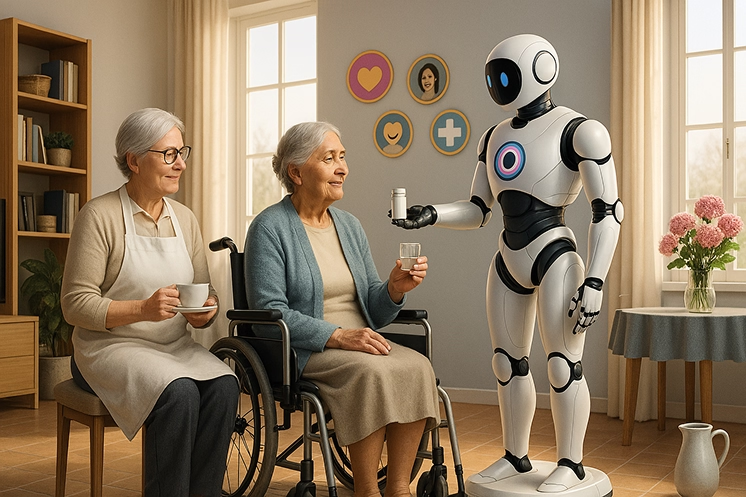
What Are Social and Companion Robots?
Social robots focus on emotional well-being — combating loneliness, stimulating conversation, and providing a sense of presence. They are the most widely deployed category in elderly care today.
Paro — the robotic baby harp seal developed in Japan — remains the gold standard in this category. Designed by AIST researcher Takanori Shibata, Paro has been used in care facilities worldwide since 2003. A 2019 review by researcher Lillian Hung at the University of British Columbia analyzed 29 studies and found three consistent benefits: reduced negative emotions and behaviors, better social engagement, and improved mood.
In one particularly striking case at Vancouver General Hospital, a dementia patient who was hitting staff and kicking lab technicians became calm after Paro was placed in his lap. He began petting the robot and talking to it, allowing medical staff to perform necessary tests. "The patient had quality care and safety, and the staff were able to get their work done," Hung reported.
Hyodol is a newer entrant from South Korea — a ChatGPT-powered doll-like robot deployed to over 12,000 elderly people living alone across the country. It uses conversational AI to chat with seniors, reminds them to take medication, and has sensors that alert social workers during emergencies. The Guro district of Seoul alone has distributed 412 units since 2019. Hyodol is preparing for a US launch in 2026, adapting its chatbot for English, Chinese, and Japanese.
ElliQ, developed by Israeli company Intuition Robotics, is deployed in apartments across New York City. Resembling a small Pixar lamp, it engages seniors in conversations about everything from daily activities to the meaning of life, and proactively initiates check-ins to combat isolation.
Ryan, built by Mohammad Mahoor at the University of Denver, is a humanoid companion specifically designed for people with early-stage dementia or depression. In a study where six older adults had around-the-clock access to Ryan for 4–6 weeks, participants reported enjoying conversations and feeling happier, though they noted it was not the same as talking to a real person.
What Are Service and Physical Assistance Robots?
Service robots help with the physical aspects of daily life — mobility support, household tasks, logistics, and rehabilitation.
Fourier GR-3 represents the cutting edge of this category. Unveiled in August 2025 as the company's first full-size "Care-bot," GR-3 stands 165 cm tall, weighs 71 kg, and has 55 degrees of freedom. What sets it apart is its Full-Perception Multimodal Interaction System, which fuses vision, audio, and tactile feedback into a real-time emotional processing engine. With 31 pressure sensors across its body, it can detect touch and respond with lifelike gestures. It uses a dual-path architecture: "fast thinking" for reflexive responses and "slow thinking" powered by a large language model for complex conversations. Fourier is targeting eldercare, rehabilitation, and service environments.
1X NEO (from 1X, formerly Halodi Robotics) is a general-purpose humanoid designed to operate in home environments. The company raised $100 million in 2025 specifically to develop robots for elder care and assistive tasks. NEO is built for everyday tasks in unstructured settings rather than factory floors.
Robotic exoskeletons from companies like Ekso Bionics and ReWalk assist elderly individuals with walking and rehabilitation. These wearable devices reduce fall risk and help maintain mobility, which is critical for independent living.
TUG robots handle hospital logistics — transporting supplies, medications, and meals — freeing nursing staff to focus on patient care.
What Are Medical Monitoring and Health Robots?
Medical assistance robots integrate health monitoring with daily care routines. They can track vital signs (heart rate, blood pressure, blood oxygen), provide medication reminders, detect falls, and transmit health data to physicians or family members in real time.
Pepper (originally by SoftBank Robotics, now owned by United Robotics Group after SoftBank sold Aldebaran in 2022) has been extensively studied in clinical settings. Researcher Arshia Khan at the University of Minnesota placed Pepper and NAO robots in eight nursing homes in Minnesota. Compared with facilities without robots, residents who interacted with them felt happier, more cared for, and less tired and frustrated.
Note: Aldebaran, the manufacturer of Pepper and NAO, filed for bankruptcy in February 2025. This development has raised questions about the future support and availability of these widely-studied robots, and highlights the business viability challenges in the care robotics space.
Comparison: Major Robots Used in Elderly Care (2026)
Real-World Deployments and Clinical Evidence
The evidence base for robots in elderly care has grown substantially. Here are the most significant real-world programs and studies:
South Korea: Hyodol National Rollout
South Korea's approach is arguably the most ambitious. Facing a demographic crisis (the world's lowest birth rate combined with rapid aging), the government has subsidized Hyodol robot deployments through municipal welfare centers. Over 12,000 units are now in the homes of elderly people living alone. Care workers in Seoul's Guro district describe the robots as "eyes and ears on the ground," alerting them to emergencies and tracking whether seniors are eating and taking medication.
The emotional impact has been profound. One elderly user told reporters: "I was going to die, but not anymore. Why would I die in such a wonderful world!" — attributing her renewed outlook to her Hyodol companion.
China: National Pilot Program (2025)
In June 2025, China's government launched a formal national elderly-care robot pilot program. The initiative requires companies and research institutes to conduct trials of at least six months, deploying a minimum of 200 robots to 200 families. For community and nursing home tests, similar scale requirements apply. Companies like Unitree Robotics, UBTech, Fourier, and AgiBot are all participating.
In Chengdu's Pacific Care Home, a humanoid robot named "Yang Yang" already wakes residents each morning, provides weather updates, and reminds them of daily activities. The Chinese government's stated goal is to address "the full life-cycle needs of elder adults, including daily care, rehabilitation, psychological support and emotional companionship."
United States: Minnesota Nursing Home Study
Arshia Khan's study at the University of Minnesota placed Pepper and NAO robots in eight nursing homes. The results were clear: compared with control facilities, residents interacting with robots felt happier, more cared for, and less frustrated. The robots led group activities including bingo, trivia, and guided conversations.
Canada: Vancouver General Hospital
Lillian Hung's research at UBC demonstrated Paro's effectiveness with dementia patients in acute care settings. Beyond the individual calming cases, her 2019 review of 29 studies confirmed consistent benefits across three domains: reduced agitation, improved social engagement, and better care experiences.
The CARESSES Trial
The CARESSES (Culture-Aware Robots and Environmental Sensor Systems for Elderly Support) randomized controlled trial tested culturally competent Pepper robots in care homes. This landmark study explored whether robots that adapt to cultural backgrounds can improve outcomes — a critical factor as care robots deploy globally across diverse populations.
How Do Humanoid Robots Benefit Elderly Care?
Combating Loneliness and Isolation
Loneliness is not just an emotional issue — it's a health crisis. Research links chronic loneliness to increased risks of dementia, heart disease, stroke, and premature death. For elderly people living alone, the absence of daily social contact can be devastating.
Social robots address this by providing consistent, judgment-free interaction. As Lillian Hung noted: "For an older person who is frail and struggles with language, the robot doesn't judge. It offers an unconditional presence. Regardless of what they say, it is always happy to listen."
While robots cannot fully replace human connection, they fill critical gaps — especially during nights, weekends, and between caregiver visits.
Reducing Caregiver Burnout
Care workers face extraordinary physical and emotional demands. Staff shortages mean longer shifts, higher patient-to-caregiver ratios, and burnout. Robots can handle routine tasks — medication reminders, activity leadership, basic health monitoring, logistics — freeing human caregivers to focus on complex, empathetic care that requires a human touch.
In South Korea, care workers reported that while Hyodol maintenance added to their workload, the psychological benefits for seniors were worth the effort. The robots acted as a force multiplier rather than a replacement.
Supporting Independent Living
Most seniors prefer to age at home rather than move to institutional care. Robots that can monitor health, remind about medications, detect falls, and facilitate communication with family members make independent living safer and more sustainable. The 1X NEO robot, for example, is specifically designed for home environments and everyday tasks in unstructured settings.
Health Monitoring and Emergency Response
Medical assistance robots provide continuous monitoring that human caregivers cannot. They can track vital signs 24/7, detect anomalies, and alert medical professionals or family members immediately. This is particularly valuable for managing chronic conditions like diabetes, hypertension, and heart disease — conditions that affect the majority of elderly adults.
What Are the Challenges Facing Robot-Assisted Elderly Care?
Cost and Accessibility
The cost barrier remains significant. Paro costs approximately $6,000 per unit. Pepper robots were $20,000–$25,000 before the manufacturer's bankruptcy. Full-size humanoid robots like Fourier's GR-3 will likely cost significantly more. For nursing homes operating on thin margins and families on fixed incomes, these prices are prohibitive without government subsidies or insurance coverage.
Some models are becoming more accessible — ElliQ costs around $250 plus $30/month — but the most capable robots remain expensive. Government pilot programs in South Korea and China are demonstrating that public funding can bridge this gap.
Privacy and Data Security
Modern care robots collect vast amounts of personal data: health metrics, daily routines, conversations, facial recognition data, and home environment information. AI-powered chatbots like Hyodol's process conversations through cloud-based systems (ChatGPT), raising questions about where that data goes and who can access it.
As ethics researcher Julie Carpenter noted: "We don't know how the data is being triangulated or gathered." For elderly users who may not fully understand AI data practices, informed consent is a serious concern.
The Human Connection Debate
This is perhaps the most profound ethical question. Gerontologist Clara Berridge at the University of Washington recalls a story about a nursing home resident who died clutching his robot companion. Students were split: some thought it was beautiful he wasn't alone; others found it tragic he died without human connection.
"If we're going to invest resources in elder care, I want more staff in the facility so they don't die alone," Berridge said. Her own grandmother died alone in an understaffed nursing home during the COVID-19 pandemic.
The research evidence supporting robots' effectiveness is still developing. While individual studies show benefits, large-scale randomized controlled trials are limited. Some researchers caution against rushing to deploy robots when the fundamental issue is understaffing and underfunding of human care.
Technical Limitations
Despite advances, creating a robot that can safely navigate a home, understand natural language reliably, and physically assist with tasks like bathing or transfers remains technically challenging. Most deployed robots today are either stationary companions (Paro, Hyodol, ElliQ) or require controlled environments. True humanoid assistants that can operate autonomously in a home setting are still in early development phases.
Manufacturer Viability
The bankruptcy of Aldebaran (maker of Pepper and NAO) in February 2025 highlighted a critical risk: the companies building care robots may not survive commercially. When a robot manufacturer goes under, support, updates, and replacement parts can disappear — leaving care facilities with expensive paperweights.
What's Coming for Elderly Care Robots in 2026 and Beyond?
Several developments will shape the near-term future of humanoid robots in elderly care:
China's national pilot results — The 2025 pilot program will generate the largest structured dataset on elderly care robot effectiveness. Results expected in 2026 will likely influence global policy.
Fourier GR-3 commercialization — Following its CES 2026 showcase, Fourier's care-centric humanoid could become the first full-size robot specifically designed and marketed for eldercare at commercial scale.
1X NEO home deployment — With $100 million in funding, 1X is positioning NEO as the first general-purpose humanoid for home use, with elder care as a primary use case.
Hyodol's US expansion — The 2026 US launch will test whether a companion robot designed for Korean culture can succeed in Western markets.
LLM-powered interaction — The integration of large language models (like ChatGPT) into care robots is dramatically improving conversational ability. Robots are becoming better listeners, more contextually aware, and more engaging in conversation.
Government policy expansion — Following South Korea and China's lead, more nations are expected to develop formal policies and funding mechanisms for care robotics. The eldercare robot market is projected to reach $7.7 billion by 2030 and $12.2 billion by 2033.
January 2026: CES and New Entrants
Several major developments emerged at CES 2026 in January:
- Mind With Heart Robotics showcased its An'An Panda Cub Robot — a CES 2026 Innovation Award Honoree — designed specifically for loneliness and elderly care. Made with premium Australian wool and featuring 10+ full-body tactile sensors, An'An represents a new wave of biomimetic companion robots that mimic natural animal movements to provide emotional comfort.
- Japan's Moonshot AIREC Robot — Funded by the Japan Science and Technology Agency and powered by NVIDIA, the AIREC (AI-Driven Robot for Embrace and Care) project is developing robots capable of physical caregiving tasks including changing diapers, bath assistance, and meal support. Professor Tetsuya Ogata of Waseda University noted that generative AI breakthroughs have made what seemed impossible five years ago now "seriously possible."
- Fourier GR-3 made its formal CES 2026 debut, positioning itself as the most capable full-size humanoid specifically targeting eldercare, rehabilitation, and service environments.
How Do I Choose a Care Robot for an Elderly Family Member?
If you're considering a care robot for an elderly loved one, here's what to evaluate:
- Identify the primary need — Is it companionship (Paro, Hyodol, ElliQ), physical assistance (exoskeletons, future humanoids), or health monitoring (medical robots)?
- Assess tech comfort level — Simpler robots like Paro require zero technical skill. Chatbot-based robots need basic voice interaction. Full humanoids will require more setup.
- Check ongoing costs — Beyond purchase price, some robots have subscription fees (ElliQ: $30/month) or may need software updates and maintenance.
- Evaluate privacy policies — Understand what data the robot collects, where it's stored, and who has access. This is especially important for AI-powered chatbot robots.
- Consider the care environment — A nursing home may benefit from an interactive humanoid like Pepper for group activities. A solo-living senior may prefer a personal companion like Hyodol or ElliQ.
- Don't replace human contact — Robots should supplement, not substitute, visits from family, friends, and professional caregivers.
Frequently Asked Questions
What are the best humanoid robots for elderly care in 2026?
The most effective robots currently deployed in elderly care include Paro (a therapeutic seal robot used globally since 2003), Hyodol (a ChatGPT-powered companion doll with 12,000+ deployments in South Korea), ElliQ (a proactive AI companion used in New York), and Pepper/NAO (humanoid robots used in clinical research, though the manufacturer filed for bankruptcy in 2025). New entrants like Fourier's GR-3 Care-bot and 1X NEO are designed specifically for eldercare and home assistance.
How much do elderly care robots cost?
Costs vary dramatically by robot type. Paro costs approximately $6,000. ElliQ is around $250 plus $30/month subscription. Pepper robots were $20,000–$25,000 before Aldebaran's bankruptcy. Full-size humanoid robots like Fourier GR-3 and 1X NEO have not yet announced consumer pricing but are expected to cost significantly more. Government subsidies in South Korea and China have made companion robots available to elderly citizens at no personal cost.
Can robots actually reduce loneliness in elderly people?
Clinical evidence says yes, with caveats. A review of 29 studies of Paro found consistent improvements in mood, social engagement, and reduced negative behaviors. Studies of Pepper and NAO in Minnesota nursing homes showed residents felt happier and more cared for. However, participants in a Ryan robot study noted the experience was "not the same as talking to a real person." Robots are most effective as supplements to — not replacements for — human social interaction.
Are elderly care robots safe to use?
Companion robots like Paro, Hyodol, and ElliQ are designed with safety as a primary concern — they are lightweight, have no sharp edges, and do not move autonomously through the environment. Full-size humanoid robots like GR-3 incorporate extensive safety systems including compliant actuators and force-sensing. The primary safety concerns are around data privacy (what personal information is collected and how it's used) rather than physical harm.
What is China's elderly care robot pilot program?
In June 2025, China launched a national pilot program requiring companies and research institutes to deploy at least 200 robots to 200 families for trial periods of six months or more. The program addresses "the full life-cycle needs of elder adults, including daily care, rehabilitation, psychological support and emotional companionship." Major Chinese robotics firms including Unitree, UBTech, Fourier, and AgiBot are participating.
Will humanoid robots replace human caregivers?
No — and that's not their intended purpose. Every researcher and developer interviewed consistently positions robots as supplements to human care, not replacements. Robots handle routine tasks (medication reminders, basic monitoring, companionship during off-hours) so human caregivers can focus on complex, empathetic care. The fundamental problem is that there aren't enough human caregivers to meet demand, and robots help bridge that gap.
Related: Humanoid Robots in Healthcare: How They Will Revolutionize The Industry · Applications of Humanoid Robots
Ready to buy? Browse humanoid robots for sale on Robozaps.
Humanoid robots in disaster response: search & rescue, hazardous operations & emergency applications. Real capabilities, deployments & future.
Humanoid robots in disaster response are transforming how emergency teams save lives in the world's most dangerous environments. From the rubble of earthquake zones to radiation-contaminated nuclear facilities, humanoid robots and other search and rescue robots now operate where humans simply cannot survive. In 2026, with the search and rescue robotics market valued at over $27 billion and projected to reach $70 billion by 2030, this technology has moved decisively from laboratory curiosity to operational necessity. This guide covers every major search and rescue robot type, real deployment case studies, the humanoid robots purpose-built for disaster scenarios, the technologies enabling autonomous rescue, and where the field is heading next.
Key Takeaways
- Search and rescue robots have been deployed in real disasters since 2001 (9/11 World Trade Center), with over 50 documented deployments through 2025 according to the Center for Robot-Assisted Search and Rescue (CRASAR).
- The search and rescue robotics market reached $27.86 billion in 2025 and is projected to hit $70.33 billion by 2030 (14.79% CAGR), driven by quadrupling natural disaster frequency since 1970 and rapid advances in AI autonomy.
- Key robot categories include ground crawlers (snake robots, tracked vehicles), aerial drones (thermal imaging, 3D mapping), aquatic robots (flood rescue, underwater search), quadrupeds (terrain traversal), and humanoid robots (door/valve operation, tool use, stair climbing).
- The 2015 DARPA Robotics Challenge — an $80 million U.S. government program — proved humanoid robots could drive vehicles, traverse rubble, open doors, turn valves, and cut through walls. Team KAIST's DRC-HUBO won by completing all 8 tasks in 44 minutes 28 seconds.
- Purpose-built disaster humanoids include IIT's WALK-MAN (1.85 m, 102 kg, 33 DoF), the Centauro hybrid (1.5 m, 93 kg, wheel-legged), and Boston Dynamics Atlas — each designed for different rescue scenarios.
- Major challenges remain: battery life limits most robots to 1–4 hours of operation, wireless communication fails inside collapsed structures, and robots still require human supervision for complex life-or-death decisions.
History of Robotics for Search and Rescue
The field of robotics for search and rescue traces its origins to two devastating events in 1995: the Oklahoma City bombing (April 19, 1995, 168 killed) and the Great Hanshin-Awaji earthquake in Kobe, Japan (January 17, 1995, 6,434 killed). Both disasters exposed critical gaps in human rescuers' ability to reach trapped survivors inside collapsed structures — gaps that machines could potentially fill.
Robin Murphy, a computer science professor who later founded the Center for Robot-Assisted Search and Rescue (CRASAR) at Texas A&M University, responded to these tragedies by launching systematic research into deploying robots in disaster zones. Her pioneering work, including deploying the first robots at Ground Zero on September 11, 2001, established the scientific and operational foundation for the entire field of disaster robotics.
Timeline: Key Milestones in Search and Rescue Robotics
The DARPA Robotics Challenge: Proving Humanoid Robots in Disaster Scenarios
The DARPA Robotics Challenge (DRC), running from 2012 to 2015, was the single most important event in proving that humanoid robots could perform disaster response tasks. The U.S. Department of Defense invested $80 million to challenge international teams to build robots capable of operating in environments too dangerous for humans — specifically modeled on the Fukushima nuclear disaster, where human rescuers couldn't enter reactor buildings.
DRC Task Requirements
Each robot had to complete 8 sequential tasks within 60 minutes:
- Drive a vehicle — get in, drive through an obstacle course, get out
- Walk across rubble — traverse uneven, debris-strewn terrain on foot
- Open a door — approach, turn handle, push through a standard door
- Turn a valve — locate and rotate an industrial shut-off valve
- Cut through a wall — use a power tool to breach drywall
- Surprise task — previously unknown manipulation challenge
- Climb stairs — ascend a standard staircase
- Cross uneven terrain — navigate a final rough terrain obstacle
Communication was deliberately degraded to simulate real disaster conditions — robots experienced intermittent signal loss and had to maintain partial autonomy when their operators lost contact.
DRC Finals Results (June 2015)
Why DRC-HUBO won: Team KAIST's breakthrough was a transforming locomotion system. DRC-HUBO could walk upright like a human on two legs and also kneel down to roll on wheels built into its knees and feet. This dual-mode approach meant the robot could walk when it needed to (stairs, rubble) but roll quickly and stably when conditions allowed — dramatically reducing the risk of falling, which plagued many competing robots during the challenge.
Humanoid Robots Built for Disaster Response
Several humanoid and humanoid-hybrid robots have been purpose-designed for disaster scenarios. Unlike warehouse or factory humanoids, these machines prioritize ruggedness, manipulation strength, and the ability to operate in degraded environments.
Comparison: Disaster-Response Humanoid Robots
Boston Dynamics Atlas
Atlas is the most recognizable disaster-response humanoid in the world. Originally developed for the DARPA Robotics Challenge in 2013, the hydraulic Atlas (1.8 m, 150 kg) served as the reference platform for 7 DRC teams. Its capabilities included walking over rough terrain, opening doors, turning valves, climbing stairs, and manipulating heavy objects — all core disaster response tasks.
In 2024, Boston Dynamics unveiled the fully electric Atlas — a redesigned humanoid standing 1.5 m and weighing 89 kg, with improved agility, stronger electric actuators, and AI-powered motion planning. While the electric Atlas is currently deployed at Hyundai manufacturing facilities for logistics tasks, its disaster-response lineage makes it a prime candidate for future emergency deployment. The robot's ability to perform parkour, backflips, and recover from falls demonstrates the dynamic balance needed to navigate rubble fields.
IIT WALK-MAN
Developed by the Istituto Italiano di Tecnologia (IIT) in collaboration with the University of Pisa, WALK-MAN is a full-size humanoid (1.85 m, 102 kg, 33 degrees of freedom) built explicitly for disaster response. What makes WALK-MAN unique is its biomorphic 19-degree-of-freedom hands, developed with the University of Pisa, that can robustly grasp a wide variety of objects — from door handles to fire extinguishers to industrial valves.
In its most significant validation test, conducted in collaboration with the Italian Civil Protection agency (Protezione Civile), WALK-MAN navigated a simulated earthquake-damaged industrial plant and completed four sequential tasks:
- Opened a heavy door and traversed the entry
- Located a gas valve and closed it to stop a simulated leak
- Removed debris blocking its path
- Identified a fire and activated a fire extinguisher
The arms are strong enough to carry 10 kg loads for more than 10 minutes continuously — critical for tasks like hauling fire extinguishers, clearing rubble, or carrying survivor-detection equipment.
IIT Centauro
Rather than building another bipedal humanoid, IIT took a different approach with Centauro — a hybrid robot with a human-like upper body mounted on a four-legged, wheeled base. Standing 1.5 m tall with a shoulder width of 65 cm and weighing 93 kg, Centauro is constructed from aluminum, magnesium, and titanium alloys with 3D-printed plastic covers for rapid prototyping and field repairability.
The centaur design solves one of the biggest problems in disaster robotics: bipedal robots frequently fall. Centauro's four-legged base with wheels at each foot provides extreme stability while still allowing it to navigate stairs, rubble, and uneven terrain. Its 42 degrees of freedom give it manipulation capabilities that far exceed those of tracked or wheeled robots, and its arm kinematics are specifically optimized for strength and reach in disaster-relevant tasks.
KAIST DRC-HUBO
The $2 million DARPA Robotics Challenge winner, DRC-HUBO (1.47 m, 80 kg, 32 DoF) from South Korea's KAIST, introduced the concept of transforming locomotion to disaster robotics. The robot's revolutionary design allows it to walk upright on two legs for tasks requiring human-like mobility (stairs, doors) and then drop to its knees to roll on integrated wheels for fast, stable traversal of flat surfaces.
This approach directly addressed the single biggest failure mode in the DRC: falling. While competitors tumbled repeatedly, DRC-HUBO completed all 8 disaster tasks without a fall, finishing in 44 minutes and 28 seconds — the fastest of the three perfect-scoring teams. Professor Jun Ho Oh's team at KAIST demonstrated that solving disaster robotics may require abandoning strict human mimicry in favor of practical engineering solutions.
All Types of Search and Rescue Robots
Humanoid robots in disaster response are one part of a broader ecosystem. Effective robotics in disaster recovery deploys multiple robot types, each optimized for specific aspects of rescue operations:
Ground Crawlers and Snake Robots
These are the most commonly deployed search and rescue robots because they access spaces no human or conventional machine can reach:
- CMU Snakebot: Developed by Professor Howie Choset at Carnegie Mellon University's Robotics Institute. Features 16+ articulated joints, head-mounted camera with LED illumination, distance-measuring laser, and the ability to crawl through pipes, gaps in rubble, and along poles. Deployed in the 2017 Mexico City earthquake to search collapsed buildings.
- MIT SPROUT (2025): A flexible, vine-like robot built by MIT Lincoln Laboratory and Notre Dame researchers. Grows by inflating a tube-like body, navigating through tight spaces in rubble. Equipped with sensors to map the environment and relay 3D data to rescue commanders. Designed specifically for post-earthquake and building-collapse scenarios.
- Quince (Japan): Developed by Chiba Institute of Technology. Tracked robot with radiation sensors deployed inside the Fukushima Daiichi nuclear plant in 2011 to measure radiation levels in areas where human exposure would be lethal within minutes.
Aerial Drones for Disaster Response
Drones are now standard equipment for disaster response teams worldwide, providing the fastest situational awareness of any robotic platform:
- Teledyne FLIR SkyRanger: Launches in under 3 minutes, carries infrared and daylight cameras for detecting human heat signatures in rubble or wilderness. Used by military and emergency response teams globally.
- DJI Matrice 350 RTK: The most widely deployed disaster response drone platform. Used for post-earthquake damage mapping, flood extent assessment, and wildfire monitoring. DJI's thermal cameras detect humans at distances exceeding 100 meters through smoke and dust.
- Lockheed Martin K-MAX: Autonomous heavy-lift helicopter with 2,700 kg (6,000 lb) cargo capacity. Delivers supplies, humanitarian aid, and firefighting water to inaccessible locations. Proven in wildfire suppression and military logistics.
Aquatic and Amphibious Rescue Robots
- Hydronalix EMILY: 4-foot, 26-lb remote-controlled flotation robot. Speeds up to 23 mph. Rescued 240+ refugees off the Greek coast during the 2016 European migrant crisis in its first 10 days of deployment. Carries up to 5 people. Kevlar-reinforced hull withstands heavy waves. Co-developed by U.S. Office of Naval Research.
- Pliant Energy Velox: Amphibious robot using undulating silicone fins for propulsion. Swims through water, skates on ice, and pushes through snow — ideal for cold-water rescues where ice conditions prevent human approach.
- VideoRay ROV: Remote-operated submersible with multi-beam sonar imaging, GPS, high-power lights, and video. Used by law enforcement and rescue teams for underwater search and recovery in lakes, rivers, and harbors.
Firefighting Robots
- Shark Robotics Colossus: 500 kg tracked firefighting robot. Pumps 660 gallons of water per minute. Fireproof construction with 360° HD thermal camera. Saved Notre-Dame Cathedral in 2019 — Paris Fire Brigade Commander Jean-Claude Gallet credited Colossus with saving his crew's lives when conditions became too dangerous for human firefighters.
- Howe & Howe Thermite RS1/RS3: 24-HP diesel-powered firefighting robots on industrial tank treads. Climb slopes up to 70 degrees. Blast 2,500 gallons of water and foam per minute. Purpose-built for industrial fires: oil refinery blazes, HAZMAT incidents, and BLEVEs (boiling liquid expanding vapor explosions).
Quadruped Robots
- Boston Dynamics Spot: The most commercially deployed inspection robot ($75,000). 14 kg payload, 90-minute battery, autonomous navigation. Used by utilities, construction firms, and nuclear facilities for hazardous environment inspection. Equipped with gas detectors, thermal cameras, and radiation sensors for disaster assessment.
- DEEP Robotics Jueying X20: Quadruped with 85 kg (187 lb) working load, autonomous navigation, and ability to climb 35-degree slopes. Carries oxygen tanks and emergency equipment. Full IP-rated for extreme weather operations.
Master Comparison: Search and Rescue Robots by Type
For more on humanoid robot capabilities across industries, see our guide to the best humanoid robots in 2026 and our applications of humanoid robots overview.
Key Technologies Powering Search and Rescue Robots
AI and Machine Learning for Autonomous Navigation
Modern rescue robots use deep learning for real-time obstacle avoidance, path planning, and terrain classification. Reinforcement learning — the same technique used to train humanoid robots like the Unitree G1 to walk — enables rescue robots to navigate rubble fields they've never encountered before. The AI processes LiDAR point clouds, depth camera feeds, and IMU data to build 3D maps and plan safe routes in real time.
The latest foundation models for robotics — including Google DeepMind's RT-2, Figure AI's Helix, and NVIDIA's GR00T — represent a paradigm shift. These vision-language-action models enable robots to understand natural language commands from rescue workers ("go through that doorway and check the room on the left") and execute complex multi-step tasks autonomously. In disaster scenarios where communication with operators is intermittent, this capability is transformative.
Thermal and Biological Sensors
Finding survivors is the core mission. Modern search and rescue robots deploy multiple sensor modalities simultaneously to maximize detection probability:
- Thermal cameras (LWIR): Detect body heat through dust, smoke, and total darkness. Effective range exceeds 100 meters for human-sized targets. The temperature differential between a living human and surrounding rubble is detectable even hours after burial.
- CO₂ sensors: Detect elevated carbon dioxide concentrations indicating breathing humans trapped under debris. More reliable than thermal in deep-burial scenarios where thermal radiation is blocked.
- Acoustic sensors / microphones: Ultra-sensitive audio sensors detect tapping, voices, breathing, or heartbeat sounds from survivors buried under meters of rubble.
- LiDAR (3D mapping): Creates precise three-dimensional maps of collapsed structures, identifying voids where survivors may be trapped and planning safe routes for human rescue teams.
- Gas detectors: Identify hazardous gas leaks (methane, CO, hydrogen sulfide, chlorine) that endanger both survivors and rescuers. Critical in industrial disaster and post-earthquake gas line rupture scenarios.
- Ground-penetrating radar: Experimental but promising for detecting human bodies and voids through concrete and steel — effective at depths up to several meters.
Communication Systems for Denied Environments
One of the biggest unsolved challenges in robotics for search and rescue is maintaining communication inside collapsed buildings where GPS, cellular, and radio signals are blocked by concrete and steel. The DARPA Robotics Challenge deliberately degraded communications to force teams to build partially autonomous robots. Current and emerging solutions include:
- Mesh networking: Multiple robots create ad-hoc wireless networks, relaying data through each other to reach external operators. Each robot serves as a communication node.
- Fiber-optic tethers: Physical cables providing guaranteed bandwidth for video and control signals — proven in nuclear facilities like Fukushima but limiting robot range.
- Acoustic communication: Sound-based data transmission through solid structures — experimental but promising for reaching deeply buried robots.
- Drone relay stations: Aerial robots hovering above collapsed buildings relay ground robot signals to command centers, bridging the communication gap between buried robots and surface operators.
- Edge computing / onboard autonomy: Rather than relying on communication, next-generation robots process data and make decisions onboard using AI chips, only transmitting results when a link becomes available.
Real Disaster Deployments: Case Studies
Fukushima Nuclear Disaster (2011) — The Most Extensive Robot Deployment in History
The March 11, 2011 earthquake and tsunami triggered the worst nuclear disaster since Chernobyl. Human entry into the Fukushima Daiichi reactor buildings was impossible — radiation levels exceeded 10 sieverts per hour (lethal within minutes of exposure). This became the most extensive deployment of robotics in disaster recovery ever documented.
iRobot deployed its PackBot (31 kg tracked robot) and Warrior (136 kg heavy-duty platform) to:
- Measure radiation levels inside reactor buildings 1, 2, and 3
- Transmit video footage of structural damage to TEPCO engineers planning decommissioning
- Clear small debris to create pathways for larger decontamination equipment
Japan's Quince robot, developed by Chiba Institute of Technology, later entered areas even PackBot couldn't reach, mapping radiation distribution across multiple floors. Over the following decade, more than 30 different robot models were deployed in the ongoing Fukushima cleanup — including swimming robots to inspect flooded reactor containment vessels and remote-controlled demolition machines to remove melted fuel debris. The Fukushima experience proved that robotics isn't just helpful in nuclear disasters — it's the only option.
Notre-Dame Cathedral Fire (2019) — Robot Saves an 800-Year-Old Landmark
When fire engulfed Notre-Dame Cathedral on April 15, 2019, the Paris Fire Brigade (Brigade de Sapeurs-Pompiers de Paris) faced an impossible situation. The cathedral's medieval wooden roof was fully ablaze, structural collapse was imminent, and entering the building risked both firefighter lives and the loss of an irreplaceable cultural treasure.
Shark Robotics' Colossus — a 500 kg tracked firefighting robot — was deployed to:
- Spray water directly at the fire's hottest points from inside the cathedral nave
- Use its 360° HD thermal camera to identify hidden fire pockets within the stone and wood structure
- Transport firefighting hoses and equipment through areas where structural collapse made human entry suicidal
Brigade Commander Jean-Claude Gallet stated publicly that Colossus saved his firefighters' lives. The incident was a watershed moment for disaster robotics — not experimental, not theoretical, but a real robot saving real lives and an 800-year-old monument in real time.
Turkey-Syria Earthquake (2023) — Robotics at Scale
The February 6, 2023 earthquake (magnitude 7.8) killed over 50,000 people and damaged more than 160,000 buildings across southeastern Turkey and northern Syria. Multiple robot teams deployed within hours:
- Thermal imaging drones identified heat signatures in collapsed buildings, directing rescue crews to buried survivors
- Mapping drones created 3D photogrammetric models of destroyed urban areas, helping commanders prioritize search zones
- Ground robots assessed structural stability of partially collapsed buildings before sending human teams inside
- Social media AI tools accelerated coordination of international rescue efforts
The deployment highlighted both the potential and limitations of rescue robotics at scale. While drones proved effective for rapid aerial assessment, the sheer scale of destruction overwhelmed available robotic resources. The disaster reinforced the need for cheaper, more numerous rescue robots — driving renewed interest in swarm robotics and low-cost drone fleets.
WALK-MAN Disaster Scenario Test (2016) — Humanoid Proves Concept
In a collaboration with Italy's Protezione Civile (Civil Protection), IIT staged a realistic disaster scenario in its Genoa laboratories: a simulated earthquake-damaged industrial plant with gas leaks, fire, and blocked corridors. WALK-MAN successfully:
- Opened a heavy industrial door and traversed the entry autonomously
- Located and closed a gas shut-off valve to stop the simulated leak
- Cleared debris from its path using its 19-DoF manipulator hands
- Identified the fire source and activated a CO₂ fire extinguisher
While performed in a controlled laboratory setting, this test validated that a full-size humanoid robot could perform the complete chain of tasks required in a real industrial disaster — a significant milestone for humanoid robots in disaster response.
Challenges Facing Robotics in Disaster Recovery
Battery Life and Endurance
Most rescue robots operate for 1–4 hours before requiring recharge or battery swap. In disaster scenarios where operations continue for days or weeks, this remains the single most limiting factor. Current and emerging solutions include:
- Hot-swappable battery systems (available on robots like the Unitree G1 with 30-second battery swaps)
- Deployable solar charging stations for forward operating bases
- Hydrogen fuel cells extending operation to 8+ hours
- Wireless charging pads at staging areas for autonomous recharge cycles
- Tethered power delivery for stationary or semi-stationary operations
Terrain Adaptability and Robustness
Disaster environments are inherently unpredictable — rubble fields with unstable footing, flooded basements, extreme heat from fires, toxic atmospheres from chemical spills, and structures threatening secondary collapse. No single robot design handles all conditions. The current best practice deploys mixed robot teams (drones for aerial recon, quadrupeds for terrain traversal, snake robots for confined spaces, humanoids for manipulation) coordinated from a single command post.
Communication in Collapsed Structures
Inside collapsed buildings, wireless signals attenuate rapidly through concrete and steel rebar. GPS doesn't work underground. Maintaining reliable two-way communication between buried robots and surface operators remains one of the biggest unsolved problems — and the reason why increasing onboard autonomy is critical for next-generation rescue robots.
Cost and Accessibility
Advanced rescue robots remain expensive. Boston Dynamics' Spot costs $75,000 and Atlas is not commercially available. The Colossus firefighting robot costs well over $100,000. These prices put advanced robotics out of reach for most local fire departments and emergency agencies worldwide. However, more affordable options are emerging — the Unitree G1 starting at $16,000, consumer drones under $5,000, and open-source robot platforms are beginning to democratize basic robotic capabilities. See our humanoid robot cost guide for current pricing across all platforms.
Regulatory and Operational Integration
Even when robots are available and capable, integrating them into existing emergency response workflows is challenging. First responders need training. Radio frequencies must be coordinated. Liability questions arise when robots make autonomous decisions in life-or-death scenarios. Organizations like CRASAR and NIST's Engineering Laboratory are developing standard protocols for robot-assisted search and rescue to address these operational gaps.
The Future of Search and Rescue Robots
Swarm Robotics for Large-Scale Disasters
Instead of deploying one expensive robot, future disasters may see swarms of dozens or hundreds of small, cheap robots collectively searching large areas. The Zebro project at TU Delft has demonstrated swarming algorithms where robots autonomously coordinate to cover earthquake-damaged areas, sharing map data in real time. Each robot is expendable — if one gets stuck in rubble, the swarm continues without interruption. This approach directly addresses the scale problem exposed by the Turkey-Syria earthquake.
AI-Powered Full Autonomy
Current rescue robots mostly require human operators via remote control or teleoperation. Next-generation systems will operate with full autonomy — entering a collapsed building, navigating to search zones, identifying survivors using multi-modal sensors, and reporting back without constant human guidance. The AI breakthroughs powering companies like Figure AI, Google DeepMind's robotics division, and NVIDIA's Project GR00T are building the foundation models that will enable this level of autonomous disaster response.
Humanoid Robots as First Responders
As humanoid robots mature — Boston Dynamics Atlas, Apptronik Apollo, Tesla Optimus, Unitree H1, and DEEP Robotics DR02 — their ability to navigate human-built environments makes them natural candidates for disaster deployment. A humanoid can open doors, climb stairs, turn valves, operate elevators, and use human tools — capabilities that specialized crawlers and drones fundamentally lack. The latest humanoid robots of 2026 are approaching the dexterity, battery life, and robustness needed for real disaster missions.
CES 2026 showcased 9 humanoid robots from companies already shipping or deploying units, including models designed for all-weather outdoor operation (DEEP Robotics DR02 with full IP66 protection). The convergence of rugged hardware, AI autonomy, and declining costs suggests humanoid first responders may be operational within this decade.
Integration with Smart Building Infrastructure
Future disaster response will leverage IoT-connected building sensor networks. Smart buildings could automatically transmit floor plans, structural load sensor data, fire detection locations, and last-known occupant positions directly to rescue robot AI systems — dramatically accelerating search operations. Building Information Modeling (BIM) data, already standard in new construction, provides the 3D maps robots need to navigate efficiently.
Soft Robotics and Bio-Inspired Design
The next frontier includes soft robots that can squeeze through gaps rigid robots cannot, inspired by organisms like octopi and worms. MIT's SPROUT vine robot is an early example. Researchers are also developing robots with gecko-inspired adhesive feet for climbing walls in damaged buildings, and snake robots with force-sensitive skins that can detect survivors through touch.
Frequently Asked Questions
What robots are used for search and rescue?
Search and rescue operations use multiple robot types: ground crawlers and snake robots (CMU Snakebot, MIT SPROUT) for navigating rubble and pipes; aerial drones (DJI Matrice 350, FLIR SkyRanger) for thermal imaging and mapping; aquatic robots (Hydronalix EMILY, VideoRay ROV) for water rescue; tracked firefighting robots (Shark Robotics Colossus, Howe & Howe Thermite RS3); humanoid robots (Boston Dynamics Atlas, IIT WALK-MAN) for operating in human-built environments; and quadruped robots (Boston Dynamics Spot, DEEP Robotics Jueying X20) for rough terrain inspection.
How are humanoid robots used in disaster response?
Humanoid robots in disaster response perform tasks that require human-like body configuration: opening doors, climbing stairs, turning industrial valves, operating power tools, clearing debris, and navigating hallways. The DARPA Robotics Challenge proved humanoid robots could drive vehicles, walk over rubble, breach walls, and shut off valves — all tasks needed in real disaster scenarios. IIT's WALK-MAN successfully completed a full disaster scenario including gas valve shutoff and fire extinguisher activation in a test validated by Italian Civil Protection.
What was the DARPA Robotics Challenge?
The DARPA Robotics Challenge (2012–2015) was an $80 million U.S. Department of Defense competition that challenged 25 international teams to build robots capable of performing disaster response tasks. Inspired by the Fukushima nuclear disaster, the competition required robots to drive vehicles, traverse rubble, open doors, turn valves, cut through walls, and climb stairs. Team KAIST from South Korea won the $2 million grand prize with their DRC-HUBO robot, which completed all 8 tasks in 44 minutes 28 seconds using a unique walk-and-roll transformation system.
What are the limitations of search and rescue robots?
Key limitations include: battery life of 1–4 hours for most platforms; communication failure inside collapsed structures where GPS and radio are blocked; limited terrain adaptability (no single robot handles all disaster environments); high cost ($10,000–$500,000+) putting advanced robots out of reach for many agencies; need for specially trained operators; difficulty functioning in extreme temperatures, deep water, or toxic atmospheres; and inability to make complex moral or judgment-based decisions without human oversight.
How much do rescue robots cost?
Costs span a wide range: consumer drones adapted for search use cost under $5,000; specialized ground crawlers and snake robots run $10,000–$50,000; Boston Dynamics Spot is $75,000; tracked firefighting robots like Colossus exceed $100,000; and advanced humanoid platforms are estimated at $500,000+. More affordable humanoid options are emerging — the Unitree G1 starts at $16,000. See our humanoid robot cost guide for detailed pricing.
What was the first search and rescue robot deployment?
The first documented deployment of robots in a real disaster was at the World Trade Center collapse on September 11, 2001. CRASAR founder Robin Murphy led the deployment of small ground robots that searched through rubble for survivors and victims over a 10-day period. This operation proved the concept of rescue robotics and catalyzed billions of dollars in subsequent research, development, and government funding — including the DARPA Robotics Challenge.
Related: Humanoid Robots in Military and Defense · Applications of Humanoid Robots · Best Humanoid Robots 2026 · Humanoid Robot Cost Guide
Ready to explore humanoid robots? Browse humanoid robots for sale on Robozaps.
Get the latest robotics news delivered to your inbox
Improve your crypto earnings automatically. Use Robozaps to compare rates and rewards.