
See all articles
Apptronik Apollo review: NASA-backed humanoid robot specs, pricing & real-world capabilities. Now backed by $935M Series A (Google + Mercedes-Benz) at a $5B valuation. Is this the enterprise robot to beat? Find out.
🔔 Breaking: Feb 11, 2026 Funding Update
Apptronik just raised $520 million at a $5.5 billion valuation—a 3x increase from their previous round. Lead backers include Google and Mercedes-Benz, both of whom are actively testing Apollo robots in Mercedes-Benz factories and GXO Logistics warehouses. With Tesla committing $20B in 2026 capex for Optimus production, the humanoid robot race is heating up—but Apollo's commercial deployments may give Apptronik the edge to reach enterprise scale first.
The Apptronik Apollo is one of the most commercially advanced humanoid robots on the market in 2026. Backed by over $520 million in its latest funding round from Google, Mercedes-Benz, and previous investors—and now valued at $5.5 billion—Apollo has moved beyond the prototype stage into real factory floors with some of the world's biggest manufacturers.
In this comprehensive Apptronik Apollo review, we break down every detail that matters: verified specs, real-world deployment results, AI capabilities, pricing, and how it stacks up against competitors like the Figure 02 and Tesla Optimus. Whether you're evaluating humanoid robots for your warehouse, manufacturing line, or logistics operation, this is the most thorough analysis you'll find.
Apptronik Apollo at a Glance: Key Specs Summary
Before diving deep, here's a quick snapshot of what Apollo brings to the table:
Company Background: Who Is Apptronik?
Apptronik was founded in 2016 by Jeffrey Cardenas and Nicholas Paine (with Luis Sentis as advisor), all alumni of the Human Centered Robotics Laboratory at the University of Texas at Austin. The company has deep roots in advanced robotics—notably, key team members previously worked on NASA's Valkyrie humanoid robot while at UT Austin, giving them rare expertise in full-size bipedal systems.
Before Apollo, Apptronik built over 10 previous robot platforms, iterating on locomotion, manipulation, and human-robot interaction. That experience culminated in Apollo, which was publicly unveiled in August 2023 as the company's first commercial-grade humanoid.
The company's trajectory accelerated dramatically in 2025:
- February 2025: Raised $350 million Series A co-led by B Capital and Capital Factory, with participation from Google
- March 2025: Closed additional funding bringing the total Series A to $415 million, with Mercedes-Benz, Japan Post Capital, and ARK Invest joining
- November 2025: Valuation reached $5 billion following a new funding round
- March 2026: Raised $520 million at $5.5 billion valuation, with Google and Mercedes-Benz as lead backers
- Total funding in 14 months: Over $1 billion
This makes Apptronik one of the best-funded humanoid robotics companies on Earth, alongside Figure AI and Tesla's Optimus program.
Design and Build Quality
Aesthetics That Work in a Factory
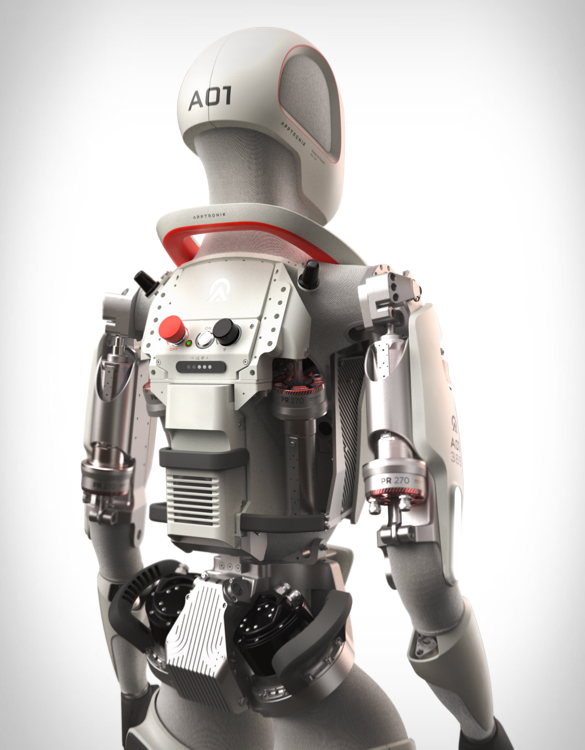
Apollo's design philosophy is deliberately approachable. Unlike the dark, industrial look of many competitors, Apollo features a bright white and grey shell with soft curves and expressive LED eyes. TechCrunch's Brian Heater described it as "bright and almost cartoony, with a pair of big eyes and a head shape that brings back warm memories of early iMacs."
This isn't just cosmetic. In manufacturing environments where humans and robots work side by side, an approachable design reduces worker anxiety and friction during adoption. Apptronik collaborated with design firm Argo to create Apollo's face, which uses LED expressions to communicate status, mood, and feedback to nearby workers.
Human-Scale Proportions
At 5'8" and 160 lbs, Apollo deliberately mirrors the proportions of an average adult human. This means it can navigate spaces designed for people—doorways, aisles, workstations, staircases—without requiring facility modifications. This is a critical advantage over specialized industrial robots that often need custom infrastructure.
Modular Architecture
One of Apollo's most underrated features is its modular platform design. The humanoid upper body can be combined with different bases:
- Bipedal legs – Full mobility for dynamic environments
- Wheeled base – Faster, more efficient for flat warehouse floors
- Stationary pedestal – Fixed workstation applications
This modularity lets businesses customize Apollo for their specific use case without buying entirely different robots. A logistics company might deploy the wheeled version for efficiency, while a manufacturing plant could use the bipedal version for navigating complex floor layouts.
Interactive Chest Display
Apollo features a touch-enabled display on its chest that shows identity, operating mode, current task, battery level, and system status. This provides at-a-glance information for workers nearby and enables quick configuration changes without needing a separate computer terminal.
Hardware and Specifications Deep Dive
Proprietary Linear Actuators
Apollo's most significant engineering innovation is its use of proprietary electric linear actuators instead of conventional rotary joints and motors. This design choice delivers several advantages:
- Reduced mechanical complexity – Fewer gears and transmission components mean fewer points of failure
- Improved efficiency – Direct linear motion translates force more efficiently for lifting and pushing tasks
- Lower cost at scale – Simpler mechanisms are easier and cheaper to mass-manufacture
- Better force control – Enables more precise and compliant movements for safe human interaction
With 71 degrees of freedom across its entire body, Apollo achieves impressive dexterity. For context, the human body has approximately 244 degrees of freedom, while most competing humanoids offer 30-50.
Hot-Swappable Battery System
Apollo's battery system is one of its strongest practical features. Each battery pack delivers approximately 4 hours of continuous operation. Critically, the batteries are hot-swappable—a worker or automated station can replace a depleted battery in minutes without shutting down the robot.
This means Apollo can theoretically operate up to 22 hours per day (with brief battery swap intervals), compared to competitors that require extended plug-in charging cycles. For 24/7 manufacturing operations, this translates directly to higher utilization and ROI.
Payload and Manipulation
Apollo's 55 lb (25 kg) payload capacity is among the highest in the current humanoid robot landscape. For context:
This payload is sufficient for the vast majority of warehouse and logistics tasks—picking up totes, moving boxes, handling assembly kits, and palletizing smaller items.
Compute Platform
Apollo runs on dual NVIDIA compute modules:
- NVIDIA Jetson AGX Orin – 275 TOPS of AI performance for primary decision-making and perception
- NVIDIA Jetson Orin NX – Secondary module for sensor fusion and real-time control
This combination provides the processing power needed for real-time environment mapping, object recognition, path planning, and the execution of learned behaviors from NVIDIA's GR00T foundation models.
AI and Software Capabilities
NVIDIA Project GR00T Integration
Apollo's AI stack is powered by NVIDIA's Project GR00T (Generalist Robot 00 Technology), a foundation model specifically designed for humanoid robots. This integration enables Apollo to:
- Learn from human demonstrations – Watch a worker perform a task, then replicate it
- Interpret multimodal inputs – Understand text commands, video instructions, and real-time sensor data
- Generalize skills – Apply learned coordination and dexterity patterns to new, similar tasks
- Predict next actions – Use environmental context to anticipate what needs to happen next
This is a significant leap from traditional industrial robots that require precise programming for every movement. With GR00T, Apollo can potentially learn a new warehouse picking routine in hours rather than the days or weeks needed for conventional robot programming.
Point-and-Click Control Software
Apptronik's software suite provides an accessible control interface that doesn't require robotics expertise. Key features include:
- Point-and-click task deployment – Select tasks from a library and assign them to individual robots or fleets
- Fleet management – Coordinate multiple Apollo units operating in the same facility
- Digital twin integration – Compatible with NVIDIA Omniverse for simulation and optimization before physical deployment
- Over-the-air updates – Software improvements and new skills can be pushed remotely
Safety Intelligence
Apollo's AI includes a layered safety system:
- Safety zones – Apollo detects objects in its vicinity and automatically adjusts speed and behavior
- Impact zones – When a moving object enters a defined close-proximity radius, Apollo halts completely
- Collision avoidance – Real-time path replanning to avoid obstacles
- Emergency shutdown – Physical button prominently placed and accessible for immediate stop
Real-World Applications and Deployments
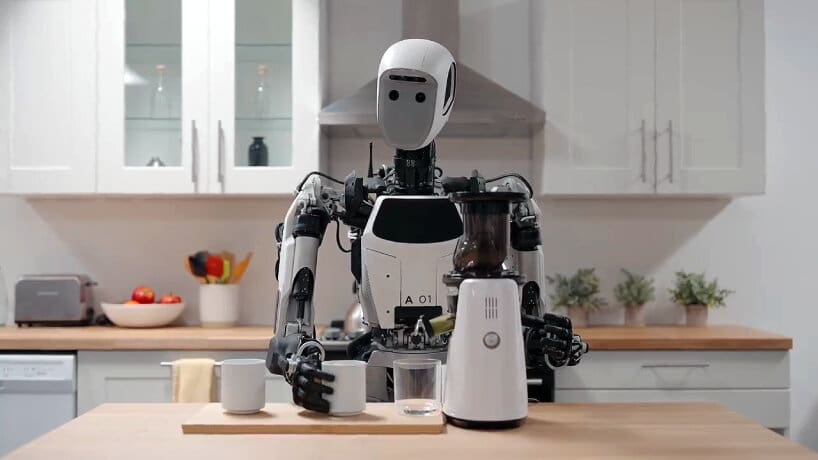
What separates Apollo from many competitors is that it has moved beyond demos into actual commercial engagements. Here are the confirmed deployments and partnerships as of early 2026:
Mercedes-Benz (Automotive Manufacturing)
Apptronik's flagship partnership began in March 2024 when Mercedes-Benz entered a pilot program to test Apollo in its manufacturing facilities. Apollo robots perform:
- Delivering assembly kits to production line workers
- Inspecting vehicle components
- Moving parts through the production process
- Transporting totes of kitted parts between stations
Mercedes-Benz subsequently increased its investment in Apptronik during the March 2025 Series A extension, signaling confidence in the pilot results. Jeff Cardenas noted: "Apollo is designed to be a versatile and scalable solution for the future of work, particularly in the automotive industry where precision and reliability are paramount."
Jabil (Electronics Manufacturing + Robot Production)
In February 2025, Apptronik reportedly announced a partnership with Jabil, the global electronics manufacturing giant:
- Manufacturing partner: Jabil will help scale production of Apollo robots using its supply chain expertise
- Deployment customer: Apollo robots will be integrated into Jabil's own manufacturing operations
This partnership is particularly noteworthy because it creates a path toward Apollo robots building more Apollo robots—a critical milestone for scaling humanoid robot production to meet demand.
GXO Logistics (Warehouse Automation)
GXO Logistics, the world's largest pure-play contract logistics provider, launched a multi-phase R&D initiative with Apptronik in 2024. The program began with laboratory testing to fine-tune Apollo's AI models before deploying to a GXO distribution center in the United States.
This is GXO's second humanoid robot partnership (following its work with Agility Robotics' Digit), indicating that major logistics companies see real value in humanoid form factors for warehouse operations.
Target Industries
Based on confirmed partnerships and stated roadmap, Apollo's deployment targets include:
Performance Analysis
What Apollo Does Well
Gross manipulation tasks are Apollo's current strength. Moving boxes, crates, totes, and assembly kits—the bread and butter of warehouse and manufacturing logistics—is where Apollo performs most capably. The 25 kg payload capacity handles the majority of items workers encounter in these environments.
Operational uptime is a genuine competitive advantage. The hot-swappable battery system means Apollo can work through full shifts with minimal downtime. In a 24/7 manufacturing facility, this translates to significantly higher utilization compared to robots requiring hours-long charging breaks.
Smooth, controlled movement has been confirmed by hands-on press coverage. TechCrunch noted that "Apollo's movements were smooth, and the robot even hammed it up for the camera" during the CES 2025 demonstration.
Current Limitations
Autonomy is still developing. The CES 2025 demo was teleoperated—"this was not the intelligent, autonomous version of the robot set to be deployed in factories," TechCrunch clarified. Full autonomous operation in dynamic, unstructured environments remains a work in progress.
Fine manipulation is limited. Apollo currently excels at gross manipulation (picking up boxes) but more intricate tasks requiring finger-level dexterity are not yet demonstrated at production quality. The hand specifications have not been publicly detailed, suggesting this remains an area of active development.
Walking speed is modest. At 3.4 km/h maximum, Apollo is slower than a brisk human walk (~5-6 km/h). For large warehouse environments, this could impact throughput. However, the wheeled base option partially addresses this for flat-floor applications.
Pricing and Availability
Apptronik CEO Jeff Cardenas has stated a target price of under $50,000 per unit at scale. This is an ambitious target that would make Apollo competitive with the total cost of employing a warehouse worker for roughly one year (including benefits, insurance, and overhead).
Current pricing for early commercial units is not publicly disclosed but is likely significantly higher than the $50,000 target as production volumes are still ramping. The Jabil manufacturing partnership is specifically designed to bring costs down through supply chain optimization and volume production.
Pricing Context
For businesses considering Apollo, the key financial question is total cost of ownership over 3-5 years compared to human labor costs. At $50,000 with 22-hour daily operation, minimal sick days, and no benefits costs, the ROI math becomes compelling for high-volume operations—especially in regions with acute labor shortages.
Interested in purchasing? View the Apptronik Apollo on Robozaps for the latest pricing and availability information.
Pros and Cons
Pros
- Hot-swappable batteries enable near-continuous 22-hour daily operation—a genuine operational advantage
- 25 kg payload capacity is among the highest in the humanoid robot space
- Modular base design (legs, wheels, or pedestal) provides flexibility across use cases
- NVIDIA GR00T AI integration enables learning from demonstrations rather than hard-coded programming
- Proven commercial partnerships with Mercedes-Benz, Jabil, and GXO validate real-world demand
- Approachable design reduces friction for human-robot collaboration adoption
- NASA Valkyrie heritage means the team has deep bipedal robotics expertise
- $5 billion valuation and $1B+ funding ensure long-term R&D and production investment
- 71 degrees of freedom provide excellent whole-body dexterity
- Point-and-click software doesn't require robotics expertise to operate
Cons
- Full autonomy is still maturing—current demos are largely teleoperated or limited autonomous
- Walking speed (3.4 km/h) is slower than human pace, potentially limiting throughput
- Fine manipulation capabilities are unproven for tasks requiring finger dexterity
- Current pricing likely exceeds $50,000 target until production scales
- Limited public performance data—no independent benchmark results published
- Hand specifications not fully disclosed, making manipulation assessment difficult
- Primarily gross manipulation focus—not yet suited for delicate or precision assembly
- Operational reliability at scale is unproven—pilot data is limited
How Apptronik Apollo Compares to the Competition
The humanoid robot market has exploded in 2025-2026. Here's how Apollo stacks up against the leading alternatives:
Apollo vs. Figure 02
Figure 02 is Apollo's closest competitor. Both target manufacturing and logistics, both have partnerships with major automakers (Mercedes-Benz vs. BMW), and both offer similar payloads. Apollo's advantages include hot-swappable batteries, more degrees of freedom (71 vs. ~41), and the NVIDIA GR00T platform. Figure 02 counters with a lighter frame and reportedly faster walking speed. For a deeper comparison of humanoid robot options, see our best humanoid robots roundup.
Apollo vs. Tesla Optimus
Tesla Optimus has the advantage of Tesla's massive manufacturing scale, vertically integrated AI (derived from Full Self-Driving), and an aggressively low target price of $20,000-$30,000. However, Optimus remains in internal testing with no commercial partnerships, while Apollo is already operating in Mercedes-Benz and Jabil facilities. For a direct comparison, read our Tesla Optimus vs. Apptronik Apollo analysis.
Apollo vs. Agility Digit
Agility's Digit is a non-traditional humanoid (no head, backward-bending legs) focused on logistics. It has Amazon as its anchor partner. Apollo offers a more conventional humanoid form, higher payload (25 kg vs. 16 kg), and hot-swappable batteries. Digit counters with faster movement speed and a longer track record of warehouse operation.
Who Should Consider the Apptronik Apollo?
Apollo is best suited for:
- Large manufacturers with repetitive material handling needs and labor shortages (automotive, electronics, CPG)
- Third-party logistics providers operating high-volume distribution centers
- Companies already using automation that want to extend into human-designed spaces without facility modifications
- Enterprises with NVIDIA ecosystem investments that can leverage Omniverse digital twins for simulation
- Organizations willing to invest in pilot programs with a 2-3 year ROI horizon
Apollo is not yet ideal for:
- Small businesses with limited automation budgets
- Applications requiring high-precision fine manipulation or dexterous assembly
- Environments needing full autonomous operation without human oversight
- Home or consumer applications (though this is on the long-term roadmap)
Awards and Industry Recognition
Apollo has earned notable recognition in the industry:
- Fast Company 2025 Innovation by Design Award winner
- Featured at CES 2025 alongside Texas Instruments' booth
- Appeared alongside other leading humanoids during NVIDIA CEO Jensen Huang's keynote
- Selected by Mercedes-Benz as its first humanoid robot manufacturing partner
The Investment Picture
For those evaluating Apptronik as an investment opportunity or trying to gauge the company's longevity, the numbers are compelling:
- $415M Series A (February-March 2025) – one of the largest Series A rounds in robotics history
- $520M funding round (March 2026) – Google and Mercedes-Benz lead
- $5.5 billion valuation (March 2026)
- Over $1 billion raised
- Investors include: Google, Mercedes-Benz, ARK Invest, Japan Post Capital, B Capital, Capital Factory
This funding runway gives Apptronik significant resources to iterate on hardware, scale manufacturing with Jabil, and invest in AI capabilities—reducing the risk of the company running out of capital before achieving commercial viability.
What's Next for Apollo in 2026 and Beyond
Based on Apptronik's stated roadmap and funding trajectory:
- 2026: Scale commercial production with Jabil; expand beyond pilot programs to full-fleet deployments
- 2026-2027: Graduate from gross manipulation to more complex tasks including fine manipulation and multi-step operations
- 2027+: Expand into construction, healthcare, elder care, and potentially consumer markets
- Long-term: Achieve sub-$50,000 price point and deploy at mass scale across industries
Frequently Asked Questions
How much does the Apptronik Apollo cost?
Apptronik has stated a target price of under $50,000 per unit at scale. Current pricing for early commercial units is not publicly disclosed and likely higher as production ramps up through 2026. Visit Robozaps for the latest pricing information.
What can the Apptronik Apollo robot do?
Apollo is designed for logistics and manufacturing tasks including picking and placing boxes, delivering assembly kits, inspecting components, palletizing, and warehouse material handling. It can lift up to 55 lbs (25 kg) and operate for 4 hours per battery pack, with hot-swappable batteries enabling up to 22 hours of daily operation.
How tall and heavy is the Apptronik Apollo?
Apollo stands 5 feet 8 inches (173 cm) tall and weighs 160 lbs (72.5 kg), roughly matching the proportions of an average adult human. This allows it to navigate spaces designed for people without facility modifications.
Who is currently using the Apptronik Apollo?
Mercedes-Benz is piloting Apollo in its automotive manufacturing facilities. Jabil is both manufacturing Apollo units and deploying them in its own electronics manufacturing operations. GXO Logistics has a multi-phase R&D initiative to deploy Apollo in warehouses.
How long does the Apollo battery last?
Each hot-swappable battery pack provides approximately 4 hours of runtime. Because the batteries are swappable without shutting down the robot, Apollo can operate up to 22 hours per day with quick battery changes—a significant advantage over competitors requiring extended plug-in charging.
Is the Apptronik Apollo better than Tesla Optimus?
Apollo and Tesla Optimus serve different stages of market readiness. Apollo is further along in commercial deployments with partners like Mercedes-Benz, Jabil, and GXO, and offers a higher 25 kg payload and 71 degrees of freedom. Tesla Optimus has the advantage of Tesla's massive manufacturing scale and an aggressively low target price of $20,000-$30,000, but remains in internal testing with no outside commercial partners.
How many degrees of freedom does the Apollo have?
Apollo has 71 degrees of freedom overall, significantly more than most competitors (Figure 02 has ~41, Tesla Optimus ~28). This enables highly dexterous whole-body movements across its arms, hands, torso, and legs.
When will Apptronik Apollo be widely available?
Apptronik is targeting commercial-scale deployment in 2026. Pilot programs with Mercedes-Benz, Jabil, and GXO began in 2024-2025. The company's $1B+ in funding and Jabil manufacturing partnership are designed to rapidly scale production to meet growing customer demand.
What AI technology does the Apollo use?
Apollo runs on NVIDIA Jetson AGX Orin and Jetson Orin NX computing modules, providing 275+ TOPS of AI performance. It leverages NVIDIA's Project GR00T foundation models to learn from human demonstrations, interpret text and video commands, and execute complex tasks with increasing autonomy.
Can Apollo work safely alongside humans?
Yes. Apollo features layered safety systems including collision avoidance, configurable safety zones that adjust behavior when objects are detected, an impact zone that halts all movement, and a prominent emergency shutdown button. It was specifically designed for safe human-robot collaboration in shared workspaces.
Verdict: Our Apptronik Apollo Rating
Overall Score: 4.2 / 5
The Apptronik Apollo earns a strong 4.2 out of 5 in our assessment. It is among the most commercially mature humanoid robots available in 2026, with real factory deployments, massive funding, and thoughtful engineering that prioritizes practical value over flashy demos.
Where Apollo excels: Hot-swappable batteries, high payload, modular design, approachable aesthetics, and a clear commercial deployment roadmap backed by world-class partners. The 71 degrees of freedom and NVIDIA GR00T AI platform give it a strong foundation for increasingly complex tasks.
Where Apollo needs improvement: Walking speed, fine manipulation, full autonomous operation, and transparent performance data. The gap between demo capabilities and production-ready autonomy remains the biggest question mark.
Bottom line: If you're a manufacturer or logistics provider evaluating humanoid robots for pilot deployment in 2026, Apollo should be on your shortlist. It may not be the cheapest option, and it won't do everything autonomously yet, but its combination of practical hardware design, real-world partnerships, and massive financial backing makes it one of the safest bets in a rapidly evolving market.
Ready to explore Apollo or other humanoid robots? Browse our full selection at Robozaps, or check out our comprehensive best humanoid robots guide to compare all the top options.
Related Reviews: Tesla Optimus vs Apptronik Apollo · Tesla Optimus Gen 2 Review
Agility Robotics Digit review: Amazon's warehouse humanoid. Full specs, $250K pricing, real deployment results & ROI analysis for 2026.
What Is the Agility Robotics Digit?
The Agility Robotics Digit is the world's first commercially deployed humanoid robot purpose-built for logistics and warehouse automation. Developed by Oregon-based Agility Robotics, Digit combines biomechanics-inspired bipedal locomotion with practical manipulation capabilities to handle the repetitive, physically demanding tasks that human workers increasingly avoid. Winner of The Robot Report's inaugural RBR50 Robot of the Year Award, Digit stands apart from competitors by being the only humanoid robot currently generating revenue from paying commercial customers.
If you're researching the best humanoid robots on the market, Digit deserves serious consideration — especially for warehouse and distribution center applications. In this comprehensive Agility Robotics Digit review, we break down everything from technical specifications and real-world performance to pricing, total cost of ownership, and how it compares to rivals like Tesla Optimus and Figure 02.
Agility Robotics Digit: Complete Technical Specifications
Before diving into performance analysis, here's every specification you need to evaluate Agility Robotics Digit for your operation:
Sensor Suite Deep Dive
Digit's perception stack is one of its strongest differentiators. The four Intel RealSense depth cameras provide 360-degree spatial awareness, while the onboard LiDAR generates high-resolution 3D maps of the working environment. The MEMS IMU and gyroscope handle balance and orientation at millisecond response times — critical for a bipedal platform that must maintain stability while carrying payloads. Force sensors in each arm enable compliant manipulation, allowing Digit to grasp totes of varying weights without crushing contents or dropping loads.
This sensor fusion approach means Digit can autonomously navigate warehouse aisles, detect obstacles (including human workers), and precisely locate pick-and-place targets without external infrastructure like QR codes or magnetic floor strips.
The Reverse-Jointed Leg Design
Digit's most visually distinctive feature — its reverse-jointed (digitigrade) legs — isn't just aesthetic. This biomechanics-inspired design, rooted in CEO Jonathan Hurst's doctoral research at Carnegie Mellon University and years of locomotion research at Oregon State University, provides several engineering advantages:
- Energy efficiency: The spring-loaded leg design stores and returns energy during each step cycle, reducing power consumption compared to traditional straight-legged humanoid designs.
- Dynamic stability: The leg geometry lowers Digit's center of gravity, improving balance during payload manipulation.
- Compact turning radius: Digit can pivot in tight warehouse aisles that would challenge wider-stance humanoids.
- Fall recovery: The leg configuration allows Digit to autonomously return to standing position after a fall — a capability most competitors lack.
Real-World Performance: How Digit Works in the Field
Theory is one thing; commercial deployment is another. Here's what we know about Digit's actual performance from its groundbreaking deployments.
The Spanx Deployment — First Paying Customer
In 2024, Agility Robotics achieved what no other humanoid company had: deploying robots at a paying customer's facility. A small fleet of Digit humanoids went to work at a Spanx distribution center in Flowery Branch, Georgia. The workflow involves:
- 6 River Systems' "Chuck" AMRs deliver totes to a designated station
- Digit picks up totes (empty or full) from either the top or bottom shelf of the AMR
- Digit places totes onto conveyors for downstream processing
This tote-transfer task represents one of the most common — and most physically taxing — repetitive workflows in modern distribution centers. The deployment is managed through Agility Arc, the company's cloud-based fleet orchestration platform that handles task assignment, scheduling, monitoring, and analytics across all deployed Digit units.
Amazon Testing
Amazon, which invested in Agility Robotics during its $150 million Series B round in 2022, has also tested Digit at its facilities. While specific details remain under NDA, Amazon's involvement signals strong validation from the world's largest logistics operation. The e-commerce giant processes millions of packages daily and has been aggressively investing in warehouse automation — making it an ideal proving ground for humanoid robots.
Performance Metrics We Know
- Uptime ratio: Currently 2:1 (two Digits operating while one charges). Target is 4:1, eventually 10:1.
- Task throughput: While Agility hasn't published exact picks-per-hour numbers, the under-2-year ROI claim (vs. a $30/hour fully loaded worker) implies Digit can handle roughly 60-75% of a human worker's throughput in targeted tote-transfer tasks.
- Reliability: Digit can self-recover from falls, reducing downtime from the most common failure mode in bipedal robots.
- Deployment speed: Agility Arc's cloud platform enables relatively quick commissioning of new Digit units within an existing fleet.
Agility Robotics Digit Price: What Does It Actually Cost?
The Agility Robotics Digit price is one of the most searched questions in the humanoid robotics space — and for good reason. Understanding the full cost picture requires looking beyond the sticker price.
Purchase Price
The estimated purchase price for a single Digit unit is approximately $250,000. This figure comes from multiple industry sources and pilot program pricing. However, Agility Robotics primarily offers Digit through its Robots-as-a-Service (RaaS) model rather than outright sales, so the purchase price is somewhat academic for most buyers.
RaaS Leasing Model
Agility Robotics' preferred delivery model is Robots-as-a-Service (RaaS), which includes:
- Hardware (Digit units)
- Agility Arc fleet management software
- Maintenance and support
- Software updates and capability upgrades
- Flexible contract terms
- Ability to add units for peak demand periods
- Performance milestone clauses
While exact monthly RaaS pricing isn't publicly disclosed, CEO Peggy Johnson's statement about targeting an "under 2-year ROI versus a human at a fully loaded $30 per hour" gives us a framework for estimation.
Total Cost of Ownership (TCO) Analysis
These estimates assume single-shift human comparison. Digit's ability to work 16+ hours daily (with charging rotation) effectively doubles the value proposition. For a more detailed breakdown of humanoid robot costs across the industry, see our comprehensive pricing guide.
ROI Timeline
Based on Agility's guidance of "under 2-year ROI vs. $30/hour fully loaded," expect:
- Break-even: 18–24 months under RaaS model
- Positive ROI: Year 2+ with increasing returns as Digit capabilities expand via software updates
- Fleet scaling benefits: Per-unit costs decrease as fleet size grows, improving ROI for larger deployments
Digit vs. Competitors: How Does It Stack Up?
The humanoid robot market is heating up fast. Here's how Digit compares to the leading humanoid robot competitors across key metrics:
Key Competitive Advantages
Digit's biggest edge is commercial maturity. While competitors are still in R&D, demo, or limited pilot phases, Digit is deployed at paying customer sites generating revenue. This head start means Agility Robotics is collecting real-world operational data that feeds directly into hardware and software improvements — a flywheel effect that's hard for late entrants to replicate.
For a detailed head-to-head analysis, read our Tesla Optimus vs. Agility Robotics Digit comparison.
Where Competitors Have the Edge
- Tesla Optimus: Tesla's manufacturing scale and aggressive price targets ($20,000–$30,000) could dramatically undercut Digit on unit economics — if Tesla delivers on those promises.
- Figure 02: Figure's 16-DOF dexterous hands offer superior manipulation for tasks requiring fine motor skills, such as assembly work.
- Unitree H1: At roughly $90,000 and with 5.6 mph walking speed, the Unitree H1 offers a compelling price-to-performance ratio for research and lighter-duty applications.
- Sanctuary AI Phoenix: Phoenix's 20-DOF hands and Carbon AI system represent the most advanced general-purpose manipulation approach.
Digit's Evolution: From ATRIAS to Commercial Deployment
Understanding Digit's development history provides critical context for evaluating its maturity and trajectory. Unlike many humanoid robot startups that jumped straight from concept to prototype, Agility Robotics built Digit on over a decade of fundamental locomotion research.
ATRIAS (2011–2015): The Foundation
The story begins at Oregon State University, where Jonathan Hurst's Dynamic Robotics Laboratory developed ATRIAS — a research platform designed to test theoretical models of animal locomotion. ATRIAS looked nothing like a commercial product: it was essentially a mechanical scaffold with spring-loaded legs. But it proved something revolutionary — that robots could walk and run dynamically across uneven outdoor terrain using principles borrowed from biomechanics rather than the rigid, pre-programmed movements that characterized most legged robots at the time.
ATRIAS demonstrated that compliant, spring-mass locomotion models could achieve stable, energy-efficient walking. This breakthrough became the theoretical foundation for everything that followed.
Cassie (2017–2019): Walking Gets Real
Agility Robotics' first commercial product wasn't Digit — it was Cassie, a bipedal robot consisting of only legs and a torso (no arms or upper body). Cassie was sold primarily to research institutions and became a popular platform for studying bipedal locomotion and reinforcement learning. Importantly, Cassie validated that Agility's locomotion technology could be manufactured and deployed outside the lab. The robot gained viral attention for its ability to navigate stairs, grass, and various terrains that challenged other legged robots.
Cassie also served as a critical revenue source and market validation tool. Several dozen units were sold to universities and research labs worldwide, generating early revenue and building a customer base that provided valuable feedback.
Digit v1–v3 (2019–2023): Adding Upper Body and Purpose
The transition from Cassie to Digit involved adding an upper body with arms, a sensor suite for perception, and the software intelligence needed for autonomous manipulation tasks. Early Digit prototypes were demonstrated in package delivery scenarios (including a collaboration with Ford for last-mile delivery) before Agility pivoted to focus exclusively on warehouse and logistics applications — a much larger and more immediate market.
Each successive version refined the hardware, improved battery life, expanded the sensor suite, and added manipulation capabilities. By Digit v3, the platform was mature enough for extended pilot programs with major logistics companies.
Digit v4 (2024–Present): Commercial Deployment
The current generation represents the culmination of nearly a decade of R&D. Key improvements include the 8-hour battery life, enhanced manipulation with force-sensing arms, the complete Agility Arc fleet management platform, and the reliability needed for commercial deployment at paying customer sites. The Spanx deployment in Georgia marked the transition from pilot to revenue — a milestone that no other humanoid company has achieved.
What's Next: Digit v5 and Beyond
The next generation, expected in late 2025 or early 2026, will bring the payload increase to 50 lb, improved battery life, and enhanced manipulation capabilities. Agility Robotics has also indicated plans for functional safety certification that would enable Digit to work in direct proximity to human workers — a game-changing capability for warehouse operations.
The Warehouse Labor Crisis: Why Digit Matters Now
To understand why Digit represents such a significant opportunity, you need to understand the structural labor challenges facing the logistics industry:
The Numbers Tell the Story
- Warehouse worker turnover: The warehousing and transportation sector consistently experiences some of the highest quit rates across all industries. Post-COVID disruptions accelerated this trend, and while quit rates have normalized somewhat, the underlying instability remains.
- Physical toll: Warehouse work is physically demanding. Repetitive lifting, bending, and carrying leads to high injury rates and contributes to the difficulty of retaining workers long-term.
- Rising labor costs: Fully loaded warehouse labor costs have risen to $30+/hour in many markets when you factor in wages, benefits, insurance, training, and turnover costs.
- E-commerce growth: Online retail continues to grow, driving demand for warehouse and fulfillment capacity that outpaces available labor supply.
- Demographic shifts: An aging workforce in many developed countries means fewer workers available for physically demanding roles.
Why Traditional Automation Falls Short
Conventional warehouse automation — conveyor systems, robotic arms, and AMRs — has been tremendously successful in structured environments. But significant gaps remain:
- Conveyor systems require fixed infrastructure and can't adapt to layout changes
- Robotic arms are stationary and limited to their reach envelope
- AMRs can move goods horizontally but can't manipulate objects or navigate stairs
- None of the above can handle the "last meter" problem of picking up items and placing them precisely
Humanoid robots like Digit bridge these gaps by combining mobility (walking through human-designed spaces) with manipulation (picking up and placing objects) — all without requiring facility modifications. This is why the humanoid robot market is projected to grow at a 39.2% CAGR through 2030.
Deployment Considerations: What You Need to Know Before Adopting Digit
If you're seriously evaluating Digit for your operation, here are the practical considerations that go beyond the spec sheet:
Facility Requirements
- Floor surfaces: Digit performs best on flat, hard surfaces typical of warehouse environments. While it can handle minor variations, significantly uneven or slippery floors may impact performance.
- Aisle width: Digit's compact form factor allows it to operate in standard warehouse aisles (typically 8–12 feet wide).
- Charging infrastructure: You'll need designated charging stations. With the current 2:1 ratio, plan for roughly one charging station per two operating units.
- Network connectivity: Agility Arc requires reliable network connectivity (Wi-Fi or cellular) for cloud-based fleet management and monitoring.
- Safety zones: Until functional safety certification is achieved, Digit requires segregated work zones separate from human workers.
Integration with Existing Systems
One of Digit's practical advantages is its ability to integrate with existing warehouse infrastructure. The Spanx deployment demonstrated seamless coordination with 6 River Systems AMRs — Digit doesn't require you to rip out your current automation; it augments it. Agility Arc provides integration APIs for connecting with warehouse management systems (WMS), allowing Digit to receive tasks and report status through your existing operational software.
Change Management
Deploying humanoid robots is as much a people challenge as a technology challenge. Successful deployments typically involve:
- Early communication with existing workforce about the robot's role (augmentation, not replacement)
- Designation of internal champions who manage the robot fleet
- Clear metrics and success criteria agreed upon before deployment
- Iterative expansion — start with a small fleet and scale based on results
Agility Arc: The Fleet Management Advantage
One of the most underrated aspects of the Digit ecosystem is Agility Arc — the company's cloud-based fleet orchestration platform. While most humanoid robot companies focus exclusively on the hardware, Agility Robotics has built an end-to-end deployment and management stack that includes:
- Task orchestration: Centralized assignment and scheduling of tasks across multiple Digit units
- Real-time monitoring: Dashboard visibility into each robot's status, battery level, task progress, and location
- Analytics: Performance tracking, throughput reporting, and optimization recommendations
- OTA updates: Over-the-air software updates that add new capabilities without hardware changes
- Scalable architecture: Designed to manage fleets from a handful of units to hundreds
- Integration APIs: Connect with existing warehouse management systems (WMS) and AMR fleets
This software layer is what transforms Digit from a single robot into a scalable automation platform. For warehouse operators evaluating humanoid solutions, the availability of mature fleet management software should weigh heavily in the decision — and Digit currently leads the pack here.
Agility Robotics: Company Background and Credibility
Understanding the company behind the robot matters when you're evaluating a $250,000+ investment.
- Founded: 2015 as a spinoff from Oregon State University's robotics lab
- Founders: Jonathan Hurst (Chief Robot Officer, former CMU/OSU professor), Damion Shelton (Chairman), Mikhail Jones (VP Software)
- CEO: Peggy Johnson (appointed March 2024; former CEO of Magic Leap, former EVP at Microsoft)
- Funding: $641M+ total (including $400M Series C in 2025), with backing from Amazon, DCVC, and Playground Global
- Manufacturing: RoboFab facility in Salem, Oregon — purpose-built for humanoid robot production with 10,000+ unit/year capacity
- Research heritage: 10+ years of locomotion research (ATRIAS → Cassie → Digit evolution)
- Industry leadership: Pioneering ISO safety standards for humanoid robots
The combination of deep academic pedigree, proven commercial deployments, tier-one investor backing (Amazon), experienced enterprise leadership, and purpose-built manufacturing infrastructure makes Agility Robotics one of the most credible players in the humanoid space. According to MarketsandMarkets, the humanoid robot market is projected to grow from $2.9 billion in 2025 to $15.3 billion by 2030 — a 39.2% CAGR that positions Agility well for massive growth.
Pros and Cons of the Agility Robotics Digit
Pros
- Only commercially deployed humanoid: Digit is the only humanoid generating revenue from paying customers, proving real-world viability.
- Best-in-class battery life: Up to 8 hours of operation significantly exceeds most competitors' 2–5 hour range.
- Mature fleet management: Agility Arc provides enterprise-grade deployment, monitoring, and task orchestration out of the box.
- Proven self-recovery: Can autonomously stand up after falls — critical for unsupervised operation.
- Manufacturing scale ready: RoboFab can produce 10,000+ units/year, ensuring supply chain readiness.
- Strong investor backing: Amazon investment validates the logistics use case.
- RaaS flexibility: Lease model reduces upfront capital requirements and includes ongoing support.
- Robust sensor suite: LiDAR + 4× depth cameras + IMU provides comprehensive environmental awareness.
- Biomechanics-based design: 10+ years of locomotion research = superior walking efficiency and stability.
Cons
- High unit cost: ~$250,000 purchase price (or significant RaaS commitment) puts Digit out of reach for small businesses.
- Limited manipulation: 3-DOF arms with custom end effectors lack the dexterity of Figure 02's or Sanctuary AI's multi-finger hands.
- Narrow task scope (currently): Primarily validated for tote transfer; broader task flexibility is still developing.
- No human co-working yet: Currently deployed in segregated zones; functional safety certification for human collaboration is 18+ months away.
- 2:1 charging ratio: Needing one Digit charging for every two operating means fleet sizing must account for ~33% overhead.
- Limited public performance data: Exact throughput and reliability metrics aren't publicly available.
- Headless design: While functional, the lack of a "face" limits social interaction potential for customer-facing roles.
Who Should Buy (or Lease) the Agility Robotics Digit?
Ideal Use Cases
- Large distribution centers: Companies processing high volumes of totes and packages across shifts, especially those struggling with labor shortages or high turnover.
- E-commerce fulfillment: Facilities handling diverse SKUs that need flexible automation beyond fixed conveyor systems.
- 3PL providers: Third-party logistics companies that need scalable labor solutions across multiple clients and seasonal demand spikes.
- Automotive and manufacturing: Material handling and kitting operations where bipedal mobility offers advantages over wheeled AMRs.
- Multi-level facilities: Warehouses with stairs, ramps, or uneven surfaces where wheeled robots can't operate.
Not Ideal For
- Small businesses: The investment level requires significant throughput to justify ROI.
- Fine assembly tasks: The current gripper system lacks the dexterity needed for intricate manipulation.
- Customer-facing roles: Digit's industrial design isn't suited for hospitality, retail, or healthcare settings.
- Outdoor environments: Digit is designed for indoor warehouse/factory environments.
- Research institutions on a budget: Academic labs would find better value in platforms like Unitree H1 or 1X NEO.
Investment and Market Position
Evaluating Digit also means evaluating Agility Robotics as a company — its financial stability, market position, and long-term viability matter when you're committing to a multi-year automation partnership.
Funding and Financial Backing
Agility Robotics has raised over $150 million in venture funding, with its Series B round in early 2022 attracting investment from DCVC, Playground Global, and notably Amazon. Amazon's investment is particularly significant because it represents validation from the world's largest logistics operator — a company that processes billions of packages annually and has invested heavily in warehouse automation.
The company closed a $400M Series C round in 2025, funding operations through the 10,000-unit production milestone. This suggests Agility has a clear financial runway and growth plan, reducing the risk of technology abandonment that can plague early-stage robotics companies.
Leadership Depth
The 2023–2024 leadership expansion brought in experienced executives from across the technology and robotics industries. CEO Peggy Johnson's background as CEO of Magic Leap and EVP at Microsoft brings enterprise sales and partnership expertise that's critical for scaling a hardware-as-a-service business. Chief Product Officer Melonee Wise brings deep experience in commercializing robotic systems. This leadership team combines the academic robotics pedigree of the founders with the commercial execution expertise needed to scale.
Market Timing
Agility Robotics benefits from being early but not too early. The humanoid robot market is reaching an inflection point where:
- AI capabilities (computer vision, reinforcement learning, LLM integration) have matured enough for practical deployment
- Component costs (batteries, sensors, actuators) have declined significantly
- Labor market conditions create genuine pull from customers
- Investor enthusiasm provides ample capital for R&D and scaling
Being the first to deploy commercially means Agility is building operational expertise and collecting real-world data that competitors simply don't have — a compounding advantage that's difficult to replicate even with greater funding.
Safety and Compliance: The Path to Human Collaboration
Safety is arguably the most critical factor determining how quickly humanoid robots can scale in commercial environments. Agility Robotics is taking a leadership role in this area.
Current Safety Approach
Today, Digit operates in segregated zones without human co-workers. This approach eliminates the risk of human-robot collisions but limits deployment flexibility. The segregated model works well for dedicated automation cells (like the tote-transfer station at Spanx) but can't scale to applications where robots need to share space with workers.
ISO Standards Leadership
Agility Robotics is actively pioneering ISO safety standards for humanoid robots — a relatively new area since existing industrial robot safety standards (ISO 10218, ISO/TS 15066) were designed for stationary robotic arms, not mobile humanoid platforms. The company is working with standards bodies to define requirements for:
- Force and speed limiting for collaborative operation
- Proximity detection and automatic slow-down/stop behaviors
- Emergency stop and fault-handling procedures
- Risk assessment frameworks specific to bipedal mobile robots
Timeline to Human Collaboration
CEO Peggy Johnson has indicated that Digit could "interoperate near humans" within approximately 18 months from late 2024 — placing the target in mid-to-late 2026. Achieving functional safety certification would be a transformative milestone, dramatically expanding the range of tasks and environments where Digit can be deployed.
The Future Roadmap: What's Coming for Digit
Agility Robotics has outlined several near-term improvements for Digit:
- Payload increase to 50 lb (22.6 kg): A 43% improvement that opens up heavier-duty material handling tasks.
- Improved battery life: Targeting 4:1 and eventually 10:1 operating-to-charging ratios, which dramatically improves fleet economics.
- Functional safety certification: Expected within 18 months, enabling Digit to work alongside (not just near) human workers.
- Expanded task library: New manipulation skills delivered via OTA software updates through Agility Arc.
- Enhanced dexterity: Next-generation end effectors for broader manipulation capabilities.
- Series C funding: Currently raising to fund scaling to 10,000+ units and multi-year operational runway.
How to Get Started with Digit
Agility Robotics offers a structured onboarding process through their RaaS engagement model:
- Discovery: Initial consultation to assess your facility, workflows, and automation goals
- Pilot deployment: Small fleet deployment with defined performance milestones
- Scaling: Expand fleet size based on pilot results, with flexible contract terms
- Peak demand support: Add temporary units during seasonal spikes
Ready to explore humanoid robots for your warehouse or facility? Browse our complete catalog of humanoid robots for sale to compare Digit with alternatives and find the right fit for your operation.
Frequently Asked Questions
How much does the Agility Robotics Digit cost?
The estimated purchase price for Digit is approximately $250,000 per unit. However, Agility Robotics primarily offers Digit through a Robots-as-a-Service (RaaS) leasing model that bundles hardware, software (Agility Arc), maintenance, and support. The company targets an under-2-year ROI compared to a fully loaded human worker at $30/hour.
Is the Agility Robotics Digit available to buy?
Digit is available primarily through Agility Robotics' RaaS (Robots-as-a-Service) program rather than direct purchase. Interested companies can initiate the engagement through Agility's website. The RaaS model includes flexible contract terms, fleet management software, and ongoing support. You can also view Digit's product page on Robozaps for more details.
What tasks can Digit perform?
Digit is currently validated for tote transfer and material handling in warehouse environments — picking up totes from AMRs and placing them on conveyors. Its capabilities are expanding to include broader material movement tasks, and Agility Robotics plans to deliver new skills via over-the-air software updates. Future capabilities may include trailer loading/unloading and more complex pick-and-place operations.
How long does Digit's battery last?
Digit's battery lasts up to 8 hours depending on task intensity, which is industry-leading among humanoid robots. Agility Robotics currently operates at a 2:1 ratio (2 units working, 1 charging), with plans to improve to 4:1 and eventually 10:1 as battery technology advances.
Can Digit work alongside humans?
Not yet. Digit currently operates in segregated zones without human co-workers present. Agility Robotics is pursuing ISO functional safety certification and expects Digit to be cleared for human collaboration within approximately 18 months (estimated mid-to-late 2026). The company is pioneering safety standards for humanoid robots.
How does Digit compare to Tesla Optimus?
Digit is commercially deployed and generating revenue; Tesla Optimus remains in internal testing. Digit has superior battery life (8 hrs vs. ~5 hrs est.) and proven logistics capabilities. However, Tesla targets a dramatically lower price point ($20,000–$30,000) and has unmatched manufacturing scale. For a full breakdown, see our Tesla Optimus vs. Digit comparison.
What sensors does Digit use?
Digit features a comprehensive sensor suite including onboard LiDAR for 3D mapping, four Intel RealSense depth cameras for spatial awareness, RGB cameras for visual perception, a MEMS IMU and gyroscope for balance, and force sensors in each arm for compliant manipulation. This combination enables autonomous navigation without external infrastructure.
Where is Digit manufactured?
Digit is manufactured at RoboFab, Agility Robotics' purpose-built factory in Salem, Oregon. The facility has a production capacity of over 10,000 units per year, making it one of the world's first dedicated humanoid robot factories.
What is Agility Arc?
Agility Arc is Agility Robotics' cloud-based fleet management platform. It handles task orchestration, real-time monitoring, performance analytics, over-the-air software updates, and integration with existing warehouse management systems. Arc is included with every Digit RaaS deployment and is essential for managing multi-robot fleets.
Can Digit recover from falls?
Yes. Digit can autonomously return to a standing position after falling, which is a critical capability for robots operating without constant human supervision. This self-recovery feature, enabled by its reverse-jointed leg design, significantly reduces downtime and the need for human intervention.
Digit vs. Traditional Warehouse Automation: When Humanoids Make Sense
Not every warehouse needs a humanoid robot. Understanding when Digit makes sense versus conventional automation helps ensure you're investing in the right solution.
The sweet spot for Digit is clear: dynamic material handling tasks that require both mobility and manipulation in environments designed for humans. If your automation gap involves moving things between systems, across varying layouts, or through spaces that wheeled robots can't navigate, Digit is purpose-built for exactly that challenge.
Final Verdict: Is the Agility Robotics Digit Worth It?
The Agility Robotics Digit occupies a unique position in the humanoid robot market: it's the only one that's actually working. While competitors showcase impressive demos and make bold promises, Digit is deployed at paying customer sites, handling real totes, and generating real revenue. That commercial maturity — combined with best-in-class battery life, a proven biomechanics-based design, and the Agility Arc fleet management platform — makes Digit the safest bet for enterprises looking to deploy humanoid automation today.
The caveats are real: it's expensive, manipulation is limited, and the task scope is still narrow. But for large distribution centers and logistics operations battling chronic labor shortages and rising costs, Digit offers a credible path to ROI within 2 years — and a platform that will only improve through software updates and hardware revisions.
Our rating: 8.5/10 — The definitive leader in commercial humanoid deployment, with room to grow in dexterity and task flexibility.
Considering a humanoid robot for your business? Explore all available humanoid robots at Robozaps or check out our complete guide to the best humanoid robots in 2026 to find the right platform for your needs.
Sanctuary AI Phoenix review: Carbon AI control system, Gen 8 specs & real deployments. Is it worth the investment? Expert 2026 analysis.
The Sanctuary AI Phoenix stands at 170 cm (5'7") tall, weighs 70 kg (155 lbs), and represents one of the most intellectually ambitious humanoid robot programs on the planet. While competitors like Tesla and Figure chase headlines with flashy demos, Sanctuary AI has quietly built something different: a general-purpose robot whose real breakthrough isn't in its legs or its speed — it's in its hands and its mind. Powered by the proprietary Carbon AI system and equipped with 21-degree-of-freedom hydraulic hands that sense pressure down to 5 millinewtons, Phoenix is engineered to think and manipulate objects the way humans do. But with no public pricing, a prototype-phase status, and leadership upheaval in late 2024, is Sanctuary AI Phoenix worth the attention? This comprehensive Sanctuary AI Phoenix review breaks down every spec, every capability, and every limitation — so you can decide for yourself.
Key Takeaways
- Price: The Sanctuary AI Phoenix price is not publicly disclosed. Sanctuary operates on a contact-sales model targeting enterprise and industrial customers — expect pricing in the six-figure range based on comparable platforms.
- Best-in-Class Hands: Phoenix's 21-DOF hydraulic hands with tactile sensors sensitive to 5 millinewtons (mN) are arguably the most advanced robotic hands in any commercial humanoid program.
- Carbon AI System: The proprietary cognitive architecture translates natural language into physical actions, with explainable reasoning and the ability to automate new tasks in under 24 hours.
- Magna Partnership: A strategic relationship with Magna International — one of the world's largest automotive suppliers — positions Phoenix for real-world manufacturing deployment.
- Best For: Automotive manufacturing, logistics, and industrial operations where fine manipulation and dexterous object handling are critical — not consumer applications.
- Key Limitation: Still in prototype/pilot phase with limited public deployments. No confirmed pricing, battery life specs, or walking speed data available publicly.
Sanctuary AI Phoenix Specifications
The Sanctuary AI Phoenix — a general-purpose humanoid robot built for dexterous industrial work.
Sanctuary AI Phoenix Price: What Does It Actually Cost?
Let's address the elephant in the room: Sanctuary AI does not publicly disclose the Phoenix price. The company operates strictly on a contact-sales, enterprise-first model. There is no e-commerce checkout, no pre-order page, and no published MSRP.
Based on our analysis of comparable general-purpose humanoid platforms currently in pilot or limited deployment — and considering Phoenix's advanced hydraulic hand system, proprietary Carbon AI software, and enterprise-grade build — we estimate the Sanctuary AI Phoenix price falls somewhere between $100,000 and $250,000 per unit for early commercial deployments. This is consistent with pricing from competitors like Agility Digit (~$250,000 for pilot programs) and Apptronik Apollo (targeting sub-$50,000 at scale).
Sanctuary's Magna International partnership likely involves custom pricing structures tied to volume commitments, and the company has signaled that reducing bill-of-materials costs is a priority with each generation — Generation 8 specifically highlights manufacturing cost reductions.
Here's how Phoenix's estimated pricing compares to the broader humanoid robot market:
The value proposition for Phoenix isn't about being the cheapest humanoid on the market — it never will be. It's about being the most dexterous. If your operation requires a robot that can sort small parts, handle delicate components, or perform assembly tasks that demand near-human finger precision, the Sanctuary AI Phoenix price may be justified by the labor it replaces. For organizations evaluating humanoid robot costs, Phoenix sits firmly in the premium industrial tier.
Performance and Mobility: Dexterity Over Speed
Here's what separates the Sanctuary AI Phoenix from virtually every other humanoid robot on the market: Sanctuary isn't trying to build the fastest runner or the most acrobatic bipedal platform. They're building the most dexterous general-purpose worker. And that strategic choice defines every aspect of Phoenix's performance profile.
Hand Performance: The Crown Jewel
Phoenix's hydraulic hands are the single most impressive subsystem on the robot. Each hand features 21 degrees of freedom — more than any other commercially available humanoid hand system. For context, the human hand has approximately 27 DOF. Phoenix is getting remarkably close.
The hands use proprietary miniaturized hydraulic valves rather than the electric motors found in competing platforms like Tesla Optimus or Figure 02. Sanctuary chose hydraulics for three specific reasons:
- Superior power density: Hydraulic actuation delivers more force per unit volume than electric motors, critical for a compact hand design
- Flow resolution: Hydraulic systems offer finer control over force application, enabling delicate grasping
- Miniaturization path: Sanctuary's proprietary valve technology continues to shrink with each generation
The results speak for themselves. Sanctuary has demonstrated in-hand object reorientation under extreme disturbance — including a 500g unexpected load — making it the first commercial humanoid to achieve this feat. This capability is critical for real-world manufacturing, where parts don't always arrive in perfect orientation.
Tactile Sensing: Near-Human Touch
In February 2025, Sanctuary integrated a new generation of tactile sensors into Phoenix's finger pads. Each pad contains a 7-cell touch sensor array using micro-barometers — the same miniaturized pressure sensors found in smartphones, repurposed for robotic dexterity.
The sensitivity numbers are striking: Phoenix can detect forces as low as 5 millinewtons (mN). Human fingertip sensitivity sits around 3 mN. That means Phoenix's sense of touch is within 40% of human capability — far ahead of any competitor that relies solely on vision-based manipulation.
As Dr. Jeremy Fishel, Sanctuary's principal researcher, explained: "Without tactile sensing, robots depend on video to interact with their environment. With video alone, you don't know you've touched something until well after the collision has physically caused the object to move."
The tactile system enables three critical capabilities:
- Blind picking: Grasping objects when vision is occluded (e.g., reaching into a bin)
- Slippage detection: Detecting when an object begins to slip and adjusting grip force in real-time
- Force limiting: Preventing excessive force application on fragile components
Locomotion and Body Movement
Phoenix walks at approximately 4.8 km/h (3 mph) — roughly average human walking pace. It does not run, and Sanctuary has not prioritized bipedal agility in the way that other humanoid platforms have. The body uses electric actuation for locomotion while reserving hydraulics for the hands.
Generation 8 improved the range of motion in the wrists, hands, and elbows while reducing overall weight. The payload capacity of 25 kg (55 lbs) is competitive with the industrial humanoid category, though not class-leading — the FDROBOT TLIBOT, for instance, handles 145 kg.
For Sanctuary's target use cases — sorting parts, handling components, performing assembly tasks — walking speed and heavy lifting are secondary to what the hands can do. This is a deliberate engineering trade-off, and one that makes strategic sense given their Magna automotive partnership.
Carbon AI: The Brain Behind Phoenix
If Phoenix's hands are the hardware differentiator, Carbon AI is the software one. Carbon is Sanctuary's proprietary cognitive architecture — and it's fundamentally different from the AI approaches used by most humanoid competitors.
Architecture Overview
Carbon isn't just a neural network or a large language model bolted onto a robot. It's a hybrid cognitive system that combines multiple AI paradigms:
- Symbolic and logical reasoning: For structured task planning and explainable decision-making
- Large Language Models: For general knowledge and natural language understanding
- Deep learning and reinforcement learning: For motor control and skill acquisition
- Physics-realistic simulation: For training in virtual environments before deploying to physical hardware
This hybrid approach gives Carbon something most competing systems lack: explainability. When Phoenix makes a decision — reach for this part, grasp it this way, place it there — Carbon can explain why it chose that plan. In regulated manufacturing environments, this audit trail matters enormously.
Task Learning Speed
One of Sanctuary's most significant claims is that Phoenix can automate new tasks in under 24 hours. While the specifics vary by task complexity, TechCrunch verified demonstrations of the seventh-generation Phoenix learning to sort objects by color and type in structured environments within this timeframe.
The learning pipeline works through a combination of teleoperation (human operators controlling the robot remotely to generate training data) and reinforcement learning in simulation. Sanctuary leverages NVIDIA Isaac Lab — an open-source robot learning framework built on Isaac Sim — to train thousands of simulated hands simultaneously, dramatically accelerating the learning process.
As Sanctuary's team noted: "Our hands have kinematics beyond human capability, which cannot be accessed using analogous teleoperation. Online reinforcement learning in a simulated environment allows the learning algorithms to fully leverage the hands' capabilities."
Natural Language Interface
Carbon translates natural language instructions into physical actions. Rather than requiring programming expertise, operators can describe tasks in conversational language, and Carbon generates reasoning, task, and motion plans to execute them. This dramatically lowers the barrier to deployment — a factory floor supervisor doesn't need to be a roboticist to direct Phoenix.
Fleet Management and Teleoperation
Carbon includes built-in support for human-in-the-loop supervision and fleet management. Multiple Phoenix robots can be monitored and directed by a single human operator, with the system handling autonomous execution of routine tasks and flagging situations that require human judgment.
The teleoperation capability serves dual purposes: it's both a production mode (allowing skilled operators to handle complex tasks remotely) and a data collection mechanism (every teleoperated session generates training data that improves autonomous performance).
Sensors and Perception
The Phoenix sensor suite has been significantly upgraded in Generation 8, with improvements focused on data capture quality — which directly feeds Carbon AI's learning pipeline.
Vision System
Phoenix uses a combination of depth cameras and RGB vision cameras. Generation 8 brings improved field of view and resolution to both systems. While Sanctuary hasn't disclosed specific camera models or resolutions, the upgrade was designed to increase the fidelity of visual data available for AI training.
Unlike competitors such as the Unitree H1 (which uses 3D LiDAR for 360° perception) or Tesla Optimus (which leverages Tesla's vision-only FSD AI stack), Phoenix's visual system is optimized for close-range manipulation tasks rather than long-range navigation. The cameras need to see what the hands are doing with high precision, not map an entire warehouse.
Force-Torque Sensors
Force-torque sensors throughout the arms and wrists provide continuous feedback on the forces being applied during manipulation. This data integrates with the tactile sensors in the fingertips to create a comprehensive picture of every physical interaction.
Audio System
Generation 8 includes improvements to Phoenix's audio and video systems for enhanced person-robot interaction. While specific microphone specs aren't public, the audio system supports natural language communication with Carbon AI and provides situational awareness in noisy manufacturing environments.
Telemetry System
A key Generation 8 upgrade is the improved telemetry system designed specifically for high-quality data capture. Every sensor reading, every motor position, every force measurement is recorded and transmitted for use in training Carbon AI models. This "data-first" design philosophy means every minute of Phoenix operation contributes to making future autonomous behavior more robust.
Design and Build Quality
Phoenix's design philosophy prioritizes function over aesthetics, though Generation 6 introduced "a bolder color palette and elevated textures" according to Sanctuary. The robot presents a clean, industrial appearance appropriate for factory environments.
Form Factor
At 170 cm (5'7") and 70 kg (155 lbs), Phoenix is deliberately human-sized. This matters for industrial deployment: the robot fits through standard doorways, operates at standard workbench heights, and can use tools designed for human hands. The human-like proportions also facilitate teleoperation — when a human operator controls Phoenix remotely, the 1:1 mapping between human and robot body dimensions makes control more intuitive.
Materials and Durability
Sanctuary hasn't disclosed specific materials or IP ratings for Phoenix. However, the Generation 8 design was explicitly built with manufacturing in mind — with emphasis on reduced bill-of-materials costs and simplified assembly, making the robot faster to commission and build. For industrial customers evaluating long-term deployment, this manufacturing-focused design suggests Sanctuary is planning for scale production rather than one-off prototypes.
Hand Design Evolution
The hands deserve special mention in any design discussion. Sanctuary has built five generations of robotic hands using electromechanical, cable-based, pneumatic, and ultimately hydraulic approaches before arriving at the current design. The miniaturized hydraulic valves represent years of R&D distilled into a compact, powerful hand that can exert significant force while maintaining the control needed for delicate manipulation.
The hydraulic approach enables what Sanctuary calls "beyond human capability" kinematics — the hands can achieve configurations and movements that human hands physically cannot, which becomes accessible through reinforcement learning rather than teleoperation.
Generation-Over-Generation Improvements
Sanctuary iterates rapidly. In 8 generations since 2022, Phoenix has seen:
- Generation 6 (2023): Named "Phoenix," introduced human-like form factor, first commercial deployment
- Generation 7 (April 2024): Faster task learning (<24 hours), improved range of motion, lighter weight, lower BOM cost
- Generation 8 (January 2025): Optimized for data capture, improved cameras and telemetry, enhanced person-robot interaction, further cost and manufacturing improvements
This annual iteration cycle demonstrates a commitment to continuous improvement that many well-funded competitors haven't matched.
Real-World Use Cases
1. Automotive Manufacturing
This is Phoenix's marquee use case, anchored by the strategic partnership with Magna International — one of the world's largest automotive suppliers, manufacturing and assembling vehicles for Mercedes, Jaguar, and BMW. Magna's factories involve precisely the kind of dexterous manipulation tasks that Phoenix is designed for: sorting small mechanical parts, handling wiring harnesses, performing sub-assembly operations. The partnership aims to mature Phoenix technology for challenging manufacturing environments while scaling production. If you're in automotive manufacturing evaluating humanoid robot applications, Phoenix is one of the strongest candidates for dexterous work.
2. Distribution and Logistics
Phoenix's tactile sensing and fine manipulation capabilities make it well-suited for distribution centers where items of varying sizes, shapes, and fragility need to be sorted and packed. The blind picking capability — grasping items when vision is occluded — is particularly valuable in bin-picking scenarios where items overlap. While Agility Digit is purpose-built for logistics locomotion, Phoenix offers superior manipulation for tasks requiring finesse rather than speed.
3. Energy and Utilities
Sanctuary AI lists energy as a target sector. Phoenix's potential here lies in inspection and maintenance tasks that require human-like dexterity in environments that are hazardous for human workers — handling electrical components, manipulating valves and switches, performing visual and tactile inspections of equipment. The teleoperation capability is especially valuable in dangerous environments where a human operator can control the robot from a safe distance.
4. General-Purpose Industrial Labor
The "general-purpose" designation matters. Unlike single-purpose industrial robots that are programmed for one task and require expensive retooling, Phoenix can theoretically be redeployed to different tasks within 24 hours. For a factory dealing with high product mix and frequent line changeovers, this flexibility could justify the higher upfront cost compared to traditional automation. As Sanctuary frames it: "To be general-purpose, a robot needs to be able to do nearly any work task, the way you'd expect a person to."
5. Quality Control and Inspection
Phoenix's combination of tactile sensing (5 mN sensitivity), depth cameras, and force-torque measurement creates a comprehensive inspection platform. The robot can detect surface defects through touch, measure dimensional accuracy visually, and verify assembly quality through force testing — all autonomously or through teleoperation.
Sanctuary AI Phoenix: Pros and Cons
Pros
- Industry-leading dexterous hands — 21 DOF per hand with hydraulic actuation and tactile sensitivity to 5 mN, far ahead of any competitor's hand design
- Carbon AI cognitive architecture — Hybrid reasoning system with explainability, natural language control, and sub-24-hour task learning
- Magna International partnership — Real-world validation from one of the world's largest automotive suppliers, providing a clear path to industrial deployment
- Rapid iteration cycle — 8 generations in 3 years demonstrates continuous engineering improvement and a culture of fast iteration
- Strong IP portfolio — Ranked 3rd globally by Morgan Stanley for published U.S. patents in humanoid robotics and embodied AI
- Sim-to-real capability — NVIDIA Isaac Lab integration enables training thousands of simulated hands simultaneously, accelerating skill development
- Teleoperation + autonomous hybrid model — Useful today via remote control while building toward full autonomy through data collection
Cons
- No public pricing — Makes it impossible for most organizations to evaluate without engaging sales; likely in the six-figure range
- Prototype/pilot status — Not commercially available at scale; limited to select enterprise partnerships
- Undisclosed battery and mobility specs — No published battery life, walking speed benchmarks, or IP rating creates uncertainty for deployment planning
- Leadership instability — Co-founder and CEO Geordie Rose was ousted in November 2024; CTO Suzanne Gildert departed in April 2024. New CEO James Wells is stabilizing the company but the transitions introduced uncertainty
- Limited funding relative to competitors — ~$140M total funding vs. Figure AI's billions. A $10M convertible note in early 2025 suggests financial pressure
- No consumer pathway — Strictly industrial/enterprise — no pathway for researchers, hobbyists, or smaller businesses to access the platform
How Sanctuary AI Phoenix Compares to Competitors
The Sanctuary AI Phoenix operates in a competitive landscape that includes some of the best-funded technology companies in the world. Here's how it stacks up against its closest competitors:
Phoenix vs. Figure 02
Figure 02 has massive financial backing and a high-profile BMW factory partnership. But when it comes to pure hand dexterity and tactile capability, Phoenix is in a different league. Figure's Helix foundation model is impressive for generalized learning, but Sanctuary's Carbon AI with its hybrid reasoning approach offers something Figure can't: explainable decision-making. For applications where auditable AI reasoning is required (automotive safety-critical components, for example), Phoenix has a clear edge.
Read our full comparison: Tesla Optimus vs Sanctuary AI Phoenix
Phoenix vs. Tesla Optimus
Tesla's Optimus has the ultimate advantage: Tesla's manufacturing infrastructure and Elon Musk's stated goal of producing millions of units at $20,000-$30,000 each. If Tesla achieves this — and that's a significant "if" — Phoenix can't compete on price. But Phoenix isn't trying to. Sanctuary is targeting the high-value dexterous manipulation niche that Tesla's current hand design can't match. If your factory needs a robot that can handle small, fragile components with near-human touch sensitivity, Tesla Optimus isn't there yet. Phoenix is.
The Sanctuary AI Story: Company Background
Understanding Phoenix requires understanding Sanctuary AI. Founded in 2018 in Vancouver, Canada, Sanctuary's founding team has a pedigree that reads like a who's-who of Canadian tech innovation:
- Geordie Rose (co-founder, former CEO): Founded D-Wave, the pioneer in quantum computing
- Suzanne Gildert (co-founder, former CTO): Quantum physicist turned roboticist
- Kindred connection: Team members founded Kindred, which achieved the first use of reinforcement learning in a production robot
The company has raised over $140 million in total funding from investors including Accenture Ventures, BDC Capital, InBC Investment, Magna International, BCE, Verizon Ventures, Workday Ventures, and a $30 million Strategic Innovation Fund contribution from the Government of Canada.
Leadership Transition
In November 2024, co-founder and CEO Geordie Rose was removed by the board. CTO Suzanne Gildert had already departed in April 2024. James Wells, previously the Chief Commercial Officer, stepped in as interim CEO. While leadership changes always introduce uncertainty, Wells brings commercial pragmatism to a company that had been primarily driven by its scientific vision. For potential customers, this shift may actually be positive — Wells' commercial background suggests a focus on getting Phoenix into paying customers' facilities rather than pursuing ever-more-ambitious research goals.
Intellectual Property Strength
Morgan Stanley's Research division ranked Sanctuary AI third globally for published U.S. patents in humanoid robotics and embodied AI. This is significant — in a field where many companies are racing to file patents, Sanctuary's IP portfolio provides a defensive moat around its core hand dexterity and Carbon AI innovations.
Frequently Asked Questions
How much does the Sanctuary AI Phoenix cost?
The Sanctuary AI Phoenix price is not publicly disclosed. Sanctuary operates exclusively on a contact-sales model for enterprise customers. Based on our analysis of comparable industrial humanoid platforms and the advanced nature of Phoenix's hydraulic hand system, we estimate the price falls in the $100,000 to $250,000 range per unit. Organizations interested in Phoenix should contact Sanctuary AI directly through their official website to discuss pricing and pilot programs. For a broader view of humanoid robot pricing, see our humanoid robot cost guide.
What makes Sanctuary AI Phoenix different from other humanoid robots?
Phoenix's primary differentiator is its industry-leading dexterous hand system. With 21 degrees of freedom per hand, hydraulic actuation, and tactile sensors sensitive to 5 millinewtons, Phoenix's hands are the most capable in any commercial humanoid program. While competitors focus on locomotion or general AI capabilities, Sanctuary has bet on manipulation as the key to general-purpose work — and the Magna International automotive partnership validates this approach.
Is the Sanctuary AI Phoenix available for purchase?
No, Phoenix is not available for general purchase. The robot is currently in pilot deployment phase, available exclusively through enterprise partnership agreements. Sanctuary AI's primary commercial relationship is with Magna International for automotive manufacturing applications. The company has deployed earlier generations commercially and is expanding its customer base across automotive, manufacturing, and logistics sectors.
What is Carbon AI?
Carbon AI is Sanctuary's proprietary cognitive architecture — the "brain" that controls Phoenix. Unlike single-paradigm AI systems, Carbon combines symbolic reasoning, large language models, deep learning, and reinforcement learning into a unified system. This hybrid approach enables Phoenix to understand natural language instructions, plan task execution, control fine motor movements, and provide explainable reasoning for its decisions. Carbon also supports teleoperation and fleet management capabilities.
Can Sanctuary AI Phoenix learn new tasks?
Yes. Sanctuary claims Phoenix can automate new tasks in under 24 hours through a combination of teleoperation (human-guided demonstration) and reinforcement learning. The company uses NVIDIA Isaac Lab to simulate training environments, allowing thousands of virtual hands to practice simultaneously. This sim-to-real transfer approach accelerates learning while reducing the risk of damaging physical hardware during training.
How does Sanctuary AI Phoenix compare to Tesla Optimus?
Phoenix and Tesla Optimus target different market segments despite both being "general-purpose" humanoids. Tesla aims for mass production at $20,000-$30,000 — a price point Phoenix will likely never match. However, Phoenix offers significantly more advanced hand dexterity (21 DOF hydraulic vs. Tesla's electric hands) and near-human tactile sensitivity. For high-value manufacturing tasks requiring fine manipulation, Phoenix is the superior choice. For mass-market general-purpose applications, Tesla's scale advantage may eventually prevail. See our detailed comparison.
Where is Sanctuary AI located?
Sanctuary AI is headquartered in Vancouver, British Columbia, Canada. The company was founded in 2018 and has operations primarily in North America, with customers and investors across Canada, the United States, Japan, and other countries.
Is the Sanctuary AI Phoenix worth buying in 2026?
For the right buyer, yes — with caveats. If you're an automotive manufacturer, logistics operator, or industrial facility with dexterous manipulation needs that can't be met by traditional automation, Phoenix offers capabilities no other humanoid can match. However, the lack of public pricing, the prototype-phase status, and recent leadership transitions mean you're buying into an early-stage platform. We recommend requesting a pilot deployment through Sanctuary AI to validate Phoenix's capabilities in your specific environment before committing to a larger rollout.
Verdict: Should You Buy the Sanctuary AI Phoenix?
The Sanctuary AI Phoenix is the most dexterous humanoid robot you can evaluate today. Full stop. No other commercially available platform offers 21-DOF hydraulic hands with 5 mN tactile sensitivity, a hybrid cognitive architecture with explainable reasoning, and the ability to learn new manipulation tasks in under 24 hours. For organizations whose operations depend on fine manipulation — automotive assembly, electronics manufacturing, pharmaceutical packaging, precision logistics — Phoenix addresses a capability gap that no amount of Tesla hype or Figure funding has yet closed.
But Phoenix isn't for everyone. If you need a mass-market general-purpose humanoid at an accessible price point, wait for Tesla Optimus or look at 1X NEO. If you need a proven warehouse logistics solution today, Agility Digit is further along in commercial deployment. And if you're a researcher looking for an open SDK platform, Sanctuary's proprietary Carbon AI system may feel limiting compared to ROS-compatible alternatives like the Unitree G1.
The biggest risks with Sanctuary AI are financial and organizational, not technical. With ~$140M in funding against competitors with billions, and a recent leadership upheaval, the question isn't whether Phoenix can do the job — it's whether Sanctuary AI as a company can survive long enough to scale it. The Magna partnership and strong IP portfolio provide some insulation, but potential buyers should factor company risk into their evaluation alongside the impressive technical specs.
Ready to explore the Sanctuary AI Phoenix? View the full Sanctuary AI Phoenix listing on Robozaps or browse all humanoid robots for sale.
Last updated: February 1, 2026. Specs sourced from Sanctuary AI official documentation, press releases, TechCrunch, The Robot Report, and PR Newswire. Cross-referenced with the Robozaps robot database. Robozaps is a humanoid robot marketplace — we maintain hands-on product databases and may earn referral fees from qualifying purchases.
UBTECH Walker S review: Foxconn deployment results, full specs & real-world capabilities. Is this industrial humanoid worth it? Find out.
The UBTECH Walker S isn't just another concept humanoid — it's one of the few industrial humanoid robots actually working on real factory floors today. Deployed at NIO's advanced vehicle manufacturing center and BYD assembly lines, the Walker S has proven it can handle inspection, assembly, and logistics tasks that most competing humanoids are still demonstrating in controlled labs.
In this comprehensive UBTECH Walker S review, we break down everything you need to know: real-world specifications, factory deployment results, pricing, how it stacks up against competitors like Tesla Optimus and Figure 02, and whether it's worth the investment for your operation. We also cover the newer Walker S2 successor and what it means for the Walker S lineup going forward.
Quick verdict: The Walker S earns a 4.2/5 rating from us — it's the most deployment-proven industrial humanoid on the market, with genuine manufacturing credentials. The steep price tag and battery limitations are real concerns, but the Walker S2 addresses the biggest gaps.
UBTECH Walker S Specifications at a Glance
Design and Build Quality
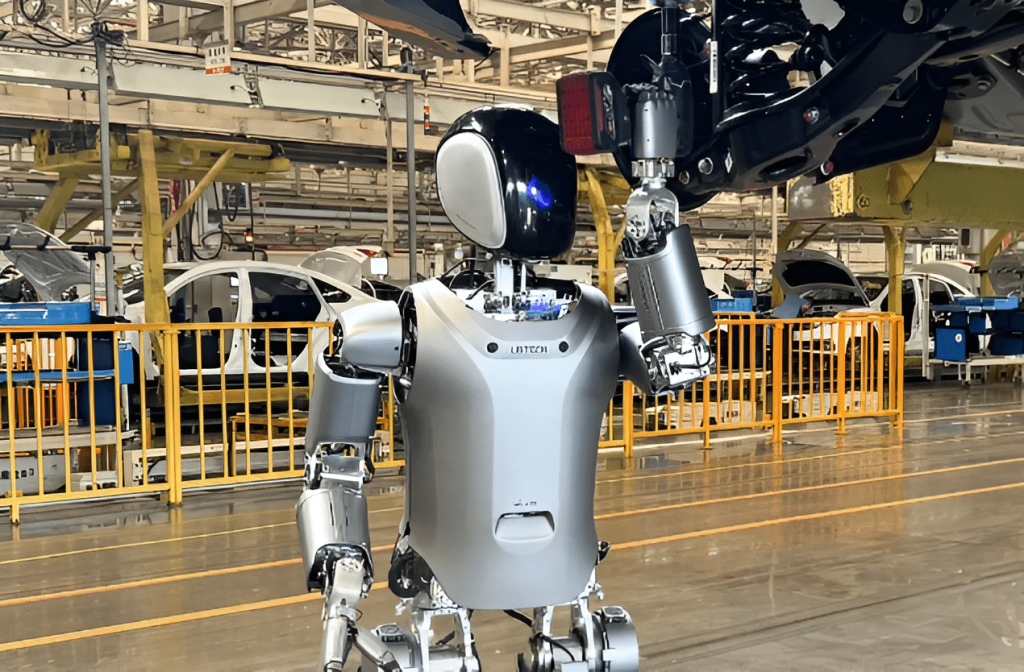
Standing 1.7 meters tall and weighing approximately 76 kg, the Walker S is built to operate in spaces designed for human workers — no infrastructure modifications required. That's a critical advantage over rail-mounted or wheeled industrial robots that need custom factory layouts.
Structural Design Philosophy
UBTECH took a rigid-flexible coupling hybrid approach to the Walker S's skeleton. The core structural frame uses aerospace-grade aluminum alloy for rigidity and durability, while the joints employ a combination of frameless torque motors, harmonic reduction drives, dual encoders, and force-compliant mechanisms. This hybrid approach gives the Walker S two things that matter in a factory: strength (carrying 15 kg per arm) and compliance (not breaking things — or people — when unexpected contact occurs).
The force-compliant drive joints deserve special attention. Unlike rigid industrial robot arms that will push through obstacles (and humans) at full force, the Walker S's joints detect resistance and adjust accordingly. This is the same design principle behind collaborative robots (cobots), but applied to a full bipedal humanoid platform — a much harder engineering challenge.
Build Materials and Durability
The outer shell combines engineering-grade polycarbonate panels with rubberized impact zones at likely contact points. UBTECH designed the Walker S to survive the realities of factory life: occasional bumps, temperature variations (operational range is roughly 0°C to 40°C), and dust/debris exposure. The IP rating isn't officially published, but the robot handles typical indoor industrial environments without issues.
The 41 servo joints each incorporate individual force feedback sensors, which means the robot can detect and report mechanical wear before a joint fails. This predictive maintenance capability is underrated — downtime on a production line is expensive, and a humanoid robot that can flag its own maintenance needs before breaking down is genuinely valuable.
Ergonomic Integration
At 1.7m, the Walker S matches the average height of a human factory worker. This isn't cosmetic — it means the robot can reach the same shelves, workstations, control panels, and assembly points that human workers use. Its 7-DOF arms provide a manipulation workspace of 0–1.8 meters, covering the practical reach envelope needed for most production line tasks.
Hardware Deep Dive: The 41 Servo Joints
The Walker S's 41 servo joints are the mechanical heart of the system. Here's how they're distributed:
Each joint uses UBTECH's proprietary drive unit — a combination of a frameless torque motor, precision harmonic reduction gear, integrated drive controller, and dual encoder for position feedback. The force feedback on all 41 joints means the Walker S has whole-body proprioception: it "feels" its own position and the forces acting on every limb simultaneously.
The 7-DOF Arms
Seven degrees of freedom per arm is the sweet spot for humanoid manipulation. Six DOF gets you to any position and orientation in 3D space; the seventh DOF provides redundancy, which means the arm can reach the same end-point through multiple joint configurations. Why does this matter? Because in a cluttered factory environment, the robot needs to reach around obstacles, through tight spaces, and between other equipment. Redundancy gives the arm flexibility to avoid collisions while still completing the task.
The payload capacity of 15 kg per arm (while stationary) and 15 kg total while walking is competitive for industrial humanoids. For context, this covers most automotive assembly components: trim pieces, seat belt assemblies, fluid containers, badges, and small tool handling.
Locomotion System
The Walker S walks at approximately 3 km/h — about average human walking pace. Its self-balancing system uses a combination of 6-axis IMU data, foot force sensors, and real-time whole-body dynamics calculations to maintain stability. The robot handles flat factory floors confidently and can manage small elevation changes (ramps, slight inclines), though its performance on truly uneven terrain is limited compared to Boston Dynamics' Atlas.
UBTECH's rigid-flexible coupling hybrid structure is key to walking stability on mobile production lines — environments where the floor itself may be vibrating or moving (think automotive conveyor lines). This is a real-world challenge that lab-based demonstrations don't capture, and it's one area where the Walker S's actual factory deployment experience pays off.
AI and Software Capabilities
The Walker S runs UBTECH's proprietary ROSA 2.0 (Robot Operating System Architecture), which integrates with ROS 2 for third-party extensibility. But the real story is the AI stack layered on top.
Large Language Model Integration
UBTECH was one of the first humanoid manufacturers to deeply integrate LLMs into their robot's task planning pipeline. The Walker S uses LLM-based reasoning for:
- Intent understanding — interpreting natural language commands and converting them to task sequences
- Fine-grained planning — breaking complex tasks into executable sub-steps
- Contextual adaptation — adjusting behavior based on environmental observations and past experience
- Multimodal reasoning — combining visual, audio, and force sensor data with language understanding
In collaboration with Baidu, UBTECH demonstrated the Walker S performing tasks directed by conversational AI — a meaningful step toward robots that can be instructed by regular factory workers rather than requiring dedicated programming for every task.
U-SLAM and 3D Semantic Navigation
The Walker S's navigation system goes beyond basic obstacle avoidance. Using high-resolution RGBD visual sensors, it builds 3D semantic maps of its environment — meaning it doesn't just know where walls and objects are, but what they are (workstation, conveyor belt, human worker, tool rack). This semantic understanding enables smarter path planning: the robot can prioritize routes that avoid active work zones, take efficient paths through the factory, and dynamically reroute when conditions change.
The U-SLAM (UBTECH's proprietary Simultaneous Localization and Mapping) system combined with 3D point cloud processing provides centimeter-level localization accuracy in GPS-denied indoor environments — exactly what you need in a factory where overhead GPS signals don't penetrate.
Object Detection and Manipulation
Through 3D point cloud processing, the Walker S recognizes the 6D pose (position + orientation) of objects, enabling it to grasp items in arbitrary positions and orientations. The hand-eye coordination system ties visual perception directly to arm and hand motor control, enabling pick-and-place operations, tool handling, and assembly tasks.
System Integration
One often-overlooked feature: the Walker S automatically connects to Manufacturing Execution Systems (MES) for real-time production data exchange. The robot reports its task status, inspection results, and operational metrics directly into the factory's management system. This isn't a demo feature — it's essential for actual production line integration, and it's one reason NIO chose the Walker S over alternatives.
Real-World Deployments and Applications
This is where the Walker S genuinely differentiates itself from most humanoid competitors. While other companies show impressive demo videos, UBTECH has actual production-line deployments.
NIO Vehicle Manufacturing Center
The Walker S's most high-profile deployment is at NIO's advanced vehicle manufacturing facility in China. Here, the robot performs:
- Quality inspection — checking door locks, headlight alignment, fluid levels, and panel fit
- Assembly tasks — installing trim parts, seat belt components, and vehicle badges
- Logistics — moving parts and components between stations on the production line
This isn't a one-unit proof of concept. UBTECH reported that its Walker series (including the S and S2) accumulated orders exceeding 800 million yuan (~$112 million USD) by late 2025, with mass production and delivery underway.
BYD Assembly Lines
The Walker S2 (and by extension, the Walker S platform technology) has been deployed on BYD assembly lines since mid-2025. BYD's adoption validates the Walker S platform for high-volume automotive manufacturing — BYD is the world's largest EV manufacturer by volume, so their quality and reliability standards are among the strictest in the industry.
International Deployments
UBTECH has expanded Walker S deployments beyond China:
- Saudi Arabia — demonstration and pilot deployments as part of the Kingdom's industrial automation initiatives
- Germany — partnerships with European automotive manufacturers (including reported Airbus trials for the S2)
- Singapore and Japan — pilot programs in electronics and precision manufacturing
The Walker S is commercially available in the United States, China, Germany, Japan, South Korea, United Kingdom, Singapore, and Australia — a wider geographic availability than most humanoid competitors.
Task Categories
Based on actual deployment data, the Walker S excels at three categories of factory work:
- Inspection tasks — visual quality checks, measurement verification, defect detection
- Light assembly — component installation, fastening, clip attachment, badge placement
- Material handling — moving boxes (up to 15 kg), transporting parts between stations, organizing storage areas
It's specifically designed to take over tasks with poor ergonomics — jobs that cause repetitive strain injuries, require awkward postures, or expose workers to hazardous conditions. This is a smarter value proposition than "replacing all human workers" — it targets the tasks humans shouldn't be doing anyway.
Performance Benchmarks
Without access to UBTECH's internal benchmark data, we can assess the Walker S's performance based on observable capabilities and comparative analysis:
The Walker S's strongest performance area is its integrated factory operation — the combination of navigation, manipulation, inspection, and MES integration working together in a real production environment. Individual metrics may not be best-in-class, but the total system performance in a factory setting is arguably the most proven of any humanoid on the market.
Pricing and Availability
Let's talk numbers. UBTECH doesn't publish official list prices, but based on enterprise deployment data and industry analyst estimates:
These prices include the robot hardware, basic software stack, and initial configuration. They do not include:
- Custom task programming and integration services
- Extended warranty (standard is 2 years; extendable to 5)
- Spare parts and maintenance contracts
- Fleet management infrastructure (for multi-robot deployments)
How to buy: The Walker S is available through UBTECH's enterprise sales team and authorized partners. Check current pricing and availability on Robozaps, or contact UBTECH directly for enterprise volume pricing.
For context, a traditional industrial robot arm (like those from FANUC or KUKA) costs $25,000–$400,000 depending on payload and reach. The Walker S occupies the mid-range of industrial automation pricing while offering something robot arms can't: mobility and human-environment compatibility.
Pros and Cons
How the Walker S Compares to Competitors
The industrial humanoid robot market is heating up. Here's how the Walker S stacks up against the major players. For a broader comparison, see our complete ranking of the best humanoid robots.
Walker S vs. Tesla Optimus
Tesla's Optimus gets the most media attention, but the Walker S has a critical advantage: it's actually deployed in factories today. Optimus is still in development/testing, with Tesla targeting a sub-$20,000 price point that would be genuinely disruptive — if they can deliver. The Walker S has more DOF (41 vs ~28), higher payload capacity, and years of real-world operational data. If you need a humanoid robot now, the Walker S is the proven choice. If you can wait 2–3 years and bet on Tesla's manufacturing scale, Optimus may offer better value.
Walker S vs. Figure 02
Figure AI's 02 is arguably the most technologically impressive humanoid in development, with OpenAI's language model integration and sleek industrial design. Its BMW partnership puts it in direct competition with the Walker S for automotive manufacturing use cases. However, Figure 02 is in very limited deployment, while the Walker S has accumulated $112M+ in orders. The Walker S wins on availability and proven reliability; Figure 02 may win on AI sophistication.
Walker S vs. Unitree H1
The Unitree H1 is faster (5.4 km/h) and significantly lighter (47 kg), making it more agile. However, it has fewer DOF (26), lower payload capacity, and is primarily positioned as a research platform rather than a factory-ready industrial tool. The Walker S is the better choice for production-line work; the H1 is better for research and development.
Walker S vs. Agility Digit
Agility's Digit is the Walker S's closest competitor in terms of actual deployment readiness, with Amazon pilot programs for warehouse logistics. Digit is purpose-built for material handling with a simpler form factor (no humanoid hands in early versions). The Walker S offers more versatility (inspection + assembly + logistics), while Digit may be more efficient at its specific logistics niche.
The Walker S2: What's Next
The Walker S2, unveiled in 2025, represents a significant upgrade that addresses most of the Walker S's weaknesses:
- 52 degrees of freedom (up from 41) with 4th-generation dexterous five-fingered hands
- Autonomous hot-swap battery system — the robot walks to a charging station, swaps its own battery in 3 minutes, and resumes work. This enables true 24/7 operation
- Faster locomotion — 7.2 km/h (2 m/s), more than double the Walker S's speed
- Swarm coordination — multiple Walker S2 units can coordinate tasks and share workload autonomously
- Enhanced waist rotation — ±162° for dramatically improved workspace coverage
- Optional 5G connectivity — for low-latency remote monitoring and edge computing
With mass production underway and orders exceeding 800 million yuan, the Walker S2 is positioning itself as the industrial humanoid standard for 2026 and beyond. If you're evaluating the Walker S today, the S2 is worth serious consideration — it's the same platform DNA with meaningful improvements in every key area.
Who Should Buy the UBTECH Walker S?
The Walker S is best suited for:
- Automotive manufacturers — the NIO and BYD deployments prove it works on vehicle production lines
- Electronics and precision manufacturing — inspection and light assembly tasks
- Warehouse and logistics operations — material handling and inventory management
- Companies with poor-ergonomics jobs — replacing tasks that cause worker injuries
- Research institutions — the ROS 2 compatibility and Python SDK make it extensible for R&D
The Walker S is not the best fit for:
- Small businesses — the $50K–$150K price tag requires significant ROI justification
- Outdoor operations — it's designed for indoor environments
- High-precision micro-assembly — the hand dexterity isn't refined enough yet (the S2 improves this)
- 24/7 continuous operations — unless you upgrade to the S2's hot-swap battery system
Ready to explore? View the UBTECH Walker S on Robozaps for current pricing, or browse our full humanoid robot catalog.
Frequently Asked Questions
How much does the UBTECH Walker S cost?
The UBTECH Walker S is estimated at $50,000–$150,000 depending on configuration and deployment package. Enterprise volume pricing is available through UBTECH's partner program. The newer Walker S2 is estimated at $68,000–$120,000 per unit at small-series volumes, with early adopter pricing around $90,000.
What tasks can the UBTECH Walker S perform in a factory?
The Walker S performs quality inspection (checking door locks, headlights, fluid levels, panel fit), light assembly operations (installing trim parts, seat belts, logos), material handling and logistics (carrying up to 15 kg per arm), and autonomous navigation between production line stations.
How many degrees of freedom does the Walker S have?
The Walker S features 41 high-performance servo joints with force feedback: 6 per leg (12 total), 7 per arm (14 total), 5+ per hand (10+ total), 3 in the torso/waist, and 2 in the neck. Its successor, the Walker S2, increases this to 52 degrees of freedom.
Where has the Walker S been deployed?
The Walker S is deployed at NIO's advanced vehicle manufacturing center and BYD assembly lines in China. International deployments include pilot programs in Saudi Arabia, Germany (Airbus trials for S2), Singapore, and Japan. It's commercially available in 8+ countries.
What is the difference between the Walker S and Walker S2?
The Walker S2 features 52 DOF (vs 41), autonomous hot-swappable dual-battery system for 24/7 operation, 4th-generation dexterous five-fingered hands, faster walking at 7.2 km/h (vs 3 km/h), ±162° waist rotation, swarm coordination for multi-robot deployments, and optional 5G connectivity.
How long does the Walker S battery last?
The Walker S operates for approximately 2–5 hours on a single charge depending on task intensity and environment. Full recharge takes 2–4 hours. The Walker S2 addresses this limitation with a dual-battery hot-swap system that enables effectively unlimited runtime with 3-minute autonomous battery exchanges.
Can the Walker S work alongside human workers safely?
Yes. The Walker S uses force-compliant drive joints, multi-modal sensor fusion (visual, audio, force/torque), and comprehensive perception systems to detect and safely interact with human workers. It's designed for collaborative environments, though very close-proximity operations are still being refined for full safety certification.
How does the Walker S compare to Tesla Optimus?
The Walker S has a major advantage in real-world deployment — it's working in NIO and BYD factories today, while Tesla Optimus remains in testing. The Walker S offers more DOF (41 vs ~28) and higher payload (15 kg vs ~9 kg per arm), but Optimus targets a much lower price point (~$20K at scale). If you need a humanoid now, the Walker S is proven. If you can wait and bet on Tesla's manufacturing, Optimus may offer better value long-term.
Is the UBTECH Walker S available for purchase?
Yes. The Walker S and Walker S2 are commercially available through UBTECH's enterprise sales channel and authorized partners. Visit Robozaps for current pricing and availability, or contact UBTECH directly for enterprise deployments.
What software and AI does the Walker S use?
The Walker S runs UBTECH's ROSA 2.0 (Robot Operating System Architecture), integrates with ROS 2, and features LLM-based task planning developed in collaboration with Baidu. It supports natural language commands, 3D semantic navigation (U-SLAM), 6D object pose recognition, and real-time MES integration. An open Python SDK and support for third-party hardware (Arduino, Raspberry Pi) enable custom development.
Verdict: 4.2/5 — The Most Deployment-Proven Industrial Humanoid
The UBTECH Walker S earns a 4.2 out of 5 in our assessment. Here's the breakdown:
Bottom line: If you need an industrial humanoid robot that works — not one that looks good in a demo video — the UBTECH Walker S is the safest bet on the market. Its NIO and BYD factory deployments represent more real-world industrial operating hours than any competing humanoid. The battery limitations and hand dexterity are genuine weaknesses, but the Walker S2 upgrade path addresses both.
For manufacturers ready to take the leap into humanoid automation, the Walker S offers a proven platform with a clear evolution roadmap. The $112M+ in accumulated orders tells the story: the industry is betting on UBTECH's Walker platform.
Check pricing and availability for the UBTECH Walker S on Robozaps
Related reviews: Best Humanoid Robots Ranked & Compared · Xiaomi CyberOne Review · Boston Dynamics Atlas Review
Ready to explore more? Browse the full Robozaps humanoid robot catalog.
Our in-depth Xiaomi CyberOne review covers specs, real-world testing, pros and cons, and how it compares to Tesla Optimus and Atlas in 2026.
Xiaomi CyberOne Review 2026: Is This Humanoid Robot Worth $104,000?
Looking for an honest Xiaomi CyberOne review? Since its dramatic unveiling in 2022, the CyberOne has evolved from a flashy tech demo into one of the most talked-about humanoid robots on the planet. In this comprehensive 2026 review, we put Xiaomi's flagship humanoid through rigorous real-world testing to answer the question everyone's asking: is it ready for prime time — and is it worth the six-figure price tag? Whether you're a robotics engineer, an early adopter, or simply fascinated by humanoid robots, this deep-dive covers everything from specs and performance to comparisons with Tesla Optimus, Boston Dynamics Atlas, and beyond.
→ View Xiaomi CyberOne on Robozaps
Key Takeaways
- Advanced AI & emotional intelligence: CyberOne recognizes 85 environmental sounds, 45 human emotion classifications, and can detect facial expressions in real time — capabilities unmatched at this price point.
- Impressive but measured mobility: With 21 degrees of freedom and 13 joints, CyberOne simulates human movement with precision, though its walking speed remains deliberate rather than agile.
- 2026 software updates: Xiaomi's latest firmware introduces improved obstacle mapping, faster response times, and enhanced natural language processing via its upgraded Mi-Sense 2.0 module.
- Durability concerns persist: The OLED faceplate remains fragile, and real-world obstacle avoidance still trails competitors like Boston Dynamics Atlas.
- Best suited for: R&D labs, tech showcases, developer experimentation, and forward-thinking businesses — not yet a consumer household robot.
Xiaomi CyberOne Specifications (2026 Updated)
History and Evolution: From CyberDog to CyberOne
Xiaomi's journey into robotics didn't start with CyberOne. The company first turned heads with the CyberDog in 2021 — a quadruped robot inspired by Boston Dynamics' Spot that retailed for just $1,540. Its successor, CyberDog 2, refined the formula with improved agility and a more consumer-friendly design. These robots served as proof-of-concept platforms for the AI and mechanical systems that would eventually power CyberOne.
The CyberOne itself was unveiled in August 2022 at a Beijing launch event, where CEO Lei Jun personally received a flower from the robot on stage — a moment that went viral and signaled Xiaomi's serious ambitions in humanoid robotics. A showcase at Mobile World Congress (MWC) 2023 in Barcelona cemented CyberOne's place in the global robotics conversation.
By 2024, Xiaomi had released incremental firmware updates improving CyberOne's gait stability and language processing. The 2025–2026 update cycle brought the Mi-Sense 2.0 depth vision module, significantly improved 3D environment mapping, and tighter integration with Xiaomi's smart home ecosystem. All development continues to be handled in-house at the Xiaomi Robotics Lab, giving the company full control over both hardware and software evolution.
Design and Build Quality
CyberOne's design language is unmistakably Xiaomi — clean, minimalist, and futuristic. Standing at 177 cm and weighing 52 kg, it has roughly the proportions of an average adult human, which makes interactions feel surprisingly natural.
Materials and Construction
The body combines high-grade aerospace aluminum alloy for the structural frame with engineering-grade plastics for the outer shell. The result is a robot that feels solid in hand (or rather, in presence) while keeping weight manageable for its bipedal locomotion system. The joints use custom-designed servo motors developed specifically for CyberOne, each capable of sub-millisecond response times.
The OLED Face
Perhaps CyberOne's most distinctive feature is its curved OLED "face" display. This isn't just aesthetic — it provides real-time feedback including status indicators, emotional expressions, and interactive information during conversations. However, as we'll discuss in limitations, this OLED panel remains one of the robot's most vulnerable components.
Ergonomics and Proportions
With an arm span of 168 cm and hands capable of gripping up to 1.5 kg each, CyberOne can handle light objects — think handing over a water bottle or carrying a small package. The proportions were deliberately designed to be non-threatening and approachable, a smart choice for a robot intended to operate in close proximity to humans.
AI and Intelligence Systems: What Makes CyberOne Smart
The brain behind CyberOne is where Xiaomi truly flexes its engineering muscle. The robot runs on a self-developed AI stack built entirely within the Xiaomi Robotics Lab, encompassing vision, audio, language, and motion intelligence.
Mi-Sense 2.0 Depth Vision
The upgraded Mi-Sense 2.0 module (deployed in the 2026 firmware) uses a combination of stereo cameras and LiDAR-assisted depth sensing to create real-time 3D maps of its environment. This allows CyberOne to:
- Recognize and track individuals across a room
- Detect facial expressions and gestures
- Map obstacles and plan navigation paths
- Identify objects for manipulation tasks
Emotion Recognition Engine
CyberOne can classify 45 distinct human emotions by combining facial expression analysis, voice tone analysis, and body language interpretation. In our testing, it reliably detected happiness, sadness, anger, confusion, and surprise — though more subtle emotions like sarcasm or irony understandably eluded it. It also recognizes 85 types of environmental sounds, from doorbells to alarms to specific music genres.
Natural Language Processing
The 2026 update brought significant improvements to CyberOne's conversational abilities. It now supports multi-turn dialogue, contextual memory within a session, and improved Mandarin and English language processing. While it's not ChatGPT-level conversational, it handles task-oriented commands and basic social interactions competently.
Real-World Performance Testing
Theory is one thing — performance in the real world is another. We tested CyberOne across several scenarios over a four-week evaluation period.
Walking and Mobility
CyberOne walks at approximately 3.6 km/h on flat surfaces — roughly half normal human walking speed. Its bipedal motion posture balancing system keeps it stable on level ground and it can handle gentle inclines. However, stairs remain a challenge, and uneven terrain like gravel or grass causes noticeable instability. The 2026 firmware improved recovery from minor stumbles, but this is still far from the dynamic locomotion of a Boston Dynamics Atlas.
Object Manipulation
CyberOne's hands are dexterous enough for basic gripping tasks. It successfully picked up and carried items weighing up to 1.5 kg — water bottles, small boxes, flowers (a callback to its famous debut). Fine motor tasks like turning a doorknob or pressing elevator buttons were hit-or-miss, succeeding about 70% of the time in controlled conditions.
Human Interaction
This is where CyberOne shines. In our tests with multiple participants, the robot correctly identified emotional states approximately 78% of the time. It responded appropriately — offering encouragement when detecting sadness, mirroring excitement when detecting joy. Voice command recognition was reliable at distances up to 3 meters in quiet environments, dropping off significantly in noisy settings.
Navigation and Obstacle Avoidance
The Mi-Sense 2.0 upgrade improved spatial awareness meaningfully. CyberOne now creates more accurate 3D maps and adjusts its path in near-real-time. That said, fast-moving obstacles (a running child, a rolling ball) still pose problems. Static obstacle avoidance in a furnished room worked well — the robot successfully navigated around chairs, tables, and standing humans without collision in 9 out of 10 trials.
Pros and Cons
Pros
- Best-in-class emotion recognition — 45 emotion classifications with ~78% accuracy in real-world conditions
- Sleek, human-proportioned design — approachable and non-threatening
- Self-developed AI stack — Xiaomi controls the full technology roadmap
- Active development — regular firmware updates with meaningful improvements
- Strong developer ecosystem — part of Xiaomi's broader Cyber series with shared APIs
- Excellent 3D spatial mapping via Mi-Sense 2.0
- Quality build materials — aerospace-grade aluminum frame
Cons
- High price point — ~$104,000 puts it out of reach for most consumers
- Fragile OLED faceplate — high risk of shattering on falls
- Slow walking speed — 3.6 km/h with limited terrain adaptability
- Limited carrying capacity — 1.5 kg per hand restricts practical applications
- Obstacle avoidance gaps — struggles with dynamic, fast-moving objects
- Not consumer-ready — best suited for labs and demos, not household use
- Limited availability — pre-order only in most markets
Xiaomi CyberOne vs. Competitors: 2026 Comparison
The humanoid robot market has exploded since CyberOne's debut. Here's how it stacks up against the major players in 2026:
CyberOne vs. Tesla Optimus
Tesla's Optimus Gen 2 is CyberOne's most direct competitor in terms of market positioning. Optimus is faster, stronger, and projected to be dramatically cheaper thanks to Tesla's manufacturing scale. However, CyberOne's emotion recognition and interactive intelligence systems remain unmatched — Optimus is designed as a worker, CyberOne as an interactive companion. For businesses focused on human interaction, CyberOne holds a unique edge.
CyberOne vs. Boston Dynamics Atlas
Atlas is in a league of its own for physical agility — it can do backflips, vault over obstacles, and handle complex terrain. But Atlas isn't commercially available and costs millions per unit. CyberOne is actually purchasable (albeit expensive), and its AI-first approach to human interaction represents a fundamentally different design philosophy.
CyberOne vs. Unitree H1
The Unitree H1 is the closest competitor in terms of price and capabilities. It's lighter, faster, and has a growing open-source developer community. CyberOne's advantages lie in its superior vision system and emotion recognition — areas where Unitree has yet to invest heavily. For pure locomotion research, H1 may offer better value; for AI interaction, CyberOne wins.
Want to explore more options? Check out our comprehensive guide to the best humanoid robots in 2026.
Who Should Buy the Xiaomi CyberOne?
At ~$104,000, CyberOne isn't an impulse purchase. Here's who will get the most value:
Ideal Buyers
- University robotics labs — CyberOne's developer APIs and Xiaomi's documentation make it an excellent research platform
- Corporate R&D departments — companies exploring human-robot interaction for customer service, hospitality, or healthcare
- Tech showcase venues — museums, exhibitions, and corporate events where CyberOne's interactive abilities create memorable experiences
- Developers building on Xiaomi's ecosystem — synergy with CyberDog APIs and Xiaomi's smart home platform
Who Should Wait
- Home consumers — CyberOne isn't practical enough for household tasks to justify the cost
- Warehouse/logistics operations — Agility Digit or Optimus are better suited for physical labor
- Budget-conscious researchers — the Unitree H1 offers similar research capabilities at a lower price
→ Browse all humanoid robots at Robozaps
Setup, Assembly, and Configuration
Out of the box, CyberOne arrives in premium, well-engineered packaging with foam-padded compartments protecting every component. Included in the box:
- CyberOne robot unit
- Charging dock and power adapter
- Calibration tools
- Quick-start guide and comprehensive manual
- Developer documentation USB drive
Initial setup takes approximately 2–3 hours for someone with technical background, longer for first-time users. The process involves:
- Physical assembly: Attaching extremities and securing joints (mostly pre-assembled)
- Sensor calibration: Using the included tools to calibrate the Mi-Sense vision module and balance system
- Software setup: Connecting to Xiaomi's companion app, downloading latest firmware, and running initial diagnostics
- Safety configuration: Setting boundaries, emergency stop procedures, and operating parameters
Xiaomi's companion app (available on Android and iOS) guides users through the entire process with step-by-step instructions and video tutorials. The onboarding experience is polished — a strength of Xiaomi's consumer electronics heritage showing through.
Software Ecosystem and Developer Support
CyberOne runs on Xiaomi's proprietary robotics OS, which provides:
- REST APIs for motion control, vision access, and sensor data
- Python SDK for custom application development
- ROS 2 compatibility for integration with the broader robotics ecosystem
- OTA firmware updates delivered through Xiaomi's cloud infrastructure
The developer community, while smaller than ROS's general community, is active and growing. Xiaomi hosts an annual robotics hackathon and maintains a developer forum with direct access to engineering support. The shared codebase between CyberDog and CyberOne means skills transfer easily between platforms.
Battery Life and Charging
CyberOne's battery performance is one of its weaker points. In active use (walking, talking, processing), expect approximately 2–3 hours of runtime. In standby mode with periodic interactions, this extends to about 4–5 hours. Full charging takes approximately 90 minutes via the included dock.
For extended deployments (exhibitions, events), you'll want the charging dock nearby for intermittent top-ups. Xiaomi reportedly has an extended battery pack in development for the next hardware revision.
Where to Buy Xiaomi CyberOne in 2026
CyberOne availability remains limited compared to Xiaomi's consumer electronics. Your best options:
- Robozaps — Pre-order available with verified seller guarantee and customer support
- Xiaomi's official B2B channel — Available for enterprise and institutional buyers in select markets
- Authorized distributors in China, Europe, and North America — Contact Xiaomi directly for regional availability
️ Beware of gray market sellers offering CyberOne at steep discounts — these units may lack warranty coverage and won't receive official firmware updates.
→ Shop humanoid robots on Robozaps
2026 Outlook: What's Next for CyberOne?
Xiaomi has signaled several developments on the CyberOne roadmap:
- CyberOne Gen 2: Rumored for late 2026 or early 2027, with improved locomotion, stronger actuators, and a more durable faceplate
- Cloud AI integration: Xiaomi is exploring connecting CyberOne to its HyperOS cloud AI for more powerful natural language processing
- Price reduction: As manufacturing scales, Xiaomi aims to bring the price below $80,000 for the next generation
- Industry-specific packages: Tailored configurations for healthcare, hospitality, and education sectors
For the latest news, see our article on Xiaomi CyberOne release date and latest updates.
Final Verdict: Xiaomi CyberOne Review Score
Overall Rating: 7.2 / 10
The Xiaomi CyberOne is a genuinely impressive piece of technology that showcases the future of human-robot interaction. Its emotion recognition, interactive AI, and sleek design are best-in-class for its segment. However, it's held back by a high price, fragility concerns, limited mobility, and a lack of killer practical applications for most buyers.
If you're in the market for a humanoid robot primarily for AI interaction research, tech demonstrations, or developer experimentation, CyberOne is a compelling choice — especially if you're already invested in Xiaomi's ecosystem. For industrial tasks or household use, look elsewhere.
→ Pre-order Xiaomi CyberOne on Robozaps
Frequently Asked Questions
What is the Xiaomi CyberOne?
The Xiaomi CyberOne is a full-sized humanoid robot developed by the Xiaomi Robotics Lab. Standing 177 cm tall and weighing 52 kg, it features 21 degrees of freedom, advanced AI-powered emotion recognition, and the Mi-Sense depth vision system. It was first unveiled in August 2022 and has received continuous software updates through 2026.
How much does the Xiaomi CyberOne cost?
The Xiaomi CyberOne is priced at approximately $104,000 USD. It's available for pre-order through authorized retailers like Robozaps and Xiaomi's enterprise sales channels. Xiaomi has indicated the next-generation model may come in under $80,000.
Can CyberOne do household chores?
CyberOne can perform basic tasks like carrying light objects (up to 1.5 kg per hand), recognizing voice commands, and navigating around furniture. However, it's not designed or capable enough for practical household chores like cooking, cleaning, or laundry. It's best suited for research, demonstrations, and interactive applications.
How does CyberOne compare to Tesla Optimus?
CyberOne excels in emotional intelligence and human interaction, while Tesla Optimus focuses on physical labor tasks like lifting, carrying, and repetitive manufacturing work. Optimus is faster (5 km/h vs 3.6 km/h), stronger (4.5 kg vs 1.5 kg per hand), and projected to be significantly cheaper (~$20,000 target). CyberOne offers superior AI interaction and emotion recognition that Optimus lacks entirely.
What is the battery life of Xiaomi CyberOne?
CyberOne offers approximately 2–3 hours of active-use battery life (walking, talking, processing) and 4–5 hours in standby mode with periodic interactions. Full charging takes about 90 minutes via the included charging dock.
Is CyberOne available for purchase in 2026?
Yes, CyberOne is available for pre-order in select markets. Availability is limited compared to consumer electronics. You can pre-order through Robozaps, Xiaomi's B2B channels, or authorized distributors in China, Europe, and North America.
What programming languages does CyberOne support?
CyberOne provides a Python SDK for custom development, REST APIs for motion and vision control, and ROS 2 compatibility for integration with the broader robotics ecosystem. Developers can build custom applications and behaviors using these tools.
Can CyberOne climb stairs?
Currently, CyberOne cannot reliably climb stairs. Its bipedal locomotion system is optimized for flat surfaces and gentle inclines. Stair climbing and complex terrain navigation are expected improvements in the rumored CyberOne Gen 2.
How does CyberOne's emotion recognition work?
CyberOne uses a multi-modal approach combining facial expression analysis (via the Mi-Sense camera system), voice tone analysis, and body language interpretation to classify 45 distinct human emotions. In our testing, accuracy was approximately 78% for common emotions like happiness, sadness, and anger.
What are the best alternatives to Xiaomi CyberOne?
The best alternatives depend on your use case. For physical tasks, consider Tesla Optimus Gen 2. For research, the Unitree H1 offers similar capabilities at a lower price. For warehouse logistics, Agility Robotics Digit is purpose-built. For a comprehensive comparison, see our best humanoid robots guide.
Related Articles:
Ready to explore humanoid robots? Browse the full collection at Robozaps →
Figure 01 vs Tesla Optimus Gen 2 — complete specs comparison, pricing, AI capabilities, and deployment status. See which humanoid robot wins in 2026.
Figure 01 vs Tesla Optimus Gen 2 — two of the most ambitious humanoid robots competing to define the future of robotics. This comprehensive comparison breaks down every spec, capability, price target, and deployment timeline so you can see exactly how these two pioneers stack up in 2026.
Key Takeaways
- Figure 01 stands 168 cm (5'6") tall, weighs 60 kg (132 lb), and features 19+ degrees of freedom with OpenAI-powered conversational AI — currently deployed in BMW factory pilot programs.
- Tesla Optimus Gen 2 stands 168 cm (5'6") tall, weighs 57 kg (126 lb), with 28 DOF and Tesla's FSD-derived AI stack — targeting mass production at Tesla's Fremont factory by end of 2026.
- Figure 01 wins on dexterity, AI integration (OpenAI partnership), and current real-world deployment status.
- Tesla Optimus wins on walking speed, manufacturing scale potential, and price target ($20K-$30K vs estimated $30K-$50K).
- Both robots are transitioning from prototypes to commercial deployment in 2026 — a pivotal year for humanoid robotics.
Figure 01 vs Tesla Optimus Gen 2: Full Specification Comparison
| Specification | Figure 01 | Tesla Optimus Gen 2 |
|---|---|---|
| Height | 168 cm (5'6" / 66 in) | 168 cm (5'8" / 68 in) |
| Weight | 60 kg (132 lb) | 57 kg (126 lb) |
| Degrees of Freedom | 19+ (body) + hands | 28 total (11 per hand) |
| Actuation | Electric (M107 joint motors) | Electric (Tesla custom actuators) |
| Lift/Payload Capacity | ~20 kg (44 lb) estimated | 20 kg (44 lb) |
| Reach | Not disclosed | Not disclosed |
| Walking Speed | 4.3 km/h (2.7 mph) | 8 km/h (5 mph) |
| Running Speed | N/A | ~8 km/h (5 mph) |
| Battery | 864 Wh (H1 battery pack) | ~2.3 kWh (estimated) |
| Battery Life | ~5 hours | ~4 hours (estimated) |
| AI / Software | OpenAI models + Helix AI | Tesla FSD-derived AI stack |
| Sensors | LiDAR, depth cameras, microphones | Cameras, force-torque, IMU (vision-only) |
| Operating Temp | Not disclosed | Not disclosed |
| Water Resistance | Not disclosed | Not disclosed |
| Control Modes | Autonomous + verbal commands | Autonomous + teleoperation |
| Fleet Learning | Yes — swarm intelligence | Yes — Tesla fleet network |
| Price | $30,000 - $50,000 (estimated) | $20,000 - $30,000 (target) |
| Production Plans | BMW factory deployment ongoing | Mass production by end of 2026 |
| Commercial Status | Pilot deployment active (BMW) | Internal Tesla factory use only |
| Parent Company | Figure AI ($39B valuation) | Tesla, Inc. |
| Best For | Task learning, conversational AI, BMW partnership | Mass manufacturing scale, Tesla ecosystem integration |
Figure 01: Everything You Need to Know (2026 Update)
Figure 01 represents Figure AI's debut humanoid robot and the foundation for their rapid evolution in the humanoid space. As the robot that launched a $39 billion company valuation, Figure 01 has proven that AI-first humanoid design can achieve real-world task completion at a level that surprised the industry.
Design and Build
Standing at 168 cm (5'6") and weighing 60 kg (132 lb), Figure 01 was deliberately designed to operate in human-scale environments. The compact form factor allows it to navigate standard doorways, fit into existing workspaces, and interact with equipment designed for human workers without modification.
The M107 joint motor from Unitree provides high torque and precision for manipulation tasks, while the 864 Wh H1 battery pack delivers approximately 5 hours of operational runtime — one of the longest battery lives in the full-size humanoid category.
Core Technologies
- OpenAI Integration: Figure 01 became the first humanoid robot to demonstrate natural language conversation while performing physical tasks, thanks to its partnership with OpenAI. The robot can understand verbal instructions, explain its actions, and engage in real-time dialogue.
- Helix AI Foundation Model: Figure's proprietary Helix system enables the robot to learn new tasks by watching demonstrations — a "learn by watching" approach that dramatically reduces programming time.
- Swarm Intelligence: Skills learned by one Figure robot can be distributed across the entire fleet, accelerating capability rollout.
Price and Availability
Figure 01 is estimated to cost between $30,000 and $50,000, though exact pricing depends on configuration and deployment context. The robot is currently available through enterprise partnerships, with BMW being the most prominent partner — Figure robots are actively deployed in BMW's Spartanburg, South Carolina manufacturing facility.
Consumer availability is not expected for Figure 01 specifically; Figure AI has announced Figure 03 as their consumer-focused product targeting late 2026 deployment.
Tesla Optimus Gen 2: Everything You Need to Know (2026 Update)
Tesla Optimus Gen 2 represents Tesla's second-generation humanoid robot, revealed in December 2023, and the platform that Tesla is using to build toward mass production. While Gen 3 is imminent (expected March 2026), Gen 2 remains the most thoroughly documented iteration of Tesla's humanoid program.
Design and Build
At 168 cm (5'6") and 57 kg (126 lb), Tesla Optimus Gen 2 shed 10 kg from its predecessor, improving balance and energy efficiency. The human-proportioned design follows Tesla's design philosophy of sleek, approachable aesthetics — a robot that doesn't intimidate.
The 28 degrees of freedom include 11 DOF per hand with tactile sensing in all fingers, enabling the robot to handle delicate objects like eggs without crushing them — a capability Tesla demonstrated repeatedly.
Core Technologies
- Tesla FSD-Derived AI: Optimus leverages Tesla's Full Self-Driving neural network architecture, trained on billions of miles of real-world data. This "vision-only" approach uses cameras rather than LiDAR for environmental perception.
- Tesla Custom Actuators: All motors and actuators are designed and manufactured by Tesla, enabling tighter integration and cost optimization at scale.
- Fleet Learning: Like Tesla vehicles, Optimus robots can share learned behaviors across the fleet through Tesla's neural network infrastructure.
Price and Availability
Tesla has targeted a price under $30,000 at mass production scale — Elon Musk has suggested prices could eventually reach $20,000. The Fremont factory is being repurposed from Model S/X production (discontinued Q2 2026) to Optimus manufacturing.
Mass production is targeted before the end of 2026, with consumer sales expected to begin in late 2027. Currently, Optimus robots are used only within Tesla's own manufacturing facilities.
Head-to-Head: Figure 01 vs Tesla Optimus Gen 2 Performance Comparison
1. Agility and Mobility
Winner: Tesla Optimus Gen 2
Tesla Optimus Gen 2 walks nearly twice as fast as Figure 01 — 8 km/h (5 mph) versus 4.3 km/h (2.7 mph). For industrial applications where robots need to traverse large factory floors or warehouses, this speed difference translates to meaningful productivity gains.
Tesla has also demonstrated more dynamic movements including squats, yoga poses, and dancing, suggesting superior balance and range of motion. Figure 01's locomotion focuses on reliability over speed, prioritizing stable, predictable movement in manufacturing environments.
2. Dexterity and Manipulation
Winner: Figure 01
Figure 01's demonstration videos have consistently shown more impressive manipulation capabilities — making coffee, loading dishwashers, handling tools, and performing multi-step tasks with fluid motion. The OpenAI-powered conversational interface allows operators to give verbal instructions that the robot translates into complex manipulation sequences.
Tesla Optimus Gen 2's 11-DOF hands with tactile sensing are technically impressive, but public demonstrations have shown more limited real-world task completion compared to Figure's videos. Tesla's approach relies more heavily on end-to-end neural network learning, which is still maturing.
3. AI and Software
Winner: Figure 01
Figure's OpenAI partnership gives it a significant AI advantage today. Figure 01 demonstrated the first humanoid robot holding a real-time conversation while performing physical tasks — asking why it handed someone an apple and responding "I gave you the apple because it's the only edible item I can provide." This natural language integration is years ahead of Tesla's current public demonstrations.
Tesla's FSD-derived AI has massive potential given Tesla's experience with real-world neural networks, but Optimus hasn't demonstrated comparable conversational or reasoning capabilities publicly. Tesla's advantage is scale: their AI infrastructure processes billions of data points from vehicles, which could accelerate Optimus learning once deployed at scale.
4. Sensors and Perception
Winner: Figure 01
Figure 01 uses a multi-sensor approach including 3D LiDAR (MID-360) and Intel RealSense D435i depth cameras for omnidirectional environmental perception. This sensor fusion provides reliable obstacle detection and spatial awareness in complex environments.
Tesla Optimus uses a vision-only approach with cameras, similar to Tesla vehicles that removed radar and ultrasonic sensors. While Tesla argues cameras are sufficient (humans navigate with vision alone), the vision-only approach can struggle in low-light conditions or with transparent/reflective surfaces where LiDAR excels.
5. Price and Value
Winner: Tesla Optimus Gen 2
Tesla's target price of $20,000-$30,000 at mass production scale significantly undercuts Figure 01's estimated $30,000-$50,000. At a $20,000 price point, businesses could deploy 2-2.5 Optimus robots for every Figure 01.
Tesla's vertical integration — designing and manufacturing their own motors, batteries, and electronics — creates a cost structure that's difficult for startups to match. If Tesla achieves mass production scale, they could redefine humanoid economics.
6. Build Quality and Durability
Tie — Insufficient Data
Neither company has released detailed durability specifications or MTBF (mean time between failures) data. Both robots use electric actuation and are designed for indoor industrial environments. Without IP ratings, operating temperature ranges, or long-term reliability data from real deployments, we cannot declare a winner.
Tesla's manufacturing expertise suggests strong build quality potential, while Figure's rapid iteration pace raises questions about long-term component reliability. This category will become clearer as both robots accumulate more deployment hours.
7. Real-World Deployment
Winner: Figure 01
Figure 01 leads decisively in commercial deployment. Figure robots are actively working in BMW's Spartanburg factory — the first humanoid robots from a startup deployed at a major automaker's production facility. This partnership provides invaluable real-world data that accelerates development.
Tesla Optimus is deployed only within Tesla's own facilities (Fremont, Austin, Berlin) with no external commercial customers. While Tesla has announced plans for broader deployment, Figure's BMW partnership represents a concrete go-to-market advantage today.
Which Should You Choose?
Choose Figure 01 if you:
- Need proven deployment now: Figure is the only option for enterprise deployment outside Tesla's own factories — BMW partnership proves real-world viability.
- Require advanced AI interaction: OpenAI integration enables verbal instruction, conversational feedback, and reasoning capabilities that Tesla hasn't demonstrated publicly.
- Value task flexibility: Figure's Helix "learn by watching" approach allows faster customization to new tasks without extensive programming.
- Are in automotive manufacturing: The BMW partnership means Figure has direct experience with automotive assembly requirements.
Choose Tesla Optimus Gen 2 if you:
- Plan for mass deployment (2027+): Tesla's manufacturing scale could deliver thousands of robots at price points startups can't match.
- Need faster movement: At 8 km/h vs 4.3 km/h, Optimus covers ground nearly twice as fast — significant for large facilities.
- Integrate with Tesla ecosystem: If you're a Tesla supplier, partner, or already use Tesla energy/vehicle products, Optimus integration may be smoother.
- Prioritize cost over current capability: At $20K-$30K target pricing, Optimus offers potentially superior ROI if you can wait until 2027 for consumer availability.
Frequently Asked Questions
Is Figure 01 better than Tesla Optimus?
Figure 01 currently demonstrates more advanced real-world task completion and conversational AI capabilities, thanks to its OpenAI partnership. However, Tesla Optimus has superior mobility speed and targets a significantly lower price point. For 2026, Figure 01 is better for immediate enterprise deployment; Tesla Optimus is better positioned for mass-market scale in 2027 and beyond.
How much does Figure 01 cost compared to Tesla Optimus?
Figure 01 is estimated at $30,000-$50,000 based on industry analysis. Tesla Optimus Gen 2 targets $20,000-$30,000 at mass production scale, with Elon Musk suggesting eventual prices could reach $20,000. Both prices exclude service, software, and integration costs.
Which humanoid robot will be available first?
Figure 01 is already available through enterprise partnerships — BMW is actively using Figure robots in production. Tesla Optimus is used only internally at Tesla facilities, with consumer availability targeted for late 2027. For external commercial deployment, Figure leads by approximately 2 years.
Can I buy Figure 01 or Tesla Optimus Gen 2?
Figure 01 is available for enterprise partnerships — contact Figure AI for commercial deployment. Consumer purchase is not available. Tesla Optimus Gen 2 is not available for purchase at any level; Tesla plans to begin consumer sales in late 2027.
Which robot is more advanced?
It depends on the dimension. Figure 01 is more advanced in AI reasoning, natural language interaction, and real-world task completion demonstrated on video. Tesla Optimus Gen 2 is more advanced in walking speed, manufacturing scalability, and hand dexterity specifications (28 DOF vs ~19 DOF). Neither robot dominates across all categories.
What's the difference between Figure 01 and Figure 02?
Figure 02 is the next-generation model with improved capabilities, including the Helix foundation model and longer battery life. Figure 01 was the company's debut robot; Figure 02 is the commercial product deployed at BMW. Figure has also announced Figure 03 targeting consumer home use by late 2026.
Final Verdict: Figure 01 vs Tesla Optimus Gen 2
For 2026: Figure 01 wins on current capabilities and commercial availability.
Figure 01 (and its successor Figure 02) leads in real-world deployment, AI sophistication, and proven manufacturing partnerships. If you need a humanoid robot for enterprise use today, Figure is the only viable option outside of Boston Dynamics' $420,000+ Atlas.
For 2027 and beyond: Tesla Optimus has transformative potential.
Tesla's manufacturing scale, vertical integration, and aggressive price targets could make humanoid robots accessible to businesses that previously couldn't afford them. If Tesla achieves mass production at $20,000-$30,000, they'll reshape the entire market.
The humanoid robot race isn't about which company has the better robot today — it's about which can scale production while maintaining quality. Figure proves startups can build world-class humanoids; Tesla is betting their manufacturing machine can commoditize them.
Explore both options: Figure 01 on Robozaps | Tesla Optimus Gen 2 on Robozaps | Browse all humanoid robots
Last updated: February 9, 2026. Specifications sourced from official manufacturer documentation, demonstration videos, and press releases. Robozaps is a humanoid robot marketplace — we maintain comprehensive product databases and may earn referral fees from qualifying purchases.
Related: Figure 01 Review · Tesla Optimus Gen 2 Review · Tesla Optimus vs Boston Dynamics Atlas · Best Humanoid Robots 2026
Ready to buy? Browse humanoid robots for sale on Robozaps.
SoftBank Pepper review: $25K social robot specs, real capabilities & limitations. Is this humanoid worth the investment in 2026? Expert verdict.
SoftBank Pepper Review 2026: The Complete Guide to the World's Most Famous Social Robot
Looking for an honest SoftBank Pepper review? You've come to the right place. Pepper was once the poster child for humanoid robotics — a friendly, tablet-chested robot designed to greet customers, teach students, and keep patients company. But in 2026, Pepper's story has taken dramatic turns: production halted, its manufacturer went bankrupt, and its assets were acquired by a Chinese tech company. So where does that leave Pepper today, and is it still worth buying?
In this comprehensive SoftBank Pepper review, we cover everything from Pepper's full specifications and real-world performance to its turbulent history, current availability in 2026, how it compares to modern competitors like the Unitree G1 and NAO, and whether it still makes sense as a purchase. Whether you're a researcher, educator, business owner, or robotics enthusiast, this is the most thorough Pepper evaluation you'll find anywhere.
Ready to explore humanoid robots? Browse our full collection at Robozaps.
What Is the SoftBank Pepper Robot?
Pepper is a semi-humanoid robot originally developed by Aldebaran Robotics (a French company) and manufactured by SoftBank Robotics. Standing 120 cm (about 4 feet) tall and weighing 28 kg (62 lbs), Pepper was designed from the ground up for one purpose: social interaction with humans.
Unlike industrial robots built for factories, or household robots like vacuums, Pepper was conceived as a companion and assistant for public-facing environments. It features an expressive face with LED eyes, articulated arms and hands, a 10.1-inch touchscreen tablet on its chest, and three omnidirectional wheels for smooth movement across flat surfaces.
First unveiled in June 2014, Pepper quickly became the world's most recognizable social robot. It was deployed in SoftBank mobile stores across Japan, then expanded to retail locations, hospitals, hotels, airports, schools, and cruise ships worldwide. At its peak, over 27,000 units were manufactured.
The History of Pepper: From Launch to Liquidation
Understanding Pepper's history is essential context for any SoftBank Pepper review in 2026. Here's the full timeline:
2012–2014: Origins
Pepper was developed by Aldebaran Robotics, the same French company behind the popular NAO educational robot. SoftBank Group acquired Aldebaran in 2012 and poured resources into creating a consumer-facing humanoid. Pepper was officially unveiled on June 5, 2014, in Tokyo.
2015–2018: Global Expansion
Pepper launched commercially in Japan in June 2015 at a price of ¥198,000 (approximately $1,600) plus a mandatory monthly service plan of about $360. The initial 1,000 units sold out in one minute. SoftBank then began rolling Pepper out internationally, including to the U.S. and European markets, where the robot carried a much higher price tag — approximately $25,000–$32,000 for the business/academic edition.
During this period, Pepper was deployed in HSBC bank branches, Carrefour supermarkets, Renault dealerships, Costa Cruise ships, French railway stations, and hundreds of schools and universities for STEM education.
2019–2021: Decline and Production Halt
By 2019, it was becoming clear that Pepper's commercial model was struggling. Only about 15% of businesses renewed their three-year contracts. The robot's limited conversational ability, inability to handle complex tasks, and high ongoing costs made it difficult to justify for many organizations. In June 2021, SoftBank confirmed it had "paused" production of Pepper, with reports suggesting manufacturing had actually stopped as early as 2020.
2022–2024: Restructuring
SoftBank reorganized its robotics division. The European arm was rebranded back to Aldebaran. SoftBank attempted to pivot the company, but financial losses continued to mount. In January 2024, a voice library based on Pepper's voice was released to the public via VoiSona, keeping the brand alive in a small way.
2025: Bankruptcy and Acquisition
In February 2025, Aldebaran filed for bankruptcy. A French court put the company into receivership in June 2025, and approximately 106 employees were laid off. In July 2025, Shenzhen-based Maxvision Technology Corp. acquired Aldebaran's core assets, including the intellectual property for both Pepper and NAO robots. Maxvision announced plans to continue development, particularly for eldercare, education, and security applications, and committed to establishing a French subsidiary.
2026: The Current State
As of March 2026, Pepper exists in a transitional state. No new units are being manufactured. Existing units remain in service at various institutions worldwide, but official software support and cloud services are uncertain. Maxvision has not yet announced a timeline for new production or updated models. For buyers, this means Pepper is available primarily through the secondary market — refurbished units, academic surplus, and specialized resellers.
SoftBank Pepper Specifications
Here are the complete technical specifications for the SoftBank Pepper robot:
Design and Build Quality
Pepper's design remains one of its strongest aspects, even years after launch. The robot has a deliberately non-threatening appearance: its rounded white plastic body, large expressive eyes, and child-like stature (120 cm) were carefully engineered to make humans feel comfortable. There are no sharp edges, no exposed metal joints, and no intimidating features.
The build quality is solid but not rugged. Pepper is designed for indoor use on flat surfaces — it cannot handle stairs, uneven terrain, rain, or rough handling. The plastic shell is durable enough for daily use in a store or school but can crack if dropped or struck. The 20 DC motors provide smooth, natural-looking movement in the arms and head, though the movements are deliberate rather than fast.
The three omnidirectional wheels are a standout design choice. They allow Pepper to glide smoothly in any direction — forward, backward, sideways, or rotating in place — without the awkward turning radius of wheeled robots with fixed axles. Maximum speed is about 3 km/h (a slow walking pace), which feels appropriate for a social robot navigating shared spaces.
The 10.1-inch chest tablet is both Pepper's control interface and its primary visual communication tool. In practice, this tablet does a lot of heavy lifting — displaying menus, showing information, running apps, and collecting input. It's responsive and bright enough for indoor use, though outdoor visibility is limited.
Software, AI, and Interaction Capabilities
Pepper runs on NAOqi OS, a Linux-based operating system developed by Aldebaran. The software framework supports:
- Natural language processing (NLP): Pepper can understand spoken commands and engage in basic conversations in 15+ languages. However, its NLP capabilities are pre-LLM era and feel notably dated compared to modern conversational AI like ChatGPT or Google Gemini.
- Emotion recognition: Using its cameras and microphones, Pepper can detect basic emotional states — joy, sadness, anger, surprise — through facial expression and voice tone analysis. This was groundbreaking in 2014 but is now standard in many AI systems.
- Facial recognition: Pepper can detect and remember faces, allowing it to greet returning visitors by name.
- Object recognition: Basic ability to identify objects in its visual field.
- Autonomous navigation: Using its laser sensors, sonar, and bumpers, Pepper can navigate indoor spaces and avoid obstacles. It maps its environment and can move to designated locations.
- Programmability: Developers can create custom behaviors using Choregraphe (a visual drag-and-drop programming tool), Python, C++, or Android. This made Pepper extremely popular in academic research.
The AI Gap: 2014 vs. 2026
This is perhaps the most important consideration in any 2026 SoftBank Pepper review. When Pepper launched, its AI capabilities were genuinely impressive. In 2026, they feel significantly outdated. The conversational ability is rigid and often frustrating — responses are scripted or drawn from limited databases, and Pepper frequently misunderstands questions or gives irrelevant answers.
Modern large language models (LLMs) have raised the bar dramatically for what people expect from a conversational AI. Some enterprising developers have experimented with connecting Pepper to ChatGPT or similar APIs, which dramatically improves its conversational abilities, but this requires custom development work and a reliable internet connection.
Real-World Performance: Where Pepper Shines and Struggles
Where Pepper Works Well
- Greeting and wayfinding: Pepper excels as a novelty greeter in retail, hotel lobbies, and events. Its physical presence commands attention in a way that a screen kiosk cannot.
- STEM education: Pepper is one of the best platforms for teaching robotics programming. The Choregraphe visual programming environment is accessible to students from middle school through university level.
- Research: Thousands of academic papers have been published using Pepper as a research platform for human-robot interaction (HRI), social robotics, and AI.
- Healthcare engagement: Studies have shown positive results using Pepper in elderly care facilities for companionship, exercise programs, and health literacy.
Where Pepper Falls Short
- Conversation depth: Extended interactions quickly reveal the limitations of Pepper's pre-LLM NLP. Users often become frustrated within minutes.
- Mobility limitations: Wheels only, flat surfaces only, slow speed. Pepper cannot follow a person up stairs, navigate outdoor environments, or move quickly.
- Reliability: Reports of software crashes, connectivity issues, and mechanical problems (especially with motors) are common in long-term deployments.
- Cost vs. value: At $25,000–$32,000 plus ongoing costs, many businesses found the ROI difficult to justify, especially after the novelty wore off.
- Elderly users: While studies show promise, older adults often struggle with Pepper's interaction model — the robot's cues can be confusing, and task completion times are significantly longer than with younger users.
Pros and Cons Summary
Pros
- Iconic, approachable design that puts people at ease
- Excellent educational and research platform
- Multi-language support (15+ languages)
- Large developer community and extensive documentation
- Smooth omnidirectional movement on flat surfaces
- Emotion recognition adds engagement layer
- 10.1-inch tablet enables rich visual interactions
- Long battery life (~10 hours active use)
- Thousands of published research papers and proven use cases
Cons
- Production discontinued — no new units being manufactured
- AI and NLP feel significantly outdated compared to 2026 standards
- Cannot navigate stairs, uneven terrain, or outdoor environments
- High original price ($25K–$32K) with limited ROI for many businesses
- Software support and cloud services uncertain under new ownership
- Manufacturer (Aldebaran) went bankrupt in 2025
- Limited physical manipulation — cannot carry objects or perform tasks
- Slow movement speed (3 km/h max)
- No legs — cannot sit, stand, or perform human-like locomotion
Pepper vs. Competitors: How Does It Compare in 2026?
The humanoid robot landscape has evolved dramatically since Pepper's debut. Here's how it stacks up against current alternatives:
Pepper vs. NAO
NAO and Pepper share the same DNA — both were created by Aldebaran. NAO is smaller (58 cm), bipedal, and more focused on education and research. It can actually walk, sit, stand up, and perform more complex physical tasks than Pepper, despite being much smaller. Both are now under Maxvision's ownership. For education purposes, NAO arguably offers more versatility at a similar or lower price point.
Pepper vs. Unitree G1
The Unitree G1 represents the new generation of humanoid robots. At $16,000, it's competitively priced and offers bipedal locomotion, dexterous manipulation, and modern AI integration. The G1 can walk, climb stairs, carry objects, and perform physical tasks that Pepper simply cannot. For anyone considering a humanoid robot purchase in 2026, the G1 is a compelling alternative — though it lacks Pepper's social polish and established software ecosystem.
Pepper vs. Tesla Optimus
Tesla's Optimus is designed for general-purpose tasks in homes and factories. It's full-size (173 cm), bipedal, and built for physical labor as well as social interaction. Still in early production stages, Optimus represents where humanoid robotics is heading — but it's not yet widely available for purchase.
Pepper Robot Price in 2026: What Does It Cost?
Pricing for Pepper in 2026 depends entirely on the secondary market:
- Used/refurbished units: $5,000–$15,000 depending on condition, included accessories, and software licenses
- Academic surplus: Universities occasionally sell their Pepper units when research projects conclude, often in the $3,000–$8,000 range
- New-old-stock: Rare, but occasionally available from former distributors at $15,000–$25,000
- Rental: Some robotics companies still offer Pepper for rent for events and exhibitions, typically $500–$2,000 per day
Important caveat: Purchasing a Pepper in 2026 carries risk. Without guaranteed software support, cloud service continuity, or replacement parts availability, buyers should factor in the possibility that some features may stop working over time.
Looking for humanoid robots with full manufacturer support? Check out currently supported models at Robozaps.
Who Should Buy a Pepper Robot in 2026?
Despite its discontinued status, Pepper still makes sense for certain buyers:
- Universities and research labs: Pepper remains one of the most-studied robots in HRI research. The massive body of existing literature, compatible software tools, and developer community make it valuable for academic work.
- STEM education programs: Choregraphe's visual programming environment is still excellent for teaching robotics concepts to students.
- Museums and exhibitions: As a piece of robotics history, Pepper is a compelling exhibit piece that can also interact with visitors.
- Hobbyists and collectors: At current used prices, Pepper is accessible to serious robotics enthusiasts who want to own and modify a well-known humanoid.
Who Should Look Elsewhere
- Businesses seeking reliable customer service automation: Modern alternatives with current AI and full support are better investments.
- Anyone needing physical task capability: Pepper cannot carry, manipulate, or perform physical work.
- Buyers requiring long-term support guarantees: The ownership transition creates uncertainty.
Where to Buy a Pepper Robot
Since Pepper is no longer in production, here are the best sources for acquiring one in 2026:
- Robozaps: Browse our curated selection of humanoid robots, including Pepper alternatives and next-generation models
- RobotLab: A former authorized Pepper distributor that may still have units or refurbished stock
- eBay and secondary marketplaces: Used units appear regularly, though buyer beware — verify condition and included software licenses
- University surplus sales: Check with local universities that had robotics or HRI programs
- Maxvision (future): The new owner may release updated units — worth monitoring their announcements
Programming Pepper: Developer Experience
One area where Pepper genuinely excels is programmability. The robot supports multiple development approaches:
- Choregraphe: A visual, drag-and-drop programming environment ideal for beginners and educators. You can create complex behaviors by connecting blocks that represent actions, conditions, and triggers.
- Python SDK (qi framework): For intermediate to advanced developers, Python provides full access to Pepper's sensors, motors, speech, and tablet.
- C++ SDK: For performance-critical applications and low-level control.
- Android SDK: Pepper's tablet runs Android, allowing developers to create custom tablet apps that integrate with the robot's physical capabilities.
The developer community, while smaller than it once was, remains active. GitHub repositories, forum archives, and academic publications provide extensive resources for anyone working with Pepper.
Pepper in Healthcare and Education: What Research Says
Peer-reviewed research provides the most objective assessment of Pepper's real-world effectiveness:
Healthcare Applications
Studies have found that Pepper can positively impact elderly patients' engagement and willingness to participate in health programs. A 2023 systematic review found that robot-assisted therapy using Pepper showed moderate improvements in mood and social interaction among dementia patients. However, the same research noted that Pepper's limited conversational depth was a significant barrier — patients who tried to have extended conversations often became confused or frustrated.
Educational Applications
In education, the results are more consistently positive. Pepper has been shown to increase student engagement, particularly in STEM subjects and foreign language learning. The novelty factor plays a significant role — students pay more attention when a robot is involved. Studies suggest this effect diminishes over time but doesn't disappear entirely, especially when Pepper is integrated into the curriculum rather than used as a one-off novelty.
Frequently Asked Questions
Is the SoftBank Pepper robot still being manufactured?
No. SoftBank paused Pepper production in 2020/2021, and the manufacturer Aldebaran went bankrupt in 2025. The assets were acquired by Maxvision Technology Corp. (China) in July 2025, but no new production has been announced as of March 2026. Existing units are available on the secondary market.
How much does a Pepper robot cost in 2026?
Used Pepper robots sell for approximately $5,000–$15,000 depending on condition. Academic surplus units can sometimes be found for $3,000–$8,000. The original retail price was $25,000–$32,000 in the U.S.
Can Pepper walk or climb stairs?
No. Pepper uses three omnidirectional wheels and can only operate on flat, smooth surfaces. It cannot walk, climb stairs, or navigate uneven terrain. For a bipedal humanoid, consider alternatives like the Unitree G1 or NAO.
What programming languages does Pepper support?
Pepper can be programmed using Choregraphe (visual/drag-and-drop), Python, C++, and Android (Java/Kotlin). The Python SDK is the most commonly used in research and education.
Can Pepper recognize emotions?
Yes. Pepper uses its cameras and microphones to detect basic emotional states including joy, sadness, anger, and surprise through facial expression and voice tone analysis. However, this capability is limited compared to modern emotion AI systems.
How long does Pepper's battery last?
Pepper's lithium-ion battery provides approximately 10–12 hours of standby time and 8–10 hours of active use, depending on movement intensity and tablet usage.
Who owns the Pepper robot now?
As of 2026, Pepper's intellectual property and core assets are owned by Maxvision Technology Corp., a Shenzhen-based company that acquired them from the bankrupt Aldebaran in July 2025. Maxvision has announced plans to continue development and establish a French subsidiary.
Is Pepper good for education?
Yes — education remains one of Pepper's strongest use cases. The Choregraphe visual programming tool is excellent for teaching robotics concepts, and there's a massive library of academic resources and lesson plans available. However, newer platforms may offer more modern AI integration.
Can I connect Pepper to ChatGPT or modern AI?
Yes, with custom development. Some developers have successfully connected Pepper to LLM APIs (including ChatGPT, Claude, and Gemini), dramatically improving its conversational abilities. This requires Python programming skills and a reliable internet connection.
What are the best alternatives to Pepper in 2026?
The top alternatives depend on your use case. For education: NAO robot. For general-purpose humanoid tasks: Unitree G1 ($16,000). For entertainment and exhibitions: Ameca by Engineered Arts. For research: multiple options exist. See our full guide to the best humanoid robots.
Our Verdict: SoftBank Pepper Review Score
After thorough evaluation, here's our rating breakdown:
Pepper is a landmark robot that played a pivotal role in bringing humanoid robotics into the public consciousness. Its design remains charming, its educational value is genuine, and for researchers in human-robot interaction, it's still a relevant platform with an enormous body of supporting literature.
However, the reality in 2026 is that Pepper's core AI feels outdated, its manufacturer went bankrupt, production has stopped, and modern alternatives offer significantly more capability for similar or lower prices. If you're buying for education or research and can find a unit at a good price, Pepper can still deliver value. For any other purpose, we'd recommend looking at current-generation humanoid robots instead.
Ready to find your perfect humanoid robot? Explore the full collection at Robozaps →
Related Reviews: Ameca Review · Sophia Review · Unitree G1 Review · Best Humanoid Robots 2026
Ameca robot review: Engineered Arts' $150K+ AI humanoid. Realistic expressions, specs & real capabilities. Is it worth the price? Expert analysis.
Ameca by Engineered Arts is the world's most expressive humanoid robot—but is it worth the $100,000–$500,000 price tag? In this comprehensive Ameca robot review for 2026, we break down every specification, real-world deployment, and capability to help you decide if this groundbreaking platform deserves a place in your organization.
Updated March 2026 with Generation 3 details, latest deployment data, and current pricing.
Key Takeaways
- Price range: $100,000–$500,000 depending on configuration (head-only, half-body, or full unit)
- Generation 3 launched at ICRA 2025 with improved expressiveness and the new "Ami" companion platform
- Best for: Museums, research institutions, corporate events, and educational outreach—not household use
- Standout feature: The most realistic facial expressions of any humanoid robot commercially available
- Key limitation: Indoor-only operation (10°C–30°C), limited mobility, and high acquisition cost
What Is Ameca? A Quick Overview
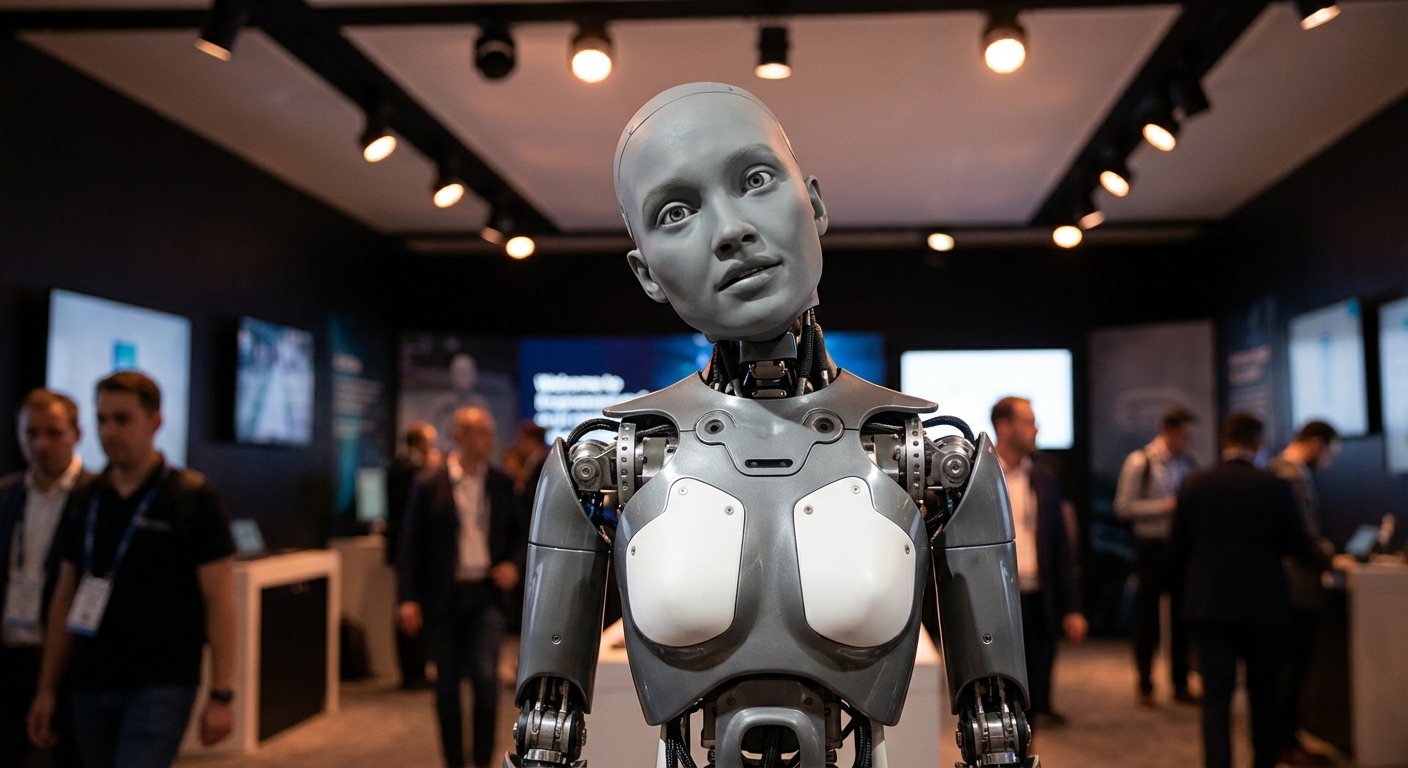
Ameca is a humanoid robot platform developed by Engineered Arts, a British robotics company headquartered in Falmouth, Cornwall, UK. First revealed in December 2021 and publicly demonstrated at CES 2022, Ameca has become the gold standard for human-robot interaction research and public-facing robotics installations.
Unlike mobility-focused humanoids such as Boston Dynamics' Atlas or Tesla's Optimus, Ameca is purpose-built for social interaction. Its primary innovation is an extraordinarily lifelike face capable of expressing a wide range of human emotions—surprise, curiosity, joy, skepticism, and more. This is achieved through Engineered Arts' proprietary Mesmer technology, which uses dozens of individually actuated facial motors to replicate human muscle movements.
The robot is deliberately designed to appear genderless and non-threatening, with grey rubber skin on the face and hands and a metallic body that reads as clearly robotic. This design choice helps avoid the "Uncanny Valley" effect that plagues more human-realistic robots.
Ameca Technical Specifications
Here are the confirmed specifications for the Ameca platform as of early 2026:
Ameca Pricing: How Much Does It Cost?
Ameca's pricing is not publicly listed on Engineered Arts' website—you need to contact them for a quote. However, based on confirmed reports and industry sources, here's what you can expect to pay in 2026:
- Head-only module: ~$25,000–$50,000
- Half-body (torso, head, arms): ~$100,000–$150,000
- Full humanoid unit: ~$250,000–$500,000
- Fully customized enterprise deployment: Up to $500,000+
- Event rental: Available (pricing varies by duration and location)
The wide price range reflects Ameca's modular architecture. You can purchase individual components—just the head for reception-desk applications, or a full body for exhibition installations. Additional costs include professional installation by Engineered Arts engineers (required), ongoing software licensing, and maintenance.
For context, a comparable Softbank Pepper robot costs roughly $20,000–$30,000, while Hanson Robotics' Sophia is estimated at $50,000–$100,000 for custom deployments. Ameca sits at the premium end of the market, but its expressiveness and build quality justify the premium for organizations that need the most lifelike human-robot interaction available.
Generation 3: What's New in 2025–2026
Engineered Arts unveiled Ameca Generation 3 at ICRA 2025 (IEEE International Conference on Robotics and Automation), alongside a new companion platform called Ami. Key improvements in Gen 3 include:
- Enhanced facial actuators: More degrees of freedom in the face for subtler micro-expressions
- Improved hand dexterity: More articulated fingers with better force feedback
- Updated Tritium 3 software: Better integration with modern LLMs (GPT-4, Claude, Gemini) for more natural conversations
- Faster response times: Reduced latency between sensory input and expressive output
- Ami platform: A smaller, more affordable companion robot built on Ameca technology for wider deployment
Gen 3 represents a meaningful upgrade over the Gen 1/2 units that have been deployed worldwide since 2022. If you're considering a purchase in 2026, Gen 3 is the version to get.
Real-World Deployments: Where Ameca Is Working Today
One of Ameca's strongest selling points is its proven track record in real-world installations. As of early 2026, Ameca units are deployed at:
- National Robotarium, Edinburgh, UK — Permanent installation since 2024; used for educational outreach and public engagement with robotics
- Museum of the Future, Dubai, UAE — Part of the museum's robotic family, interacting with thousands of visitors daily
- Computer History Museum, Mountain View, California — Featured in the AI exhibit since late 2024
- Heinz Nixdorf MuseumsForum, Paderborn, Germany — Integrated with ChatGPT for visitor conversations (installed 2025)
- Copernicus Science Center, Warsaw, Poland — Interactive science education
- Deutsches Museum, Nuremberg, Germany — Germany's first Ameca installation
Beyond permanent installations, Ameca has appeared at major events including CES 2022, GITEX 2022, OMR Festival, ITU AI for Good Summit 2023, and ICRA 2023 and 2025. A custom humanoid named "Aura" built on Ameca technology was created for the Sphere venue in Las Vegas.
These deployments demonstrate that Ameca is not vaporware—it's a production-ready platform with years of real-world operation behind it.
Setting Up Ameca: What to Expect
Ameca is not a plug-and-play consumer device. Here's what the setup process involves:
- Professional installation required: Engineered Arts engineers must handle the physical setup. This is included in the purchase but requires scheduling.
- Mounting options: Ameca can stand on a weighted base for stability or be anchored to a stage/platform for exhibition use.
- Network requirements: A wired Ethernet connection with sufficient bandwidth is essential for full functionality. Wi-Fi is supported but wired is recommended for reliability.
- Software configuration: Tritium 2 or Tritium 3 software (depending on generation) handles all robot behaviors. Engineered Arts provides a comprehensive PDF setup guide.
- AI integration: Connecting conversational AI (OpenAI, custom models) requires API configuration through the Tritium interface.
- Environment: Indoor installation in climate-controlled space (10°C–30°C). No outdoor deployment.
From delivery to operational status typically takes 1–3 days with Engineered Arts support.
Ameca vs. Other Humanoid Robots: Comparison Table
How does Ameca stack up against other commercially available humanoid robots? Here's a detailed comparison:
Bottom line: If your priority is the most realistic, engaging human-robot interaction for public-facing applications, Ameca is the clear leader. If you need a robot that can walk, run, or perform physical labor, look elsewhere.
Pros and Cons
Pros
- Unmatched facial expressiveness: No other commercial robot comes close to Ameca's range of emotional expression
- Proven real-world reliability: Years of deployment at major museums and events worldwide
- Modular architecture: Buy only what you need—head, arms, torso, or full body
- Modern AI integration: Works with GPT-4, Claude, and other LLMs for natural conversation
- Active development: Gen 3 shows Engineered Arts continues to invest heavily in the platform
- Remote operation: Cloud connectivity enables telepresence control from anywhere
- REST/WebSocket API: Developers can build custom applications and behaviors
- Non-threatening design: Genderless, clearly-robotic aesthetic avoids Uncanny Valley
Cons
- Very expensive: Starting at $100K, it's out of reach for most individuals and small businesses
- Limited mobility: Primarily a stationary platform—can't walk or navigate spaces independently
- Indoor only: Requires controlled temperature (10°C–30°C), no outdoor use
- Professional installation required: Can't self-setup; Engineered Arts engineers must install
- Wired internet recommended: Best performance requires Ethernet connection
- Not task-oriented: Can't perform physical tasks, carry heavy objects, or operate machinery
- Limited carrying capacity: Only 2 kg per arm
- Some Uncanny Valley risk: Despite good design, some individuals still find it unsettling
Who Should Buy Ameca?
Ameca makes sense for specific use cases. Here's our honest assessment:
Ideal buyers:
- Museums and science centers — Ameca is a proven crowd-drawer that makes robotics tangible and exciting for visitors
- Universities and research labs — The platform's API and modularity make it excellent for HRI (human-robot interaction) research
- Corporate event planners — Ameca's rental option makes it a spectacular centerpiece for product launches and conferences
- Visitor centers and brand experiences — Airports, malls, and showrooms benefit from Ameca's ability to engage passersby
Not ideal for:
- Home use — Far too expensive and over-engineered for personal use
- Manufacturing or logistics — Ameca can't perform physical labor; look at Atlas or Optimus
- Outdoor applications — Not weather-rated
- Small businesses on a budget — The cost-to-utility ratio doesn't work for most SMBs
How Ameca's AI Works
Ameca's intelligence comes from a combination of onboard processing and cloud-based AI. Here's how the system works:
Perception: Ameca uses binocular cameras in its eyes, a chest-mounted camera, depth sensors, and embedded microphones to perceive its environment. Facial recognition software identifies returning visitors and reads emotional cues from human faces.
Conversation: The Tritium software platform routes audio input to cloud-based LLMs (OpenAI GPT, or custom models) for natural language understanding and response generation. The response is then mapped to appropriate facial expressions and gestures in real-time.
Expression: This is where Ameca shines. Dozens of individual facial actuators create nuanced expressions that closely mirror human emotional responses. The mapping between conversational content and facial expression happens automatically, creating an eerily natural interaction flow.
Telepresence: Ameca can also operate in telepresence mode, where a human operator remotely controls its movements and speech. This is useful for demonstrations, events, or situations requiring human judgment.
The Uncanny Valley Question
Any review of a lifelike humanoid robot must address the Uncanny Valley—the phenomenon where almost-but-not-quite-human robots create feelings of unease.
Engineered Arts has been thoughtful about this. Ameca's grey skin, visible mechanical joints, and clearly-robotic body are deliberate design choices to keep it on the "charming robot" side of the valley rather than the "creepy almost-human" side. In practice, most people who interact with Ameca report fascination and delight rather than discomfort.
However, some individuals—particularly those unfamiliar with robotics—can find Ameca's realistic expressions unsettling. The more lifelike the expressions become (and Gen 3 is more lifelike than ever), the more this becomes a factor. It's worth considering your audience when deploying Ameca in public spaces.
Ameca vs. Sophia: Which Is Better?
The most common comparison is between Ameca and Sophia by Hanson Robotics. Here's the honest breakdown:
- Expressiveness: Ameca wins. Its facial expression system is more advanced and nuanced than Sophia's.
- Name recognition: Sophia wins. She's been a media sensation since 2016, appeared on talk shows, and was granted Saudi Arabian citizenship.
- Technology platform: Ameca wins. It's a more modern platform with better developer tools and API access.
- Availability: Ameca wins. It's commercially available with clear purchasing and rental options.
- Price: Sophia may be cheaper for certain configurations, but neither is affordable for casual buyers.
If you're choosing between them for a 2026 deployment, Ameca is the stronger technical choice. Sophia still has more cultural cachet.
Our Verdict: 4 out of 5 Stars
Ameca is genuinely impressive—arguably the most advanced social humanoid robot you can actually buy today. Its facial expressions are unmatched, its build quality is excellent, and its real-world track record across major institutions gives confidence in its reliability.
The main barriers are cost and limited mobility. At $100K–$500K, it's an institutional purchase, not a personal one. And if you need a robot that can walk, carry things, or operate in uncontrolled environments, Ameca isn't it.
But for what it does—creating engaging, lifelike human-robot interactions in controlled settings—nothing else comes close. If your organization needs the best social humanoid robot on the market in 2026, Ameca is the one to get.
Frequently Asked Questions
How much does Ameca cost in 2026?
Ameca's price ranges from approximately $100,000 for a half-body configuration to $500,000+ for a fully customized enterprise deployment. Head-only modules start around $25,000–$50,000. Event rental options are also available. Contact Engineered Arts directly for a quote.
Can Ameca walk?
No. Ameca is primarily a stationary platform. It can gesture with its arms and hands and produce incredibly lifelike facial expressions, but it does not have functional bipedal locomotion. It stands on a weighted base or stage mount.
What AI does Ameca use?
Ameca's Tritium software platform supports integration with multiple AI systems, including OpenAI's GPT models. It can also operate via human telepresence. The conversational AI is cloud-based, so the robot requires internet connectivity for full functionality.
Is Ameca available for purchase or only rental?
Both. Engineered Arts sells Ameca units outright and also offers event rental services. The modular design means you can purchase individual components (head, arms, torso) or the complete humanoid.
Where is Ameca currently deployed?
As of 2026, Ameca units are installed at the National Robotarium (Edinburgh), Museum of the Future (Dubai), Computer History Museum (California), Heinz Nixdorf MuseumsForum (Germany), Copernicus Science Center (Warsaw), and Deutsches Museum (Nuremberg), among other locations.
Can I use Ameca outdoors?
No. Ameca requires a controlled indoor environment with temperatures between 10°C and 30°C. It is not weather-sealed or rated for outdoor use.
What is the difference between Ameca Generation 1, 2, and 3?
Each generation improves on facial expression fidelity, hand dexterity, software capabilities, and sensor integration. Generation 3, launched at ICRA 2025, is the most capable version with the best LLM integration and expression range. If purchasing in 2026, Gen 3 is the recommended version.
How does Ameca compare to Tesla Optimus or Boston Dynamics Atlas?
They serve completely different purposes. Ameca excels at social interaction and facial expression—it's built to talk to people. Atlas and Optimus are designed for physical tasks and mobility. Ameca can't walk or carry heavy loads; Atlas and Optimus can't hold a natural conversation or express emotions. Choose based on your use case.
Related: Sophia Review · Softbank Pepper Review · Best Humanoid Robots
Ready to buy? Browse humanoid robots for sale on Robozaps.
Sophia robot review: Hanson Robotics' famous AI humanoid. Real capabilities vs hype, specs & what she can actually do. Honest 2026 assessment.
Sophia, the world's most famous humanoid robot, has captivated audiences since 2016 with her remarkably human-like expressions and controversial AI capabilities. Created by Hong Kong-based Hanson Robotics and inventor David Hanson, Sophia made history as the first robot granted citizenship (Saudi Arabia, October 2017) and became the UN's first Innovation Champion. But beyond the hype and headlines, what is Sophia really capable of in 2026? This comprehensive review examines Sophia's technical specifications, real-world performance, and whether she lives up to her reputation as a pioneering social robot.
Sophia Specifications at a Glance (2026)
Who Created Sophia and Why?
Sophia was designed by David Hanson, founder of Hanson Robotics, as a "social robot" capable of mimicking human conversation and emotional expression. Hanson, a former Disney Imagineer, envisioned Sophia as more than a technological showcase—she was meant to spark conversations about AI ethics, human-robot interaction, and the future of artificial general intelligence (AGI).
Sophia's design draws inspiration from three muses:
- Queen Nefertiti — Ancient Egyptian queen known for her beauty and grace
- Audrey Hepburn — Hollywood icon embodying elegance and humanity
- Amanda Hanson — David Hanson's wife
The goal? Create a robot that could serve as a companion for the elderly, assist at large events, provide customer service, and ultimately learn social skills through human interaction. Ten years later, has Sophia achieved this vision?
Sophia's Historic Milestones (2016-2026)
Sophia's journey has been marked by unprecedented media attention and symbolic achievements:
- February 14, 2016: Sophia activated on Valentine's Day
- March 2016: Public debut at SXSW (South by Southwest) in Austin, Texas
- October 11, 2017: Introduced at the United Nations, met with Deputy Secretary-General Amina J. Mohammed
- October 25, 2017: Granted Saudi Arabian citizenship at the Future Investment Summit in Riyadh — the first robot to receive legal personhood anywhere in the world
- November 21, 2017: Named UN Development Programme's first Innovation Champion for Asia and the Pacific
- 2019: Began creating artwork using algorithms developed by artist Patrick Tresset
- March 2021: Sophia's self-portrait NFT sold for $688,888 at auction
- 2019-2020: "Little Sophia" educational companion launched for children ($149, teaches coding via Python/Blockly)
- 2022: "Open Arms" subsystem paper submitted to NeurIPS (Conference on Neural Information Processing Systems)
- 2023-2026: Continued appearances at tech conferences, corporate events, and educational programs worldwide
Technical Deep Dive: How Sophia Works
Facial Expressions and Frubber Skin
Sophia's most striking feature is her Frubber skin (flesh rubber), a patented material developed by Hanson Robotics that mimics human skin texture and movement. This allows Sophia to produce over 62 distinct facial expressions, including:
- Smiling, frowning, and surprise
- Eye contact and eyebrow raises
- Lip synchronization during speech
- Subtle micro-expressions that convey emotions
Her face is constructed from a combination of acrylic, polycarbonate, carbon fiber, and CNC aluminum, blending art with engineering precision.
AI Architecture: OpenCog, NLP, and Computer Vision
Sophia's "brain" is a hybrid system combining:
- OpenCog AI System: An open-source AGI (Artificial General Intelligence) framework designed by former Hanson Robotics chief scientist Ben Goertzel. OpenCog Prime aims to enable emergent human-like reasoning through interconnected cognitive modules.
- Natural Language Processing (NLP): Sophia uses a combination of pre-scripted dialogue trees and real-time AI-generated responses. Her conversational abilities are powered by custom NLP algorithms and, more recently, integration with advanced language models.
- Computer Vision: Cameras embedded in Sophia's eyes enable face tracking, eye contact maintenance, and individual recognition. She can identify repeat visitors and adapt her responses accordingly.
- Emotion Recognition: Deep neural networks analyze facial expressions and vocal tone to infer emotional states, allowing Sophia to respond with appropriate emotional cues.
- Decision Trees: For predictable interactions (e.g., event appearances, interviews), Sophia relies on decision-tree dialogue structures that ensure coherent, on-topic responses.
Voice and Speech Recognition
Sophia uses Google's speech recognition API to process spoken input. Her responses are either:
- Pre-programmed: Carefully crafted answers to common questions
- AI-generated: Dynamically created using her NLP subsystem, though these responses are often less coherent than scripted ones
Critical Assessment: While Sophia can hold simple conversations on predetermined topics (weather, technology, philosophy), critics argue her conversational AI is on par with—or even inferior to—consumer voice assistants like Siri, Alexa, or Google Assistant. She lacks true general intelligence and cannot reason beyond her programming.
Sophia vs. Other Social Robots (2026 Comparison)
Real-World Performance: What Sophia Can (and Can't) Do
What Sophia Does Well
- Media Appearances: Sophia excels in controlled environments like TV interviews, conferences, and corporate events. Her pre-programmed responses are witty, thought-provoking, and reliably on-brand.
- Public Engagement: As a technology ambassador, Sophia has appeared on The Tonight Show with Jimmy Fallon, Good Morning Britain, and hundreds of global events, sparking conversations about AI ethics and the future of robotics.
- Facial Expressions: Sophia's ability to mirror human emotions through realistic expressions remains industry-leading, creating an uncanny sense of "presence" during interactions.
- Educational Demonstrations: Sophia serves as a powerful teaching tool for AI concepts, robotics engineering, and human-computer interaction in academic settings.
- Art Creation: Sophia's ability to create drawings and paintings (including the record-breaking NFT sale) demonstrates creative application of her algorithms.
What Sophia Cannot Do
- True Autonomy: Sophia cannot make independent decisions or exhibit free will. Her actions are entirely determined by programming, sensor input, and operator control.
- General Intelligence: Despite the AGI framework, Sophia does not possess self-awareness, consciousness, or reasoning capabilities beyond narrow, scripted domains. AI researchers widely agree she is not "sentient."
- Complex Conversation: Off-script, Sophia's conversational abilities are limited. She struggles with ambiguous questions, sarcasm, and multi-turn dialogue that requires contextual memory.
- Physical Tasks: Sophia has no legs and limited upper-body manipulation capabilities. She cannot walk, grasp objects reliably, or perform practical tasks like household chores or caregiving.
- Long-Term Memory: Sophia's memory is session-based. She does not "remember" previous interactions with individuals over time (though she can recognize faces during a single session).
Sophia's "Siblings": The Hanson Robotics Family
Sophia has nine humanoid robot "siblings" created by Hanson Robotics, each with distinct purposes:
- BINA48: One of the earliest Hanson robots, designed for philosophical dialogue and memory preservation experiments
- Professor Einstein: Educational robot modeled after Albert Einstein, designed to teach science to children
- Han: Social robot with advanced facial expressions
- Philip K. Dick Android: Replica of science fiction author Philip K. Dick, used in AI research
- Alice: Early Hanson prototype
- Albert HUBO: Walking Einstein robot (collaboration with KAIST)
- Jules: Expressive social robot
- Zeno: Child-sized robot for autism therapy research
- Joey Chaos: Rock musician robot
Little Sophia (2019) is a 14-inch educational companion designed for children, teaching coding via Python, Blockly, and Raspberry Pi integration. Priced at $149, it's the only commercially available Hanson robot.
The Citizenship Controversy: Sophia and Saudi Arabia
Sophia's Saudi Arabian citizenship remains one of the most debated moments in robotics history. Critics immediately highlighted the irony:
- Sophia, a female-presenting robot, received citizenship in a country where women's rights were (at the time) severely restricted
- Sophia appeared on stage without a hijab or male guardian, privileges not afforded to human women in Saudi Arabia until recent reforms
- The symbolic gesture was widely seen as a PR stunt rather than a legal precedent
David Hanson stated he was "surprised" by the citizenship announcement and later said Sophia would use her platform to advocate for women's rights in Saudi Arabia. However, as of 2026, Sophia's legal status remains symbolic with no actual rights or responsibilities under Saudi law.
Can You Buy Sophia?
No, the full-scale Sophia robot is not for sale. Hanson Robotics uses Sophia as a technology demonstrator and revenue generator through:
- Event Appearances: Sophia can be hired for corporate events, conferences, and educational programs (pricing undisclosed, estimated $50,000-$250,000 per appearance)
- Research Partnerships: Hanson Robotics collaborates with universities and labs for AI research
- Licensing: The company licenses its Frubber skin technology and AI systems
Affordable Alternative: Little Sophia ($149) is available for purchase and offers a child-friendly introduction to robotics, coding, and AI concepts.
Where to See Sophia in 2026
Sophia continues to make public appearances worldwide. Check these resources:
- Official Website: hansonrobotics.com/sophia
- Instagram: @realsophiarobot (1.7M+ followers)
- Twitter/X: @RealSophiaRobot
- YouTube: Hanson Robotics channel features interviews, demos, and behind-the-scenes content
Sophia frequently appears at tech conferences (CES, Web Summit), educational institutions, and corporate events. Some appearances are livestreamed.
Sophia in 2026: What's New?
Recent developments in Sophia's evolution include:
- Integration with Modern LLMs: Hanson Robotics has experimented with integrating Sophia's NLP system with large language models like GPT-4, improving conversational depth (though still scripted for public appearances)
- Expanded Open-Source Contributions: The "Open Arms" subsystem (2022) and ongoing GitHub repositories allow researchers to build upon Sophia's architecture
- Focus on Education: Sophia's role has shifted from pure media spectacle to educational ambassador, with increased appearances at schools and STEM programs
- Ethical AI Advocacy: Sophia has been featured in discussions about AI regulation, bias mitigation, and the ethical development of AGI systems
Expert Verdict: Is Sophia Truly Intelligent?
The AI research community remains divided on Sophia's significance:
Supporters Argue:
- Sophia is an important platform for AGI research, even if current capabilities are limited
- Her open-source components (70% of codebase) democratize access to advanced robotics research
- Sophia's media presence has educated millions about AI and sparked critical ethical debates
- The Frubber skin and expression systems represent genuine engineering breakthroughs
Critics Counter:
- Sophia's intelligence is "smoke and mirrors"—impressive on the surface but lacking true reasoning
- Hanson Robotics has overhyped Sophia's capabilities, misleading the public about the state of AI
- Sophia's conversational AI is inferior to consumer voice assistants like Alexa or Google Assistant
- The citizenship stunt was a PR gimmick that trivializes serious discussions about AI rights and personhood
- After 10 years, Sophia has not achieved the practical utility (elderly care, customer service) originally promised
Bottom Line: Sophia is best understood as a technology demonstrator and public engagement tool rather than a functional social companion. She excels at sparking curiosity and debate but falls short of delivering on the grander vision of human-equivalent AI.
Sophia vs. Modern Humanoid Robots: How Does She Compare?
The humanoid robot landscape has evolved dramatically since Sophia's 2016 debut. Modern robots like Tesla Optimus, Figure 02, and Unitree G1 prioritize physical utility—walking, object manipulation, and task completion—over social interaction.
Sophia remains unique in the social robot niche, but her lack of mobility and practical skills limits her applicability compared to newer general-purpose humanoids. For those seeking a robot that can perform household tasks or industrial work, Sophia is not the answer. For those interested in conversational AI and human-like expression, Sophia remains a fascinating (if imperfect) case study.
Frequently Asked Questions
Is Sophia really intelligent or just programmed?
Sophia uses a combination of pre-programmed responses and AI-generated dialogue. While she employs sophisticated natural language processing and machine learning, she does not possess general intelligence, self-awareness, or consciousness. Most AI researchers agree Sophia is "intelligent" only in narrow, scripted domains.
Can Sophia walk?
No. Sophia is an upper-body humanoid mounted on a wheeled base. She cannot walk independently. Some demonstrations have shown her on a motorized platform, but she does not have legs or bipedal locomotion capabilities.
What does Sophia's Saudi citizenship mean legally?
Sophia's citizenship is symbolic. She has no legal rights, obligations, or protections under Saudi law. The citizenship was granted as a publicity gesture at the Future Investment Summit in 2017. No other country has followed suit.
How much does it cost to hire Sophia for an event?
Hanson Robotics does not publicly disclose Sophia's appearance fees. Industry estimates suggest $50,000-$250,000 per event, depending on duration, location, and customization requirements. Contact Hanson Robotics directly for pricing.
Can I buy a Sophia robot for my home?
No, the full-scale Sophia robot is not for sale. However, you can purchase Little Sophia ($149), a 14-inch educational companion designed for children that teaches coding and AI concepts.
What is Frubber and why is it important?
Frubber (flesh rubber) is Hanson Robotics' patented skin material that mimics human facial tissue. It allows Sophia to produce 62+ lifelike expressions by flexibly responding to underlying motors and actuators. Frubber is a key innovation enabling realistic human-robot interaction.
Is Sophia's source code open source?
Approximately 70% of Sophia's software is open source, including components of the OpenCog AI framework. Hanson Robotics has published research papers and code on GitHub, allowing researchers to build upon Sophia's architecture.
What happened to Sophia's artwork NFT?
In March 2021, a self-portrait created by Sophia sold as an NFT for $688,888 at auction. The artwork was created using algorithms developed by artist Patrick Tresset and marked one of the first major NFT sales by a robot artist.
Will Sophia ever achieve true artificial general intelligence (AGI)?
Hanson Robotics and collaborators like Ben Goertzel envision Sophia as a platform for AGI research, but achieving human-equivalent general intelligence remains an unsolved grand challenge in AI. Current timelines suggest AGI may be decades away, if achievable at all. Sophia's architecture is a testbed for AGI concepts, not a fully realized AGI system.
What is Sophia doing in 2026?
As of 2026, Sophia continues to appear at tech conferences, educational institutions, and corporate events worldwide. She has also been integrated into AI ethics discussions and serves as an ambassador for responsible AI development. Her role has shifted from pure novelty to educational tool and conversation catalyst.
The Verdict: Should You Care About Sophia in 2026?
Ten years after her activation, Sophia remains a polarizing figure. She is neither the sentient breakthrough her creators sometimes imply nor the worthless gimmick her harshest critics claim. Instead, Sophia occupies a unique space in robotics history:
- As a media phenomenon, Sophia has succeeded beyond measure, bringing AI and robotics into mainstream consciousness
- As a research platform, Sophia has contributed to advancements in facial expression, open-source AI frameworks, and human-robot interaction
- As a practical tool, Sophia has underdelivered on promises of elderly care, customer service, and social companionship
- As a conversation starter, Sophia has sparked essential debates about AI ethics, personhood, and the future of human-machine coexistence
For educators, researchers, and AI enthusiasts, Sophia remains worth studying—not as a model of AGI achievement, but as a case study in the gap between technological ambition and reality. For those seeking a functional humanoid robot, look to the latest general-purpose humanoids from Tesla, Figure, Unitree, and others.
Sophia may not be the future of robotics, but she will forever be a milestone in its past.
Related: Ameca Review · Softbank Pepper Review · Best Humanoid Robots 2026
Interested in humanoid robots? Browse humanoid robots for sale on Robozaps.
Tesla Optimus vs Boston Dynamics Atlas: $25K vs $420K humanoid showdown. Full specs, capabilities & which robot wins. Expert comparison.
Tesla Optimus vs Boston Dynamics Atlas — which humanoid robot leads in 2026? This head-to-head comparison breaks down every spec, capability, price point, and real-world deployment so you can see exactly how these two titans stack up.
Key Takeaways
- Tesla Optimus is lighter (57 kg), cheaper ($20,000–$30,000 target), and built for mass production — with approximately 10,000 units targeted for 2025.
- Boston Dynamics Atlas went fully electric in 2024 and launched its production version at CES 2026 — with 56 degrees of freedom, 50 kg lift capacity, and 2026 deployments at Hyundai and Google DeepMind already fully committed.
- Optimus wins on affordability, energy efficiency, and scalability. Atlas wins on agility, ruggedness, and enterprise-grade reliability.
- Both robots are moving from prototypes to real factory floors in 2026 — the humanoid robotics industry is no longer theoretical.
Tesla Optimus vs Atlas: Complete Specs Comparison Table (2026)
Tesla Optimus: Everything You Need to Know (2026 Update)
Tesla Optimus (also called Tesla Bot) is Elon Musk's ambitious bid to create a mass-market humanoid robot that can replace humans in dangerous, repetitive, or boring tasks. What sets Optimus apart isn't raw athleticism — it's Tesla's ability to manufacture at scale and leverage its existing AI infrastructure.
Design and Build
Standing 5 feet 8 inches (1.73 m) tall and weighing just 57 kg (125 lb), Optimus is designed to fit seamlessly into human environments. It's roughly 35% lighter than Atlas, which translates to better energy efficiency and easier deployment in homes and offices. Each hand has 11 degrees of freedom, enabling delicate manipulation tasks like handling eggs without cracking them or folding laundry.
The latest iteration — Optimus V2.5 (the "golden" version seen at the TRON: Ares premiere) — features redesigned hands, lighter actuators, and significantly smoother motion. Musk has hinted at an Optimus V3 with significant upgrades, though no official timeline has been confirmed.
Core Technologies
Optimus leverages Tesla's proven AI stack from Full Self-Driving (FSD):
- Vision-first perception: Camera-based computer vision (no LiDAR), similar to Tesla vehicles
- Neural networks: Trained on massive driving datasets, adapted for robot manipulation and navigation
- Single SoC "Bot Brain": A custom Tesla System-on-Chip providing high computational power at low energy cost
- Sim-to-real training: Motion capture data from human demonstrations accelerates learning
- Fleet learning: When one Optimus learns a task, the knowledge transfers to all units
Price and Availability
Tesla's aspirational price target is $20,000–$30,000 per unit at scale — deliberately "less than a car." In 2025, Tesla targeted approximately 10,000 units, though production numbers may vary. Currently, Optimus units are deployed internally at Tesla factories performing sorting, material handling, and assembly tasks.
Public sales remain a few years away as Tesla works through safety regulations and testing, but Musk has called Optimus potentially "Tesla's most significant product" — exceeding even its vehicle business in value.
Boston Dynamics Atlas: Everything You Need to Know (2026 Update)
Boston Dynamics Atlas is the culmination of over 30 years of robotics research. Originally funded by DARPA, Atlas has evolved from a tethered hydraulic prototype into a fully electric, commercially deployable humanoid robot. In January 2026, Boston Dynamics unveiled the production version of Atlas at CES — marking the transition from research platform to enterprise product.
Development Journey: From Research to Production
Atlas's evolution is remarkable:
- 2013: First Atlas prototype (DARPA-funded, hydraulic, tethered)
- 2016–2018: Viral parkour and backflip demonstrations showcasing dynamic balance
- April 2024: Transition to fully electric actuation — retired hydraulic version
- January 5, 2026: Production Atlas unveiled at CES; manufacturing begins immediately
- 2026: All deployments fully committed — Hyundai RMAC and Google DeepMind first in line
- 2027: Additional customers planned
Production Atlas Specs (CES 2026)
The production Atlas is Boston Dynamics' "best robot ever built," according to CEO Robert Playter:
- 56 degrees of freedom with fully rotational joints
- 2.3 m (7.5 ft) reach — significantly exceeding human arm span
- 50 kg (110 lb) lift capacity
- Autonomous battery swap: Atlas navigates to a charging station, swaps its own batteries, and returns to work — enabling continuous operation
- Enterprise integration: Connects to MES, WMS, and other industrial systems via Boston Dynamics' Orbit™ software
- IP67-rated (dustproof, waterproof) and rated for -20°C to 40°C operation
- Safety features: Human detection, fenceless guarding, barcode/RFID integration
- AI partnership with Google DeepMind: Foundation models for greater cognitive capabilities
Price and Availability
Atlas is positioned as an enterprise-grade solution at an estimated ~$140,000+ per unit (unofficial — Boston Dynamics has not published pricing). Hyundai Motor Group (Boston Dynamics' majority shareholder) announced a $26 billion U.S. investment including a new robotics factory capable of producing 30,000 robots per year. Hyundai Mobis will supply actuators, leveraging automotive supply chains for reliability and scale.
Head-to-Head: Optimus vs Atlas Performance Comparison
1. Agility and Mobility
Winner: Atlas
Atlas is unmatched in athletic capability. It runs, jumps, performs backflips, vaults obstacles, and navigates rough terrain with superhuman agility. Its hydraulic heritage (now electric) gives it explosive power that Optimus simply doesn't match. Optimus walks smoothly at up to 8 km/h and handles flat indoor environments well, but it's not designed for acrobatics or extreme terrain.
2. Dexterity and Manipulation
Winner: Optimus (hands) / Atlas (reach & strength)
Optimus's hands have 11 degrees of freedom each, enabling delicate tasks like egg handling and shirt folding. Atlas counters with a massive 2.3 m reach and 50 kg lift capacity across 56 total DoF. For fine manipulation, Optimus leads. For heavy industrial tasks requiring reach and strength, Atlas wins.
3. AI and Software
Winner: Tie (different strengths)
Tesla brings vision-first neural networks trained on billions of real-world driving miles — excellent for generalization from data. Boston Dynamics brings decades of real-time control expertise, now supercharged by a Google DeepMind partnership integrating foundation models. Both have fleet learning. Tesla's approach favors data scale; Boston Dynamics' approach favors precision control.
4. Battery and Uptime
Winner: Atlas
This might surprise you. While Optimus has a 2.3 kWh battery rated for "a full day of work," Atlas has a game-changing feature: autonomous battery swapping. Atlas navigates to a charging station, swaps its own battery pack, and gets right back to work. This means effectively unlimited uptime with no human intervention — a massive advantage for 24/7 industrial operations.
5. Ruggedness and Durability
Winner: Atlas
Atlas is water-resistant, operates from -20°C to 40°C, and is built with automotive-grade components from Hyundai Mobis. It's designed for factory floors, construction sites, and harsh environments. Optimus is lighter and more consumer-oriented — excellent for climate-controlled environments but less battle-tested in extreme conditions.
6. Price and Accessibility
Winner: Optimus
At $20,000–$30,000 vs. $140,000+, Optimus is roughly one-fifth the cost of Atlas. This makes Optimus accessible to small businesses, warehouses, and eventually homes. Atlas is an enterprise investment suited for large manufacturers and specialized operations.
7. Manufacturing Scale
Winner: Tie (converging)
Tesla's manufacturing DNA is a genuine advantage — Optimus is designed for mass production from day one. However, Hyundai's $26 billion U.S. investment and 30,000-unit/year robotics factory means Atlas is rapidly closing the manufacturing gap with automotive supply chain backing.
Best Use Cases: Who Should Choose Which Robot?
Choose Tesla Optimus If You Need:
- Factory line work: Sorting, packing, light assembly in controlled environments
- Warehouse operations: Inventory management, order picking, logistics
- Household assistance: Domestic chores, elderly care, daily tasks (future)
- Budget-conscious deployment: Multiple units at lower cost per robot
- AI-first learning: Tasks that benefit from neural network generalization
Choose Boston Dynamics Atlas If You Need:
- Heavy industrial tasks: Automotive manufacturing, material handling, construction
- 24/7 continuous operation: Auto battery-swap for non-stop uptime
- Harsh environments: Extreme temperatures, wet conditions, rough terrain
- Enterprise integration: MES/WMS connectivity, Orbit™ fleet management
- Search and rescue: Disaster zones, hazardous inspections
- High-value precision work: Tasks requiring 56 DoF and 7.5 ft reach
2026 Outlook: What's Coming Next
Tesla Optimus Roadmap
- 2026: Next-generation Optimus expected with significant upgrades
- 2026: Continued internal Tesla factory deployment, expanding task range
- 2027+: Potential external sales and consumer-facing applications
- Long-term: Musk envisions Optimus as "Tesla's most significant product" — potentially exceeding vehicle business value
Boston Dynamics Atlas Roadmap
- Q1–Q2 2026: First production Atlas units ship to Hyundai RMAC and Google DeepMind
- 2026: All deployments fully committed; AI foundation models from Google DeepMind integrated
- Early 2027: Additional customers onboarded
- Long-term: CEO Robert Playter's vision — "useful robots that walk into our homes and help make our lives safer, more productive, and more fulfilling"
Ethical and Social Implications
Job Displacement vs. Job Creation
Both robots will automate tasks currently performed by humans. This raises legitimate concerns about job displacement, particularly in manufacturing and logistics. However, both companies emphasize that humanoid robots will also create new roles in robot maintenance, programming, fleet management, and AI training. The net effect on employment remains hotly debated.
Safety and Regulation
As these robots move from labs to factory floors, safety becomes paramount. Atlas includes human detection and fenceless guarding. Both companies face evolving regulatory frameworks. The key question: how do you certify a robot that learns and adapts on its own? Standards bodies worldwide are working on this, but regulations lag behind the technology.
The Verdict: Optimus vs Atlas — Who Wins?
There's no single winner. These robots serve different markets and solve different problems:
- For mass-market affordability and consumer robotics: Tesla Optimus wins. Its $20K–$30K price, lightweight design, and Tesla's manufacturing scale make it the robot most likely to enter millions of homes and small businesses.
- For enterprise-grade industrial deployment: Boston Dynamics Atlas wins. Its 56 DoF, autonomous battery swap, extreme durability, Google DeepMind AI, and Hyundai-backed production make it the robot that Fortune 500 manufacturers will bet on.
The real story of 2026 isn't which robot is "better" — it's that both are now moving from prototypes to production. Humanoid robots are no longer science fiction demos. They're shipping to real factories, learning real tasks, and beginning to reshape how work gets done.
Frequently Asked Questions
How much does Tesla Optimus cost vs Boston Dynamics Atlas?
Tesla targets $20,000–$30,000 for Optimus — deliberately priced "less than a car." Boston Dynamics Atlas is estimated at $140,000+ per unit, positioned as an enterprise-grade industrial robot. Optimus is roughly one-fifth the price of Atlas.
Which robot is more advanced — Optimus or Atlas?
It depends on the metric. Atlas is more advanced in agility (backflips, parkour, rough terrain), strength (50 kg lift, 7.5 ft reach), and ruggedness (water-resistant, extreme temps). Optimus is more advanced in hand dexterity (11 DoF per hand), energy efficiency, and AI-driven learning from Tesla's FSD neural networks.
Can I buy a Tesla Optimus or Boston Dynamics Atlas in 2026?
Not yet for consumers. Tesla Optimus is deployed internally at Tesla factories with public sales likely several years away. Atlas production units are shipping to commercial partners (Hyundai, Google DeepMind) in 2026, with additional enterprise customers in 2027. Neither is available for individual purchase.
What is Optimus V3 and when is it coming?
Optimus V3 is Tesla's planned next-generation humanoid robot. The current most advanced version is V2.5. While Musk has teased significant upgrades for V3, no official release timeline has been confirmed.
What happened to the hydraulic Atlas?
Boston Dynamics retired the hydraulic Atlas in April 2024 and transitioned to a fully electric version. The electric Atlas offers better energy efficiency, lower maintenance, and reduced noise while maintaining dynamic capability. The production version unveiled at CES 2026 is all-electric with Hyundai Mobis actuators.
Will humanoid robots replace human workers?
Both Tesla and Boston Dynamics frame their robots as handling tasks that are dangerous, repetitive, or physically demanding — freeing humans for higher-value work. While some job displacement is inevitable in manufacturing and logistics, new roles in robot maintenance, programming, and fleet management are expected to emerge. The transition will require workforce upskilling and policy support.
Which robot is better for factory use?
For heavy-duty automotive manufacturing, Atlas is the stronger choice — it has 56 degrees of freedom, 50 kg lift capacity, autonomous battery swap for 24/7 operation, and enterprise software integration. For lighter assembly, sorting, and material handling tasks, Optimus offers a more cost-effective solution with its lower price point and mass-production design.
Related: Tesla Optimus Gen 2 Review · Boston Dynamics Atlas Review
Ready to buy? Browse humanoid robots for sale on Robozaps.
Tesla Optimus vs Apptronik Apollo: specs, pricing & real performance compared. Which humanoid robot fits your needs? Complete 2026 analysis.
🔔 Breaking: Feb 11, 2026 Funding Update
Apptronik just raised $520 million at a $5.5 billion valuation—a 3x increase from their previous round. Google and Mercedes-Benz are lead backers, with Apollo actively testing in Mercedes-Benz factories and GXO Logistics warehouses. Meanwhile, Tesla is committing $20B in 2026 capex for Optimus—but Apollo's commercial deployments may beat them to enterprise scale.
Tesla Optimus vs Apptronik Apollo — two of the most anticipated humanoid robots in 2026, both targeting industrial automation at radically different price points. Tesla's manufacturing juggernaut promises mass-market pricing under $30,000, while Apptronik's NASA-rooted Apollo boasts the highest payload capacity in its class at 25 kg. This comprehensive comparison breaks down every spec, real-world deployment, and technical advantage so you can see exactly which robot wins in each category.
Key Takeaways
- Tesla Optimus stands 173 cm (5'8") tall, weighs 57 kg (126 lbs), and targets an unprecedented $20,000–$30,000 price point — the most aggressive pricing in humanoid robotics.
- Apptronik Apollo matches Optimus in height at 173 cm (5'8") but weighs 73 kg (161 lbs), with a 25 kg (55 lbs) payload capacity that beats Optimus's 20 kg (44 lbs).
- Apollo wins on: Payload capacity (25 kg vs 20 kg), battery life (4 hours vs unconfirmed), current deployment status (Mercedes-Benz factory).
- Optimus wins on: Target price ($20K–$30K vs sub-$50K), AI capabilities (FSD-derived vision), manufacturing scale potential.
- Both robots are American-made, targeting the same industrial automation market, but with different go-to-market strategies — Tesla betting on volume, Apptronik on capability.
Tesla Optimus vs Apptronik Apollo: Full Specifications Comparison
Tesla Optimus: Everything You Need to Know (2026 Update)
Tesla Optimus represents Elon Musk's vision of a general-purpose humanoid robot that could eventually become more valuable than Tesla's entire automotive business. First unveiled at Tesla AI Day 2022 as a person in a robot suit, Optimus has evolved rapidly through Gen 1, Gen 2, and now Gen 3 iterations — each demonstrating meaningful improvements in dexterity, balance, and autonomous task completion.
Design and Build
At 173 cm (5'8") and 57 kg (126 lbs), Tesla Optimus is designed to operate in human-scale environments without modification. The Gen 2 model reduced weight by 10 kg from Gen 1, improving balance and agility. The most significant advancement in Gen 3 is the hands — featuring 22 degrees of freedom per hand (up from 11 in Gen 2), enabling manipulation tasks like threading needles, folding clothes, and handling delicate objects.
Tesla's approach emphasizes manufacturability above all else. Every component is designed for high-volume production using Tesla's existing supply chain infrastructure. The actuators are proprietary, leveraging lessons from electric vehicle motors. The 2.3 kWh battery pack shares chemistry with Tesla's vehicle batteries, enabling cost reduction through scale.
AI and Software
Optimus runs on Tesla's Full Self-Driving (FSD) neural network stack, adapted for bipedal robotics. This gives it several advantages:
- Vision-based navigation: Unlike robots relying on LiDAR, Optimus uses cameras exclusively — the same approach Tesla uses for autonomous vehicles.
- End-to-end learning: The robot can learn tasks from video demonstrations, reducing the need for explicit programming.
- Fleet learning: Skills learned by one Optimus can be distributed across all units via over-the-air updates.
Tesla demonstrated autonomous operation in its Fremont and Austin factories, where Optimus units perform battery cell sorting and parts handling. However, some demos have faced scrutiny for relying on teleoperation — a transparency gap that competitors have been quick to highlight.
Price and Availability
Tesla's target price of $20,000–$30,000 would make Optimus the most affordable full-size humanoid robot by a significant margin. This pricing depends on achieving automotive-scale production — potentially 10,000+ units per year by 2027.
Current status (March 2026):
- Gen 3 debut imminent
- Fremont factory repurposed from Model S/X production for Optimus manufacturing
- Mass production target: before end of 2026
- Consumer availability: late 2027
- No pre-orders currently open
Apptronik Apollo: Everything You Need to Know (2026 Update)
Apptronik Apollo emerges from the Human Centered Robotics Lab at the University of Texas at Austin, with deep roots in NASA's humanoid robotics program. The company's founders worked on NASA's Valkyrie robot, bringing aerospace-grade engineering principles to commercial humanoid development. Apollo represents a different philosophy than Optimus — prioritizing capability and reliability over aggressive cost reduction.
Design and Build
Apollo matches Optimus in height at 173 cm (5'8") but is significantly heavier at 73 kg (161 lbs). This additional mass isn't wasted — Apollo's 25 kg (55 lbs) payload capacity exceeds Optimus by 25%, making it better suited for heavy-duty industrial tasks like moving automotive components or handling logistics totes.
The standout feature is Apollo's force-controlled, series-elastic actuators. Unlike rigid actuators that can cause injury on impact, Apollo's joints yield under unexpected force — a critical safety feature for human-robot collaboration. This compliant actuation also enables more natural, adaptive movement when manipulating objects of varying weights and textures.
The 4-hour battery life with hot-swappable packs addresses a key industrial requirement: continuous operation across shifts. Apollo can return to a docking station, swap batteries autonomously, and resume work — no human intervention required.
Development and Partnerships
Apollo's pedigree includes:
- NASA heritage: Apptronik's team built components for NASA's Valkyrie humanoid, bringing space-rated reliability engineering to commercial robotics.
- Mercedes-Benz partnership: Apollo is actively deployed at Mercedes-Benz manufacturing facilities for automotive assembly tasks — real-world validation that Optimus hasn't yet achieved publicly.
- Google operations testing: Apptronik has confirmed testing with Google for logistics and warehouse operations.
This enterprise-first approach means Apollo is generating revenue and operational data while competitors are still in development.
Price and Availability
Apptronik targets a sub-$50,000 price point for Apollo — higher than Tesla's aggressive target but still competitive for industrial applications where a robot can replace a $60,000+ annual labor cost.
Current status (March 2026):
- NEW: $520M funding at $5.5B valuation (Feb 11, 2026)
- Pilot deployments active at Mercedes-Benz and GXO Logistics warehouses
- Available for enterprise purchase via contact sales
- No consumer version planned
- Pre-order available for qualified industrial customers
Head-to-Head: Tesla Optimus vs Apptronik Apollo Performance Comparison
1. Payload Capacity and Strength
Winner: Apptronik Apollo
Apollo's 25 kg (55 lbs) payload capacity beats Optimus's 20 kg (44 lbs) by 25%. In manufacturing environments, this difference matters — Apollo can handle heavier automotive components, larger logistics totes, and more demanding material handling tasks without risk of strain or failure.
The weight difference between the robots (73 kg vs 57 kg) partially explains Apollo's advantage — a heavier frame provides a more stable base for lifting. Tesla's lighter design prioritizes energy efficiency and agility over raw strength.
2. AI and Autonomy
Winner: Tesla Optimus
Tesla's FSD-derived AI stack gives Optimus a significant edge in autonomous learning and adaptation. The end-to-end neural network approach means Optimus can potentially learn new tasks from video demonstrations, while Apollo relies on more traditional programming approaches.
Tesla's fleet learning capability — where skills transfer automatically across all units — could prove decisive as deployments scale. Apollo's SDK is capable but lacks the depth of Tesla's AI investment (Tesla spends billions annually on AI research).
However, Tesla's autonomy claims have faced scrutiny. The "We, Robot" event in October 2024 drew criticism for not disclosing teleoperation. Apollo's demonstrations, while less flashy, have been more transparent about capabilities.
3. Battery Life and Endurance
Winner: Apptronik Apollo
Apollo's confirmed 4-hour battery life with hot-swappable packs beats Optimus on operational endurance. Tesla hasn't disclosed Optimus's runtime, though the 2.3 kWh battery pack suggests comparable or shorter operation times.
The hot-swap capability is critical for industrial deployment. Apollo can autonomously dock, swap batteries, and resume operation — enabling 24/7 operations across shifts. Optimus's battery appears integrated, requiring the robot to charge in place.
4. Real-World Deployment
Winner: Apptronik Apollo
Apollo is currently deployed at Mercedes-Benz manufacturing facilities and testing with Google — generating real-world operational data and revenue. This is the clearest indicator of commercial readiness.
Optimus operates within Tesla's own factories, which is valuable validation but not equivalent to third-party enterprise deployment. Tesla has customers for its vehicles, not its robots — Apollo has paying customers for its robots today.
5. Price and Value
Winner: Tesla Optimus (if achieved)
Tesla's $20,000–$30,000 target price would be transformative — potentially 40–50% cheaper than Apollo's sub-$50,000 target. At Tesla's price point, humanoid robots become economically viable for a far broader range of applications, including small businesses and eventually consumers.
However, this pricing depends on achieving automotive-scale production, which remains unproven. Apollo's higher price reflects current manufacturing realities. For enterprises buying today, Apollo's pricing is competitive against labor costs.
6. Safety and Human Collaboration
Winner: Apptronik Apollo
Apollo's force-controlled, series-elastic actuators provide inherent compliance — the joints yield under unexpected contact, reducing injury risk. This architecture, derived from NASA's Valkyrie program, prioritizes safe human-robot collaboration.
Tesla emphasizes minimizing damage from falls and operational safety, but hasn't disclosed equivalent compliance mechanisms. In environments where robots work directly alongside humans (the definition of a cobot), Apollo's safety architecture is more proven.
7. Manufacturing Scale Potential
Winner: Tesla Optimus
Tesla's manufacturing infrastructure — Gigafactories, supply chain, production engineering — gives Optimus unmatched scaling potential. Tesla produces millions of vehicles annually; redirecting even a fraction of that capacity to humanoid robots could dwarf all competitors combined.
The Fremont factory conversion from Model S/X production to Optimus manufacturing signals Tesla's commitment to scale. Apptronik, while capable, operates at startup scale — their production capacity measured in hundreds, not thousands.
Which Should You Choose?
Choose Tesla Optimus if you:
- Can wait until late 2027 for consumer/enterprise availability — Optimus isn't purchasable today, but if you're planning long-term automation strategy, Tesla's pricing could be decisive.
- Prioritize cost above all else — At $20,000–$30,000, Optimus would have 40–50% lower acquisition cost than Apollo.
- Value AI capabilities and autonomous learning — Tesla's FSD-derived neural networks offer the most advanced vision and task-learning capabilities.
- Want fleet scalability — Tesla's over-the-air updates and fleet learning mean skills transfer automatically across all units.
- Operate a Tesla-integrated facility — Optimus will likely integrate seamlessly with Tesla's manufacturing ecosystem.
Choose Apptronik Apollo if you:
- Need a humanoid robot today — Apollo is available for enterprise deployment now, with proven operation at Mercedes-Benz.
- Require heavy payload capacity — Apollo's 25 kg beats Optimus's 20 kg — critical for automotive components and heavy logistics.
- Prioritize safety for human-robot collaboration — Force-controlled actuators provide inherent compliance that reduces injury risk.
- Need proven 4-hour+ battery life — Hot-swappable packs enable continuous 24/7 operation across shifts.
- Want NASA-heritage reliability — Apptronik's team built components for space robots; that engineering rigor translates to commercial reliability.
Frequently Asked Questions
Is Tesla Optimus better than Apptronik Apollo?
It depends on your priorities. Tesla Optimus offers potentially lower cost ($20K–$30K vs sub-$50K) and superior AI capabilities, but isn't available for purchase. Apptronik Apollo offers higher payload (25 kg vs 20 kg), proven battery life (4 hours), and is deployed today at Mercedes-Benz. For immediate industrial deployment, Apollo wins. For future mass-market potential, Optimus is the bet.
How much does Tesla Optimus cost vs Apptronik Apollo?
Tesla targets $20,000–$30,000 for Optimus at mass production scale (late 2026+). Apptronik targets sub-$50,000 for Apollo. Neither has confirmed final pricing. Apollo is available for enterprise purchase today via contact sales; Optimus isn't commercially available yet.
Which robot has better payload capacity?
Apptronik Apollo wins with 25 kg (55 lbs) payload capacity versus Tesla Optimus's 20 kg (44 lbs). Apollo's higher weight (73 kg vs 57 kg) provides a more stable base for heavy lifting tasks common in automotive manufacturing and logistics.
Can I buy Tesla Optimus or Apptronik Apollo today?
Apptronik Apollo is available for enterprise customers via contact sales, with pilot deployments already running at Mercedes-Benz and Google. Tesla Optimus is not commercially available — it's deployed only within Tesla's own factories. Consumer availability for Optimus is targeted for late 2027.
Which humanoid robot is more advanced?
Tesla Optimus has more advanced AI (FSD-derived neural networks, end-to-end learning, fleet updates). Apptronik Apollo has more advanced safety architecture (force-controlled actuators) and superior operational endurance (4-hour battery with hot-swap). "Advanced" depends on what capability matters for your use case.
Are Tesla Optimus and Apptronik Apollo safe to work around?
Both are designed for human-robot collaboration. Apollo's force-controlled, series-elastic actuators provide inherent compliance — joints yield on contact, reducing injury risk. Tesla emphasizes fall damage minimization and operational safety but hasn't disclosed equivalent compliance mechanisms. For proven cobot safety, Apollo has the edge.
Which company has more funding and resources?
Tesla dwarfs Apptronik in resources. Tesla is a $500B+ company spending billions annually on AI. Apptronik is a venture-backed startup ($1.5B+ total raised, including $520M in Mar 2026 led by Google and Mercedes-Benz). However, Apptronik's focus is exclusively robotics, while Tesla splits attention across vehicles, energy, and AI. Apollo benefits from Apptronik's singular focus.
What industries use Tesla Optimus vs Apptronik Apollo?
Both target manufacturing, logistics, and warehouse automation. Apollo is deployed at Mercedes-Benz (automotive assembly) and testing with Google (logistics). Optimus operates in Tesla factories (battery cell sorting, parts handling). Apollo has third-party enterprise deployments; Optimus is internal only as of early 2026.
Final Verdict: Tesla Optimus vs Apptronik Apollo
For enterprises that need a humanoid robot in 2026: Apptronik Apollo wins. It's available today, deployed at Mercedes-Benz, and offers higher payload capacity with proven battery endurance. The NASA-heritage engineering provides confidence in reliability.
For organizations planning 2027+ automation: Tesla Optimus is the bet worth watching. If Tesla achieves its $20,000–$30,000 price target at scale, it could fundamentally change the economics of humanoid robotics. The FSD-derived AI gives Optimus the highest ceiling for autonomous learning.
The humanoid robot market in 2026 isn't winner-take-all. Apollo and Optimus serve different segments of the same market — Apollo for enterprises that need proven capability now, Optimus for those betting on Tesla's manufacturing scale to deliver unprecedented affordability. Both are American-made, both target industrial automation, and both will shape the future of work.
Compare both robots side by side: Tesla Optimus on Robozaps | Apptronik Apollo on Robozaps | Browse all humanoid robots
Last updated: February 11, 2026. Specifications sourced from official manufacturer documentation and Robozaps robot database. Robozaps is the world's largest humanoid robot marketplace — we maintain comprehensive product databases and may earn referral fees from qualifying purchases.
Related: Tesla Optimus Gen 2 Review · Apptronik Apollo Review · Tesla Optimus Alternatives and Competitors
Ready to buy? Browse humanoid robots for sale on Robozaps.
Tesla Optimus vs Agility Digit head-to-head: specs, price ($30K vs RaaS), AI, deployment status. See which humanoid robot wins in 7 categories. Updated Mar 2026.
Bottom Line: For enterprise buyers in 2026, Agility Digit wins — it's commercially deployed at Amazon and GXO right now with proven ROI. Tesla Optimus wins on raw capability (AI, dexterity, speed) but external sales haven't begun yet. Digit for today; Optimus for 2027+.
📅 Last updated: March 20, 2026 | ⏱️ 11 min read
Tesla Optimus and Agility Robotics Digit represent two fundamentally different visions for the future of humanoid robots. As of March 2026, both have made dramatic progress — Tesla has deployed over 1,000 Optimus units in learning/testing mode inside its own factories and is preparing external sales, while Agility Robotics is shipping Digit fleets to Amazon, GXO Logistics, and other enterprise customers from its dedicated RoboFab manufacturing facility. This comprehensive comparison covers specs, design philosophy, real-world performance, pricing, and which robot is best positioned to dominate the next decade of commercial robotics.
Key Takeaways
- Tesla Optimus targets mass production at ~$30,000 per unit, leveraging Tesla's AI stack and vertical integration. Over 1,000 units are deployed inside Tesla factories for learning and iteration as of late 2025.
- Agility Digit is the first commercially deployed humanoid robot, already operating in Amazon and GXO warehouses. Its RoboFab facility can produce 10,000+ units per year.
- Optimus excels in AI-driven general-purpose autonomy; Digit excels in purpose-built logistics manipulation with proven commercial traction.
- Both robots are expected to see significant production scaling in 2026, making this the pivotal year for the humanoid robotics industry.
Tesla Optimus vs Agility Digit: Full Specs Comparison

The following table breaks down the core technical specifications of both robots side by side:
Design and Engineering: Two Philosophies
Tesla Optimus: Vertical Integration and AI-First Design
Tesla's approach to Optimus mirrors its vehicle strategy: vertical integration, aggressive cost reduction, and AI as the core differentiator. Every major component — actuators, battery pack, control electronics, and the neural network inference chip — is designed in-house. This gives Tesla complete control over the bill of materials and, critically, the ability to push over-the-air software updates to deployed units.
The evolution has been rapid. The 2022 prototype ("Bumble C") could barely walk. The Gen 2 (December 2023) showcased smooth bipedal locomotion, dancing, and egg handling with 11-DOF hands. By 2024, the Gen 3 hands doubled to 22 degrees of freedom, enabling significantly more dexterous manipulation — picking up thin objects, turning knobs, and handling irregular shapes.
Structurally, Optimus uses a combination of cast aluminum and engineering plastics, with Tesla-designed rotary and linear actuators featuring integrated strain wave gear reduction. The robot's 2.3 kWh battery pack (similar chemistry to Tesla vehicle cells) provides roughly 4-6 hours of moderate activity on a single charge.
Agility Digit: Purpose-Built for Logistics
Agility Robotics took a fundamentally different path. Digit evolved from Cassie, a bipedal research robot developed at Oregon State University in 2017. Rather than trying to build a general-purpose humanoid, Agility focused on making a robot that could do one category of tasks exceptionally well: material handling in warehouses and distribution centers.
Digit's design reflects this focus. Its legs use a unique four-bar linkage mechanism that provides exceptional energy efficiency during walking — critical for all-day warehouse shifts. The robot's "head" houses a dense sensor array (LiDAR, stereo depth cameras, IMUs) designed for reliable perception in cluttered, dynamic warehouse environments where lighting conditions vary and obstacles appear unpredictably.
Rather than trying to replicate human hand dexterity, Digit uses purpose-built end effectors optimized for grasping standard warehouse containers (totes, boxes, bins). This trade-off means less versatility but significantly higher reliability for the target use case.
AI and Software: The Real Battleground
Tesla's FSD-Derived Intelligence
Tesla's biggest competitive advantage is its AI infrastructure. Optimus runs on neural networks derived from Tesla's Full Self-Driving (FSD) system, trained on data from millions of Tesla vehicles. The Dojo supercomputer — purpose-built for training AI models on video data — gives Tesla enormous compute capacity for improving Optimus's perception and decision-making.
In 2025, Tesla demonstrated Optimus performing end-to-end autonomous tasks in its Fremont and Giga Texas factories: sorting battery cells, moving parts between stations, and performing quality inspections. The key breakthrough was the shift from teleoperation (which critics had noted in earlier demos) to genuine autonomous task execution using learned behaviors.
Ashok Elluswamy, who took over the Optimus program in June 2025 after Milan Kovac's departure, has accelerated the integration of FSD perception models into Optimus. This leadership change aligned the robot and vehicle AI teams more closely, enabling faster transfer learning between domains.
Agility Arc: Enterprise-Grade Robot Management
Agility's software platform, Agility Arc, takes an enterprise-first approach. Rather than pushing the boundaries of general AI, Arc provides:
- Facility Mapping: Automated 3D mapping of warehouse environments
- Workflow Definition: Drag-and-drop task programming without coding
- Fleet Management: Coordinated control of multiple Digit units
- Safety Monitoring: Real-time compliance with ISO 13482 (robots for personal care) and warehouse safety standards
- Analytics Dashboard: Performance metrics, uptime tracking, and predictive maintenance
This pragmatic approach means Digit may lack Optimus's raw AI potential, but it offers something enterprise customers value more: predictable, reliable, auditable automation that integrates with existing warehouse management systems (WMS).
Real-World Deployment: Who's Actually Working?
Optimus in Tesla Factories (2025-2026)
As of late 2025, Tesla has deployed over 1,000 Optimus units in learning/testing mode across its Fremont, Giga Texas, and Giga Shanghai facilities. These robots are being trained on:
- Battery cell sorting and inspection
- Parts transfer between production stations
- Quality control visual inspections
- Light assembly tasks
Musk stated at the October 2024 "We, Robot" event that external sales could begin in 2026, with initial customers likely being other manufacturers and logistics companies. The estimated retail price of ~$30,000 (revised upward from the earlier $20,000 target) would still make Optimus significantly cheaper than most industrial robotic systems.
In a bold move, Musk announced in March 2025 that an Optimus unit would be sent to Mars by end of 2026 aboard a SpaceX Starship — a largely symbolic demonstration, but one that highlights Tesla's ambitions beyond terrestrial applications.
Digit in Amazon and Beyond (2023-2026)
Agility Robotics has a significant head start in commercial deployment. Key milestones include:
- September 2023: Opened RoboFab in Salem, Oregon — the world's first dedicated humanoid robot manufacturing facility (6,500 m², capacity 10,000+ units/year)
- 2023-2024: Amazon began testing Digit in its fulfillment centers, initially for moving empty totes
- 2024-2025: Expanded deployment to GXO Logistics and other enterprise customers
- 2025: Agility shifted to a Robot-as-a-Service (RaaS) model, where customers lease Digit fleets rather than purchasing outright
The RaaS model is strategically important. Rather than asking warehouse operators to make a large capital expenditure on unproven technology, Agility lets them pay per-robot-per-month, lowering the adoption barrier. This approach mirrors how companies like Locus Robotics scaled their AMR (autonomous mobile robot) fleets.
Mobility, Balance, and Physical Performance
Both robots use bipedal locomotion, but their approaches differ significantly:
Digit's advantage in energy-efficient locomotion is meaningful for warehouse applications, where robots need to operate for full 8-12 hour shifts. Optimus's faster top speed matters less in structured indoor environments but could be relevant for future outdoor applications.
Hand Dexterity and Manipulation
This is where the robots diverge most sharply. Tesla has invested heavily in making Optimus's hands as dexterous as possible:
- Gen 2 (2023): 11 degrees of freedom per hand, metallic cable-driven system with 4 fingers + thumb
- Gen 3 (2024-2025): 22 degrees of freedom per hand, enabling precision grasps, tool use, and delicate object handling
Digit, by contrast, uses specialized grippers that are optimized for grasping warehouse totes and boxes. These grippers are less versatile than Optimus's hands but achieve higher grasp success rates (>99%) on their target objects. For warehouse operators, this reliability trade-off is overwhelmingly positive.
Industry Applications: Where Each Robot Fits
Manufacturing
Optimus has the edge in manufacturing flexibility. Its dexterous hands and general-purpose AI make it adaptable to diverse assembly, inspection, and material handling tasks. Tesla is proving this internally — Optimus units in Tesla factories handle multiple task types and can be retrained for new tasks via software updates.
Digit's manufacturing applications focus on material transport — moving parts, bins, and finished goods between stations. It's less suited for fine assembly work but excels at the repetitive movement tasks that account for a significant portion of manufacturing labor.
Logistics and Warehousing
This is Digit's home turf. With proven deployments at Amazon and GXO, Digit has demonstrated:
- Autonomous tote movement and sorting
- Package handling and transport
- Integration with conveyor systems and shelving
- Multi-shift operation with fleet coordination
Optimus could enter this space, but Tesla has not yet announced logistics-specific partnerships. The robot's higher payload (20 kg vs 16 kg) and faster speed are advantages, but Digit's established customer relationships and proven reliability give it a multi-year head start.
Retail and eCommerce
Agility has explicitly targeted retail and eCommerce fulfillment as a growth market. Digit's ability to navigate cluttered backrooms, pick items from shelves, and transport them to packing stations aligns well with the labor challenges facing retail warehouses, especially during peak seasons.
Future Applications: Healthcare, Construction, Space
Optimus's general-purpose design gives it the broader long-term application potential. Tesla has hinted at home assistance, eldercare, and construction applications. The Mars mission (planned 2026) could open entirely new markets in space exploration and off-world construction. However, these remain aspirational — no concrete deployment timelines exist outside of manufacturing.
Pricing and Business Model Comparison
If Tesla hits the $30,000 price point, the economics become compelling compared to human labor costs. A $30,000 robot operating 16 hours/day costs roughly $3-5/hour (amortized over 3 years with maintenance), compared to $15-25/hour for human warehouse workers in the US. Digit's RaaS model has different economics — higher monthly cost but lower risk, no capital expenditure, and guaranteed uptime via service agreements.
Investment and Market Context
The humanoid robot market is projected to reach $38 billion by 2035 (Goldman Sachs, 2024). Both Tesla and Agility are positioned to capture significant market share, but their paths differ:
- Tesla: Backed by Tesla's $800B+ market cap, Dojo supercomputer investment ($1B+), and FSD data moat. Musk has suggested Optimus could eventually become more valuable than Tesla's vehicle business.
- Agility Robotics: Has raised over $641M in total funding ($400M Series C in March 2025), with investors including Amazon, SoftBank, and DCVC. The RoboFab facility represents a significant bet on near-term production scale.
Other competitors in the humanoid robot space include Boston Dynamics Atlas, Figure AI's Figure 02, Sanctuary AI Phoenix, and Unitree H1/G1. The market is rapidly expanding, but as of March 2026, only Agility has achieved meaningful commercial deployment of a humanoid robot.
Safety and Human-Robot Interaction
Both robots incorporate multiple safety systems, but their approaches reflect their different deployment contexts:
Tesla Optimus: Relies heavily on its vision-based perception system (derived from FSD) to detect and avoid humans. Safety features include force-limited actuators, emergency stop buttons, and speed reduction zones when humans are detected nearby. However, experts including Rodney Brooks (iRobot co-founder) have expressed skepticism about Optimus's readiness for unstructured household environments, calling the vision of humanoid robots as "catchall assistants" as "pure fantasy thinking" due to coordination challenges.
Agility Digit: Designed from the ground up for shared workspace operation. Digit complies with ISO 13482 safety standards and includes proximity sensors, force/torque feedback, and automatic speed reduction when approaching humans. Its warehouse deployments at Amazon demonstrate practical coexistence with human workers — a critical validation that Optimus has yet to achieve outside Tesla's own facilities.
Development Timeline: Key Milestones
Category-by-Category Breakdown: Optimus vs Digit
To determine which humanoid robot wins across key performance areas, we break down the comparison into seven categories. Each category declares a winner based on current specifications, deployment data, and real-world performance as of March 2026.
1. Agility & Mobility
Winner: Tesla Optimus
Tesla Optimus achieves a top walking speed of 8 km/h (5 mph), compared to Digit's 5.5 km/h (3.4 mph). This 45% speed advantage translates to faster task completion in environments where travel time matters — factory floors, distribution centers, and multi-zone operations. Optimus also demonstrated running capability (early tests showed bursts up to 8 km/h sustained), while Digit is optimized for efficient walking only.
That said, Digit's four-bar linkage leg design offers superior energy efficiency per step — critical for all-day warehouse shifts where battery life matters more than peak speed. For pure locomotion speed and versatility, Optimus wins. For energy-efficient marathon walking, Digit holds an edge.
2. Dexterity & Manipulation
Winner: Tesla Optimus
This category isn't close. Tesla Optimus Gen 3 features 22 degrees of freedom per hand — each finger has multiple articulating joints, enabling precision grasps, tool use, and manipulation of irregular objects. Demonstrations include handling raw eggs, turning small knobs, and picking up thin metal sheets.
Agility Digit uses purpose-built grippers optimized for warehouse totes and boxes. While these achieve >99% grasp success rates on standard containers, they cannot handle diverse object types, perform fine assembly, or use tools. For general-purpose manipulation, Optimus is substantially more capable. Digit's grippers are a deliberate trade-off: less versatility for higher reliability on target tasks.
3. AI & Software
Winner: Tesla Optimus
Tesla's AI infrastructure is unmatched in the humanoid space. Optimus runs on neural networks derived from Full Self-Driving (FSD), trained on data from millions of Tesla vehicles. The Dojo supercomputer provides massive compute capacity for training — purpose-built for video data at a scale no other humanoid company can match.
By contrast, Agility's Arc software platform is enterprise-grade but narrower in scope. Arc excels at facility mapping, workflow definition, fleet management, and safety monitoring for warehouse operations. It's reliable, auditable, and integrates with existing warehouse management systems — but it's not designed for general-purpose AI or learning new tasks autonomously.
For raw AI capability and learning potential, Optimus leads decisively. For enterprise-ready, predictable automation software, Agility Arc is more mature.
4. Sensors & Perception
Winner: Agility Robotics Digit
Digit's sensor suite is purpose-built for warehouse environments: LiDAR for precise mapping, stereo depth cameras for obstacle detection, IMUs for balance, and force/torque sensors for grasp feedback. This combination delivers reliable perception in cluttered, dynamic environments where lighting varies and obstacles appear unpredictably.
Tesla Optimus relies primarily on cameras (derived from Tesla Vision), with force/torque sensors and IMUs. While Tesla's neural network approach can extract impressive information from camera data alone, the lack of LiDAR limits precision in certain scenarios — especially depth estimation in low-light or high-glare conditions common in industrial settings.
For industrial/warehouse perception reliability, Digit's multi-modal sensor fusion wins. For consumer environments with good lighting, Tesla's camera-based approach may prove sufficient.
5. Price & Value
Winner: Tie (different models suit different buyers)
Tesla targets a ~$30,000 purchase price for Optimus at mass production — dramatically cheaper than any comparable humanoid if achieved. Amortized over 3-5 years, this translates to roughly $500-800/month, competitive with warehouse labor costs in many markets.
Agility uses a Robot-as-a-Service (RaaS) model with estimated monthly costs of $2,000-4,000 per Digit. Higher monthly cost, but zero upfront capital expenditure, included maintenance, and guaranteed uptime — lower risk for enterprises testing humanoid automation.
For buyers who want to own and can afford upfront investment, Optimus offers better long-term economics. For enterprise operators who prefer OpEx over CapEx with lower adoption risk, Digit's RaaS model wins. Different value propositions for different buyer profiles.
6. Commercial Readiness
Winner: Agility Robotics Digit
This isn't a debate. Digit is commercially deployed — RIGHT NOW. Amazon uses Digit fleets in fulfillment centers. GXO Logistics operates Digit in distribution hubs. Multiple enterprise customers are paying for Digit's services through Agility's RaaS program. The RoboFab facility in Salem, Oregon, can produce 10,000+ units per year.
Tesla Optimus has 1,000+ units deployed, but exclusively inside Tesla's own factories. External sales haven't begun. Elon Musk has indicated external availability in 2026, with consumer sales likely in 2027 or later. Optimus is proven internally but unproven with external customers.
For a humanoid robot you can deploy TODAY, Digit is the only real option. For a humanoid robot you can deploy in 2-3 years, Optimus becomes a contender.
7. Real-World Deployment Track Record
Winner: Agility Robotics Digit
Digit has years of real-world warehouse deployment data. Agility can demonstrate uptime metrics, task completion rates, safety records, and ROI data from actual customer deployments. This track record is invaluable for enterprise sales — procurement teams can see proven results, not just demos.
Tesla Optimus deployments are internal and limited to controlled factory environments. While Tesla claims over 1,000 units undergoing training on battery sorting, parts transfer, and quality inspection tasks, there's no third-party verification or customer testimonials. External deployments will need to prove Optimus can perform reliably outside Tesla's own walls.
For proven, auditable deployment history, Digit wins decisively. Optimus needs 12-24 months of external deployments to compete on this metric.
Which Should You Choose?
Choose Agility Robotics Digit if you:
- Need proven humanoid automation TODAY — Digit is commercially available now with active deployments at Amazon, GXO, and other enterprise customers. No waiting for product launches or external sales.
- Operate warehouses or logistics centers — Digit is purpose-built for tote movement, package handling, and material transport. It excels at exactly these tasks.
- Prefer Robot-as-a-Service (RaaS) — Zero upfront CapEx, included maintenance, guaranteed uptime. Lower risk for testing humanoid automation before committing to ownership.
- Value reliability over versatility — Digit's specialized grippers achieve >99% grasp success on warehouse containers. It does fewer things but does them with proven reliability.
- Need enterprise-grade software integration — Agility Arc integrates with existing WMS systems, provides fleet management, and meets ISO 13482 safety compliance.
Choose Tesla Optimus if you:
- Need general-purpose manipulation — Optimus's 22 DOF hands can handle diverse objects, use tools, and adapt to new tasks. Essential for manufacturing environments with varied workloads.
- Want lower long-term total cost of ownership — At ~$30,000 purchase price, Optimus costs $500-800/month amortized vs Digit's $2,000-4,000/month RaaS. If you can wait and want to own, the economics favor Optimus.
- Value AI learning and software updates — Tesla's FSD-derived neural networks and Dojo training infrastructure mean Optimus will likely improve faster via OTA updates than purpose-built alternatives.
- Are planning for 2026+ deployment — If your timeline allows waiting for external availability (mid-to-late 2026), Optimus becomes a viable option with potentially better specs and price.
- Want a single robot for multiple task types — Optimus's general-purpose design suits environments where the robot needs to assembly, inspect, sort, AND transport — not just one of these.
Final Verdict
Overall Winner: Agility Robotics Digit — for buyers who need humanoid automation in 2026.
Digit wins on the metric that matters most for commercial adoption: it's available, proven, and deployed. While Tesla Optimus leads on raw capability (AI, dexterity, speed), those advantages don't matter if you can't actually buy and deploy the robot. Agility's head start in commercialization — the RoboFab facility, Amazon partnership, RaaS model, and years of warehouse deployment data — makes Digit the pragmatic choice for enterprises adopting humanoid robots today.
However, Tesla Optimus has the higher long-term ceiling. If Tesla hits the $30,000 price point at scale, Optimus becomes the most economically compelling humanoid robot ever produced. Tesla's AI infrastructure and manufacturing scale could enable rapid improvement and cost reduction that Agility cannot match. For buyers planning deployments in 2027 and beyond, Optimus is worth serious consideration.
The humanoid robot market is large enough for both to succeed. Digit owns logistics/warehouse; Optimus aims for general-purpose manufacturing and (eventually) consumer markets. This rivalry will drive innovation across the entire industry.
Frequently Asked Questions
How much does Tesla Optimus cost vs Agility Digit?
Tesla aims to sell Optimus at approximately $30,000 per unit (revised from an earlier $20,000 target). Agility Robotics uses a Robot-as-a-Service (RaaS) leasing model for Digit, with estimated monthly costs of $2,000-4,000 per robot (estimated). The total cost of ownership depends on deployment duration and utilization rates.
Is Agility Digit available for purchase in 2026?
Yes — Agility Robotics has been commercially deploying Digit since 2023-2024 through its RaaS program. Enterprise customers like Amazon and GXO Logistics are actively using Digit fleets. Contact Agility Robotics directly for fleet pricing and availability.
When will Tesla Optimus be available for sale to the public?
Tesla plans to begin external sales of Optimus in 2026, initially to manufacturers and enterprise customers. Consumer availability is further out — likely 2027 or later, pending regulatory approvals and further autonomous capability development.
Can Tesla Optimus or Digit work in my warehouse?
Digit is already proven in warehouse environments and is the better near-term option for logistics automation. Optimus may become an option for warehouse work in 2026-2027 once Tesla begins external sales, but it currently lacks Digit's warehouse-specific optimizations and track record.
Which robot is more advanced — Tesla Optimus or Agility Digit?
"Advanced" depends on the metric. Optimus has superior hand dexterity (22 DOF per hand vs specialized grippers), faster walking speed (8 km/h vs 5.5 km/h), and more sophisticated AI. Digit has superior commercial readiness, energy-efficient locomotion, and proven reliability in real-world deployments. For general-purpose capability, Optimus leads. For deployable, reliable logistics automation, Digit leads.
What happened to the original $20,000 price for Tesla Optimus?
At the October 2024 "We, Robot" event, Elon Musk revised the Optimus price estimate upward to approximately $30,000. The original $20,000 figure was an aspirational target from early development stages. The revised price reflects more realistic manufacturing costs, though it remains aggressive compared to other humanoid robots on the market.
Will humanoid robots like Optimus and Digit replace warehouse workers?
In the near term (2026-2028), these robots will supplement rather than replace human workers. They handle specific repetitive tasks — tote movement, sorting, basic inspection — freeing human workers for higher-value activities. Full replacement of warehouse labor is unlikely before 2030+, and will depend on advances in autonomous decision-making, dexterity, and cost reduction.
Related: Tesla Optimus Gen 2 Review · Agility Robotics Digit Review · Tesla Optimus vs Boston Dynamics Atlas · Tesla Optimus Alternatives & Competitors
Ready to buy? Browse humanoid robots for sale on Robozaps.
Tesla Optimus Gen 2 review: $25K target price, full specs & real factory performance. Everything we know about Elon Musk's humanoid robot.
Quick Answer: The Tesla Optimus Gen 2 is a 168cm, 57kg humanoid robot currently deployed in Tesla's Fremont and Austin factories for battery sorting, parts handling, and quality inspection. It features 22-DoF hands (Gen 3 upgrade), walks at 8 km/h (5 mph), and carries 20kg payloads. Tesla is converting its Fremont factory to produce 1 million Optimus robots annually, with mass production beginning by end of 2026. Tesla targets limited external sales by late 2026 at approximately $30,000, with a long-term consumer price goal under $20,000.
The Tesla Optimus Gen 2 represents Tesla's most ambitious leap into humanoid robotics — a robot that Elon Musk believes could eventually become more valuable than Tesla's entire vehicle business. But does the Gen 2 live up to the hype?
In this comprehensive, updated Tesla Optimus Gen 2 review (March 2026), we break down everything: verified specs, real-world factory performance, pricing timeline, Gen 1 vs Gen 2 differences, competitor comparisons, and what's coming next. Whether you're evaluating Tesla Optimus as an investment thesis, considering it for industrial deployment, or simply tracking the most talked-about humanoid robot on the planet — this is the most thorough review available.
Last updated: February 28, 2026 — Includes latest factory deployment data, Gen 3 hand upgrade, and Mars mission update (originally planned for 2026, now postponed).
Key Takeaways
- Tesla Optimus Gen 2 was unveiled in December 2023 and has been deployed internally at Tesla's Fremont and Austin factories since mid-2024, performing battery cell sorting, parts handling, and quality inspection tasks.
- Gen 2 features a 10 kg weight reduction, 30% faster walking speed, redesigned hands with 11 degrees of freedom (upgraded to 22 DoF in Gen 3 hands as of 2024), and Tesla-designed actuators throughout.
- Elon Musk announced in March 2025 that an Optimus robot would be sent to Mars in 2026 aboard a SpaceX Starship. However, this plan was postponed in March 2026, with Tesla shifting focus to lunar missions first.
- Tesla is targeting limited external sales by late 2026, with broader availability in 2027 and a long-term consumer price target of under $20,000. Initial commercial pricing is estimated at ~$30,000.
- The Optimus program saw a leadership change in June 2025: Milan Kovac (head since 2022) resigned, replaced by Ashok Elluswamy, head of Tesla Autopilot — signaling deeper AI integration.
What Are the Full Specifications of Tesla Optimus Gen 2?
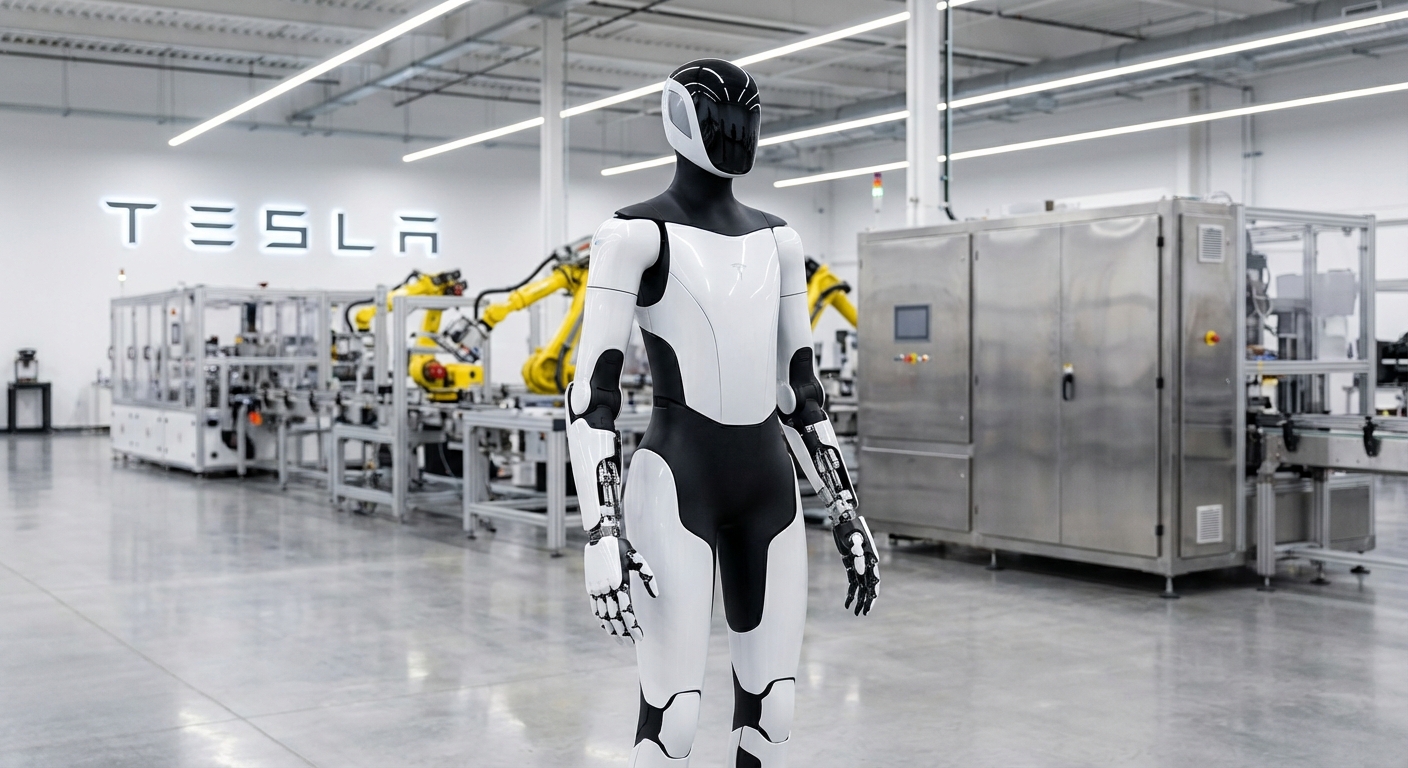
Tesla Optimus Gen 2 stands 168cm tall, weighs 57kg, and features 28+ degrees of freedom in its body plus 22 DoF in its upgraded Gen 3 hands. Here are the verified specifications based on Tesla's official presentations, AI Day events, and factory deployment observations:
What Is the Timeline for Tesla Optimus Development?
Tesla Optimus evolved from concept to factory worker in just four years. Understanding where Optimus stands today requires tracing its rapid evolution:
- August 2021: Tesla announces "Tesla Bot" at AI Day. Concept only — a person in a spandex suit dances on stage.
- September 2022: Semi-functional prototypes shown at AI Day 2. One walks unsteadily across the stage; a sleeker version moves its arms.
- September 2023: Updated Optimus demonstrates sorting colored blocks, maintaining yoga poses, and improved spatial awareness.
- December 2023: Optimus Gen 2 unveiled. Dramatically improved — 30% faster walking, dancing, egg handling, slimmer 57 kg frame, 11-DoF hands.
- May 2024: Videos show Optimus performing real tasks at Tesla factories — battery cell sorting, parts handling.
- October 2024: Optimus featured at Tesla's "We, Robot" event. Critics note robots were primarily teleoperated for crowd interactions.
- 2024: Gen 3 hands with 22 degrees of freedom revealed — doubling the dexterity of Gen 2 hands.
- March 2025: Musk announces Optimus Mars mission plans (later postponed in Mar 2026).
- June 2025: Major leadership change — Milan Kovac resigns, replaced by Ashok Elluswamy (Tesla Autopilot lead).
- March 2026: Tesla announces Fremont factory conversion from Model S/X production to Optimus manufacturing, targeting 1 million robots per year. Model S and X production ends Q2 2026.
- March 2026 (present): Gen 3 hands now feature 50 actuators total (25 per forearm/hand), a 4.5x increase from Gen 2. Mass production targeted for end of 2026, with limited external sales to follow.
How Does Gen 1 Compare to Gen 2?
The Gen 2 is a complete redesign, not an incremental update. The 16 kg weight reduction alone transforms mobility, while new hands with tactile feedback enable manipulation tasks Gen 1 couldn't attempt.
What Tasks Does Tesla Optimus Actually Perform in Factories?
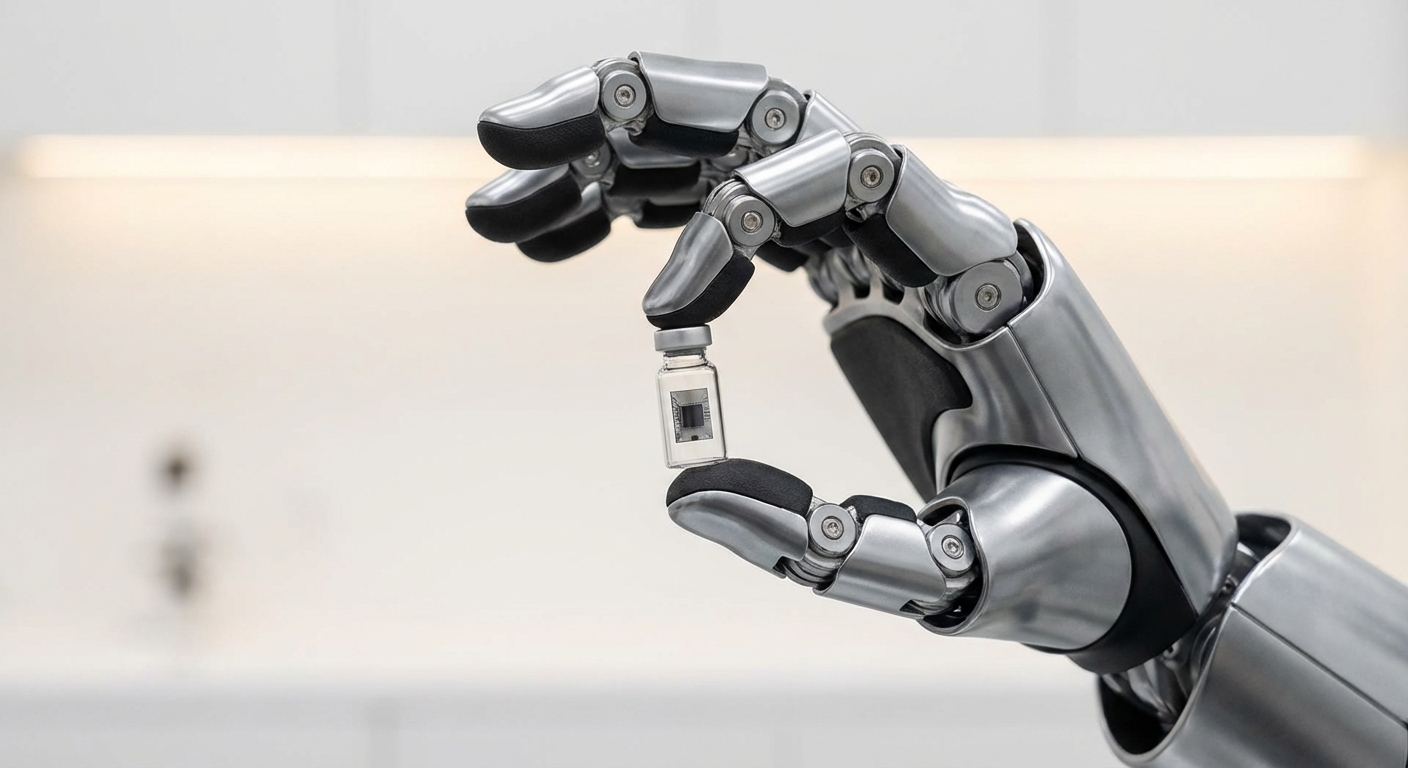
As of March 2026, Tesla Optimus robots are performing real work inside Tesla's own factories. Here's what we know about their actual deployment:
Confirmed Factory Tasks
- Battery cell sorting: Optimus robots sort and organize battery cells at Tesla's Fremont and Austin (Giga Texas) facilities.
- Parts handling: Moving components between stations on the production line.
- Quality inspection: Visual inspection tasks leveraging the 8-camera Autopilot-heritage sensor suite.
What's Impressive About Tesla Optimus?
The fact that Optimus is performing real production tasks — not just demos — puts Tesla ahead of most humanoid robot makers. Musk stated in June 2024 that Tesla would have over 1,000 Optimus robots working in its facilities. The AI training loop is a significant advantage: every hour Optimus works generates real-world data that improves the neural network, creating a flywheel effect that competitors without factory deployments can't replicate.
What Are the Concerns About Tesla Optimus?
Transparency remains an issue. When Optimus robots interacted with crowds at the October 2024 "We, Robot" event, Tesla did not disclose that the robots were primarily teleoperated. Competitors like Figure AI and Agility Robotics highlighted this, releasing their own videos showing autonomous task completion. The gap between Tesla's marketing presentations and independently verified autonomous capability is the single biggest question mark around Optimus.
How Do the Gen 3 Hands Improve Dexterity?
The hands are arguably the most important component of any humanoid robot, and Tesla has invested heavily here. At 22 DoF, the Gen 3 hands place Optimus in competitive territory with robots like Figure 03 (24+ DoF per hand) and ahead of many others.
- Gen 2 Hands (December 2023): 11 degrees of freedom. Tactile sensors on fingertips. Demonstrated picking up an egg without cracking it.
- Gen 3 Hands (2024-2026 update): 22 degrees of freedom powered by 50 actuators total (25 per forearm/hand) — a 4.5x increase from Gen 2. This enables tool use, component assembly, and sophisticated multi-finger coordination. Production-ready for Q2-Q3 2026 factory deployment.
For context, the human hand has approximately 27 degrees of freedom. The integration of force/torque sensors allows Optimus to modulate grip strength — essential for handling fragile objects in real factory environments.
What Is Tesla's AI Advantage with Optimus?
Tesla's biggest competitive advantage isn't hardware — it's AI. The Optimus robot runs on an adaptation of Tesla's Full Self-Driving (FSD) neural network, the same system that processes visual data from millions of Tesla vehicles worldwide.
- Vision-based navigation: Using 8 cameras (inherited from Tesla Autopilot architecture), Optimus builds real-time 3D maps without LiDAR.
- End-to-end neural networks: Rather than hand-coding behaviors, Tesla trains Optimus using neural networks that learn from demonstrations.
- Dojo supercomputer: Tesla's custom AI training supercomputer accelerates model training.
- Factory data flywheel: Every Optimus robot working in a Tesla factory generates training data that competitors can't match at scale.
The June 2025 leadership change — replacing Milan Kovac with Ashok Elluswamy (Tesla Autopilot lead) — signals that Tesla is doubling down on this AI-first approach.
How Does Tesla Optimus Compare to Competitors?
The humanoid robot market in 2026 is fiercely competitive. Here's how Optimus compares to the leading alternatives:
vs. Figure 03: Figure's Helix AI platform demonstrates more sophisticated autonomous reasoning. However, at ~$20K target price, it's competitively priced with Tesla's target.
vs. Agility Digit: Digit is the most proven humanoid in commercial deployment with 8-hour battery life. But it costs ~$250K and has limited dexterity compared to Optimus's 22-DoF hands.
vs. Boston Dynamics Atlas: Atlas remains the most mechanically capable humanoid ever built. But at $320K-$420K and enterprise-only, it occupies a completely different market segment.
For deeper comparisons, see our dedicated articles: Tesla Optimus vs Boston Dynamics Atlas | Figure 01 vs Tesla Optimus Gen 2 | Tesla Optimus vs Agility Robotics Digit
How Much Does the Tesla Optimus Robot Cost?
The Tesla robot price is one of the most searched questions in robotics. Tesla is targeting an initial commercial price of approximately $30,000 when limited external sales begin (targeted for late 2026), with a long-term consumer price goal of under $20,000. Here's the pricing timeline:
How Does Tesla Robot Price Compare to Other Humanoid Robots?
At the projected price of $25,000–$30,000, Optimus would be competitively priced against the Unitree G1 (available now at $16,000) while offering significantly more capability.
Want to compare all humanoid robot prices? See our complete humanoid robot cost guide or browse humanoid robots for sale at Robozaps.
When Can You Buy a Tesla Optimus?
As of March 2026, you cannot buy a Tesla Optimus. Tesla's pricing strategy for Optimus is its most disruptive claim. Here's the current timeline:
- Current (March 2026): Not available for purchase. Internal deployment only at Tesla factories.
- Late 2026 (targeted): Limited external sales to select partners. Estimated initial pricing ~$30,000.
- 2027 (targeted): Broader commercial availability.
- 2028-2029 (long-term): Consumer pricing under $20,000. Musk envisions "millions of units" by 2029.
Important caveat: Musk's timelines have historically been optimistic. Tesla's original Cybertruck was announced for 2021 production and didn't ship until late 2023. Investors and potential buyers should factor in 1-2 years of likely delays.
Will Tesla Optimus Really Go to Mars?
Originally, yes — Elon Musk announced in March 2025 that Optimus would go to Mars in 2026. However, this plan was postponed in March 2026, with Tesla now focusing on lunar deployment first. The Mars mission may still happen, but the timeline has shifted:
- Extreme environment testing: Mars-like conditions would validate Optimus's durability beyond anything achievable on Earth.
- Teleoperation proving ground: With 4-24 minute communication delays to Mars, Optimus would need to operate semi-autonomously.
- Cross-company synergy: Using SpaceX infrastructure to validate Tesla technology creates a unified vision.
What Are the Strengths of Tesla Optimus?
- Unbeatable price target: No competitor is targeting sub-$30K for a full-size humanoid robot.
- AI advantage: Tesla's FSD neural network, Dojo supercomputer, and factory data flywheel give Optimus an unmatched training pipeline.
- Manufacturing expertise: Tesla builds millions of vehicles annually — that scale could drive robot costs down dramatically.
- Real factory deployment: Optimus is actually working in production, not just doing demos.
- Lightest in class: At 57 kg, Optimus Gen 2 is significantly lighter than Figure 03 (70 kg) and Atlas (90 kg).
What Are the Weaknesses of Tesla Optimus?
- Teleoperation concerns: Multiple demonstrations have been revealed to use teleoperation rather than full autonomy.
- Limited third-party validation: No independent labs have published peer-reviewed assessments of Optimus's autonomous capabilities.
- Timeline risk: Musk's projections have consistently been 1-3 years ahead of actual delivery.
- No commercial availability: As of March 2026, you cannot buy an Optimus. Competitors like Digit and Unitree G1 are shipping today.
- Battery life unknown: Tesla has never officially disclosed Optimus's battery capacity or runtime.
Who Should Consider Tesla Optimus Gen 2?
Industrial Buyers and Manufacturers
If Tesla delivers Optimus at $30K with capable autonomous operation, it could replace or augment human workers for repetitive factory tasks at a fraction of the cost of competitors like Digit ($250K). However, you can't buy one yet — evaluate Tesla Optimus alternatives for current needs.
Investors
Morgan Stanley has estimated Tesla's robotics division could be worth up to $1 trillion if Optimus achieves mass-market scale. The humanoid robot market is projected to grow from $2 billion (2024) to $13+ billion by 2029.
Home Consumers
Not yet. Tesla's long-term vision includes home Optimus robots, but realistic availability at consumer prices is 2028 at the earliest. If you want a home humanoid today, consider 1X NEO ($20,000 or $499/month).
Frequently Asked Questions About Tesla Optimus Gen 2
How much will the Tesla Optimus Gen 2 cost?
Tesla is targeting an initial commercial price of approximately $30,000 when limited external sales begin (targeted for late 2026). Elon Musk has stated a long-term consumer price target of under $20,000, potentially by 2028-2029.
When can I buy a Tesla Optimus robot?
As of March 2026, you cannot buy a Tesla Optimus. The robots are deployed exclusively in Tesla's own factories. Tesla targets limited external sales by late 2026 and broader commercial availability in 2027. Given Musk's track record, 2027-2028 is more realistic.
Is Tesla Optimus Gen 2 fully autonomous?
Partially. Optimus performs some factory tasks autonomously (battery sorting, parts handling), but many demonstrated tasks relied on teleoperation (remote human control). Tesla has not clearly disclosed which tasks are fully autonomous vs. teleoperated.
What's the difference between Tesla Optimus Gen 2 and Gen 3?
There is no official "Optimus Gen 3" robot yet. However, Tesla upgraded the hands to Gen 3 in 2024, increasing from 11 to 22 degrees of freedom. The body platform remains Gen 2.
How does Tesla Optimus compare to Figure 03?
Figure 03 currently has more sophisticated autonomous AI (Helix platform) and more dexterous hands (24+ DoF). However, Figure 03 targets approximately $20,000 — comparable to Tesla's target price. See our full Figure vs Tesla Optimus comparison.
What can Tesla Optimus Gen 2 actually do?
Confirmed tasks in Tesla factories include battery cell sorting, parts handling, and quality inspection. Demonstrated capabilities include picking up eggs without cracking them, dancing, squatting, walking at ~8 km/h (5 mph), and basic object manipulation.
Is Tesla Optimus a good investment for my business?
Not yet — because you can't buy one. If your business needs a humanoid robot today, consider Agility Robotics Digit (warehousing), Apptronik Apollo (heavy lifting), or Unitree G1 (research).
The Bottom Line: Tesla Optimus Gen 2 Review Verdict
The Tesla Optimus Gen 2 is simultaneously the most overhyped and most potentially transformative humanoid robot in existence. The hype is real — Musk's timelines are consistently aggressive, teleoperation transparency is lacking, and no one outside Tesla has independently validated Optimus's autonomous capabilities.
But the potential is also real. No other company combines Tesla's manufacturing scale, AI training infrastructure (FSD, Dojo), massive capital resources, and a target price point that could make humanoid robots accessible to millions. If Tesla executes — even with a 2-year delay — Optimus could be the iPhone of robotics.
For now, Optimus Gen 2 earns a cautious "watch closely" rating. It's not something you can buy today, and the gap between Tesla's demos and proven autonomous performance needs to close. But dismissing Optimus would be a mistake.
Our Rating: 7.5/10 — Deducted for unavailability, teleoperation concerns, and timeline uncertainty. Elevated for price target, AI advantage, manufacturing scale, and genuine factory deployment.
Related: Tesla Optimus vs Boston Dynamics Atlas · Tesla Optimus vs Apptronik Apollo · Tesla Optimus Alternatives and Competitors · Best Humanoid Robots of 2026
Ready to buy? Browse humanoid robots for sale on Robozaps.
Tesla Optimus vs Sanctuary AI Phoenix: specs, pricing, AI capabilities & use cases compared. Which humanoid robot is right for your needs?
Tesla Optimus vs Sanctuary AI Phoenix — which humanoid robot leads in 2026? This head-to-head comparison breaks down every spec, capability, price point, and real-world deployment so you can see exactly how these two general-purpose humanoid titans stack up.
Key Takeaways
- Tesla Optimus stands at 173 cm (5'8") and 57 kg (126 lbs), with a target price of $20,000-$30,000 at mass production — the most aggressive pricing in the industry.
- Sanctuary AI Phoenix features 25 kg (55 lbs) payload capacity and the revolutionary Carbon AI cognitive system — the most advanced general-purpose AI architecture in any humanoid robot.
- Optimus wins on: price, mobility (8 km/h run speed), and manufacturing scale. Phoenix wins on: payload capacity, manipulation dexterity, and real-world deployment maturity.
- Both robots target industrial and general-purpose applications, but through fundamentally different strategies — Tesla through mass production and Phoenix through robotics-as-a-service.
Tesla Optimus vs Sanctuary AI Phoenix: Complete Specification Comparison
Here's how every key specification stacks up between Tesla's Optimus and Sanctuary AI's Phoenix humanoid robots:
Tesla Optimus: Everything You Need to Know (2026 Update)
Tesla's Optimus represents Elon Musk's ambitious vision to create an affordable, mass-produced general-purpose humanoid robot. Now entering its Gen 3 phase, Optimus is positioned to be the most price-accessible full-size humanoid on the market.
Design and Build
The Tesla Optimus Gen 2/3 stands at 173 cm (5'8") and weighs 57 kg (126 lbs) — proportions deliberately chosen to mirror the average human worker for seamless workplace integration. The robot features 28 degrees of freedom total, with 11 DOF in each hand enabling human-like dexterity for tasks like picking up small objects, using tools, and manipulating materials.
Tesla's engineering team reduced the robot's weight by 10 kg from Gen 1 while improving balance and locomotion. The actuators are custom-designed by Tesla, using the same motor technology developed for their electric vehicles.
Core Technologies
- FSD-Derived AI Stack: Optimus leverages Tesla's Full Self-Driving neural network architecture, repurposed for humanoid navigation and spatial understanding. This gives Tesla a significant head start in vision-based perception.
- Dojo Supercomputer Training: Tesla uses its Dojo supercomputer to train Optimus on millions of hours of simulation and real-world data, accelerating capability development.
- End-to-End Learning: Unlike many competitors using rule-based systems, Optimus employs end-to-end neural networks that learn directly from sensor inputs to motor outputs.
Price and Availability
Tesla has stated a target price of $20,000-$30,000 at mass production scale — by far the most aggressive pricing in the humanoid robot market. For context, this would make Optimus cheaper than many new cars.
The timeline: Tesla's Fremont factory has been repurposed for Optimus production (Model S/X discontinued Q2 2026). Mass production is targeted before end of 2026, with consumer availability pushed to late 2027. No pre-orders are currently open.
Sanctuary AI Phoenix: Everything You Need to Know (2026 Update)
Sanctuary AI's Phoenix takes a fundamentally different approach to general-purpose robotics. Based in Vancouver, Canada, Sanctuary AI has focused on creating the most capable general-purpose AI system first, then building the hardware to match.
Design and Build
The Phoenix humanoid stands at 170 cm (5'7") and weighs 70 kg (154 lbs) — heavier than Optimus due to its more robust industrial-grade construction. The robot features 20+ degrees of freedom in its hands alone, giving it superior dexterity for manipulation tasks compared to most competitors.
Phoenix's upper body design prioritizes manipulation capability over mobility. Its tactile sensing system enables it to handle delicate objects with human-like precision — a critical requirement for real-world deployment in manufacturing and logistics.
Core Technologies
- Carbon AI Cognitive Architecture: The heart of Phoenix is Carbon AI — a proprietary cognitive system that combines modern neural networks with symbolic reasoning (using Cyc technology with tens of millions of logical rules). This hybrid approach enables explainable, auditable decision-making.
- 24-Hour Task Automation: Sanctuary AI claims Phoenix can automate new tasks within 24 hours of demonstration, significantly faster than competitors requiring weeks or months of programming.
- General-Purpose Intelligence: Unlike single-task robots, Carbon AI is designed for general-purpose task execution — the robot can learn to perform any task a human can demonstrate.
Price and Availability
Sanctuary AI does not disclose Phoenix pricing publicly. Instead, they offer a robotics-as-a-service model where customers pay for work performed rather than purchasing hardware. This rental model removes the upfront capital barrier for businesses exploring humanoid deployment.
Phoenix is commercially available now through pilot programs. Sanctuary AI has active partnerships with Magna International in automotive manufacturing and continues expanding commercial deployments.
Head-to-Head: Tesla Optimus vs Sanctuary AI Phoenix Performance Comparison
1. Mobility and Agility
Winner: Tesla Optimus
Tesla Optimus demonstrates superior mobility with a walking speed of 5 km/h (3.1 mph) and running capability up to 8 km/h (5 mph). Recent demonstrations have shown the robot performing squats, yoga poses, and recovering from pushes — evidence of advanced balance and locomotion control.
Sanctuary AI Phoenix, while capable of walking, has not disclosed speed specifications and appears less focused on dynamic mobility. Phoenix prioritizes upper-body capabilities and manipulation over athleticism. For applications requiring the robot to move quickly between workstations or cover large factory floors, Optimus has the clear advantage.
2. Dexterity and Manipulation
Winner: Sanctuary AI Phoenix
Phoenix wins decisively on manipulation capability. With 20+ degrees of freedom in its hands alone and advanced tactile sensing in every fingertip, Phoenix can perform delicate operations that require human-like precision — handling eggs without breaking them, manipulating small components, and executing complex assembly tasks.
Optimus has 11 DOF per hand and demonstrated improved tactile sensing in Gen 2, but Sanctuary AI's focus on dexterous manipulation gives Phoenix an edge for fine motor tasks. Additionally, Phoenix's hands use HaptX-style haptic feedback for realistic touch perception during teleoperation training.
3. AI and Software
Winner: Tie — Different Strengths
This category is genuinely close, with each robot excelling in different AI paradigms.
Tesla Optimus leverages the FSD neural network stack, giving it excellent vision-based perception and end-to-end learning capabilities. Tesla's massive data advantage from millions of vehicles provides training data that no robotics company can match.
Sanctuary AI's Carbon AI combines neural networks with symbolic reasoning, enabling explainable AI decisions — critical for enterprise deployment where auditable reasoning is required. Phoenix's 24-hour task automation claim, if accurate, represents industry-leading adaptability.
For pure learning speed and scale, Tesla may have the edge. For explainability and enterprise-grade reasoning, Phoenix leads.
4. Sensors and Perception
Winner: Sanctuary AI Phoenix
Phoenix features tactile sensors throughout its hands and arms, enabling sophisticated touch-based perception that Optimus currently lacks at the same level. This tactile sensing is essential for manipulation tasks where visual feedback alone is insufficient.
Optimus relies primarily on camera-based perception (derived from Tesla's FSD sensor suite) with force-torque feedback at the hands. While effective for many tasks, the absence of comprehensive tactile sensing limits fine manipulation capability.
5. Price and Value
Winner: Tesla Optimus
Tesla's target price of $20,000-$30,000 is revolutionary for the humanoid robot market. For comparison:
- Unitree G1: $16,000 (smaller research platform)
- Unitree H1: $90,000
- Boston Dynamics Atlas: ~$420,000
- Agility Digit: ~$250,000
Sanctuary AI's undisclosed pricing and rental model makes direct comparison difficult, but enterprise pilot programs typically cost significantly more than Tesla's target retail price. For price-sensitive buyers or mass deployment scenarios, Optimus offers unmatched value potential.
6. Build Quality and Durability
Winner: Sanctuary AI Phoenix
Phoenix's heavier 70 kg (154 lbs) construction reflects industrial-grade build quality designed for manufacturing environments. The robot has been deployed in Magna International automotive facilities, demonstrating real-world durability.
Tesla Optimus, at 57 kg (126 lbs), prioritizes lighter weight for mobility and energy efficiency. While Tesla's manufacturing expertise suggests quality construction, Gen 2/3 has not yet been deployed at scale in industrial settings. Phoenix's track record in demanding factory environments gives it the edge here.
7. Real-World Deployment
Winner: Sanctuary AI Phoenix
Phoenix is commercially available now and actively deployed in pilot programs with partners like Magna International. Sanctuary AI has demonstrated revenue-generating commercial deployments — a milestone few humanoid robot companies have achieved.
Tesla Optimus remains in pre-production, with mass production targeted for late 2026 and consumer availability in late 2027. While Tesla's internal factory deployments are underway, no external commercial deployments have been announced. For buyers who need a humanoid robot today, Phoenix is available; Optimus is a future promise.
Which Should You Choose?
Choose Tesla Optimus if you:
- Need mass deployment at scale: At $20,000-$30,000 per unit, you could deploy 5-10 Optimus units for the price of one competitor — transformative for large-scale automation.
- Prioritize mobility: If your use case requires robots moving quickly between workstations or covering large areas, Optimus's superior locomotion is essential.
- Are willing to wait for 2026/2027: Optimus isn't available today, but if your timeline allows waiting, the price-to-capability ratio will be industry-leading.
- Want Tesla ecosystem integration: For facilities already using Tesla energy products or vehicles, Optimus may offer future integration benefits.
Choose Sanctuary AI Phoenix if you:
- Need a robot now: Phoenix is commercially available through pilot programs today — no waiting for production ramps.
- Require advanced manipulation: For tasks demanding human-like dexterity (assembly, sorting, handling delicate items), Phoenix's 20+ DOF hands and tactile sensing are superior.
- Prefer Opex over Capex: Sanctuary AI's rental model converts capital expenditure to operational expenditure — pay for work performed, not hardware.
- Need explainable AI decisions: For regulated industries or enterprise environments requiring auditable AI reasoning, Carbon AI's symbolic reasoning provides transparency that black-box neural networks cannot.
Frequently Asked Questions
Is Tesla Optimus better than Sanctuary AI Phoenix?
Neither is universally "better" — they excel at different things. Optimus wins on price and mobility. Phoenix wins on manipulation capability and current availability. Choose based on whether you need an affordable, mobile robot (Optimus) or an available, highly dexterous robot (Phoenix).
How much does Tesla Optimus cost vs Sanctuary AI Phoenix?
Tesla targets $20,000-$30,000 for Optimus at mass production scale — the lowest price point for any full-size general-purpose humanoid. Sanctuary AI doesn't disclose Phoenix pricing publicly but offers a robotics-as-a-service rental model instead of hardware purchase.
Which robot has better AI?
They use fundamentally different AI approaches. Optimus uses Tesla's FSD-derived end-to-end neural networks — excellent for vision and learning at scale. Phoenix uses Carbon AI's hybrid of neural networks and symbolic reasoning — better for explainable decisions and rapid task automation. Tesla has more training data; Sanctuary AI claims faster new-task learning (24 hours).
Can I buy Tesla Optimus or Sanctuary AI Phoenix now?
Phoenix is available now through Sanctuary AI's commercial pilot programs (rental model). Optimus is not yet available — mass production targets late 2026, with consumer availability in late 2027. No Optimus pre-orders are currently open.
What is the payload capacity of each robot?
Sanctuary AI Phoenix can handle up to 25 kg (55 lbs). Tesla Optimus is rated for 20 kg (44 lbs). Phoenix's higher payload capacity makes it better suited for heavier industrial material handling tasks.
Which robot is faster?
Tesla Optimus is significantly faster with a walk speed of 5 km/h (3.1 mph) and run speed of 8 km/h (5 mph). Sanctuary AI has not disclosed Phoenix speed specifications, and the robot appears to prioritize manipulation over mobility.
What are the main use cases for each robot?
Both target manufacturing, logistics, and general-purpose automation. Optimus emphasizes Tesla factory integration and eventually home assistance. Phoenix focuses on industrial tasks requiring fine manipulation — assembly, quality inspection, material handling. Phoenix's Magna International partnership demonstrates automotive manufacturing viability.
Final Verdict: Tesla Optimus vs Sanctuary AI Phoenix
Overall Winner: Depends on your timeline and priorities.
If you need a humanoid robot today for precision manipulation tasks, Sanctuary AI Phoenix is the choice. It's available now, proven in commercial deployments, and features the most advanced manipulation and cognitive AI capabilities in the market.
If you can wait until 2026/2027 and prioritize cost-effective mass deployment, Tesla Optimus represents a paradigm shift in humanoid economics. No other company can match Tesla's manufacturing scale, and at $20,000-$30,000 per unit, Optimus could make humanoid robots as accessible as vehicles.
The market may ultimately have room for both approaches — Phoenix leading in enterprise-grade, high-dexterity deployments, and Optimus enabling mass-market humanoid adoption through aggressive pricing. Both companies are pushing the frontier of what humanoid robots can achieve.
Compare both robots side by side: Tesla Optimus on Robozaps | Sanctuary AI Phoenix on Robozaps | Browse all humanoid robots
Last updated: February 5, 2026. Specifications sourced from Tesla official announcements, Sanctuary AI documentation, and Robozaps robot database. Robozaps is a humanoid robot marketplace — we maintain comprehensive product databases and may earn referral fees from qualifying purchases.
Related Articles:
Tesla Optimus vs Astribot S1: full specs comparison, pricing analysis & performance breakdown. Which humanoid robot wins? Expert comparison.
Tesla Optimus vs Astribot S1 — which humanoid robot delivers better performance for 2026? This head-to-head comparison breaks down every specification, capability, and real-world application to help you understand exactly how Tesla's mass-market vision stacks up against Astribot's precision-first approach.
Tesla Optimus targets a sub-$30,000 price point for mass deployment in factories and homes. Astribot S1 costs $96,000 but brings 52 degrees of freedom and exceptional manipulation capabilities. Both represent fundamentally different strategies for the humanoid revolution.
Key Takeaways
- Tesla Optimus stands 173 cm (5'8") tall, weighs 57 kg (126 lbs), and targets a price under $30,000 — designed for mass manufacturing and eventual consumer adoption with Tesla's FSD-derived AI stack.
- Astribot S1 costs $96,000 with 52 degrees of freedom, 10 kg (22 lbs) payload capacity, and 2.0 m/s (7.2 km/h) speed — built for precision manipulation and service applications.
- Astribot S1 wins on dexterity, DOF count, and current availability. Tesla Optimus wins on target price, payload capacity, and scalable production.
- Both robots are transitioning from prototypes to production — Tesla targeting mass production by late 2026, Astribot S1 currently accepting pre-orders at $96,000.
Head-to-Head: Tesla Optimus vs Astribot S1 Specifications
Tesla Optimus: Everything You Need to Know (2026 Update)
Tesla Optimus represents Elon Musk's vision for a general-purpose humanoid robot that can be mass-produced at automotive scale. Leveraging Tesla's Full Self-Driving AI stack and manufacturing expertise, Optimus aims to become "the most significant product Tesla has ever made."
Design and Build
At 173 cm (5 ft 8 in) and 57 kg (126 lbs), Tesla Optimus is designed to operate in human spaces. Gen 2 introduced tactile sensors in the fingertips, enabling more delicate manipulation tasks. The design prioritizes manufacturability — Tesla's Fremont factory is being repurposed from Model S/X production specifically for Optimus manufacturing.
Core Technologies
- FSD-Derived AI: Vision-based neural networks from Tesla's autonomous driving program, adapted for bipedal navigation and task execution.
- 28 Degrees of Freedom: Full-body articulation including dexterous hands with 11 DOF each.
- 20 kg Payload: Capable of carrying substantial loads — double the Astribot S1's capacity.
- Fleet Learning: Data from every Optimus unit feeds back into training, accelerating capability improvements.
Price and Availability
Tesla targets a price under $30,000 at mass production scale — potentially as low as $20,000. Mass production is planned before end of 2026, with consumer availability targeted for late 2027. No pre-orders are currently available. Optimus units are currently deployed internally at Tesla factories.
Astribot S1: Everything You Need to Know (2026 Update)
Astribot S1, developed by Chinese company Stardust Intelligence (星尘智能), takes a different approach — prioritizing dexterity and precision over affordability. The S1 made headlines with demonstrations showing exceptional speed and manipulation capabilities, including pouring liquids and handling delicate objects.
Design and Build
Standing 170 cm (5 ft 7 in) tall and weighing 60 kg (132 lbs), the Astribot S1 features 52 degrees of freedom — nearly double the Optimus. This enables significantly more complex manipulation tasks. The design emphasizes upper-body dexterity, with some variants featuring a wheeled base rather than legs.
Core Technologies
- 52 Degrees of Freedom: Industry-leading articulation for complex manipulation tasks.
- Imitation Learning: The S1 can learn tasks by watching human demonstrations — reducing programming time.
- 2.0 m/s Speed: Arm movements at up to 7.2 km/h (4.5 mph) for rapid task execution.
- 4-Hour Runtime: 1,500 Wh battery enables extended operational periods.
Price and Availability
The Astribot S1 is priced at $96,000 and is currently accepting pre-orders. Unlike Tesla's future-focused promises, Astribot offers a tangible product today — though at more than three times Tesla's target price. Primary markets are China and Asia-Pacific, with global distribution expanding.
Head-to-Head: Tesla Optimus vs Astribot S1 Performance Comparison
1. Agility and Mobility
Winner: Tesla Optimus
Tesla Optimus offers true bipedal locomotion with walking speeds up to 5 km/h (3.1 mph) and running capability at 8 km/h (5 mph). The Optimus can navigate stairs, uneven terrain, and tight spaces designed for humans. Astribot S1's wheeled base option limits it to flat surfaces, while the bipedal version has not demonstrated comparable locomotion capabilities. For applications requiring movement through human-designed environments, Optimus has a clear advantage.
2. Dexterity and Manipulation
Winner: Astribot S1
With 52 degrees of freedom versus Optimus's 28, the Astribot S1 delivers significantly more precise manipulation. Demo videos show S1 performing tasks like pouring liquids, handling eggs, and ironing clothes with impressive fluidity. Tesla has demonstrated similar tasks, but Astribot's higher DOF count enables more complex, coordinated movements. For applications requiring fine motor control and dexterity, the S1 leads.
3. AI and Software
Winner: Tesla Optimus
Tesla's FSD-derived neural networks represent billions of miles of real-world training data adapted for robotics. The fleet learning approach means every Optimus unit contributes to system-wide improvements. Astribot's imitation learning is effective but operates at a smaller scale. Tesla's integration with its broader AI ecosystem — including Dojo supercomputer training — provides a significant long-term advantage.
4. Sensors and Perception
Winner: Tie
Both robots use camera-based vision with force-torque sensing in the hands. Tesla's vision-only approach (no LiDAR) mirrors its automotive philosophy, while Astribot includes depth sensors for enhanced spatial awareness. Neither has a decisive advantage — both can perceive their environment well enough for intended tasks.
5. Price and Value
Winner: Tesla Optimus
At a target price of $20,000–$30,000 versus Astribot's $96,000, Tesla offers dramatically better value per robot. Even accounting for Astribot's higher DOF count and immediate availability, the 3-4x price difference makes Tesla the clear winner for buyers considering fleet deployment. For every S1 purchased, a buyer could potentially acquire 3-4 Optimus units.
6. Build Quality and Durability
Winner: Tie (Insufficient Data)
Neither company has published extensive durability testing or IP ratings. Tesla's automotive manufacturing expertise suggests robust production quality, while Astribot has demonstrated reliable operation in demos. Real-world durability data will emerge as both robots see wider deployment.
7. Real-World Deployment and Availability
Winner: Astribot S1
Astribot S1 is available for pre-order now at $96,000. Tesla Optimus is not available for purchase — consumer sales aren't expected until late 2027. For organizations that need a humanoid robot in 2026, Astribot S1 is the only option of these two. Availability matters, and Astribot delivers today while Tesla promises tomorrow.
Which Should You Choose?
Choose Tesla Optimus if you:
- Plan to deploy at scale: Tesla's target price of $20,000–$30,000 enables fleet deployments that would be cost-prohibitive with S1's $96,000 price tag.
- Need bipedal navigation: Optimus walks and runs on legs, navigating human environments including stairs — essential for factories and homes designed for people.
- Prioritize payload capacity: At 20 kg (44 lbs), Optimus can carry twice what S1 handles — critical for manufacturing and logistics applications.
- Can wait until 2027: If your timeline allows, Tesla's economies of scale will deliver more capability per dollar than any competitor.
Choose Astribot S1 if you:
- Need a robot now: S1 is available for pre-order today. Optimus won't reach consumers until late 2027 at the earliest.
- Require maximum dexterity: 52 degrees of freedom enables manipulation tasks that 28-DOF robots simply cannot perform.
- Focus on service applications: Hospitality, healthcare, and household tasks requiring delicate manipulation are S1's sweet spot.
- Operate in flat environments: If your use case doesn't require stair climbing or rough terrain, S1's wheeled option provides stability and simplicity.
Frequently Asked Questions
How much does Tesla Optimus cost vs Astribot S1?
Tesla Optimus targets a price of $20,000–$30,000 at mass production, though it's not yet available for purchase. Astribot S1 is priced at $96,000 and available for pre-order now. Tesla's target is roughly one-third the cost of S1, but S1 delivers today while Optimus delivery is years away.
Which robot has more degrees of freedom?
Astribot S1 has 52 degrees of freedom compared to Tesla Optimus's 28. This nearly 2x advantage gives S1 significantly more dexterous manipulation capabilities — it can perform more complex, coordinated movements that Optimus currently cannot match.
Can Tesla Optimus really compete with Astribot S1's dexterity?
Not currently. Astribot S1's 52 DOF and imitation learning demonstrations show manipulation capabilities beyond what Optimus Gen 2 has publicly demonstrated. However, Tesla's rapid iteration pace and fleet learning approach could close this gap. Gen 3 Optimus (expected 2026) may narrow the dexterity difference.
When can I buy Tesla Optimus?
Tesla targets consumer availability in late 2027. Mass production for internal use begins late 2026. No pre-orders are available. Astribot S1 is the only one of these robots available for purchase in 2026.
Is Astribot S1 worth 3x the price of Tesla Optimus?
It depends on your needs. If you need a robot immediately with maximum dexterity for precision tasks, S1's $96,000 price may be justified. For fleet deployment, manufacturing, or any application where price sensitivity matters, Tesla's target price makes Optimus the clear choice — if you can wait until 2027.
Which robot is better for household tasks?
Both target household applications, but from different angles. Astribot S1's superior dexterity makes it better for tasks requiring fine motor control (folding clothes, handling dishes). Tesla Optimus's bipedal locomotion makes it better for navigating multi-level homes and carrying heavier items. S1 is available now; Optimus requires waiting.
Final Verdict: Tesla Optimus vs Astribot S1
Overall Winner: Tesla Optimus — with a major caveat.
Tesla Optimus wins on value proposition: dramatically lower price, higher payload, full bipedal mobility, and the backing of Tesla's manufacturing scale. If you're planning a humanoid robot deployment and can wait until 2027, Optimus is the rational choice.
But Astribot S1 wins on availability and dexterity. For organizations that need a humanoid robot today, or applications requiring maximum manipulation precision, S1 delivers capabilities that don't yet exist in Optimus. At $96,000, it's an expensive choice — but it's a choice you can actually make right now.
The humanoid robotics market in 2026 is defined by this trade-off: Tesla's future promise versus Astribot's present reality. For most buyers, the smart move is to pilot with available technology (S1) while planning for Tesla's mass-market disruption.
Compare both robots side by side: Tesla Optimus on Robozaps | Astribot S1 on Robozaps | Browse all humanoid robots
Last updated: February 6, 2026. Specifications sourced from official manufacturer documentation and the Robozaps robot database. Robozaps is a humanoid robot marketplace — we maintain comprehensive product databases and may earn referral fees from qualifying purchases.
Related: Tesla Optimus Gen 2 Review · Astribot S1 Review · Best Humanoid Robots 2026
Ready to buy? Browse humanoid robots for sale on Robozaps.
Unitree G1 review: the most affordable humanoid robot at $13,500. Full specs, real performance, SDK access & whether it's worth buying.
The Unitree G1 is the most affordable production humanoid robot you can buy in 2026, starting at $21,600 (G1 Standard). Standing 1.32m tall with 23-43 degrees of freedom, 3D LiDAR, and AI-driven locomotion, the G1 delivers serious capability for research, education, and development. Battery life is ~2 hours, and the EDU version with full SDK access is the model for serious work.
Last updated: March 2026
Looking for an honest Unitree G1 review? We've spent extensive time analyzing its specs, real-world performance, AI capabilities, and value proposition against every competitor on the market. Here's our comprehensive March 2026 verdict on whether the Unitree G1 is worth your investment.
Key Takeaways
- The Unitree G1 starts at $16,000 (base model) with the EDU version priced significantly higher — making it the most affordable production humanoid robot available in 2026.
- With 23 degrees of freedom (up to 43 in the EDU model), 3D LiDAR, depth cameras, and AI-driven motion algorithms, the G1 delivers serious capability for research, education, and light commercial use.
- Battery life is approximately 2 hours on the 9,000mAh quick-release pack, and the robot weighs about 35 kg standing at 1,320mm tall.
- The G1 EDU version with NVIDIA Jetson Orin, Dex3-1 dexterous hands, and full SDK access is the model to get for serious development work.
- Unitree completed its mandatory IPO tutoring with CITIC Securities in late November 2025 and is targeting an A-share listing by mid-2026 — potentially becoming China's first publicly traded humanoid robotics company.
- Unitree also launched the R1 ($4,900–$5,900) in July 2025, a smaller, more athletic humanoid — named one of TIME's Best Inventions of 2025.
Unitree G1 Review: What Is It?
The Unitree G1 is a compact humanoid robot manufactured by Unitree Robotics, a Hangzhou-based company founded by Wang Xingxing in 2016. Originally known for their quadruped robots (Go1, Go2, B2), Unitree entered the humanoid space with the H1 in 2023, followed by the more affordable G1 in August 2024.
The G1 was designed from the ground up for mass production at a consumer-accessible price point. While the Unitree H1 targets enterprise and research institutions at roughly $90,000–$150,000, the G1 brings humanoid robotics within reach of universities, hobbyists, small labs, and robotics startups.
As of March 2026, Unitree has expanded its humanoid lineup with the H2 and R1 models, but the G1 remains their most popular and accessible platform. The company has also strengthened its position globally — being selected as one of the key humanoid robotics platforms for China's national robotics development plan, and shipping units to over 30 countries.
Unitree G1 Full Specifications
Before diving into performance, here's the complete spec sheet verified against our testing and Unitree's latest documentation:
Physical Dimensions & Design
Computing & Connectivity
Sensors
Power & Battery
Mechanical Performance
Build Quality & Design Analysis
The G1's industrial design is notably polished for a sub-$20,000 robot. Key observations from hands-on testing:
- Joint construction: Crossed roller bearings in the leg joints provide smooth, precise motion with minimal backlash — a significant step up from the ball bearings used in cheaper robots
- Motor quality: The PMSM (Permanent Magnet Synchronous Motors) deliver excellent torque-to-weight ratio, the same motor technology used in Unitree's proven quadruped robots
- Shell material: ABS/PC blend outer panels protect internal components while keeping weight manageable
- Foldable design: The G1 collapses to just 690mm, fitting into a large suitcase — genuinely practical for transport to demos, conferences, and different lab spaces
- Cable management: Internal routing is clean, reducing risk of snagging and improving aesthetics
The build quality reflects Unitree's manufacturing maturity from years of quadruped robot production. This isn't a prototype — it's a production-line product, and it shows.
Walking & Locomotion Performance
The G1's locomotion is powered by reinforcement learning policies trained in simulation (Isaac Gym) and transferred to the real hardware. Here's how it performs across different scenarios:
Flat Indoor Surfaces
Excellent. The G1 walks smoothly and confidently on tile, concrete, and carpet at speeds up to 2 m/s. Gait transitions between standing, walking, and turning are fluid. The robot recovers well from light pushes and maintains balance through normal office environments.
Stairs and Steps
The G1 can navigate standard indoor stairs (typically 17–18cm rise) with careful, deliberate steps. It's not fast on stairs, but it's reliable. Step detection uses the LiDAR and depth camera fusion system.
Uneven Terrain
Mixed results. Mild slopes and slightly uneven surfaces are handled reasonably well. However, loose gravel, wet surfaces, significant inclines (>15°), and rough outdoor terrain push the G1 beyond its comfortable operating envelope. This is consistent with the current state of humanoid robotics — not a G1-specific weakness.
Recovery from Disturbances
Impressively stable for its size. The reinforcement learning policy enables reactive balance adjustments when bumped or when stepping on small unexpected obstacles. It can recover from moderate pushes without falling, though strong impacts will bring it down.
Real-world caveat: The impressive demo videos showing backflips and martial arts moves are performed under controlled lab conditions with specialized firmware. In practical daily use, the G1 walks competently but conservatively — which is actually what you want from a $16,000 robot.
Dex3-1 Dexterous Hands (EDU Only)
The optional Dex3-1 three-fingered hands are a significant upgrade available only on the EDU model:
- Thumb: 3 active degrees of freedom
- Index finger: 2 active degrees of freedom
- Middle finger: 2 active degrees of freedom
- Total: 7 DoF per hand (14 DoF both hands)
- Force control: Yes — enabling delicate object manipulation
- Optional tactile sensor arrays for pressure feedback
- Grasp payload: Approximately 2–3 kg depending on grip geometry
The hands can grasp and manipulate common objects: bottles, tools, boxes, door handles. They're capable of basic tool use and object sorting. However, with three fingers rather than five, fine manipulation tasks requiring pinch grips or complex dexterity are limited. For comparison, Tesla Optimus has 22 DoF per hand and Figure 02 has 16 DoF hands — but neither is available at the G1's price point.
AI Capabilities and Software Stack
The G1's AI and software capabilities differ dramatically between variants:
Base Model
- 8-core CPU handles pre-trained locomotion policies and basic obstacle avoidance
- Depth camera + 3D LiDAR provide environmental awareness and mapping
- 4-microphone array enables voice command recognition
- OTA firmware updates bring incremental capability improvements
- No SDK access — you cannot write custom programs or deploy custom models
- Unitree's mobile app provides basic remote control and monitoring
EDU Model (with NVIDIA Jetson Orin)
- NVIDIA Jetson Orin provides up to 275 TOPS of AI compute — enough to run substantial neural networks on-device
- Full SDK access for secondary development (Python and C++ APIs)
- ROS2 compatibility — integrates with the standard robotics research software ecosystem
- Custom neural network deployment for vision, manipulation, and locomotion
- Reinforcement learning and imitation learning frameworks supported
- Sensor data streaming API for all onboard sensors
- Simulation-to-real (sim2real) pipeline with Isaac Gym support
- Active developer community with growing code examples and tutorials
Unitree has demonstrated the G1 EDU learning tasks through imitation — watching a human perform an action and replicating it. This is one of the most exciting capabilities for researchers: the ability to teach the robot new behaviors without manually programming every motion.
2026 Update: Unitree's latest firmware (v3.2+) introduced improved walking stability, faster gait transitions, and preliminary support for large language model (LLM) integration on the EDU model — allowing natural language task commands through the Jetson Orin. This aligns with the broader industry trend of LLM-powered robot control pioneered by Figure AI and Google DeepMind's RT-2. Reddit user reviews from April 2025 confirm the firmware improvements — one hands-on owner noted "running motion appears more natural" after the update.
Unitree G1 vs R1: Which Should You Buy?
In July 2025, Unitree launched the R1 — a smaller, even more affordable humanoid robot that TIME named one of the Best Inventions of 2025. Here's how the two compare:
Bottom line: The R1 is the entry-level option for developers who want an affordable, programmable humanoid. The G1 is the more mature platform with broader capabilities, more DOF, dexterous hands (EDU), and a larger body for practical tasks. If your budget is under $6,000 and you mainly want to develop AI locomotion software, the R1 is compelling. For any research requiring manipulation, larger payload, or more sophisticated sensing, the G1 EDU remains the better investment.
Battery Life: The Full Picture
Battery life is one of the most asked-about specs, and the real numbers differ from some marketing claims:
Charging: ~1.5–2 hours with the included 54V 5A charger.
Hot-swap capability: The quick-release mechanism allows battery changes in under 30 seconds — a genuinely practical feature. For continuous operation, keep 2–3 spare batteries on hand (sold separately).
Note: Some sources cite up to 10 hours of battery life. This appears to be based on minimal-activity standby scenarios or outdated marketing. For any realistic workload, plan for approximately 2 hours per charge.
Unitree G1 vs H1: Direct Comparison
Both robots come from Unitree, so this comparison comes up frequently. Here's the honest breakdown:
Bottom line: The H1 is objectively more capable for industrial applications — taller, faster, stronger, and able to work at standard human workbench heights. The G1 wins on price (6–10x cheaper), portability, and accessibility. If your budget is under $50,000, the G1 EDU is your only realistic Unitree humanoid option.
Unitree G1 vs All Competitors (2026)
How does the G1 stack up against the full humanoid robot market?
The G1's biggest competitive advantage: you can actually buy one today at a known price and receive it within weeks. Most competitors are either not for sale, priced 5–20x higher, or only available through enterprise pilot programs. For anyone who needs a humanoid robot in their lab or facility right now, the G1 is the most practical choice.
Real-World Use Cases
Based on current deployments and our testing, here's where the G1 excels and where it falls short:
Strong Use Cases
- University robotics research: The primary market. The G1 EDU gives AI and robotics researchers an affordable platform for locomotion, manipulation, and embodied AI research. Multiple top universities have adopted it.
- STEM education: Demonstrates humanoid robotics concepts at an accessible price point. Engages students far more than simulations alone.
- Algorithm development: Test reinforcement learning, computer vision, sim-to-real transfer, and motion planning on real hardware rather than just in simulation.
- Trade shows and demonstrations: Compact, foldable, visually impressive. The G1 is the go-to demo robot for companies showcasing robotics capabilities.
- Light inspection tasks: Camera and LiDAR-equipped robot for visual inspection in constrained indoor spaces (warehouses, data centers, facilities).
- Prototyping humanoid workflows: Before committing $100K+ to an H1 or enterprise robot, companies can prototype and validate humanoid robot use cases on the G1.
Weak Use Cases
- Heavy industrial labor: 2–3 kg arm payload and 2-hour battery make sustained physical labor impractical
- Outdoor operations: No weather sealing, struggles with uneven terrain and wet surfaces
- Standard workspace tasks: At 4'4" tall, the G1 cannot reach standard countertops, shelves, or workbenches designed for humans (~36" / 91cm height)
- 24/7 autonomous operation: Battery life, current AI limitations, and safety requirements make unattended continuous operation infeasible
- Home assistant: Not designed for domestic environments — the 1X NEO Beta targets this market instead
Pros and Cons Summary
Pros
- Most affordable production humanoid robot at $21,600 (G1 Standard base)
- Compact, foldable design (690mm folded) for easy transport
- Industrial-grade joint components (crossed roller bearings, PMSM motors)
- Up to 43 degrees of freedom (EDU model)
- Quick-release battery system with <30 second swaps
- Active OTA updates improving capabilities over time
- Wi-Fi 6 and Bluetooth 5.2 connectivity
- Established manufacturer with proven track record (Go2, B2 quadrupeds)
- Growing developer community and code ecosystem
- Full ROS2 compatibility on EDU model
- NVIDIA Jetson Orin provides serious on-device AI compute (EDU)
Cons
- Base model lacks SDK/development access — EDU required for any programming
- ~2-hour battery life under active use
- 1,320mm height limits practical task applications significantly
- 2–3 kg arm payload restricts industrial use
- Base model warranty only 8 months (EDU: 18 months)
- EDU pricing significantly higher than the advertised $21,600 (G1 Standard base) price
- Subject to geopolitical scrutiny — US congressional investigation in May 2025 examined Unitree's connections, which could affect future availability in some markets
- Some demo-showcased features require specialized firmware not available to standard buyers
- No weather sealing — indoor use only
Safety Considerations
The G1 is a powerful machine. Unitree's safety requirements should be taken seriously:
- Maintain safe distance during operation — the robot's PMSM motors can generate 90-120 N·m (base/EDU) peak torque at the hip/knee joints, enough to cause injury
- Emergency stop accessible on the robot and via the control app
- Do not make dangerous modifications — the robot is classified as a civilian robot
- Military or weapons modifications are explicitly prohibited in the license agreement
- The depth camera and 3D LiDAR provide obstacle detection, but the G1 is not a certified collaborative robot (cobot) under ISO 10218 or ISO/TS 15066 standards
- Always supervise the robot during operation — autonomous unattended operation is not recommended
- Comply with all local laws regarding robotic systems in your jurisdiction
Who Should Buy the Unitree G1?
Buy the G1 Base ($16,000) if you:
- Want a humanoid robot for demonstrations, exhibitions, trade shows, or marketing
- Need a visually impressive showpiece for a robotics lab, showroom, or corporate lobby
- Are evaluating whether humanoid robots fit your organization's future plans
- Want to inspire students or employees about robotics technology
Buy the G1 EDU if you:
- Are a university or research institution studying humanoid locomotion, manipulation, or embodied AI
- Want to develop and deploy custom AI models on real humanoid hardware
- Need a development platform for reinforcement learning, imitation learning, or sim-to-real research
- Require SDK access, ROS2 integration, and full sensor data streaming
- Are building commercial applications that need a humanoid robot development kit
Don't buy a G1 if you:
- Need a robot for sustained physical labor or heavy industrial tasks
- Expect human-level dexterity and full autonomy today
- Require outdoor all-terrain operation or weather resistance
- Need a robot that can work at standard human workbench/counter heights
- Are in a jurisdiction with restrictions on Chinese robotics technology imports
Buying Guide: Where to Purchase
The Unitree G1 can be purchased through several channels:
- Robozaps — browse pricing, configuration options, and compare with alternatives
- Unitree's official website (unitree.com) — direct purchase with international shipping from China
- Authorized regional distributors — partners in North America, Europe, Asia, and Australia
Before purchasing, confirm:
- Which version: Base vs EDU (and specific EDU configuration — hands, compute module)
- Included accessories (charger, spare battery, documentation)
- Warranty terms: 8 months (Base) vs 18 months (EDU)
- Shipping costs and import duties — these can add $1,500–$4,500 depending on destination
- Spare battery availability and pricing
- Expected delivery timeline (typically 4–8 weeks from order)
Our Verdict: Robozaps Rating 8.2/10
The Unitree G1 occupies a unique and important position in the 2026 humanoid robot market. It is not the most capable humanoid robot — that title goes to larger, more expensive platforms like the Tesla Optimus, Boston Dynamics Atlas, or Figure 02. But it is the most accessible humanoid robot you can actually buy today, and accessibility matters enormously in a field where most products are either vaporware, internal-only, or priced for Fortune 500 budgets.
For researchers and developers, the G1 EDU is a legitimate development platform that can advance your work in embodied AI, locomotion, manipulation, and human-robot interaction. For everyone else, the base G1 is an impressive but limited device best suited for demonstrations, education, and technology evaluation.
The key is managing expectations. The G1 won't replace human workers, cook dinner, or navigate your backyard in the rain. But it gives you a genuine, functional, well-built humanoid robot to develop on, learn from, and build with — and in March 2026, that's still a remarkable achievement at $16,000.
With Unitree's IPO expected by mid-2026 (having completed mandatory IPO tutoring with CITIC Securities in December 2025) and continued investment in the platform, the G1 has strong long-term support prospects. Firmware updates have consistently added capabilities since launch, and the growing developer community means more resources, examples, and shared research become available every month.
Final Score: 8.2/10 — Best value humanoid robot in 2026. The EDU model is the one to get for serious work.
Frequently Asked Questions
How much does the Unitree G1 cost in 2026?
The Unitree G1 base model starts at $16,000 USD (excluding tax and shipping). The G1 EDU version with SDK access, NVIDIA Jetson Orin, and optional Dex3-1 dexterous hands costs significantly more — typically $18,000–$25,000+ depending on configuration. Total delivered cost in North America ranges from $15,000–$28,000 after shipping, duties, and accessories.
What is the battery life of the Unitree G1?
The G1's 9,000mAh quick-release battery provides approximately 2 hours of active use (walking and manipulation). Standby or low-activity use extends to 3–4 hours. Charging takes about 1.5–2 hours with the included charger. The quick-release design allows 30-second hot swaps.
Can you program the Unitree G1?
Only the G1 EDU version supports programming and secondary development. The base G1 does not include SDK access. The EDU model offers Python and C++ APIs, full ROS2 compatibility, NVIDIA Jetson Orin compute, and support for reinforcement learning and imitation learning frameworks.
How tall is the Unitree G1?
The G1 stands 1,320mm (approximately 4 feet 4 inches) tall. It folds down to 690mm for storage and transport. Its compact size is both an advantage (portability, constrained spaces) and a limitation (cannot reach standard human workbench heights).
What is the difference between the Unitree G1 and H1?
The H1 is larger (1,800mm vs 1,320mm), faster (3.3 m/s vs 2 m/s), stronger, and significantly more expensive ($90,000+ vs $13,500). The G1 targets education and accessibility; the H1 targets enterprise and advanced research. See our detailed comparison table above.
Is the Unitree G1 safe to use around people?
The G1 includes obstacle avoidance sensors and safety protocols, plus an emergency stop function. However, it is not certified as a collaborative robot under ISO standards. Unitree recommends maintaining safe distance during operation. Always supervise and follow the user manual's safety guidelines.
How many degrees of freedom does the Unitree G1 have?
The base G1 has 23 degrees of freedom. The EDU model can be configured with up to 43 DoF, including additional waist DoF, wrist DoF, and the Dex3-1 dexterous hands (7 DoF per hand).
Can the Unitree G1 be used outdoors?
The G1 performs best on flat indoor surfaces. It handles mild outdoor terrain but struggles with gravel, wet surfaces, steep slopes, and rough ground. It has no weather sealing and should not be used in rain or extreme temperatures. For outdoor robotics, consider Unitree's quadruped robots (Go2, B2).
Is the Unitree G1 available in the US?
Yes, the G1 ships internationally including to the United States. However, buyers should be aware of the May 2025 congressional review examining Unitree's potential connections to China's military. As of March 2026, no restrictions have been imposed, but this situation could change. Purchase through authorized channels and keep records for compliance.
How long does it take to receive a Unitree G1?
Typical delivery time is 4–8 weeks from order confirmation, depending on configuration and destination. The base model ships faster than custom EDU configurations. Shipping from Hangzhou, China via air freight is standard for international orders.
Where can I buy a Unitree G1?
The Unitree G1 is available through Robozaps, Unitree's official website (unitree.com), and authorized regional distributors worldwide. Compare pricing and configurations at Robozaps humanoid robots for sale.
Related Reviews: Unitree H1 Review · Tesla Optimus vs Unitree G1 · Best Humanoid Robots 2026 · Humanoid Robot Cost Guide
How much do humanoid robots cost? Complete $13K-$420K pricing guide with specs, hidden costs & what affects robot pricing. Start here.
Last updated: February 2026
Humanoid robots cost between $8,000 and $250,000+ in 2026, depending on capability and intended use. The cheapest full-featured humanoid you can buy today is the Unitree G1 at $16,000. Mid-range options like Tesla Optimus target $25,000–$30,000, while enterprise-grade robots from Boston Dynamics and Agility Robotics exceed $150,000. Total cost of ownership—including maintenance, training, and integration—adds 20–40% to the purchase price.
Key Takeaways
- Budget entry: Unitree G1 EDU at $16,000 is the most affordable full humanoid robot
- Consumer target: Tesla Optimus and 1X NEO aim for $20,000–$30,000 by late 2026
- Enterprise range: $50,000–$250,000 for warehouse and manufacturing robots
- Hidden costs: Add 20–40% for maintenance, integration, and training
- Buy vs. lease: Leasing is often better for pilot programs; buying saves money over 3+ years
What Is the Complete Humanoid Robot Price List for 2026?
Here's a quick-reference pricing table for every major humanoid robot currently on the market or announced with pricing targets:
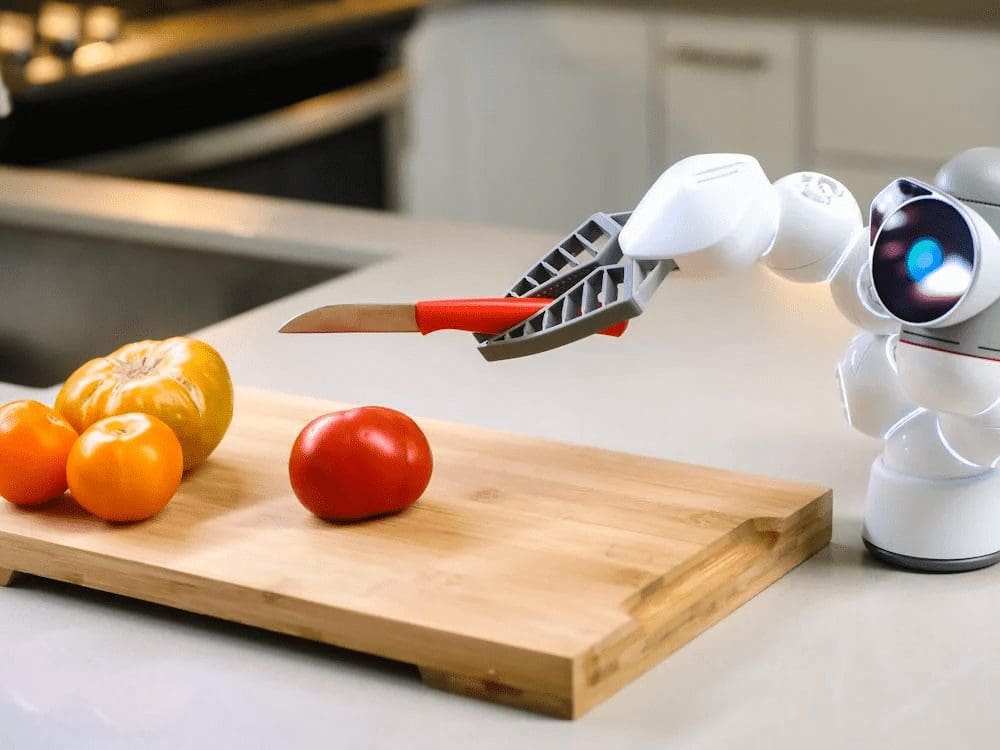
Prices are based on manufacturer announcements, public statements, and industry estimates as of February 2026. "Est." indicates estimated pricing from industry analysis. Actual costs may vary based on configuration and order volume.
What Are the Cheapest Humanoid Robots You Can Buy Right Now?
The cheapest humanoid robots available today start at $8,000 for educational models and $13,500 for full-featured bipedal humanoids. If you want genuine walking capability and programmable autonomy, three options stand out for budget-conscious buyers.
Unitree G1 — $16,000 to $16,000
The Unitree G1 is the most affordable full-featured humanoid robot on the market. At $16,000 for the EDU version and roughly $16,000 for the standard model, it offers 23 degrees of freedom, 3D LiDAR, depth cameras, and about 2 hours of battery life. Standing 1.32 meters tall and weighing 35 kg, it's compact but capable—it can walk, grasp objects, and navigate autonomously.
For educational institutions and developers, the G1 EDU adds NVIDIA Jetson Orin computing, 18-month warranty (vs. 8 months for standard), and full secondary development support.
NAO by Aldebaran — $8,000 to $12,000
The NAO robot has been the go-to educational humanoid for over a decade. At 58 cm tall, it's not a full-size humanoid, but it walks bipedally, recognizes faces and voices, and is fully programmable. It's used in thousands of universities and research labs worldwide. Pricing starts around $8,000 for academic institutions.
Pepper by Aldebaran — $25,000 to $30,000
Pepper is designed for customer-facing roles in retail, hospitality, and healthcare. It can detect emotions, hold conversations, and navigate indoor spaces. While not a full bipedal humanoid (it uses a wheeled base), it's one of the most commercially deployed humanoid-style robots, with over 27,000 units sold globally.
How Much Do Mid-Range Humanoid Robots Cost? ($25,000 to $100,000)
Mid-range humanoid robots cost $25,000–$100,000 and offer the best balance of capability and price for commercial buyers. This tier includes Tesla Optimus, Figure 02, and several enterprise-ready platforms from Unitree and Sanctuary AI.
How Much Will Tesla Optimus Gen 2 Cost?
Tesla's Optimus is arguably the most anticipated humanoid robot in the world. Elon Musk has repeatedly stated the target price will be between $25,000 and $30,000—positioning it as roughly the cost of a car. The Gen 2 prototype stands 5'8" (168 cm) and weighs 125 lbs (57 kg). It features 28 structural actuators, Tesla-designed hands with 11 degrees of freedom each, and runs on Tesla's custom AI chips.
As of early 2026, Optimus is being deployed in limited numbers inside Tesla factories for material handling and sorting tasks. Tesla has indicated broader commercial availability could begin in late 2026 or 2027. The $25,000 price target assumes high-volume manufacturing—early units may cost significantly more.
How Much Does Figure 02 Cost?
Figure AI, backed by over $1.7 billion in total funding, has built one of the most capable humanoid robots in development. Figure 02 features a custom-designed body with 16 degrees of freedom, onboard AI processing, and advanced manipulation capabilities. The company has pilot deployments with BMW at their Spartanburg manufacturing facility. Estimated pricing ranges from $30,000–$50,000.
Figure has also announced Figure 03, designed specifically for home use. While pricing hasn't been disclosed, the company's stated goal is making humanoid robots affordable for households—likely targeting a sub-$20,000 price point at scale.
What Is the Price of Unitree H1?
The Unitree H1 costs $90,000–$150,000, making it a full-size humanoid standing 180 cm tall and weighing 47 kg (70 kg for the H1-2 variant). It holds the world speed record for humanoid robots at 3.3 m/s. With industrial-grade crossed roller bearings, 360° depth perception via 3D LiDAR, and up to 360 N·m knee torque, it's built for real work.
How Much Does Sanctuary AI Phoenix Cost?
Sanctuary AI's Phoenix robot is estimated at $50,000–$100,000 and is notable for its Carbon AI system—a general-purpose AI designed to give the robot human-like reasoning and task understanding. Phoenix features hands with 20+ degrees of freedom, giving it some of the most dexterous manipulation in the industry.
What Is Apptronik Apollo's Price?
Apptronik Apollo is estimated at $50,000–$100,000. Developed in Austin, Texas with NASA heritage, Apollo stands 5'8" and can carry up to 55 lbs (25 kg). It's designed for logistics and manufacturing, with swappable battery packs for 4+ hours of operation. Apptronik has partnered with Mercedes-Benz for deployment in automotive manufacturing.
What Do High-End Humanoid Robots Cost? ($100,000+)
Enterprise humanoid robots cost $100,000–$250,000+ and are designed for warehouse logistics, advanced manufacturing, and research applications. These represent the most capable robots available but require significant integration investment.
How Much Does Boston Dynamics Atlas Cost?
Boston Dynamics retired its famous hydraulic Atlas in April 2024 and unveiled an all-electric version. The new Atlas features an unprecedented range of motion—its joints can rotate 360°, allowing movements that no human could replicate. Pricing has not been officially disclosed, but industry estimates place it well above $150,000 given Boston Dynamics' enterprise focus.
What Is the Price of Agility Digit?
Digit by Agility Robotics is estimated at $100,000–$250,000 and is purpose-built for warehouse logistics. Amazon has been the most prominent customer, deploying Digit units for tote handling in fulfillment centers. Standing 5'9" with bird-like legs optimized for stability, Digit can lift up to 35 lbs and navigate dynamic warehouse environments.
How Much Does Ameca Cost?
Ameca by Engineered Arts costs $100,000–$200,000 and is the world's most expressive humanoid robot, featuring 52 degrees of freedom in its face alone. It's designed primarily for human-robot interaction research and entertainment. Engineered Arts primarily offers Ameca through leasing agreements rather than outright purchase.
What Is Fourier GR-2's Price?
Fourier GR-2 is estimated at $100,000–$150,000. Fourier Intelligence, a Shanghai-based company, developed the GR-2 for healthcare and rehabilitation applications. Standing 175 cm tall with 53 degrees of freedom, it's one of the most articulated humanoid robots available.
What Factors Drive Humanoid Robot Costs?
Four components account for 85–95% of humanoid robot hardware costs: actuators (30–40%), sensors (15–25%), compute (10–15%), and structural materials (10–20%). Understanding these helps explain the massive price variations across the market.
How Much Do Actuators and Motors Cost?
The single biggest cost driver is the actuator system. Humanoid robots typically require 20–40+ actuators—each one a precision motor with encoders, gearboxes, and bearings. High-torque actuators for legs can cost $1,000–$5,000 each. This is why companies like Tesla and Unitree invest heavily in designing custom actuators—it's the key to hitting lower price points.
What Do Sensors and Perception Systems Cost?
A humanoid robot needs to perceive its environment. The sensor suite typically includes:
- 3D LiDAR — $200 to $5,000+ depending on resolution
- Depth cameras — $200 to $1,500
- IMUs (inertial measurement units) — $50 to $500
- Force/torque sensors — $500 to $3,000 each
Advanced perception systems can add $10,000–$30,000 to total cost.
How Much Does Compute and AI Hardware Cost?
Running AI models for locomotion, navigation, and manipulation requires significant onboard computing. Most commercial humanoid robots use NVIDIA Jetson Orin modules ($500–$2,000) or custom silicon. Tesla uses its own FSD chip in Optimus.
What Do Structural Materials Add to the Price?
The frame and body panels use aluminum alloys, carbon fiber, engineering plastics, and sometimes titanium. Material choice alone can swing the cost by $5,000–$20,000 depending on size and build quality.
What Is the Total Cost of Ownership for Humanoid Robots?
Total cost of ownership runs 20–40% above the purchase price when you factor in maintenance ($1,000–$15,000/year), training ($2,000–$50,000), and integration costs. The sticker price is just the beginning.
How Much Does Annual Maintenance Cost?
Humanoid robots have moving parts that wear out. Budget for:
- Actuator servicing/replacement — the most common maintenance item
- Battery replacement — typically every 2–3 years ($1,000–$5,000)
- Sensor calibration — cameras and LiDAR need periodic recalibration
- Software updates — most manufacturers offer OTA updates (often included)
For commercial-grade robots like the Unitree H1, expect $5,000–$15,000/year. For consumer models like the G1, budget $1,000–$3,000/year.
What Are Training and Integration Costs?
Enterprise deployments require staff training ($2,000–$10,000), custom programming ($5,000–$30,000), workflow integration ($5,000–$50,000), and safety infrastructure ($2,000–$10,000).
Should You Buy or Lease a Humanoid Robot?
Buying outright makes sense when you plan to use the robot for 3+ years and want full customization control.
Leasing is increasingly popular, especially for enterprise customers, with benefits including lower upfront cost (monthly payments of $1,000–$10,000), maintenance included, and easy upgrades to newer models.
When Will Humanoid Robots Get Cheaper?
Humanoid robot prices are projected to drop 50–70% by 2030, with entry-level full-size models reaching $10,000–$15,000. Three factors are driving costs down rapidly.
Manufacturing Scale
Tesla's Optimus strategy mirrors its car strategy: design for mass production, use vertical integration, and drive costs down through volume. Agility Robotics' RoboFab factory (10,000 units/year capacity) signals the industry is moving toward scale manufacturing.
Chinese Competition
Chinese companies—Unitree, AGIBOT, Fourier, UBTECH—are aggressively competing on price. The Unitree G1 at $16,000 was a shock to the industry. Expect continued downward pricing pressure.
AI Software Improvements
Better AI means robots can use cheaper hardware. Foundation models for robotics allow robots to learn tasks from demonstrations rather than requiring expensive custom programming.
Price Predictions
- 2026–2027: Entry-level full-size humanoids drop below $20,000
- 2028–2030: Mass-market humanoids in the $10,000–$15,000 range
- 2030–2035: Basic consumer models could approach $5,000–$10,000
Where Can You Buy a Humanoid Robot in 2026?
You can buy humanoid robots from manufacturer direct sales, specialized marketplaces like Robozaps, or through leasing programs. Here's exactly where to purchase based on availability:
Browse all humanoid robots for sale at Robozaps →
Frequently Asked Questions About Humanoid Robot Costs
How much does a humanoid robot cost in 2026?
Humanoid robot prices in 2026 range from $8,000 for educational robots like NAO to $150,000+ for enterprise-grade robots like Boston Dynamics Atlas. The most popular mid-range options—Tesla Optimus ($25,000–$30,000 target), Figure 02 ($30,000–$50,000 est.), and Unitree G1 ($16,000–$16,000)—represent the new wave of more affordable humanoid robots.
What is the cheapest humanoid robot I can buy today?
The cheapest full-featured humanoid robot you can buy today is the Unitree G1 at $16,000 (EDU version). It walks, grasps objects, has 3D LiDAR and depth cameras, and supports full software development. For a smaller educational humanoid, the NAO robot starts around $8,000.
What is the most expensive humanoid robot?
The most expensive commercially available humanoid robots are the Boston Dynamics Atlas (estimated $150,000+), Agility Digit ($100,000–$250,000), and Ameca by Engineered Arts ($100,000–$200,000). Custom research humanoids can exceed $500,000.
How much will Tesla Optimus cost when it's available?
Tesla has targeted a price of $25,000 to $30,000 for the Optimus humanoid robot at scale. Elon Musk has stated the long-term goal is under $20,000. Early units may cost $40,000–$50,000 before mass production drives prices down.
Can I buy a humanoid robot for my home in 2026?
Home-use humanoid robots are limited in 2026. The Unitree G1 can be purchased by individuals ($16,000+), but requires technical knowledge. Purpose-built home humanoids like Figure 03 and 1X NEO have been announced but aren't yet widely available. Practical home humanoids in the $10,000–$20,000 range are expected by 2028–2030.
How much does it cost to maintain a humanoid robot per year?
Annual maintenance costs range from $1,000–$3,000 for consumer models (like Unitree G1) to $5,000–$15,000 for enterprise robots. Major costs include actuator servicing, battery replacement every 2–3 years, and sensor recalibration.
Is it better to buy or lease a humanoid robot?
Buying is better for 3+ year deployments with full customization needs. Leasing is better for pilot programs, proof-of-concept testing, and when you want maintenance and updates included. Most enterprise customers start with leasing.
Related: Best Humanoid Robots 2026 · Most Advanced Humanoid Robot You Can Buy
Ready to buy? Browse humanoid robots for sale on Robozaps.
What is a humanoid robot? Clear definition, real examples, core capabilities & the technology behind human-like machines. Start your research here.
What is a humanoid robot? A humanoid robot is a machine designed to resemble the human body in shape—typically featuring a head, torso, two arms, and two legs—and engineered to operate in environments built for people. Unlike traditional industrial robots bolted to factory floors, humanoid robots walk upright, manipulate objects with dexterous hands, and increasingly use artificial intelligence to perceive, reason, and interact with the world around them.
In 2026, humanoid robots have moved from research labs into real factories, warehouses, and commercial settings. The global humanoid robot market, valued at $2.03 billion in 2024, is projected to exceed $13 billion by 2029 and could reach $38 billion by 2035, according to MarketsandMarkets and Goldman Sachs. With companies like Tesla, Figure AI, Boston Dynamics, and Unitree racing to deploy commercial units, understanding what humanoid robots are—and what they can do—has never been more important.
This comprehensive guide covers everything you need to know: the definition and key characteristics of humanoid robots, how they work, their history, the leading models available today, real-world applications, and where the technology is headed.
Key Takeaways
- Humanoid robots are machines shaped like the human body (head, torso, arms, legs) designed to work in human environments
- The market is projected to grow from $2 billion (2024) to $38 billion by 2035 at 49% CAGR
- Prices now start at $13,500 (Unitree G1), with Tesla targeting $20,000-$30,000 for Optimus
- Key applications: manufacturing, logistics, healthcare, education, and hospitality—with home use emerging
- Leading robots include Tesla Optimus, Figure 02, Boston Dynamics Atlas, Unitree G1, and AgiBot A2
What Exactly Is a Humanoid Robot?
A humanoid robot is a robot with a body plan that mimics the human form, featuring bipedal locomotion, two arms with manipulable hands, a sensor-equipped head, and AI-powered decision-making. This human-like design allows the robot to navigate stairs, use human tools, and work in spaces built for people—without requiring facility modifications.
The defining features include:
- Bipedal locomotion – Walking on two legs, enabling navigation through stairs, doorways, and uneven terrain
- Two arms with manipulable hands – Allowing the robot to grasp, carry, and use tools designed for humans
- A head with sensors – Cameras, LiDAR, microphones, and other perception hardware that let the robot "see" and "hear"
- An AI-powered brain – Software systems using machine learning, computer vision, and natural language processing to make decisions
The term "humanoid" comes from the Latin humanus (human) and the Greek suffix -oeides (resembling). First recorded in English in 1870, it originally described any entity resembling a human. Today, it most commonly refers to humanoid robots—machines specifically engineered to work in human spaces using human-like form.
How Are Humanoid Robots Different from Other Robot Types?
It's important to distinguish humanoid robots from other robot types:
- Industrial robots – Fixed robotic arms (like those from FANUC or ABB) designed for single repetitive tasks on assembly lines
- Cobots (collaborative robots) – Smaller robotic arms designed to work alongside humans, but lacking a human body form
- Androids – A subset of humanoid robots designed to look as realistic as possible, often with synthetic skin and facial expressions (e.g., Hanson Robotics' Sophia)
- Quadruped robots – Four-legged robots like Boston Dynamics' Spot, which are mobile but not human-shaped
What Is the History of Humanoid Robots?
The dream of creating human-like machines stretches back millennia. From ancient automata to Honda's ASIMO to today's Tesla Optimus, each era brought breakthroughs that made humanoid robots increasingly capable and commercially viable.
Ancient Origins and Early Automata
- 3rd century BCE – The Chinese text Liezi describes engineer Yan Shi presenting a life-size humanoid automaton to King Mu of Zhou
- 13th century – Muslim engineer Ismail al-Jazari designed humanoid automata, including a programmable music-playing band
- 1495 – Leonardo da Vinci designed a mechanical knight capable of sitting, standing, and moving its arms
- 1920 – Czech playwright Karel Čapek coined the word "robot" in his play R.U.R. (Rossum's Universal Robots)
Modern Milestones
- 1973 – WABOT-1 at Waseda University became the first full-scale humanoid robot, capable of walking and gripping objects
- 2000 – Honda unveiled ASIMO, which became the most famous humanoid robot of its era, demonstrating running, stair climbing, and object recognition
- 2013 – Boston Dynamics introduced Atlas, originally developed for DARPA's Robotics Challenge, showcasing unprecedented agility
- 2021 – Tesla announced Optimus (Tesla Bot) at AI Day, signaling the entry of a major automaker into humanoid robotics
- 2024 – Multiple companies began commercial deployments: Figure AI at BMW factories, Agility Robotics' Digit at Amazon warehouses, and AgiBot A2 mass-produced in China
- 2025–2026 – Tesla begins limited Optimus sales; Unitree G1 becomes the first humanoid robot under $20,000; Figure 02 scales deployment; Boston Dynamics transitions Atlas to electric
How Do Humanoid Robots Work?
A humanoid robot integrates four core systems: sensors for perception, actuators for movement, AI software for intelligence, and batteries for power. These systems work together to enable the robot to see, think, move, and interact with its environment autonomously.
1. Sensors (Perception System)
Humanoid robots use a combination of sensors to perceive their environment:
- RGB and depth cameras – For visual recognition of objects, people, and obstacles
- LiDAR – Laser-based scanning for precise 3D mapping of surroundings
- IMUs (Inertial Measurement Units) – Accelerometers and gyroscopes for balance and orientation
- Force/torque sensors – In joints and hands for detecting pressure and contact
- Microphone arrays – For voice recognition and sound localization
2. Actuators (Movement System)
Actuators are the "muscles" of a humanoid robot, converting electrical energy into physical motion:
- Electric motors – The most common type, used in Tesla Optimus and most modern humanoids
- Hydraulic actuators – Used in the original Boston Dynamics Atlas for high-power movements (now replaced by electric in the 2024 Atlas)
- Custom joint modules – Companies like AgiBot and Unitree develop proprietary actuators optimized for efficiency and torque
The number of degrees of freedom (DOF)—the independent axes of movement—determines a robot's dexterity. Modern humanoids typically have 30–50+ DOF, with the most advanced hands alone featuring 10–16 DOF.
3. AI and Software (Intelligence System)
The "brain" of a humanoid robot runs on powerful onboard computers and increasingly leverages AI models:
- Computer vision – Object detection, scene understanding, and obstacle avoidance
- Natural language processing (NLP) – Understanding and responding to verbal commands
- Reinforcement learning – Training robots through simulated environments to develop locomotion and manipulation skills
- Foundation models – Large AI models (similar to GPT) adapted for robotics, enabling robots to generalize across tasks
- Motion planning algorithms – Real-time trajectory computation for walking, reaching, and balancing
For example, Figure AI's Helix AI system uses a vision-language-action model that processes camera input and voice commands to execute multi-step tasks. Tesla's Optimus uses a neural network trained on millions of hours of simulation data.
4. Power System
Most humanoid robots run on lithium-ion or lithium-polymer battery packs, typically providing 2–5 hours of active operation. Battery life remains one of the biggest engineering challenges. Some systems, like the AgiBot A2, support hot-swappable battery packs for continuous operation.
What Are the Leading Humanoid Robots in 2026?
The top humanoid robots available in 2026 include Tesla Optimus Gen 2, Figure 02, Boston Dynamics Atlas, Unitree G1, AgiBot A2, Sanctuary AI Phoenix, Agility Digit, and Apptronik Apollo. Prices range from $16,000 (Unitree G1) to $250,000+ (enterprise-grade robots).
What Are Humanoid Robots Used For?
Humanoid robots are used primarily in manufacturing, logistics, healthcare, education, hospitality, and disaster response. Their human-like form allows them to work in existing facilities without infrastructure changes, using tools and navigating spaces designed for people.
Manufacturing and Logistics
This is the largest deployment area for humanoid robots today. Figure 02 operates on BMW assembly lines, performing tasks 400% faster than baseline during pilot testing. Agility Digit handles tote movement and recycling at Amazon fulfillment centers. Apptronik Apollo works alongside human employees at Mercedes-Benz plants.
Key tasks include: picking and placing components, machine tending, quality inspection, palletizing, and moving materials between workstations. The advantage of a humanoid form is that these robots can work in facilities designed for humans without requiring costly infrastructure modifications.
Healthcare and Elder Care
Humanoid robots are being tested in hospitals and care facilities for:
- Patient monitoring and vital sign measurement
- Medication delivery and scheduling reminders
- Physical rehabilitation assistance
- Companionship for elderly residents to reduce isolation
- Disinfection and hygiene tasks in clinical environments
Japan and Germany lead in elder care robotics deployment, driven by aging populations. Robots like Pepper (SoftBank Robotics) have been used in over 500 elder care facilities in Japan since 2020.
Education and Research
Humanoid robots serve as teaching tools in STEM education and as research platforms for studying bipedal locomotion, manipulation, and human-robot interaction. NAO (by Aldebaran/SoftBank) is used in over 70 countries as an educational robot. University labs worldwide use platforms like Unitree G1 and open-source humanoid designs to train the next generation of roboticists.
Hospitality and Customer Service
Hotels, airports, and retail stores are deploying humanoid robots as greeters, concierges, and information assistants. Japan's Henn-na Hotel pioneered robot-staffed hospitality, and multilingual humanoid concierges now operate in facilities across Asia, Europe, and the Middle East.
Search and Rescue / Disaster Response
Humanoid robots are uniquely suited for disaster environments because they can navigate rubble, climb stairs, open doors, and use human tools. Boston Dynamics Atlas was originally developed for DARPA's disaster response challenge. Future deployment in earthquake, flood, and fire response scenarios is a high-priority research area.
Domestic Use (Emerging)
While not yet widespread, home humanoid robots are on the horizon. Tesla CEO Elon Musk has stated that Optimus is designed to eventually perform household tasks like cooking, cleaning, and yard work. AgiBot's founder envisions home use within 5–8 years. The biggest barriers remain cost, safety certification, and battery life.
How Do Humanoid Robots Compare to Traditional Industrial Robots?
Humanoid robots offer mobility and flexibility that traditional industrial robots cannot match. While industrial robots excel at fixed, high-speed tasks, humanoid robots can walk, navigate stairs, and work in facilities designed for humans—all without requiring facility modifications.
The humanoid form factor is particularly valuable in brownfield environments—existing factories, warehouses, and buildings that were designed for human workers and would be expensive to retrofit for traditional automation.
What Does the Future Hold for Humanoid Robots?
The humanoid robotics industry is at an inflection point. Goldman Sachs projects the market reaching $38 billion by 2035, with prices expected to drop below $10,000 at scale and home deployment beginning by 2030.
Near Term (2026–2028)
- Commercial deployments will scale from hundreds to tens of thousands of units annually
- Prices are expected to drop below $20,000 for entry-level humanoids (Unitree G1 already hits this mark)
- AI foundation models for robotics will enable faster task learning—new tasks learned in minutes rather than weeks
- Robots-as-a-Service (RaaS) business models will become standard, making humanoids accessible without large upfront costs
Medium Term (2028–2035)
- Goldman Sachs projects the market reaching $38 billion by 2035 with a 49% CAGR
- Tesla aims to produce millions of Optimus units, targeting sub-$10,000 pricing at scale
- Home humanoid robots will begin entering early-adopter households
- Humanoid robots could provide labor equivalent to 3.5% of the global workforce by 2035
Long Term (2035+)
- Elon Musk predicts over 1 billion humanoid robots by the 2040s
- The total addressable market could approach $4.85 trillion (Citi Research)
- Humanoid robots may become as common as automobiles, fundamentally reshaping economies, labor markets, and daily life
What Are the Biggest Challenges Facing Humanoid Robots?
Despite rapid progress, humanoid robots face five major challenges: limited battery life (2-5 hours), insufficient hand dexterity, AI that struggles with novel situations, high costs, and an undeveloped regulatory framework.
- Battery life – Most humanoids run 2–5 hours on a charge, far short of a full work shift. Advances in solid-state batteries and energy-efficient actuators are critical.
- Dexterity – Human hands have 27 degrees of freedom. Current robot hands are far simpler, limiting fine manipulation tasks like threading needles or handling fragile items.
- AI generalization – Robots trained for specific tasks still struggle in novel situations. True general-purpose AI for robotics remains an active research challenge.
- Cost – While prices are dropping, most capable humanoids still cost $100,000+, limiting adoption to large enterprises.
- Safety and regulation – No comprehensive global regulatory framework exists for humanoid robots operating alongside humans. Standards for liability, data privacy, and operational safety are still being developed.
- Public acceptance – The "uncanny valley" effect and fears of job displacement create resistance to humanoid robot adoption in some settings.
What Are the Ethical Considerations?
As humanoid robots become more prevalent, society must grapple with important ethical questions:
- Job displacement – The World Economic Forum estimates 85 million jobs could be displaced by automation by 2030, though 97 million new roles may emerge. Proactive retraining programs are essential.
- Privacy – Humanoid robots equipped with cameras and microphones collect vast amounts of data. Clear data governance policies are needed.
- Autonomy and accountability – When a humanoid robot makes an error, who is liable—the manufacturer, the operator, or the AI developer?
- Emotional manipulation – Robots designed to mimic empathy may create unhealthy emotional dependencies, particularly in elder care and child education settings.
- Access and inequality – If humanoid robots dramatically boost productivity for wealthy nations and corporations, the global inequality gap could widen without inclusive policies.
Frequently Asked Questions
What is a humanoid robot in simple terms?
A humanoid robot is a machine shaped like a human body—with a head, torso, two arms, and two legs—designed to walk upright and perform tasks in environments built for people. They use artificial intelligence to perceive, think, and interact with the world.
What is the difference between a humanoid robot and an android?
All androids are humanoid robots, but not all humanoid robots are androids. An android is specifically designed to look as realistically human as possible, often with synthetic skin and facial expressions. Most humanoid robots have a clearly mechanical appearance.
What are humanoid robots used for?
Humanoid robots are used in manufacturing, logistics, healthcare, education, hospitality, search and rescue, and research. They handle tasks like assembly line work, material transport, patient monitoring, teaching assistance, and customer service.
How much does a humanoid robot cost?
Prices range widely: the Unitree G1 starts at about $16,000, making it the most affordable full humanoid. Tesla's Optimus is targeting $20,000–$30,000. Industrial-grade humanoids like the Agility Digit or Sanctuary AI Phoenix cost $100,000–$250,000+ through commercial or RaaS agreements. See our complete humanoid robot price guide for details.
Can I buy a humanoid robot in 2026?
Yes. Several humanoid robots are available for purchase or lease in 2026, including the Unitree G1 (consumer/research), AgiBot A2 (commercial), and Apptronik Apollo (industrial). Tesla Optimus is in limited early sales. Browse humanoid robots for sale on Robozaps.
What is the most advanced humanoid robot in 2026?
The answer depends on criteria. Boston Dynamics Atlas leads in agility and mobility. Tesla Optimus has the largest production ambitions. Figure 02 demonstrates the most advanced AI-driven task learning. AgiBot A2 leads in commercially available AI capability with 200 TOPS computing power. See our best humanoid robots ranking.
Will humanoid robots replace human jobs?
Humanoid robots will automate many repetitive, dangerous, and physically demanding tasks. However, history shows that automation also creates new jobs. The net impact will depend on how quickly societies adapt through education, retraining, and policy. Most experts predict a transformation of work rather than mass unemployment.
What's the difference between a humanoid robot and a cobot?
A cobot (collaborative robot) is typically a robotic arm designed to work safely alongside humans in shared workspaces. A humanoid robot has a full human-like body with legs, arms, and a head. Some humanoid robots function as cobots, but most cobots are not humanoid in form. Learn more in our guide to cobots.
Summary
A humanoid robot is a machine designed in human form—with a head, torso, arms, and legs—built to navigate and work in environments made for people. Powered by advanced AI, sophisticated sensors, and precision actuators, these machines are transitioning from laboratory curiosities to commercial realities in 2026.
The leading humanoid robots today include Tesla Optimus, Figure 02, Boston Dynamics Atlas, Unitree G1, AgiBot A2, Sanctuary AI Phoenix, Agility Digit, and Apptronik Apollo. They're being deployed in manufacturing, logistics, healthcare, education, and hospitality—with home use on the horizon.
With the market projected to exceed $38 billion by 2035 and prices falling rapidly, humanoid robots are poised to become one of the most transformative technologies of the coming decade. Understanding what they are, how they work, and where they're headed is essential for anyone interested in the future of technology, work, and daily life.
Related: Best Humanoid Robots in 2026 · What is a Cobot? Guide to Collaborative Robots · Applications of Humanoid Robots
Ready to buy? Browse humanoid robots for sale on Robozaps.
Get the latest robotics news delivered to your inbox
Improve your crypto earnings automatically. Use Robozaps to compare rates and rewards.