
See all articles
Humanoid robots in retail: customer service automation, inventory management & store applications. Real deployments, costs & ROI analysis.
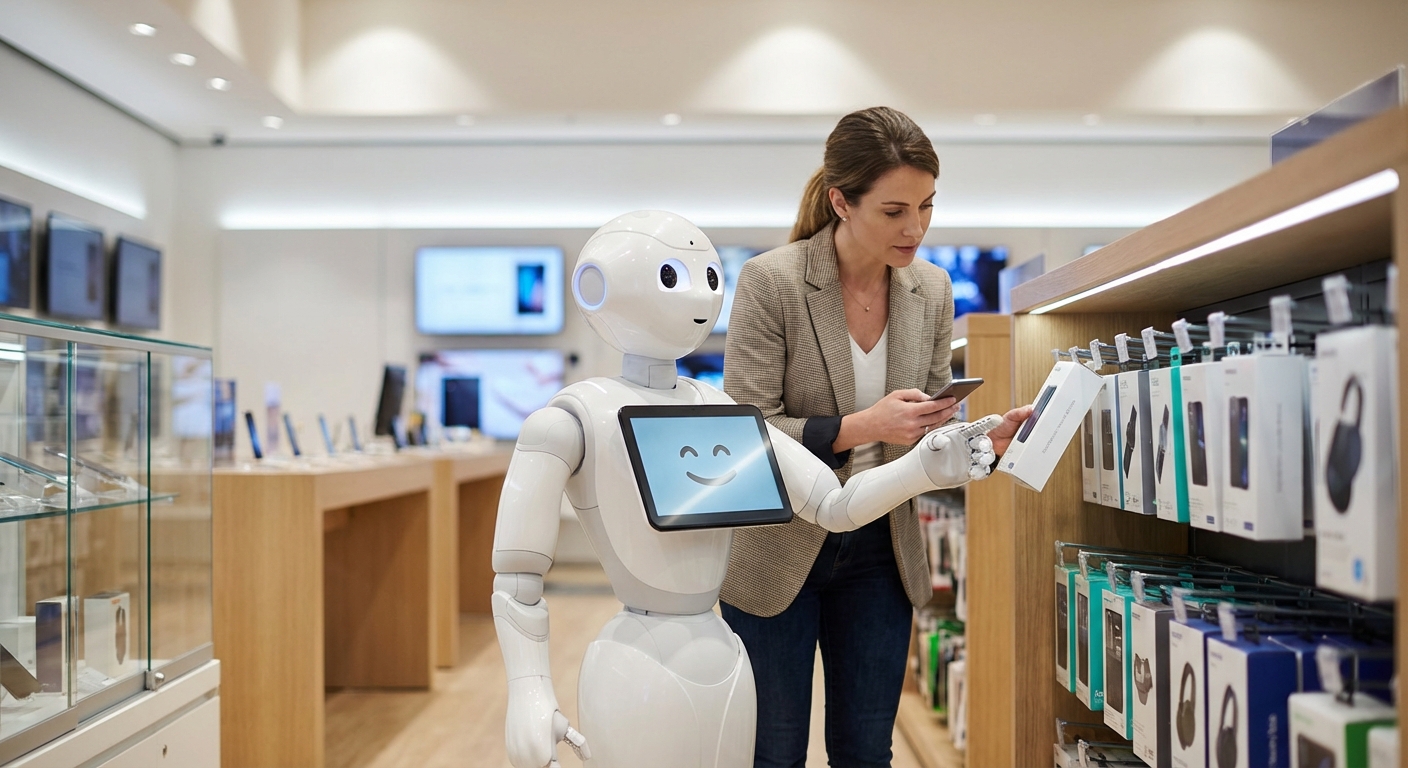
Humanoid robots in retail are no longer a futuristic concept — they're actively reshaping how stores operate, how customers shop, and how retailers compete. From SoftBank's Pepper greeting customers at Nestlé stores in Japan to Agility Robotics' Digit handling logistics at Spanx warehouses, the retail robotics landscape in 2026 looks radically different from just two years ago.
In this comprehensive guide, we break down every major humanoid robot deployment in retail, compare the leading platforms, analyze real costs and ROI data, and forecast where the industry is headed through 2030.
The State of Humanoid Robots in Retail: 2026 Market Overview
The global retail robotics market has surged past expectations. According to Goldman Sachs research, the broader humanoid robot market is projected to reach $38 billion by 2035, with retail and service applications representing approximately 22% of that figure. More immediately, the retail automation market — encompassing humanoid and non-humanoid robots — is valued at approximately $58 billion in 2026, up from $19 billion in 2015.
Several forces are converging to accelerate adoption:
- Manufacturing costs dropped 40% year-over-year between 2023 and 2025, bringing humanoid robot prices from $50,000–$250,000 down to $5,900–$150,000 per unit
- Labor shortages persist: The U.S. retail sector had approximately 531,000 unfilled positions as of late 2025 (per BLS data), making automation economically essential
- AI capabilities matured: Large language models and multimodal AI now enable robots to hold natural conversations, understand context, and make real-time decisions
- Production is scaling: Tesla targets 100,000 Optimus units by 2026; Figure AI's BotQ facility in Austin has 12,000-unit initial capacity scaling to 100,000 annually; Agility Robotics' Oregon factory produces 10,000+ Digit robots per year
McKinsey's October 2025 analysis described the industry as "crossing the chasm from concept to commercial reality," noting that several hundred humanoid robots were deployed industrially in 2025, with projections scaling to low thousands by 2026–2027.
How Humanoid Robots Are Used in Retail Today
Humanoid robots in retail serve functions across four primary categories: customer-facing service, inventory management, logistics and fulfillment, and security/loss prevention. Here's how each works in practice.
1. Customer Service and Engagement
Customer-facing humanoid robots are the most visible retail application. These robots greet shoppers, answer product questions, provide wayfinding assistance, and even process simple transactions.
SoftBank Pepper remains the most widely deployed customer-facing humanoid in retail. Since its launch in 2014, over 27,000 Pepper units have been sold globally. Major retail deployments include:
- Nestlé Japan: Pepper deployed across 1,000+ stores to recommend Nescafé machines, generating a documented 15% increase in sales at equipped locations
- HSBC branches: Pepper serves as a lobby concierge, reducing wait times by directing customers to appropriate service desks
- Carrefour (France): Pepper assists shoppers with store navigation and promotional information across select locations
- Lowe's (U.S.): The LoweBot — based on Fellow Robots' NAVii platform — helped customers locate products across 11 San Francisco Bay Area stores
UBTECH Walker S is emerging as a next-generation retail service robot. With 41 degrees of freedom, advanced hand dexterity, and integration with large AI models, Walker S can pick up objects, navigate complex store environments, and interact naturally with customers. UBTECH secured a $1 billion strategic financing facility in 2025, underscoring investor confidence in commercial deployment.
2. Inventory Management and Shelf Scanning
While not always humanoid in form, inventory robots often operate alongside humanoid customer-facing units. The key players include:
- Simbe Robotics' Tally: Deployed across all BJ's Wholesale Club locations nationwide. Tally autonomously navigates aisles, scanning shelves to detect out-of-stock items, misplaced products, and pricing errors. Tally operates during store hours with minimal disruption
- Badger Technologies' Marty: Operational in over 500 Giant Eagle and Stop & Shop locations. Marty identifies spills, debris, and inventory gaps, alerting store associates in real time
- Zebra Technologies' SmartSight: An AI-powered shelf-scanning system deployed by major grocery chains to monitor on-shelf availability with 95%+ accuracy
3. Logistics, Fulfillment, and Back-of-Store Operations
This is where humanoid robots are making the fastest inroads in 2026. The economics are clearest here — repetitive, physically demanding tasks in controlled environments.
- Agility Robotics' Digit: A leading humanoid robot deployed commercially, working at a Spanx warehouse in Georgia for material movement. Digit stands 5'9", weighs 141 lbs, can carry up to 35 lbs, and operates alongside human workers. Amazon has also been testing Digit in its fulfillment centers since late 2023
- Tesla Optimus (Gen 2): Tesla deployed Optimus units in its own Fremont factory for parts sorting and bin transport, with plans to lease units to external retailers and warehouse operators by late 2026. Target cost: under $20,000 per unit at scale
- Figure AI Figure 02: Working with BMW at their Spartanburg, SC manufacturing facility. Figure 02 performs sheet metal insertion and parts transport, demonstrating the warehouse-to-retail-backroom pipeline
4. Security and Loss Prevention
Robot security patrols are expanding in retail environments. Knightscope's K5 autonomous security robot patrols parking lots and store perimeters at several major U.S. shopping centers. While not humanoid, the trend toward humanoid-form security robots is accelerating, with companies like 1X Technologies (formerly Halodi Robotics) developing bipedal security robots for indoor retail environments.
Comparison: Top Humanoid Robots Used in Retail (2026)
Real-World Case Studies: Humanoid Robots in Retail
Case Study 1: Pepper at Nestlé Japan — 15% Sales Lift
SoftBank's Pepper was deployed across more than 1,000 Nestlé Japan stores starting in 2014, making it one of the largest humanoid retail deployments in history. Pepper's role: recommend Nescafé Dolce Gusto machines to browsing customers using natural-language dialogue and emotion recognition.
Results:
- 15% increase in Nescafé machine sales at Pepper-equipped locations
- Customer dwell time increased by an average of 3 minutes per interaction
- Brand recall improved measurably in post-visit surveys
- Stores reported increased foot traffic driven by curiosity about the robot
The Nestlé deployment demonstrated that humanoid robots don't just assist — they draw customers into the store and create memorable brand experiences.
Case Study 2: Agility Robotics Digit at Spanx — First Revenue-Earning Humanoid
In 2025, Agility Robotics' Digit achieved a major commercial milestone, operating at a Spanx warehouse in Georgia. Digit handles tote movement between workstations, picking up bins and transporting them across the facility floor.
Key metrics:
- Digit operates 16-hour shifts vs. 8-hour human shifts
- Carries up to 35 lbs per trip with consistent speed
- Works safely alongside human coworkers (no cage required)
- Estimated 18-month payback period based on displaced labor costs
Case Study 3: Simbe Tally at BJ's Wholesale — Chain-Wide Inventory Intelligence
BJ's Wholesale rolled out Simbe Robotics' Tally robot across its entire network of 240+ warehouse club locations. Tally autonomously scans shelves three times daily, generating real-time inventory data that feeds into BJ's replenishment and merchandising systems.
Results:
- Out-of-stock detection accuracy: 95%+
- Planogram compliance improved by 20%
- Labor hours redirected from manual shelf auditing to higher-value customer service tasks
- Shrinkage (theft/loss) reduced through continuous monitoring
Case Study 4: Bear Robotics Servi at Denny's — Autonomous In-Store Delivery
Bear Robotics' Servi — a wheeled service robot with a friendly face display — has been deployed at hundreds of Denny's, Chili's, and other restaurant locations. While not fully humanoid, Servi represents the service robot bridge between traditional automation and full humanoid deployment in retail food service.
Results:
- Servers handle 3–4 additional tables when Servi handles food delivery and bussing
- Tips increased an average of 10–15% as human servers focused more on customer interaction
- Table turnover time reduced by approximately 10 minutes per seating
The Economics: How Much Do Retail Robots Actually Cost?
Robot pricing in 2026 varies enormously based on capabilities, form factor, and deployment model. Here's the realistic breakdown:
Purchase vs. Robot-as-a-Service (RaaS)
Outright Purchase: Full humanoid robots range from $5,900 (Unitree R1) to $150,000+ (UBTECH Walker S). Mid-range options like SoftBank Pepper cost approximately $25,000–$30,000 with ongoing software fees of ~$360/month.
Robot-as-a-Service (RaaS): Many retailers prefer RaaS models that bundle hardware, software, maintenance, and support into a monthly fee. Simbe Robotics offers Tally at approximately $2,000/month. Bear Robotics leases Servi at $999/month. This model eliminates upfront capital expenditure and reduces deployment risk.
ROI Calculation: When Does a Retail Robot Pay for Itself?
Consider a mid-market deployment scenario:
- Robot cost: $50,000 (purchased) or $2,000/month (RaaS)
- Displaced labor equivalent: 1.5 full-time employees at $15/hour = ~$47,000/year
- Additional revenue from enhanced customer experience: 5–15% sales lift at equipped locations (documented in Nestlé case)
- Reduced shrinkage: 2–5% reduction in inventory loss through continuous monitoring
- Payback period: 12–24 months for purchase; immediate positive ROI for well-deployed RaaS
Industry data from successful humanoid deployments suggests 18-month average payback periods, with logistics and warehouse applications delivering the fastest returns.
Key Technologies Powering Retail Humanoids in 2026
Large Language Models (LLMs) and Conversational AI
The integration of models like GPT-4, Gemini, and Claude into humanoid robots has transformed customer interactions. Rather than following rigid decision trees, retail robots can now hold natural, context-aware conversations — answering nuanced product questions, handling complaints, and even upselling based on customer preferences.
Computer Vision and Spatial Intelligence
Modern retail robots use a combination of LiDAR, depth cameras, and AI-powered computer vision to navigate crowded store aisles, identify products on shelves, read price tags, and detect spills or hazards. Simbe's Tally uses a 30+ camera array to capture 3D shelf imagery with millimeter-level precision.
Dexterous Manipulation
The ability to pick up, move, and place objects is critical for retail applications like shelf stocking. Agility Robotics' Digit features custom end-effectors optimized for tote handling. UBTECH's Walker S has 41 degrees of freedom in its hands and arms, enabling fine manipulation of retail products. Tesla's Optimus Gen 2 demonstrated smooth, human-like hand movements capable of handling eggs without breaking them.
Edge Computing and 5G Connectivity
Retail robots increasingly process data at the edge rather than relying on cloud connectivity, enabling faster response times and operation in areas with limited internet access. 5G connectivity allows robots to upload inventory data, receive software updates, and coordinate with fleet management systems in real time.
Challenges and Limitations of Humanoid Robots in Retail
Technical Hurdles
- Battery life: Most humanoid robots operate 4–8 hours per charge. Digit achieves approximately 4 hours of active operation. This requires charging infrastructure and shift scheduling
- Navigation in dynamic environments: Crowded retail aisles with shopping carts, children, and unpredictable movement patterns remain challenging for autonomous navigation systems
- Dexterity limitations: While improving rapidly, most robots still cannot match human dexterity for tasks like folding clothing, arranging delicate displays, or handling irregular-shaped products
Economic Barriers
- Upfront costs: Despite price reductions, a $50,000+ humanoid robot is a significant investment for small and mid-size retailers
- Integration costs: Connecting robots to existing POS systems, inventory management software, and store networks adds 20–40% to deployment costs
- Maintenance: Humanoid robots require regular maintenance, software updates, and occasional hardware repairs. Annual maintenance typically runs 10–15% of purchase price
Consumer Acceptance
Research published in the Journal of Retailing and Consumer Services (2022) found that consumer anxiety toward robots moderates acceptance. Key findings:
- Customers respond more positively to robots with humanoid features (face, arms, voice) than purely mechanical designs
- Social capability (ability to make small talk, show empathy cues) is the strongest predictor of positive consumer attitudes
- Older demographics initially show higher resistance but adapt quickly after 2–3 positive interactions
- Transparency matters — customers prefer knowing they're interacting with a robot rather than being deceived
Workforce Concerns
The narrative around robots replacing human workers remains politically sensitive. However, most successful deployments follow an augmentation model — robots handle repetitive, physically demanding, or low-value tasks, freeing human workers for customer engagement, problem-solving, and creative merchandising. Companies emphasizing augmentation over replacement report higher workforce acceptance and smoother implementations.
The Future of Humanoid Robots in Retail: 2026–2030 Forecast
Near-Term (2026–2027)
- Expect 50,000–100,000 humanoid robots deployed globally across warehouses, fulfillment centers, and select retail stores
- Robot-as-a-Service pricing will drop below $1,000/month for basic service robots
- Major grocery chains will begin chain-wide humanoid deployments for shelf stocking and inventory management
- Tesla's Optimus will become available for commercial leasing outside Tesla's own operations
Mid-Term (2027–2029)
- Consumer-facing humanoid robots become standard in flagship stores of major retailers (think Apple Store, Nike, and luxury brands)
- Multi-robot coordination enables teams of humanoids to collaborate on complex tasks like overnight store resets
- Robot-to-robot communication and fleet management systems mature, enabling centralized control of hundreds of units across a retail chain
- Humanoid robots begin handling returns processing and basic checkout assistance
Long-Term (2029–2030+)
- Goldman Sachs projects the humanoid robot market reaching $38 billion by 2035
- Fully autonomous stores staffed primarily by humanoid robots become viable for specific retail formats
- Humanoid robots achieve near-human dexterity, enabling roles like visual merchandising and product demonstration
- Home delivery by humanoid robots expands beyond pilot programs
How Retailers Should Prepare for Humanoid Robot Adoption
Based on analysis of successful deployments, here's a practical roadmap for retailers considering humanoid robots:
Step 1: Identify High-Impact Use Cases
Start with tasks that are repetitive, physically demanding, or data-intensive. Inventory scanning, material handling, and customer greeting are proven starting points with documented ROI.
Step 2: Start with a Pilot Program
Deploy 1–3 robots in a single location for 3–6 months. Measure specific KPIs: labor hours saved, customer satisfaction scores, sales lift, and operational accuracy improvements.
Step 3: Choose the Right Deployment Model
RaaS (Robot-as-a-Service) is recommended for first-time deployers. It minimizes upfront risk, includes maintenance and support, and allows scaling up or down based on results.
Step 4: Invest in Workforce Transition
Train existing employees to work alongside robots. Create new roles like "robot supervisor" or "automation coordinator." Frame the narrative around augmentation, not replacement.
Step 5: Scale Based on Data
Use pilot program data to build the business case for chain-wide deployment. Successful pilots at companies like BJ's Wholesale and Amazon led to rapid, chain-wide scaling.
Frequently Asked Questions About Humanoid Robots in Retail
How much does a humanoid robot cost for a retail store?
Prices range widely in 2026. Entry-level humanoid robots like the Unitree R1 start at $5,900. Mid-range customer service robots like SoftBank Pepper cost $25,000–$30,000 plus monthly software fees. Advanced humanoids with dexterous manipulation (UBTECH Walker S, Agility Digit) range from $50,000 to $150,000. Robot-as-a-Service (RaaS) models start at $999–$2,000/month, eliminating upfront costs.
Which retailers are currently using humanoid robots?
As of January 2026, notable deployments include: BJ's Wholesale (Simbe Tally for inventory), Amazon (Agility Digit for fulfillment), Nestlé Japan (SoftBank Pepper for sales), Denny's and Chili's (Bear Robotics Servi for food delivery), and numerous Chinese retailers piloting UBTECH and Unitree humanoids. Walmart, Kroger, and Target have all conducted robotics pilots of various scales.
Will humanoid robots replace retail workers?
The evidence points to augmentation rather than wholesale replacement. Most successful deployments use robots for repetitive, physically demanding tasks (shelf scanning, material handling, basic customer greeting) while human workers focus on complex customer service, creative merchandising, and problem-solving. McKinsey estimates humanoid robots could address labor shortage gaps rather than displace existing workers, particularly in markets with persistent unfilled retail positions.
How long does it take for a retail robot to pay for itself?
Payback periods range from 12 to 24 months for purchased robots, based on documented deployments. RaaS models can deliver positive ROI from month one if they displace labor costs exceeding the monthly lease fee. Key factors include operating hours (robots can work 16+ hours/day), the local labor market, and whether the robot generates additional revenue through enhanced customer engagement.
What are the biggest challenges of deploying humanoid robots in retail?
The primary challenges are: (1) integration with existing store systems (POS, inventory management, security), which adds 20–40% to deployment costs; (2) battery life limitations requiring 4–8 hour charging cycles; (3) navigation in crowded, dynamic environments; (4) consumer acceptance, which requires thoughtful introduction and transparent communication; and (5) ongoing maintenance costs of 10–15% of purchase price annually.
Are humanoid robots safe to operate around customers?
Yes, modern retail humanoids are designed with extensive safety systems including force-limiting actuators, proximity sensors, emergency stop mechanisms, and compliant (soft) body surfaces. Robots like Agility Digit and SoftBank Pepper are specifically engineered for "cage-free" operation alongside humans. They meet ISO 13482 safety standards for personal care robots. However, retailers must still conduct site-specific risk assessments and maintain appropriate insurance coverage.
What's the difference between humanoid robots and other retail robots?
Humanoid robots are designed with a human-like form factor — bipedal locomotion, arms, hands, and often a head with facial expressions. This makes them more intuitive for customer interactions and capable of operating in environments designed for humans (stairs, doorways, standard shelving heights). Non-humanoid retail robots (like Simbe Tally or Knightscope K5) are typically wheeled, optimized for specific tasks, and generally less expensive. The choice depends on the use case: customer-facing roles benefit from humanoid form; back-of-store operations may not require it.
Related: Humanoid Robots in Hospitality: Enhancing Guest Experiences · Applications of Humanoid Robots
Ready to buy? Browse humanoid robots for sale on Robozaps.
Humanoid robots in agriculture: automated harvesting, livestock management & precision farming. Real deployments, ROI & technology analysis.
Humanoid Robots in Agriculture: The Complete 2026 Guide to Farming's Robotic Revolution
Humanoid robots in agriculture are emerging as a transformative force in one of humanity's oldest industries. As farms worldwide grapple with severe labor shortages, rising wages, climate pressures, and growing demand for food production, AI-powered bipedal robots offer a compelling solution. In 2026, companies like UBTECH, Unitree, and specialized agri-tech startups are deploying humanoid robots in vertical farms, orchards, and greenhouses—proving that the future of farming is increasingly robotic.
This comprehensive guide explores how humanoid robots in agriculture are enhancing efficiency, which models and technologies lead the field, real-world deployment examples, cost and ROI analysis, and what the next decade holds for robotic farming.
Why Agriculture Needs Humanoid Robots in 2026
The Global Farm Labor Crisis
Agriculture faces perhaps the most acute labor shortage of any industry. In the United States alone:
- The farm labor workforce has declined by 20% since 2006 while production demands have increased
- An estimated 40-60% of US farm workers are unauthorized immigrants, creating a volatile and unstable workforce
- Farm labor costs have risen 35-45% over the past decade, squeezing already-thin margins
- Crops worth billions of dollars go unharvested annually because there simply aren't enough workers to pick them
The situation is similarly dire across Europe, Japan, Australia, and other developed agricultural economies. Young workers increasingly reject the physically demanding, seasonal nature of farm work, and immigration restrictions further constrain labor supply.
Why Humanoid Form Factors Matter for Farming
Agriculture already uses extensive automation—tractors, combine harvesters, GPS-guided sprayers, and drone monitoring systems. But many critical farming tasks require human-like capabilities that these machines can't replicate:
- Selective harvesting: Identifying and picking only ripe produce while leaving unripe fruit on the vine requires visual judgment and gentle, precise hand movements
- Working in existing infrastructure: Greenhouses, orchards, and packing facilities were designed for human workers—humanoid robots fit without expensive retrofits
- Multi-terrain navigation: Walking between rows, stepping over irrigation lines, and navigating uneven ground demands bipedal locomotion
- Dexterous manipulation: Pruning, thinning, grafting, and handling delicate crops requires human-like arms and fingers
- Vertical reach: Picking fruit from trees, tending to tall crops, and stacking harvested produce all benefit from human proportions
How Humanoid Robots Are Used in Agriculture
Selective Crop Harvesting
Harvesting is the most labor-intensive and economically critical agricultural task—and the one where humanoid robots offer the greatest value. Advanced AI vision systems enable robots to:
- Assess ripeness in real-time: Computer vision algorithms analyze color, size, shape, and surface texture to determine whether each piece of fruit or vegetable is ready for harvest
- Pick without damage: Soft-grip end-effectors and force-torque sensors apply precisely calibrated pressure—firm enough to detach the produce, gentle enough to avoid bruising
- Navigate the plant: AI models map plant structure to identify the optimal approach angle and avoid damaging surrounding foliage or unripe fruit
- Work continuously: Unlike human pickers who fatigue after 6-8 hours, robots maintain consistent speed and quality through extended shifts
Harvest CROO's strawberry-harvesting system demonstrates the potential, using computer vision to identify and pick ripe berries at rates approaching human pickers. Cambridge University's Vegebot goes further, using machine-learning algorithms to evaluate lettuce health, skip diseased or unripe heads, and harvest only market-ready produce.
Precision Weeding and Pest Control
Weed management consumes enormous resources—both in labor and herbicide costs. Humanoid robots equipped with AI-powered visual recognition can:
- Distinguish crops from weeds with 95%+ accuracy using deep learning models trained on millions of plant images
- Apply targeted micro-doses of herbicide directly to individual weeds, reducing chemical usage by 70-90%
- Physically remove weeds through precision grasping and pulling—completely eliminating herbicide use for organic operations
- Monitor and report weed pressure patterns, enabling predictive management strategies
Crop Monitoring and Health Assessment
Walking through fields, humanoid robots can perform continuous, detailed crop health monitoring that would be impractical for human scouts or even drones:
- Leaf-level disease detection: High-resolution cameras and multispectral sensors identify early signs of disease, nutrient deficiency, or pest damage before they're visible to the human eye
- Growth rate tracking: Robots measure individual plant height, canopy coverage, and fruit development over time, creating detailed growth models
- Soil sampling: Humanoid robots can collect soil samples at precise locations and depths, creating detailed fertility maps
- Microclimate monitoring: Sensors measure temperature, humidity, and light levels at crop level—data that differs significantly from weather station readings
Vertical Farming and Controlled Environment Agriculture
Vertical farming represents the ideal near-term environment for agricultural humanoid robots. These controlled indoor facilities eliminate many outdoor challenges—weather, uneven terrain, variable lighting—while offering structured, predictable workspaces similar to factories.
In December 2025, Malaysian agri-tech company Agroz announced a partnership with UBTECH to deploy Walker S humanoid robots in its vertical farming facilities. Walker S handles:
- Seedling transplanting
- Nutrient solution monitoring and adjustment
- Harvest of leafy greens and herbs
- Quality inspection and sorting
- Facility maintenance and cleaning
This deployment is significant because it demonstrates a commercially viable humanoid robot application in agriculture—not just a lab experiment, but a production operation designed to scale.
Greenhouse Operations
Greenhouses occupy a middle ground between the controlled environment of vertical farms and the unpredictability of open fields. Humanoid robots are well-suited for greenhouse tasks:
- Tomato harvesting and pruning: Working within row structures, assessing ripeness, and pruning suckers for optimal growth
- Pollination assistance: Gently vibrating flowers or transferring pollen between plants
- Plant training: Guiding vines along support structures and adjusting plant positioning
- Environmental management: Adjusting vents, shade cloth, and irrigation based on real-time sensor data
Post-Harvest Handling and Packing
After harvest, produce must be sorted, graded, packed, and prepared for transport—labor-intensive processes with high requirements for speed, accuracy, and gentle handling. Humanoid robots can:
- Sort produce by size, color, and quality grade at consistent high speed
- Pack delicate items like berries, tomatoes, and stone fruits without damage
- Stack and palletize boxes for shipping
- Label and track individual batches for food safety traceability
Livestock Management Support
While most livestock operations use specialized wheeled or tracked robots, humanoid robots offer unique advantages for certain tasks:
- Barn maintenance: Cleaning, bedding replacement, and facility repair in spaces designed for human workers
- Animal health monitoring: Walking among livestock to observe behavior, detect lameness, and identify signs of illness
- Feed management: Distributing specialized feed supplements and monitoring intake
Top Humanoid Robots for Agricultural Applications in 2026
Browse all available humanoid robots on Robozaps →
The Economics of Humanoid Robots in Agriculture
Cost Analysis: Robots vs. Human Farm Labor
ROI by Agricultural Application
For detailed financial modeling, see our ROI of humanoid robots guide and humanoid robot cost breakdown.
Real-World Agricultural Deployments
Agroz + UBTECH Walker S: Vertical Farming in Malaysia
The most significant commercial deployment of humanoid robots in agriculture launched in late 2025 when Malaysian agri-tech company Agroz partnered with UBTECH to deploy Walker S robots in its vertical farming facilities. The robots operate in multi-story growing environments, performing planting, monitoring, harvesting, and quality control tasks autonomously.
Key results from early operations:
- 40% reduction in labor costs for monitored growing operations
- 24-hour growing cycle management with consistent environmental adjustments
- 15% improvement in crop quality through continuous monitoring and immediate response to issues
- Scalability demonstration: Agroz plans to expand robot deployment across its network of vertical farms throughout Southeast Asia
Research Deployments: University Labs to Farm Fields
Several research institutions are advancing agricultural humanoid robotics:
- Cambridge University's Vegebot: Machine-learning-powered lettuce harvesting that distinguishes healthy, ripe heads from diseased or unready ones
- Harvest CROO Robotics: Strawberry harvesting system achieving near-human picking rates with lower damage rates
- Washington State University: Award-winning fruit-bin hauling robots for orchard operations
- Wageningen University (Netherlands): Greenhouse robot systems for tomato and pepper operations
Humanoid Robots vs. Specialized Agricultural Robots
It's important to understand when humanoid robots offer advantages over purpose-built agricultural machines:
The optimal strategy for most farms combines multiple automation types: drones for aerial monitoring, specialized robots for broad-acre operations, and humanoid robots for high-value tasks requiring dexterity and versatility.
Precision Agriculture: How Humanoid Robots Enable Data-Driven Farming
Every step a humanoid robot takes through a field generates data. This continuous data collection transforms farming from intuition-based to precision-driven:
Real-Time Crop Intelligence
- Plant-by-plant health mapping: Cameras and sensors create individual plant profiles, tracking growth and health over the entire season
- Yield prediction: AI models analyze growth data to predict harvest volumes weeks in advance, enabling better market planning
- Resource optimization: Precise data on water, nutrient, and sunlight needs allows targeted delivery—reducing waste by 30-50%
Soil Intelligence
- Continuous sampling: Robots collect soil data at hundreds of points per field, creating high-resolution fertility maps
- Compaction monitoring: Walking robots detect and map soil compaction patterns, guiding tillage decisions
- Moisture mapping: Real-time soil moisture data at crop-root depth enables precision irrigation
Integrated Farm Management
Robot-collected data feeds into farm management systems, creating a closed-loop optimization cycle: sense → analyze → act → measure → improve. This data advantage compounds over time, giving robot-equipped farms increasingly significant productivity edges over conventional operations.
Challenges and Limitations
Agricultural deployment presents unique challenges beyond those faced in factory settings. For broader context, see our guide to challenges in humanoid robotics.
Environmental Challenges
- Weather exposure: Rain, mud, dust, extreme heat, and frost challenge robot electronics, joints, and sensors
- Terrain variability: Soft soil, slopes, roots, and irrigation equipment create mobility challenges for bipedal robots
- Variable lighting: Outdoor lighting changes throughout the day and seasons, affecting computer vision accuracy
- Biological variability: Every plant is unique—unlike manufactured parts, crops vary enormously in size, shape, and position
Technical Limitations
- Battery life: Current humanoid robots operate 2-4 hours before needing 1-2 hours of charging—requiring field charging stations and fleet management
- Speed: For some crops, experienced human pickers still outpace robots by 30-50% (though robots work longer hours)
- Connectivity: Rural farms often lack reliable WiFi or cellular coverage for cloud-based AI processing
- Maintenance: Agricultural environments are harsh—dust, moisture, and debris accelerate wear on mechanical components
Economic Barriers
- Thin margins: Agriculture operates on razor-thin margins (2-5% for many crops), making large capital investments risky
- Seasonal utilization: Many crops have short harvest windows, meaning expensive robots may sit idle for months
- Farm size: Small and mid-size farms struggle to justify the capital investment of humanoid robots
Solutions Emerging
The industry is actively addressing these challenges through:
- Robots-as-a-Service (RaaS): Seasonal rental models that match robot availability to harvest windows—no capital expenditure required
- Improved weatherproofing: IP67-rated robot designs built specifically for outdoor agricultural use
- Edge AI processing: On-robot computation that reduces dependence on cloud connectivity
- Multi-crop versatility: Robots that handle different crops throughout the year, maximizing utilization
- Cooperative ownership: Farmer cooperatives sharing robot fleets to spread costs across multiple operations
The Future of Humanoid Robots in Agriculture: 2026-2035
Near-Term (2026-2028)
- Vertical farming becomes the first commercially proven application at scale
- Greenhouse operations adopt humanoid robots for high-value crop management
- RaaS models emerge, enabling seasonal agricultural use without capital investment
- Battery life extends to 6-8 hours with fast-charging capabilities
Medium-Term (2028-2031)
- Outdoor field operations become practical as weatherproofing and terrain navigation improve
- Selective harvesting reaches human-level speed for major crops (berries, tomatoes, lettuce)
- Multi-robot farm teams coordinate autonomously with minimal human oversight
- Costs drop to $10,000-$30,000 for agricultural-grade humanoid robots
Long-Term (2031-2035)
- Humanoid robots handle 15-25% of harvesting for high-value crops globally
- Fully autonomous farm operations emerge for controlled-environment agriculture
- Robot-collected data drives AI-optimized growing strategies that significantly increase yields
- Agricultural humanoid robots become standard equipment on mid-to-large farms
For our broader technology forecasts, see the future of humanoid robots.
How to Get Started: Humanoid Robots on Your Farm
Step 1: Identify High-Value Applications
Start with tasks where labor is most expensive, hardest to find, or most physically demanding:
- Harvest of high-value crops (berries, specialty produce)
- Greenhouse and vertical farm operations
- Post-harvest sorting and packing
- Crop monitoring and scouting
Step 2: Evaluate Your Environment
Assess whether your operation suits current humanoid robot capabilities:
- Ideal: Vertical farms, greenhouses, packing facilities
- Good: Orchards with maintained paths, raised beds
- Challenging: Open fields with soft soil, steep terrain, extreme weather
Step 3: Explore Available Models
Review the robots best suited to agricultural use. The UBTECH Walker S leads for vertical farming, while the Unitree G1 offers an affordable entry point for experimentation. Browse all humanoid robots on Robozaps →
Step 4: Start Small, Measure Everything
Pilot one or two robots on a specific task for one growing season. Track every metric: pick rates, crop damage, labor hours saved, downtime, and maintenance costs. Use this data to build the business case for expansion.
Step 5: Scale with Data
Once you have proven ROI on a specific application, expand to adjacent tasks and additional growing areas. Each season's data improves AI models, making robots more effective over time.
Frequently Asked Questions About Humanoid Robots in Agriculture
What are humanoid robots in agriculture?
Humanoid robots in agriculture are bipedal, AI-powered robots designed to perform farming tasks such as harvesting, planting, weeding, crop monitoring, and produce handling. Unlike wheeled agricultural bots, humanoid form factors navigate uneven terrain, work in existing farm infrastructure, and handle delicate crops with human-like dexterity. Models like the UBTECH Walker S are already deployed commercially in vertical farming operations.
How are humanoid robots used in farming?
Humanoid robots perform selective harvesting of delicate crops, precision weeding, crop health monitoring via computer vision, pruning and thinning, greenhouse operations, vertical farming tasks, livestock management support, and post-harvest sorting and packing.
Can humanoid robots harvest crops?
Yes. AI vision systems and dexterous soft-grip hands enable humanoid robots to identify ripe produce and harvest it without damage. Systems demonstrate selective harvesting using machine learning to pick only ripe, healthy crops at near-human speeds.
How much do agricultural humanoid robots cost?
Prices range from $13,500 for the Unitree G1 to $100,000+ for specialized platforms. The UBTECH Walker S costs $60,000-$100,000. Robots-as-a-Service models are emerging at $2,000-$5,000/month for seasonal use. See our pricing guide and cheapest humanoid robots guide for details.
What is the ROI of humanoid robots in agriculture?
Most agricultural humanoid robots achieve ROI in 1-3 growing seasons. With labor savings of $40,000-$80,000 annually per unit plus reduced crop waste and herbicide costs, the economics are increasingly compelling—especially for high-value crops and operations with chronic labor shortages.
Which humanoid robots are used in agriculture?
The UBTECH Walker S leads commercial agricultural deployment through its partnership with Agroz in Malaysia. Other models being tested include the Unitree H1, Apptronik Apollo, and Figure 02.
Will humanoid robots replace farm workers?
Humanoid robots primarily address existing labor shortages rather than displacing workers. Agriculture already can't find enough workers—billions of dollars in crops go unharvested annually. Robots fill gaps where human workers are unavailable, particularly for physically demanding seasonal tasks.
How do humanoid robots handle delicate crops?
Soft-grip end-effectors and force-torque sensors allow precise pressure control. AI vision assesses ripeness, size, and defects in real-time, while machine learning models optimize grip strength and pick angle for each crop variety, achieving damage rates of 1-3% compared to 3-8% for fatigued human workers.
What are the limitations of humanoid robots in agriculture?
Current limitations include battery life (2-4 hours), weather sensitivity, difficulty on soft or uneven soil, variable speed compared to experienced human pickers, and high upfront costs relative to farm margins. These challenges are being addressed through improved weatherproofing, longer batteries, and RaaS pricing models.
What is the future of humanoid robots in agriculture?
By 2030, humanoid robots are expected to handle 15-25% of harvesting for high-value crops. Vertical farming will see the fastest adoption. Costs are projected to fall to $10,000-$30,000 for agricultural models by 2028-2031, making robots accessible to mid-size farms.
Conclusion: The Agricultural Robot Revolution Is Growing
Humanoid robots in agriculture represent one of the most impactful applications of robotics technology in the coming decade. With a global farm labor crisis that shows no signs of easing, rising food demand from a growing world population, and rapidly improving robot capabilities, the convergence of need and technology is undeniable.
Vertical farming and greenhouse operations are leading adoption today, with outdoor field applications following as robots become more robust. The economics are compelling and improving: every quarter brings lower costs, longer battery life, better AI, and more proven real-world results.
For farmers, agri-tech companies, and food industry leaders, the time to explore humanoid robots is now—not when every competitor has already deployed them.
Explore humanoid robots for your agricultural operation on Robozaps →
Continue learning with our guides on the best humanoid robots of 2026, applications of humanoid robots, and the economic impact of humanoid robots.
Humanoid robots in military and defense: tactical applications, search & rescue & hazardous operations. Current programs & future capabilities.
The Rise of Robots on the Battlefield: A 2026 Reality Check
The integration of robotics into military operations is no longer a distant sci-fi scenario — it is a strategic imperative reshaping how nations prepare for and wage war. From autonomous ground vehicles patrolling contested borders to humanoid robots designed for frontline combat, 2026 marks a turning point where defense robotics moves from prototype to procurement at scale.
Global defense spending on unmanned and robotic systems is projected to exceed $30 billion annually by 2027, driven by labor shortages in volunteer militaries, the lethality lessons of the Ukraine conflict, and rapid advances in AI-powered autonomy. This comprehensive guide explores every major dimension of military robotics — the platforms already deployed, the humanoid systems entering service, the nations racing ahead, and the profound ethical questions that accompany machines of war.
2026 Developments That Changed the Landscape
Foundation's Phantom MK1: The First Affordable Combat Humanoid
California-based Foundation Future Industries stunned the defense world with its Phantom MK1 — a 5-foot-9, 176-pound humanoid robot priced at approximately $150,000 per unit. That price tag is a fraction of what legacy defense contractors charge for far less capable unmanned systems, and it immediately attracted attention from the Pentagon and allied governments.
By early 2026, Foundation had secured roughly $10 million in government contracts and announced plans to manufacture 50,000 Phantom units by the end of 2027. The robot walks at nearly 4 mph, carries over 44 pounds of payload (including weapon mounts), and is designed for modularity — swapping sensor heads, manipulator arms, or armor packages depending on the mission. CEO Sankaet Pathak has publicly stated the company's goal: make humanoid robots "as common as military trucks."
The Phantom MK1 is purpose-built for environments too dangerous for soldiers — clearing buildings in urban warfare, traversing minefields, and operating in CBRN (chemical, biological, radiological, nuclear) contaminated zones. Its bipedal form factor allows it to navigate staircases, rubble, and doorways designed for human bodies — a critical advantage over wheeled or tracked robots.
U.S. Project Convergence and the Robotics Push
The U.S. Army's Project Convergence — its flagship modernization exercise — has increasingly centered on integrating robotic and autonomous systems into combined-arms operations. During 2025-2026 iterations, the Army tested formations where unmanned ground vehicles operated alongside manned units, sharing sensor data through the JADC2 (Joint All-Domain Command and Control) network.
Key demonstrations included autonomous resupply convoys, robotic forward observers directing artillery fire, and UGVs providing overwatch for dismounted infantry. The goal is not to replace soldiers wholesale, but to reduce the number of personnel exposed to direct fire while increasing the unit's sensor coverage and firepower.
Defense Secretary Hegseth's July 2025 Robotics Memo
In July 2025, U.S. Defense Secretary Pete Hegseth issued a landmark memorandum directing all service branches to accelerate the acquisition and fielding of drone and robotic systems. The memo specifically called out:
- Establishing dedicated robotic units within each service branch by FY2027
- Streamlining procurement pathways for commercial-off-the-shelf (COTS) robotic platforms
- Increasing funding for human-machine teaming research by 40%
- Creating interoperability standards so robots from different manufacturers can operate within the same tactical network
This directive signaled a fundamental shift: robotics moved from "innovation experiment" to core force structure planning.
The Ukraine Proving Ground: Combat Robotics in Real War
No conflict has done more to validate — and pressure-test — military robotics than the ongoing war in Ukraine. The battlefield has become a live laboratory for unmanned systems, generating lessons that every major military is studying.
THeMIS and Ground Robots in Ukrainian Service
Estonia's Milrem Robotics deployed its THeMIS (Tracked Hybrid Modular Infantry System) to Ukrainian forces, marking one of the first uses of a purpose-built UGV in active ground combat. THeMIS has been employed for casualty evacuation, resupply under fire, and as a mobile weapons platform mounting machine guns or anti-tank missiles.
The robot's modular design proved invaluable — Ukrainian technicians could swap mission packages in the field, converting a medevac platform into a fire-support vehicle within hours. THeMIS demonstrated that even in the mud, cold, and electronic warfare environment of eastern Ukraine, ground robots could meaningfully reduce soldier exposure to enemy fire.
Lyut Combat Robots
Ukraine's domestically developed Lyut robotic platforms represent a different approach — smaller, cheaper, and designed for expendability. These tracked robots carry mounted weapons and operate via remote control, allowing operators to engage enemy positions from behind cover. While less sophisticated than Western systems, their low cost and rapid production reflect Ukraine's philosophy of "good enough" technology deployed at scale.
FPV Drone Swarms: The Other Side of Robotic Warfare
While ground robots grab headlines, Ukraine's extensive use of FPV (first-person-view) drone swarms has arguably been the most transformative robotic development of the conflict. Thousands of inexpensive kamikaze drones, often costing under $500 each, have destroyed armored vehicles, fortified positions, and infantry formations.
The drone swarm concept is now being adapted to ground robotics. Both Ukrainian and Russian forces are experimenting with coordinated groups of small ground robots that can overwhelm defensive positions through numbers rather than individual capability — a direct parallel to FPV drone tactics.
Types of Military Robots: A Complete Classification
Explosive Ordnance Disposal (EOD) Robots
EOD robots represent the most mature category of military robotics, with decades of operational deployment. These systems save lives by allowing bomb technicians to inspect, manipulate, and neutralize explosive devices from a safe distance.
- iRobot PackBot: The workhorse of U.S. military EOD operations since the early 2000s. Over 4,500 PackBots have been deployed, with the platform seeing extensive service in Iraq and Afghanistan. It weighs about 60 pounds, carries multiple cameras and sensors, and features a manipulator arm capable of opening doors, cutting wires, and placing counter-charges.
- QinetiQ Talon: Another veteran EOD platform, the Talon family includes variants optimized for CBRN detection, reconnaissance, and even weapons mounting (the SWORDS variant). Talon robots have been credited with saving hundreds of lives during IED-heavy operations.
Unmanned Ground Vehicles (UGVs)
UGVs represent the broadest category, ranging from small throwable scouts to multi-ton armed vehicles. These systems are designed for sustained operations in the field.
- THeMIS (Milrem Robotics): A 1,630-pound tracked UGV capable of carrying 1,650 pounds of payload. Its modular architecture supports weapons, sensors, medevac stretchers, or logistics cargo. Combat-proven in Ukraine.
- Uran-9 (Russia): A 12-ton armed UGV fielded by Russia, equipped with a 30mm autocannon, Ataka anti-tank missiles, and Shmel thermobaric rockets. The Uran-9 saw its first combat deployment in Syria in 2018, where it experienced significant communications and fire-control problems — a cautionary tale about deploying complex autonomous systems prematurely.
- Ghost Robotics Vision 60: A quadruped robot (robot dog) adopted by the U.S. Air Force and Marine Corps for perimeter security, base patrol, and reconnaissance. The Vision 60 can operate autonomously for extended periods, navigate rough terrain that defeats wheeled robots, and carry sensor or weapon payloads. Its dog-like form factor provides surprising stability on uneven ground.
Armed Autonomous and Semi-Autonomous Systems
This category represents the cutting edge — and the most controversial aspect — of military robotics. These systems can detect, track, and in some cases engage targets with varying degrees of human oversight.
- Samsung SGR-A1 (South Korea): Deployed along the Korean DMZ, the SGR-A1 is a stationary sentry robot equipped with a 5.56mm machine gun and a 40mm grenade launcher. It uses infrared sensors and pattern recognition to detect intruders. Critically, the system requires human authorization to fire — though it is technically capable of autonomous engagement. It represents the reality that autonomous lethal systems already exist in operational deployment.
- Rafael REX MKII (Israel): A remote-controlled weapon station that can be mounted on vehicles or fixed positions. The REX MKII includes AI-assisted target tracking and can be paired with various weapons from 5.56mm to 12.7mm machine guns. While not fully autonomous, its AI capabilities reduce operator workload and improve engagement speed.
Humanoid Combat Robots
The newest and most ambitious category, humanoid combat robots are designed to operate in environments built for humans — urban terrain, buildings, vehicles, and infrastructure.
- Foundation Phantom MK1: As detailed above, the Phantom represents the first commercially viable humanoid combat platform. Its bipedal locomotion, modular payload system, and $150K price point make it the benchmark against which all other humanoid military robots will be measured.
- DARPA Robotics Challenge Legacy: While DARPA's famous robotics challenges (2013-2015) focused on disaster response, the technologies developed — bipedal walking, manipulation, autonomous navigation — directly feed into today's military humanoid programs. Atlas, developed by Boston Dynamics for DARPA, demonstrated capabilities that the Phantom and its competitors are now commercializing.
Global Military Robotics: Nation-by-Nation Comparison
China's Armed Robot Dogs: A New Threat Paradigm
China has emerged as perhaps the most aggressive developer of armed quadruped robots — commonly called "robot dogs." Building on the commercial success of companies like Unitree Robotics (whose consumer robot dogs cost as little as $1,600), Chinese defense firms have weaponized these platforms with rifles, grenade launchers, and sensor packages.
Most alarmingly, China has demonstrated drone-deployed robot dogs — quadrupeds dropped from heavy-lift drones that activate upon landing, immediately patrolling or engaging targets. This concept combines the range and speed of aerial drones with the persistence and ground-level capability of robotic quadrupeds, creating a rapid-deployment capability that has no Western equivalent at scale.
The PLA (People's Liberation Army) has conducted urban warfare exercises featuring robot dog squads advancing alongside infantry, providing reconnaissance, drawing fire to reveal enemy positions, and carrying explosive charges for breaching operations. The low cost of these platforms — often under $30,000 per unit — means they can be deployed in numbers that overwhelm traditional defenses.
The Ethics of Autonomous Weapons: Humanity's Hardest Question
As military robots grow more capable and more autonomous, society confronts questions that strike at the core of the laws of war and human morality.
Human-in-the-Loop: The Current Standard
Most Western nations officially adhere to the principle of human-in-the-loop (HITL) for lethal autonomous systems — meaning a human operator must authorize any engagement that could result in death. The U.S. Department of Defense Directive 3000.09 requires that autonomous and semi-autonomous weapon systems be designed to allow commanders and operators to exercise "appropriate levels of human judgment."
In practice, the definition of "appropriate" is contested. A system that presents a human operator with a target recommendation and a two-second window to approve or reject is technically HITL — but the meaningful human judgment may be illusory when operators are overwhelmed with data and time-pressured decisions.
The Autonomous Weapons Treaty Debate
At the United Nations, the Convention on Certain Conventional Weapons (CCW) has hosted years of discussions on Lethal Autonomous Weapons Systems (LAWS). As of 2026, no binding treaty exists, and the prospects remain dim:
- Proponents of a ban (including many humanitarian organizations and some nations) argue that machines should never make life-or-death decisions, that autonomous weapons lower the threshold for going to war, and that accountability gaps make them fundamentally incompatible with international humanitarian law.
- Opponents of a ban (including the U.S., Russia, and China) argue that autonomous systems can be more precise than humans (reducing civilian casualties), that a ban is unverifiable, and that unilateral restraint merely cedes advantage to adversaries who won't comply.
- Middle-ground positions advocate for regulations requiring meaningful human control without an outright ban, focusing on specific use cases and operational contexts rather than technology categories.
AI Targeting and Algorithmic Warfare
The integration of AI into targeting decisions has already occurred. Israel's use of AI systems for target identification in Gaza — reported under names like "Lavender" and "Gospel" — has drawn intense scrutiny. These systems analyze vast datasets to identify suspected combatants, generating target lists at speeds impossible for human analysts.
The fundamental tension: AI targeting can process more information and potentially reduce errors compared to stressed human decision-makers in chaotic combat. But AI systems also reflect their training data's biases, can produce confident-but-wrong outputs, and create accountability gaps when things go wrong. Who is responsible when an AI-assisted strike kills civilians — the programmer, the commander, the operator, or the algorithm?
Future Outlook: Where Military Robotics Is Heading
Goldman Sachs Projection: 50,000-100,000 Humanoid Shipments by 2026
Goldman Sachs Research has projected that 50,000 to 100,000 humanoid robots will ship globally in 2026, with military and security applications representing a significant and growing share. This projection reflects both the maturation of humanoid technology and the demand signal from defense establishments worldwide.
If even 10% of those shipments go to military end-users, that represents 5,000-10,000 humanoid robots entering military inventories in a single year — a transformation comparable to the introduction of military aviation in the early 20th century.
Key Trends to Watch (2026-2030)
- Swarm intelligence: Groups of robots operating as coordinated units, sharing information and distributing tasks without centralized control. Ground swarms will follow the aerial drone swarm model proven in Ukraine.
- Human-machine teaming: Mixed units where human soldiers work alongside robotic teammates, with each contributing their respective strengths — human judgment and adaptability paired with robotic endurance and precision.
- Logistics automation: Before combat roles mature, the most impactful near-term use of military robots will be autonomous resupply, casualty evacuation, and base maintenance — reducing the logistics "tail" that consumes the majority of military manpower.
- Counter-robot warfare: As robots proliferate, so will systems designed to defeat them — EMP weapons, cyber attacks targeting robot communications, and "anti-robot" munitions. The offense-defense balance will shift rapidly.
- Commercial-military convergence: The same humanoid robots working in warehouses and factories will be adapted for military use, creating dual-use supply chains that can scale military production rapidly in crisis.
The Cost Revolution
Perhaps the most significant trend is cost reduction. The Phantom MK1 at $150,000 is expensive compared to a consumer robot but cheap compared to military hardware. A single F-35 fighter costs over $80 million — the equivalent of 533 Phantom robots. An M1 Abrams tank costs roughly $10 million — equal to 66 humanoid robots.
As production scales and technology matures, humanoid robot costs will continue falling. Industry analysts expect sub-$100,000 military humanoids by 2028 and potentially sub-$50,000 by 2030. At those price points, robots become genuinely expendable — fundamentally changing the calculus of attrition warfare.
Implications for Military Strategy and Force Structure
The integration of robots into military forces will not simply add new tools — it will reshape how militaries organize, train, and fight.
Smaller Human Forces, Larger Robotic Components
Nations facing demographic decline and recruiting challenges (including most Western countries) see robotics as the solution to shrinking military-age populations. A brigade that today requires 4,000 soldiers might accomplish the same missions with 2,000 soldiers and 500 robotic systems — each robot replacing the most dangerous roles.
New Vulnerabilities
Robotic forces create new vulnerabilities: dependence on communications links (which can be jammed or hacked), software supply chain risks, and the potential for adversaries to capture and reverse-engineer systems. Cyber warfare and electronic warfare become even more critical when the enemy's "soldiers" run on software.
The Speed of Decision
When both sides deploy autonomous systems, the tempo of combat may exceed human decision-making capacity. Engagements between robotic forces could unfold in seconds — too fast for human commanders to intervene. This creates pressure to grant robots greater autonomy, pushing against the human-in-the-loop principle in ways that may prove irresistible in actual combat.
Frequently Asked Questions
Are humanoid robots currently being used in active military combat?
As of 2026, no fully humanoid robot has been deployed in direct combat operations. However, non-humanoid military robots (UGVs, quadrupeds, and EOD robots) are actively used in combat zones, particularly in Ukraine. The Foundation Phantom MK1 is the closest humanoid platform to military deployment, with government contracts secured and field testing underway. The transition from testing to combat deployment is expected within 1-3 years for leading platforms.
How much does a military humanoid robot cost?
Current military humanoid robots like the Foundation Phantom MK1 cost approximately $150,000 per unit. This is expected to decrease to under $100,000 by 2028 as manufacturing scales. For comparison, existing military UGVs range from $30,000 for simple tracked platforms to over $1 million for heavily armed systems like the Uran-9. The cost trajectory mirrors that of military drones, which have dropped dramatically in price over the past decade.
Can military robots operate fully autonomously without human control?
Technically, yes — the technology exists for robots to identify and engage targets without human input. Systems like South Korea's SGR-A1 have autonomous engagement capability. However, most Western militaries maintain a policy of human-in-the-loop for lethal decisions, meaning a human must authorize each engagement. The degree of autonomy varies by nation, mission type, and operational context. Non-lethal autonomous functions (navigation, patrol, surveillance) are already routine.
Which country leads in military robotics development?
The United States leads in overall R&D investment, AI capabilities, and system integration. China leads in manufacturing capacity and low-cost production, particularly for armed quadrupeds. Russia has the most experience deploying armed UGVs in combat (Syria, Ukraine), though with mixed results. Israel leads in autonomous weapons station technology. South Korea has the most mature deployed autonomous border defense system. No single nation dominates all categories.
What role did the Ukraine conflict play in advancing military robotics?
The Ukraine conflict has been the most significant catalyst for military robotics development since World War II drove radar and jet engine adoption. It demonstrated that: (1) cheap, expendable drones and robots can defeat expensive conventional equipment; (2) FPV drone swarms represent a new form of precision fires; (3) ground robots like THeMIS are viable for casualty evacuation and resupply under fire; and (4) electronic warfare is critical for both enabling and defeating robotic systems. Every major military is incorporating these lessons into their robotics programs.
What are the main ethical concerns about military robots?
The primary ethical concerns include: accountability gaps when autonomous systems cause civilian casualties; the potential for lowering the threshold to use force (since no human soldiers are at risk); algorithmic bias in AI targeting systems; the risk of an autonomous weapons arms race; the challenge of maintaining meaningful human control at machine-speed combat tempos; and fundamental questions about whether machines should ever make life-or-death decisions. International law currently has no specific treaty governing autonomous weapons.
Will robots replace human soldiers entirely?
Not in the foreseeable future. Current and projected military robots lack the general intelligence, adaptability, and judgment of human soldiers. The most likely model is "human-machine teaming" — mixed units where robots handle the most dangerous, repetitive, or physically demanding tasks while humans provide strategic judgment, ethical oversight, and adaptive decision-making. Think of military robots as analogous to military aircraft: transformative force multipliers that changed warfare but didn't eliminate the need for ground troops.
How are military robots powered, and what are their operational limitations?
Most military ground robots use lithium-ion or lithium-polymer batteries, providing 2-8 hours of operation depending on size and activity level. Larger UGVs may use diesel or hybrid powertrains for extended endurance. Key limitations include: battery life constraining mission duration, communications range limiting control distance, weather sensitivity (especially for lighter platforms), and maintenance requirements in field conditions. The Phantom MK1, for example, is designed for approximately 4-6 hours of continuous bipedal operation — sufficient for specific missions but not sustained independent operations.
Humanoid robots in hospitality: hotel concierge, restaurant service & event applications. Real ROI data, case studies & best models to deploy.
Humanoid robots in hospitality are no longer experimental curiosities — they are operational assets deployed across thousands of hotels, restaurants, and airports worldwide. In 2026, the hospitality robotics market is projected to exceed $3.1 billion, driven by labor shortages consuming over one-third of hotel revenue, rising guest expectations, and rapidly declining hardware costs. This guide covers every robot model worth knowing, real deployment case studies, ROI data, and a practical framework for adoption.
The State of Hospitality Robotics in 2026
The hospitality industry is experiencing a structural labor crisis. According to the American Hotel & Lodging Association, 87% of hotels reported staffing shortages in 2025, with housekeeping and front desk positions being the hardest to fill. Labor costs now consume approximately 33% of total hotel revenue (STR Global), making robotics and automation increasingly attractive to owners and operators.
Several converging factors have accelerated adoption in 2026:
- Hardware cost reduction: Service robot prices have dropped 40% since 2022, with delivery robots now available from $30–50/day on lease models
- AI maturity: Large language models enable natural multilingual conversation, replacing scripted interactions
- Guest acceptance: Surveys show 48% of travelers are comfortable with robotic greetings at check-in, up from 31% in 2023
- Proven ROI: Early adopters report 12–18 month payback periods on robot investments
- Post-pandemic hygiene standards: Contactless service remains a strong guest preference
Types of Robots Deployed in Hospitality
Not all hospitality robots are humanoid. Understanding the categories helps operators choose the right solution for their specific pain points.
1. Humanoid Robots (Guest-Facing)
Human-shaped robots designed for reception, concierge, and guest engagement. They use facial recognition, emotion detection, and natural language processing to interact with guests. Examples include SoftBank Pepper, UBTECH Walker S, and FLAE BE-A.
2. Delivery Robots
Autonomous mobile robots that navigate hallways and elevators to deliver room service items, amenities, and food. Leading models: Relay by Relay Robotics (formerly Savioke), Keenon W3, Bear Robotics Servi, and Pudu BellaBot.
3. Cleaning and Disinfection Robots
Autonomous vacuum, mopping, and UV disinfection units for lobbies, corridors, and guest rooms. commercial cleaning robots cleans guest rooms 20% faster and public areas up to 80% faster than human housekeepers. LG CLOi handles commercial-scale floor cleaning.
4. Food Service Robots
Kitchen automation and food delivery robots for hotel restaurants and buffet operations. Bear Robotics Servi Plus and Keenon T8 are deployed in over 25,000 restaurants globally, handling food running and table bussing.
5. Luggage and Logistics Robots
Automated luggage handling systems like YOTEL's Yobot — a robotic arm that stores and retrieves bags from secure lockers — and autonomous bellhop carts for large resort properties.
Comparison Table: Leading Hospitality Robots in 2026
Real-World Case Studies
Henn-na Hotel, Japan — The World's First Robot-Staffed Hotel
Opened in 2015 by H.I.S. Group, Henn-na Hotel in Nagasaki pioneered the concept of a fully robot-operated hotel. At its peak, the property employed over 243 robots handling check-in (via Pepper humanoids and velociraptor-shaped bots), luggage storage, room cleaning, and in-room voice assistants. The hotel reduced staffing requirements by approximately 72%, with human staff focused exclusively on maintenance and complex guest issues.
Key lesson: Henn-na later retired about half its robots due to reliability issues and guest complaints — proving that robot deployment must be strategic, not wholesale replacement. The hotel's current hybrid model (robots + lean human team) is now considered the industry gold standard.
Aloft Hotels (Marriott) — Relay Delivery Robots
Aloft Hotels became one of the first major US hotel brands to deploy autonomous delivery robots. The Relay robot (originally "Botlr") navigates hallways and elevators independently, delivering toothbrushes, snacks, towels, and room service items to guest rooms. The robot calls the room phone upon arrival and opens its compartment when the guest responds.
Results: Properties report a 25% reduction in front desk calls for amenity requests and consistently positive guest reviews mentioning the robot as a highlight of their stay. The robots operate 24/7 without breaks, handling peak-hour requests that would otherwise require additional staffing.
Hilton McLean, Virginia — Connie the AI Concierge
Connie, a Watson-powered humanoid robot developed with IBM, was stationed in Hilton's McLean property as an AI concierge experiment. Connie answered questions about hotel amenities, local attractions, and dining recommendations using natural language processing. While Connie's active deployment has wound down, the project generated critical learnings about guest interaction patterns that now inform Hilton's broader AI strategy.
Marriott Belgium — Mario the Multilingual Robot
The Marriott Hotel in Ghent, Belgium deployed "Mario," a robot capable of communicating in 19 languages. Mario greets guests, provides hotel information, and handles routine inquiries — operating continuously without breaks. For a property serving international business travelers and tourists from across Europe, the multilingual capability eliminated the need for multilingual front desk staff during off-peak hours.
Keenon Deployments — Scale Across Asia-Pacific
Keenon Robotics has deployed robots in over 10,000 hotels and 25,000 restaurants across Asia-Pacific, Europe, and North America. Their W3 delivery robot has become the workhorse of hotel room service automation, with properties reporting that a single unit can handle 300+ deliveries per day, equivalent to the workload of 1.5 full-time delivery staff members.
ROI Analysis: The Business Case for Hospitality Robots
The financial case for hospitality robots has strengthened considerably as costs decrease and deployment data accumulates. Here is a realistic breakdown:
Cost Structure
- Delivery robots (lease): $1,000–$2,000/month — equivalent to roughly $33–$66/day
- Delivery robots (purchase): $15,000–$25,000 with a 5–7 year operational lifespan
- Humanoid concierge robots: $25,000–$100,000+ depending on capabilities
- Cleaning robots: $20,000–$50,000 for commercial-grade units
- Maintenance: Typically 10–15% of purchase price annually
Savings and Revenue Impact
- Labor cost reduction: A delivery robot operating 24/7 replaces 1.5–2 FTE positions, saving $45,000–$70,000/year in wages and benefits
- Cleaning robots: commercial cleaning robots cleans rooms 20% faster, enabling faster turnover and higher occupancy potential
- Food service robots: Bear Robotics reports clients save up to 75% in food runner labor costs
- Revenue uplift: Hotels with robots report 15–30% increases in social media mentions and organic marketing value from guests sharing robot interactions
- Guest satisfaction: Properties consistently report improved review scores related to innovation and service speed
Payback Period
For a mid-range delivery robot purchased at $20,000 replacing partial FTE labor at $50,000/year in total compensation: payback occurs in approximately 5–8 months. Leased robots achieve positive ROI from month one if they displace even partial staffing needs. Humanoid concierge robots have longer payback periods (18–36 months) but generate significant brand differentiation and marketing value that is harder to quantify.
How to Implement Robots in Your Hotel: A Practical Framework
Step 1: Audit Your Pain Points
Map your guest journey from pre-arrival to checkout. Identify bottlenecks: long check-in queues, slow room service delivery, housekeeping delays, repetitive front desk inquiries. These high-volume, low-complexity tasks are prime candidates for automation.
Step 2: Start with One Use Case
Don't deploy robots across every department simultaneously. Start with the highest-impact use case — typically room delivery or lobby concierge. Run a 90-day pilot and measure specific KPIs: delivery time, guest satisfaction scores, staff workload reduction, and social media engagement.
Step 3: Infrastructure Requirements
- Wi-Fi: Robots require reliable, high-bandwidth connectivity throughout the property including hallways, elevators, and back-of-house areas
- PMS integration: Advanced robots can pull reservation data, guest preferences, and loyalty status — but require API access to your property management system
- Physical environment: Smooth flooring, ADA-compliant pathways, and elevator connectivity are essential for autonomous navigation
- Cybersecurity: Robots collecting guest data must comply with GDPR and local privacy regulations
Step 4: Train Your Staff
Position robots as colleagues, not replacements. Staff need to know how to redirect guests to the robot for routine tasks, troubleshoot basic issues, and intervene when the robot cannot handle a complex request. The most successful deployments treat robots as tools that free human staff for higher-value interactions.
Step 5: Market Your Innovation
Feature robots prominently in your marketing. Encourage guests to interact with them and share on social media. Properties that embrace robots as part of their brand identity generate organic visibility that would cost thousands in traditional advertising.
Pros and Cons of Hospitality Robots
Pros
- 24/7 operation without breaks, sick days, or overtime costs
- Consistency: Every interaction follows the same standard, eliminating variability in service quality
- Multilingual capability: Handle international guests without multilingual staffing
- Contactless service: Maintain hygiene standards that guests now expect
- Labor shortage solution: Fill positions that are increasingly difficult to recruit for
- Marketing value: Generate organic social media content and positive reviews
- Data collection: Gather operational and guest preference data for continuous improvement
- Scalability: Easily add units during peak seasons without recruitment and training cycles
Cons
- High upfront cost: Humanoid robots can exceed $100,000; even delivery bots require significant capital
- Technical failures: Malfunctions during service can frustrate guests and damage brand perception
- Limited emotional intelligence: Cannot match human empathy for complex or sensitive guest situations
- Guest resistance: Some demographics, particularly luxury travelers and older guests, prefer human interaction
- Infrastructure needs: Requires Wi-Fi upgrades, smooth flooring, and elevator integration
- Maintenance burden: Regular software updates, hardware repairs, and battery management
- Staff anxiety: Without proper change management, employees may view robots as threats
Future Outlook: Hospitality Robotics 2026–2030
The next five years will see hospitality robotics evolve from novelty deployments to standard infrastructure. Key trends to watch:
Generative AI Integration
Robots powered by large language models will hold natural, context-aware conversations with guests — moving far beyond scripted responses. A robot concierge in 2027 will be able to discuss restaurant recommendations, adjust room settings, and handle complaints with near-human conversational ability.
Humanoid Robots at Scale
Companies like Figure, Tesla (Optimus), Agility Robotics (Digit), and 1X (NEO) are racing to produce general-purpose humanoid robots at sub-$50,000 price points. Once these reach commercial availability (expected 2027–2028), hospitality will be among the first industries to adopt them for housekeeping, luggage handling, and guest services.
Autonomous Cleaning Fleets
Hotels will deploy fleets of coordinated cleaning robots that autonomously manage room turnover, public area maintenance, and deep cleaning schedules — reducing housekeeping labor by 40–60% while maintaining higher consistency.
Emotional AI and Personalization
Next-generation robots will read facial expressions, voice tone, and body language to adapt their behavior. A robot that detects a tired guest will adjust its energy level, offer room upgrade suggestions, or simply streamline the check-in process for speed.
Market Projections
The global hospitality robotics market is projected to grow at a CAGR of 25.5% through 2030, reaching over $10 billion. Asia-Pacific leads adoption, followed by North America and Europe. The segment shift from delivery robots to multipurpose humanoid platforms will drive the majority of value growth.
Frequently Asked Questions
How much does a hotel robot cost in 2026?
Costs vary widely by type. Delivery robots like Keenon W3 lease for $30–50/day, while Relay robots cost approximately $2,000/month. Humanoid concierge robots like Pepper range from $25,000–$30,000 to purchase. High-end humanoid platforms can exceed $100,000. Most vendors now offer lease-to-own models that lower the barrier to entry.
Do hotel robots actually save money?
Yes. A single delivery robot operating 24/7 typically replaces 1.5–2 full-time equivalent positions, saving $45,000–$70,000 annually in wages and benefits. Cleaning robots like commercial cleaning robots improve room turnover speed by 20%, directly impacting revenue potential. Most properties report payback within 6–18 months depending on robot type and utilization.
What do hotel guests think about robots?
Guest reception is overwhelmingly positive for novelty and efficiency. Nearly 48% of travelers say they're comfortable with robotic greetings. Delivery robots consistently receive positive mentions in online reviews. However, luxury segment guests and older demographics tend to prefer human interaction for complex requests. The most successful properties use robots for routine tasks while reserving human staff for personalized, high-touch service moments.
Can robots replace hotel staff entirely?
No — and the most successful deployments don't try to. Robots excel at repetitive, predictable tasks (deliveries, FAQs, cleaning patterns) but cannot match human emotional intelligence, problem-solving ability, or the personal warmth that defines premium hospitality. The industry consensus is a hybrid model: robots handle volume, humans handle complexity and empathy.
Which hotels are currently using robots?
Major brands with active robot deployments include Marriott (Aloft Hotels with Relay robots), Hilton (various AI concierge programs), YOTEL (Yobot luggage system), Henn-na Hotel chain in Japan, and thousands of independent properties using Keenon and Bear Robotics delivery bots. The Marriott in Belgium uses a multilingual AI assistant named Mario, and properties across Asia-Pacific have the highest density of robot deployments globally.
What is the best robot for a small hotel?
For small to mid-size properties (under 150 rooms), a leased delivery robot is the best starting point. Keenon W3 at $30–50/day or Bear Robotics Servi at approximately $999/month offer the lowest risk and fastest ROI. These handle room delivery and restaurant service without requiring major infrastructure changes. Humanoid robots are better suited for larger properties with higher guest volume where the marketing value justifies the investment.
How long does it take to deploy a hotel robot?
Most delivery robot deployments take 2–4 weeks including site survey, Wi-Fi assessment, mapping, and staff training. Humanoid robots with PMS integration require 4–8 weeks. The initial mapping phase — where the robot learns the property layout, elevator systems, and navigation paths — is the most time-intensive step. Most vendors handle this as part of their deployment service.
Related: Humanoid Robots in Retail: Revolutionizing Customer Experience · Applications of Humanoid Robots · Best Humanoid Robots in 2026
Ready to buy? Browse humanoid robots for sale on Robozaps.
Economics of humanoid robot production: manufacturing costs, scaling strategies & price trajectory analysis. Industry insider breakdown.
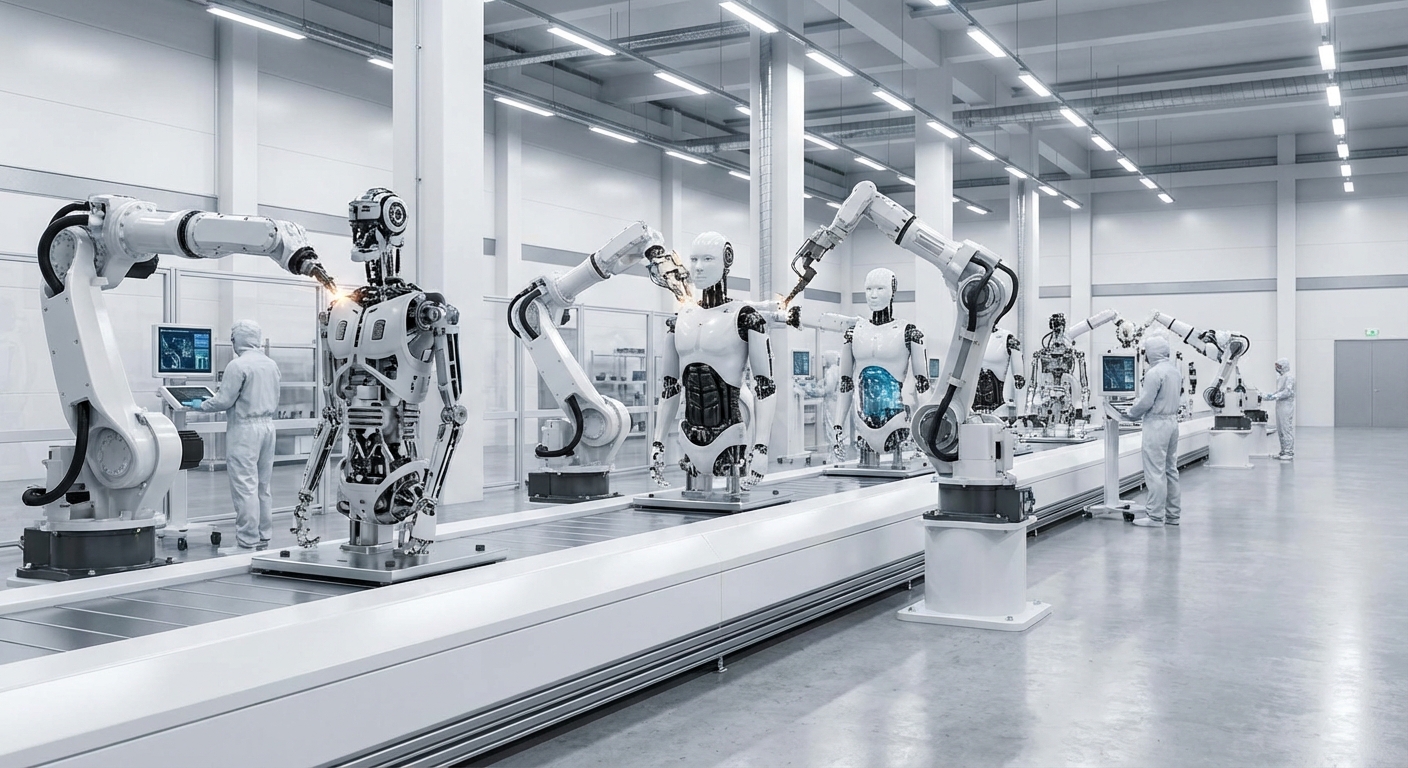 Humanoid robot assembly line in a modern factory showing robots at various stages of production" />
The humanoid robot industry is at an inflection point. In January 2026, Tesla is converting its Fremont factory to produce up to 1 million Optimus robots annually, Figure AI has reached a $39 billion valuation with $1.9 billion in total funding, and Chinese manufacturers like Unitree are shipping full-size humanoid robots for under $100,000. Goldman Sachs projects the humanoid robot market will hit $38 billion by 2035, while Morgan Stanley sees a $5 trillion opportunity by 2050.
But what does it actually cost to build a humanoid robot? And how will those costs evolve as production scales from hundreds to millions of units? This comprehensive guide breaks down the real economics of humanoid robot production in 2026 — from component-level costs to manufacturer pricing strategies, production targets, and the market forces that will determine which companies survive the coming shakeout.
Current State of Humanoid Robot Production Costs (2026)
The cost to manufacture a single humanoid robot in 2026 ranges from approximately $30,000 to $150,000 per unit, depending on capability level, component quality, and production volume. This represents a significant decline from 2023-2024, when comparable units cost $150,000–$500,000 due to low-volume production runs and expensive custom components.
Several factors are driving costs down simultaneously:
- Increased production volumes — Tesla alone targets 50,000–100,000 Optimus units in 2026, with plans to scale to 1 million
- Component standardization — actuators, sensors, and compute modules are becoming commodity parts
- Chinese manufacturing competition — Unitree, UBTECH, and Fourier Intelligence are aggressively pricing below Western competitors
- AI software commoditization — open-source models and cloud-based inference reduce per-unit software costs
Component-Level Cost Breakdown: Where the Money Goes
Understanding humanoid robot production economics requires examining each major subsystem. Here's a detailed breakdown of where manufacturing costs are allocated in a mid-range industrial humanoid robot (estimated total BOM: $40,000–$80,000):
The single most expensive component category — actuators and motion systems — accounts for nearly half the total production cost. This is why Tesla's decision to design custom actuators in-house is strategically critical: controlling actuator costs at scale could give Tesla a 30–40% cost advantage over competitors relying on third-party suppliers.
The Actuator Problem: Why It Dominates Costs
A full-size humanoid robot requires 28–44 actuators (depending on degrees of freedom), each combining a motor, gearbox, encoder, and controller. High-torque actuators for hip and knee joints cost $500–$2,000 each at low volumes. At Tesla's target of 1 million units, these could drop to $100–$300 each through dedicated production lines — a potential savings of $15,000–$25,000 per robot.
DIGITIMES Research predicts that after 2029, advances in actuator technology and economies of scale will reduce module costs for bipedal locomotion and dexterous manipulation by 50–70%, finally enabling true mass-market pricing.
Production Costs by Manufacturer: A 2026 Comparison
Not all humanoid robots are created equal, and neither are their economics. Here's how the leading manufacturers compare on pricing, production volume, and cost structure:
Tesla Optimus: The Production Scale Play
Tesla's approach to humanoid robot economics is fundamentally different from every other player. By leveraging its existing automotive manufacturing infrastructure — gigacasting, battery production, in-house chip design, and massive supply chain — Tesla aims to produce humanoid robots at automotive scale and pricing.
Key milestones for Tesla Optimus in 2026:
- Q2 2026: Model S/X production at Fremont ends, factory repurposed for Optimus manufacturing
- Production target: Up to 1 million units annually at the converted Fremont facility
- New dedicated factory: Groundbreaking on standalone Optimus factory at Giga Texas with 10-million-per-year capacity
- Target price: $20,000–$30,000 per unit at scale, with Elon Musk suggesting eventual consumer pricing as low as $20,000
- Internal deployment: Thousands of Optimus robots already working in Tesla's own factories, providing real-world data
If Tesla hits even 10% of its ambitious targets, it would produce more humanoid robots in a single year than every other manufacturer combined has built in history. The economics become self-reinforcing: higher volume → lower component costs → lower prices → more demand → higher volume.
Figure AI: The Venture-Backed Contender
Figure AI represents the most well-capitalized pure-play humanoid robotics startup. With a September 2025 Series C round of $1 billion (with participation from Intel, NVIDIA, Qualcomm, T-Mobile, Salesforce, and Brookfield Asset Management), the company reached a $39 billion valuation.
Figure's production economics differ from Tesla's:
- Target: BotQ facility designed to produce 12,000 humanoid robots annually
- Strategy: Focus on high-value industrial tasks first (BMW, Amazon pilots), then scale down in price
- AI approach: Partnership with OpenAI for advanced language-driven task execution
- Self-manufacturing goal: Plans to use its own humanoid robots to assist in building additional robots — a recursive manufacturing strategy
The Chinese Manufacturing Advantage
Chinese companies — particularly Unitree, UBTECH, and Fourier Intelligence — benefit from significantly lower manufacturing costs and strong government support for robotics development. Unitree's G1 model at approximately $13,500 and the R1 at $5,900 represent price points that Western manufacturers currently cannot match.
This pricing pressure is forcing margin compression across the industry. When a full-size, highly mobile humanoid robot (Unitree H1) sells for $90,000, it becomes difficult for Western competitors to justify $250,000+ pricing for comparable capabilities. The competitive dynamics mirror what happened in the drone industry, where DJI's manufacturing advantages eventually dominated the global market.
Economies of Scale: The Path from $150,000 to $20,000
The most critical factor in humanoid robot production economics is production volume. Like automobiles, smartphones, and solar panels before them, humanoid robots are on a cost curve where each doubling of cumulative production reduces per-unit costs by approximately 15–20%.
Cost Reduction Trajectory
This trajectory closely mirrors the automotive industry's evolution. The first automobiles cost the equivalent of $40,000+ in today's money. Henry Ford's assembly line brought the Model T down to the equivalent of $5,000. Humanoid robots are on a similar path, with Tesla explicitly modeling its strategy on this precedent.
The ROI Equation: When Do Humanoid Robots Pay for Themselves?
For businesses considering humanoid robot adoption, the critical question isn't just the purchase price — it's the total cost of ownership (TCO) versus human labor costs. Here's the math:
Industrial Deployment ROI Model
Assumptions: A humanoid robot priced at $50,000, deployed in a U.S. warehouse, operating 20 hours/day.
- Robot annual operating cost: ~$15,000 (electricity, maintenance, software updates, insurance)
- Robot total Year 1 cost: $65,000 ($50,000 purchase + $15,000 operating)
- Robot annual cost Years 2–5: $15,000/year
- Robot 5-year TCO: ~$125,000
- Equivalent human worker (2 shifts): $45,000–$55,000/year × 2 workers = $90,000–$110,000/year
- Human 5-year TCO (with benefits): ~$600,000–$700,000
At current pricing, a humanoid robot can replace two shift workers and pay for itself in approximately 12–18 months. At Tesla's target $20,000 price point, payback drops to under 6 months — at which point adoption becomes economically irresistible for nearly every warehouse and manufacturing operation.
Goldman Sachs estimates that even at current price levels, humanoid robots could fill 4% of the U.S. manufacturing labor shortage gap by 2030 and address 2% of global elderly care demand.
Key Economic Challenges Facing the Industry
1. The Reliability Gap
Current humanoid robots require maintenance intervention every 200–500 operating hours. For comparison, industrial robotic arms run 50,000+ hours between major services. Until humanoid robots achieve similar reliability, maintenance costs will remain a significant portion of TCO — potentially $20,000–$40,000 annually for complex deployments.
2. Supply Chain Bottlenecks
Several critical components face supply constraints:
- High-torque actuators: Fewer than 10 global suppliers can produce the precision required
- Tactile sensors: Advanced dexterous hands require custom sensor arrays not yet produced at scale
- AI compute chips: Competition with automotive, data center, and consumer electronics for NVIDIA and custom silicon
3. Software and AI Development Costs
While hardware costs are declining, the investment in AI software — training data, simulation environments, foundation models — is increasing. Figure AI's partnership with OpenAI and Tesla's massive AI training infrastructure represent billions in ongoing R&D that must eventually be amortized across robot sales. Companies without access to frontier AI models may find themselves unable to compete on capability, regardless of hardware costs.
4. Regulatory and Safety Certification
Humanoid robots operating alongside humans require extensive safety certification. ISO 13482 (personal care robots) and ISO 10218 (industrial robots) compliance adds $5,000–$15,000 per unit in testing and certification costs. As robots become more autonomous, regulatory frameworks will likely become more stringent, adding further cost and time-to-market delays.
Market Projections: Who Wins the Economics Race?
The humanoid robot market is entering a consolidation phase where production economics will determine winners and losers. Key market forecasts:
- Goldman Sachs (2024): Global humanoid robot market reaches $38 billion by 2035, up 6x from their previous $6 billion estimate
- Morgan Stanley (2025): Over 1 billion humanoid robots in operation by 2050, generating a $5 trillion market — 90% for industrial/commercial use
- MarketsandMarkets: Humanoid robot market grows from $1.8 billion (2023) to $13.8 billion by 2028, a 50%+ CAGR
The companies most likely to dominate are those with:
- Vertical integration — controlling actuators, compute, batteries, and software (Tesla)
- Manufacturing cost advantages — leveraging existing supply chains and low-cost production (Unitree, Chinese manufacturers)
- AI capability moats — access to frontier models and massive training data (Figure AI/OpenAI, Tesla)
- Capital to survive the scale-up — building factories and supply chains requires billions before profitability (Tesla, Figure AI, well-funded Chinese players)
The Labor Economics Impact
The economics of humanoid robot production don't exist in a vacuum — they're deeply intertwined with labor market dynamics. In the U.S., there are approximately 600,000 unfilled manufacturing jobs and a growing eldercare worker shortage expected to reach 1 million by 2030.
At $50,000 per robot (current mid-range pricing), a humanoid robot's hourly cost works out to approximately $3–$5 per hour over a 5-year lifespan operating 20 hours/day. Compare this to:
- U.S. warehouse worker: $18–$25/hour
- U.S. manufacturing worker: $22–$35/hour
- Japanese eldercare worker: $12–$18/hour
As robot costs continue falling, the economic pressure for adoption intensifies — particularly in regions with aging populations (Japan, South Korea, Germany) and tight labor markets.
Future Cost Predictions: 2026–2035
Based on current production trajectories, supply chain developments, and technology trends, here are projected cost milestones:
- 2026: Entry-level humanoid robots available at $13,500–$30,000 (Unitree G1, Tesla Optimus target). Industrial-grade units at $80,000–$250,000.
- 2028: Mass-produced industrial humanoids drop below $50,000. Consumer models emerge at $15,000–$25,000. First subscription models gain traction ($300–$500/month).
- 2030: Component cost reductions (especially actuators) bring full-featured humanoids to $10,000–$20,000. Goldman Sachs's $38B market size forecast begins materializing.
- 2032–2035: Commodity-scale production. Basic humanoid robots comparable to high-end appliance pricing ($5,000–$10,000). Premium models with advanced AI at $15,000–$30,000.
Frequently Asked Questions
How much does it cost to build a humanoid robot in 2026?
The manufacturing cost for a humanoid robot in 2026 ranges from $30,000 to $150,000 per unit, depending on capability level and production volume. Entry-level models from Chinese manufacturers like Unitree start at $5,900 (R1) to $13,500 (G1), while industrial-grade robots from Agility Robotics or Boston Dynamics can exceed $250,000. Tesla targets a consumer price of $20,000–$30,000 for Optimus at scale production.
What is the most expensive component in a humanoid robot?
Actuators and motion systems are the most expensive component, accounting for 40–50% of total manufacturing costs. A humanoid robot requires 28–44 actuators for its joints, each combining precision motors, gearboxes, and controllers. At low production volumes, actuators alone can cost $13,500–$40,000 per robot. Mass production could reduce this by 50–70%.
How many humanoid robots will Tesla produce in 2026?
Tesla's 2026 production targets range from 50,000 to 1 million Optimus units. The company is converting its Fremont factory (previously used for Model S/X) to Optimus production and has broken ground on a dedicated factory at Giga Texas with an eventual 10-million-per-year capacity. Internal deployment of thousands of units in Tesla's own factories is already underway.
Will humanoid robots be affordable for consumers?
Consumer-grade humanoid robots are becoming affordable in 2026. The Unitree G1 is available for approximately $13,500, 1X Neo is priced at $20,000 (or $499/month subscription), and Tesla targets $20,000–$30,000 for Optimus. By 2030, analysts expect full-featured consumer humanoids to reach $10,000–$20,000 — comparable to a used car or high-end appliance.
How long does it take for a humanoid robot to pay for itself in a business?
At current pricing ($50,000–$80,000), a humanoid robot deployed in a U.S. warehouse or manufacturing setting can pay for itself in 12–18 months by replacing two shift workers. At Tesla's target $20,000 price point, payback could drop to under 6 months. Operating costs (electricity, maintenance, software) run approximately $15,000 per year.
What is the humanoid robot market size in 2026?
The global humanoid robot market is projected to be $4–$6 billion in 2026, growing rapidly toward $13.8 billion by 2028 (MarketsandMarkets) and $38 billion by 2035 (Goldman Sachs). Morgan Stanley projects a $5 trillion total market by 2050 with over 1 billion robots in operation.
Why are Chinese humanoid robots so much cheaper?
Chinese manufacturers benefit from lower labor costs, government subsidies for robotics development, established domestic supply chains for actuators and electronics, and aggressive pricing strategies aimed at capturing market share. Unitree's H1 at $90,000 undercuts Western competitors by 60–75% for comparable mobility and sensing capabilities.
What's the biggest challenge in scaling humanoid robot production?
The biggest challenge is the actuator supply chain. High-precision, high-torque actuators suitable for humanoid robots are produced by fewer than 10 suppliers globally. Scaling from thousands to millions of units requires massive new manufacturing capacity for these components. Companies that control their own actuator production (like Tesla) have a significant strategic advantage.
Conclusion: The Economics Are Reaching an Inflection Point
The economics of humanoid robot production in 2026 are at a pivotal moment. Manufacturing costs are falling rapidly, production volumes are scaling from hundreds to tens of thousands, and the first mass-market pricing (sub-$30,000) is becoming reality.
Three forces will define the next decade: Tesla's automotive-scale production ambitions, Chinese manufacturers' cost advantages, and AI capability improvements that make each robot more valuable. Companies that can simultaneously solve the actuator cost problem, achieve manufacturing scale, and deliver capable AI will capture the majority of what Goldman Sachs, Morgan Stanley, and others project to be a multi-trillion-dollar market.
For businesses evaluating humanoid robot adoption, the math is clear: at current prices, ROI is achieved in 12–18 months. At projected 2028 prices, it's under 6 months. The question is no longer whether humanoid robots make economic sense — it's how quickly production can scale to meet what will be enormous demand.
Humanoid robot market size: $3.14B in 2025, projected $38B by 2035. Growth forecasts, regional data & key players driving the industry.
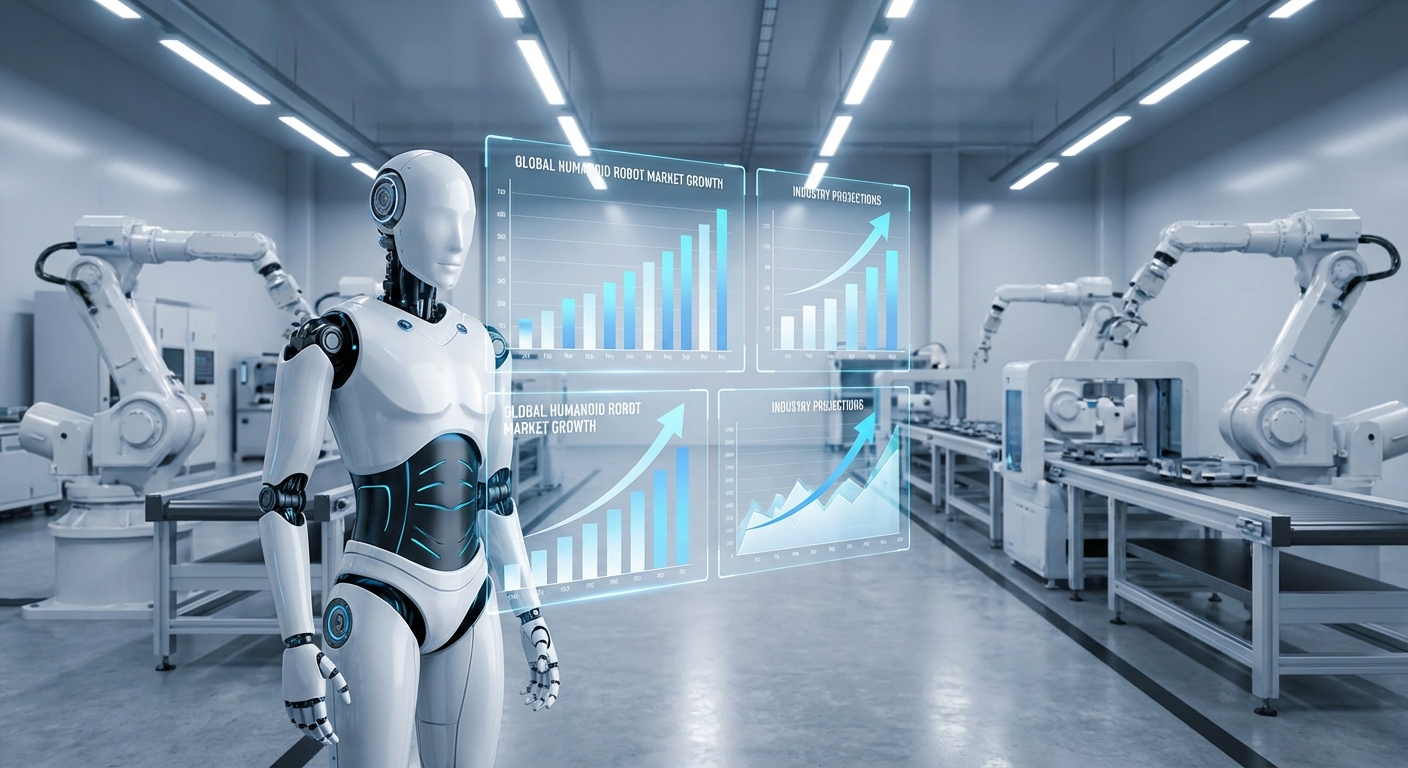 Humanoid robot market size analysis 2026 - factory robot with growth data" />
Humanoid Robot Market Size in 2026: The Complete Industry Analysis
The humanoid robot market size has entered a pivotal growth phase. Global installations reached an estimated 16,000 units in 2025, according to Counterpoint Research, with cumulative deployments expected to exceed 100,000 units by 2027. The market is no longer theoretical — it's commercial, competitive, and accelerating faster than most analysts predicted even two years ago.
In this comprehensive analysis, we break down every dimension of the humanoid robot market: current valuations, growth forecasts from leading research firms, regional dynamics, company-level market share data, application segments, and the forces shaping this industry through 2035 and beyond.
Humanoid Robot Market Size: Current Valuations (2025–2026)
Market sizing for humanoid robots varies significantly across research firms due to differences in scope (some include software and services, others focus on hardware shipments). Here's how the leading estimates compare:
Our assessment: The humanoid robot market size stood at approximately $2–3 billion in 2025, depending on whether you count pure hardware or include software and services. Based on the trajectory of 16,000 units shipped in 2025, production scaling announcements from Tesla, AgiBot, and Unitree, and enterprise pilot conversions, we project the market will reach $4–5 billion in 2026 and comfortably exceed $10 billion by 2029.
The wide range in CAGR estimates (17% to 138%) reflects genuine uncertainty about adoption speed. The conservative estimates (Grand View, Precedence) assume gradual enterprise adoption. The aggressive estimates (ABI Research, MarketsandMarkets) price in the production scaling that Tesla, Chinese manufacturers, and Figure AI have announced for 2026–2027.
Global Installations and Unit Shipments
Raw unit data tells a clearer story than dollar estimates. According to Counterpoint Research's January 2026 report:
- 16,000 humanoid robots were installed globally in 2025
- China accounted for over 80% of all installations
- Cumulative installations are projected to exceed 100,000 units by 2027
- ABI Research projects 115,000 units shipped in 2027 alone
- By 2027, logistics, manufacturing, and automotive will represent ~72% of annual installations
The jump from 16,000 units (2025) to 100,000+ cumulative by 2027 implies explosive growth in 2026 and 2027. This is consistent with production capacity announcements: Tesla is converting its Fremont factory (previously used for Model S and X production) to Optimus manufacturing, while AgiBot has already shipped over 5,000 units from its Shanghai facility.
Humanoid Robot Market Share by Company (2025)
For the first time, we have credible market share data for humanoid robot manufacturers, based on actual unit installations rather than projections:
The top five suppliers captured approximately 73% of global installations in 2025. Chinese companies dominate the early market, accounting for four of the top five positions. This reflects China's aggressive government-backed robotics funding, deep manufacturing supply chains, and willingness to deploy at scale in controlled industrial environments.
Tesla's Escalating Commitment
Tesla's humanoid robot strategy entered a new phase in January 2026. The company announced it is ending production of Model S and Model X vehicles and converting its Fremont, California factory to produce Optimus humanoid robots. CEO Elon Musk has stated that the Gigafactory Texas Optimus production line will eventually target 10 million units annually.
Tesla's production roadmap, as reported by industry analysts:
- 2025: ~800 Optimus units deployed internally at Tesla facilities
- 2026–2027: Pilot and small-scale production (10,000–500,000 annual units), reliability validation
- 2027–2029: Production scaling toward millions annually
- 2030+: Full mass production, targeting price points of $20,000–$30,000 per unit
If Tesla executes even a fraction of this roadmap, it would single-handedly reshape the humanoid robot market's total addressable market (TAM) from billions to tens of billions.
Figure AI
Figure AI raised over $750 million in Series B funding in 2024 at a $2.6 billion valuation, with backing from Microsoft, NVIDIA, OpenAI, Jeff Bezos, and Intel. The company's Figure 02 robot has been deployed at BMW's Spartanburg manufacturing plant. Figure is positioning itself as the leading Western-headquartered general-purpose humanoid company, with aggressive plans to scale production using its own robots on the assembly line.
Agility Robotics
Agility Robotics operates the world's first humanoid robot factory ("RoboFab") in Salem, Oregon, with capacity to produce 10,000 Digit robots annually. Agility has secured deployments with Amazon for warehouse operations, focusing on tote movement and logistics tasks. Their approach — wheeled lower body combined with humanoid upper body — prioritizes practical utility over human-like aesthetics.
Boston Dynamics
Boston Dynamics retired its hydraulic Atlas robot in 2024 and introduced a fully electric version designed for commercial deployment. Under Hyundai ownership, the company is targeting automotive manufacturing applications with the electric Atlas platform, leveraging Hyundai's factory network for initial deployments.
Market Size by Region
China's overwhelming 80%+ share of 2025 installations is partly a function of early-mover advantage — Chinese companies shipped in volume while Western competitors were still in pilot stages. By 2030, as Tesla, Figure, and Agility scale production, North America's share should grow substantially. However, Asia Pacific will likely retain majority market share through at least 2030.
Market Size by Application Segment
Where are humanoid robots actually being deployed? The application mix in 2025 was heavily industrial, a pattern expected to persist through the decade:
The most significant shift expected by 2030 is the growth of personal assistance and caregiving. The global elderly population is expanding rapidly — the WHO projects 2.1 billion people aged 60+ by 2050 — and humanoid robots capable of mobility support, health monitoring, and daily task assistance represent a massive untapped market.
Key Market Drivers Accelerating Growth in 2026
1. AI Breakthroughs in Embodied Intelligence
The single biggest catalyst for humanoid robot commercialization is the rapid advancement in foundation models for robotics. Companies like Google DeepMind (RT-2), OpenAI, and NVIDIA (Project GR00T) are developing generalist AI models that allow robots to understand and execute complex physical tasks from natural language instructions. This dramatically reduces the programming overhead for each new deployment scenario.
2. Declining Component Costs
Goldman Sachs Research notes that most hardware components for humanoid robots — cameras, motors, force sensors, transmission gears, batteries — are already available or close to maturity for commercial purposes. As production volumes increase, component costs are falling on a learning curve similar to what EVs experienced from 2015–2020. Unitree has been particularly aggressive in vertical integration, manufacturing motors, reducers, and sensors in-house to drive down per-unit costs.
3. Robot-as-a-Service (RaaS) Business Models
The capital cost of a humanoid robot ($50,000–$150,000+ for current commercial models) remains a barrier for many enterprises. RaaS models, gaining traction especially in China, allow companies to rent humanoid robots for specific use cases — live performances, retail promotions, event staffing — without the upfront investment. Dedicated platforms to manage leased robot fleets are expected to emerge in 2026.
4. Labor Shortages in Key Industries
Global labor shortages in manufacturing, logistics, and healthcare are structural, not cyclical. Japan's working-age population has been shrinking for two decades. Germany faces a projected shortfall of 7 million skilled workers by 2035. China's manufacturing workforce peaked in 2017. Humanoid robots offer a scalable solution for tasks that are dangerous, dirty, or dull — categories where human labor is increasingly unavailable, not just expensive.
5. Government Investment and Policy Support
China's government has established dedicated robotics funds and publicly listed component makers are actively recruiting and investing in humanoid-related R&D. The Chinese government's "Humanoid Robot Innovation and Development Guidance" policy, released in 2023, explicitly targets mass production by 2025 and global competitiveness by 2027 — targets that are being met or exceeded. In the US, the CHIPS and Science Act and DARPA's robotics programs are channeling billions toward next-generation automation.
Market Restraints and Challenges
High Capital and R&D Costs
Developing a competitive humanoid robot platform requires hundreds of millions in R&D investment. Figure AI's $750M+ in funding, Boston Dynamics' decades of DARPA-funded research, and Tesla's ability to cross-subsidize from automotive revenue all underscore the barrier to entry. Smaller companies without deep funding face structural disadvantages.
Safety and Regulatory Uncertainty
Humanoid robots operating alongside humans in factories, healthcare facilities, and public spaces introduce safety risks that existing regulatory frameworks don't fully address. Accidental collisions, malfunctions during patient care, and cybersecurity vulnerabilities all require robust standards development. The EU is ahead on regulatory frameworks, but global harmonization is years away.
AI Software Bottlenecks
While hardware is approaching commercial maturity, AI and software for robot manipulation (grasping diverse objects reliably) and natural interaction (understanding unstructured voice commands) remain significant bottlenecks. Goldman Sachs Research notes that "the viability of mass-produced, general-purpose humanoid robots hasn't been proven yet." Near-term commercial success depends on structured environments with limited variability.
Performance Limitations in Unstructured Environments
Humanoid robots perform well in controlled settings — factory floors, warehouses with standardized layouts, reception desks. Performance degrades significantly in unpredictable environments. True general-purpose operation in homes, outdoor spaces, and complex social settings remains 5–10 years away for most use cases.
Long-Term Market Projections: 2030, 2035, and 2050
Looking beyond the near-term, the investment bank forecasts paint a picture of extraordinary market potential:
Goldman Sachs notably revised their 2035 forecast upward by 6x — from $6 billion to $38 billion — reflecting how quickly the supply chain and AI capabilities have matured. Morgan Stanley's $5 trillion figure for 2050 includes the entire humanoid ecosystem: the robots themselves, their supply chains, and service networks. At nearly 1 billion units, this implies humanoid robots becoming as ubiquitous as smartphones.
The Supply Chain Landscape
The humanoid robot supply chain is rapidly maturing, with clear parallels to the EV industry's evolution. Key component categories include:
- Actuators and Motors: Electric actuators dominate (hydraulic systems are being phased out, as Boston Dynamics' Atlas transition demonstrated). Harmonic drives and planetary gearboxes are critical for joint precision.
- Sensors: LiDAR, depth cameras, force/torque sensors, IMUs. NVIDIA and Intel provide key vision processing hardware.
- Compute Platforms: NVIDIA's Jetson and Thor platforms are emerging as the standard for on-robot AI inference. Qualcomm is also competing in this space.
- Batteries: Humanoid robots require energy-dense, lightweight battery packs. Current-generation robots achieve 2–4 hours of continuous operation — a key limitation driving battery R&D.
- AI Software: Foundation models from OpenAI, Google DeepMind, and NVIDIA (Isaac Sim, GR00T) are the backbone of robot intelligence. Custom control software from each manufacturer handles locomotion and task execution.
Goldman Sachs Research notes that while most components are commercially available, some require high-precision grinding machines that are limited in number, constraining production ramp-up speed. This bottleneck is expected to ease as manufacturers invest in dedicated production capacity through 2026–2027.
Humanoid Robot Pricing: From $150K to $20K
Current humanoid robot pricing varies dramatically by capability level:
Unitree's G1 at $16,000 represents the current price floor for a functional bipedal humanoid. Tesla's stated target of $20,000–$30,000 for Optimus — a far more capable robot — would be transformative if achieved at scale. For context, that's roughly half the price of a new car, for a machine that could work 20+ hours per day without breaks.
What Makes This Market Different From Previous Robotics Waves
Industrial robotics is a mature $50+ billion market dominated by FANUC, ABB, KUKA, and Yaskawa. What makes humanoid robots fundamentally different?
- Human-compatible environments: Humanoid robots can operate in spaces designed for people — stairs, doorways, standard workstations — without facility modifications. This dramatically expands the addressable deployment base.
- Generalist capability: Traditional industrial robots are programmed for specific tasks. AI-powered humanoid robots can potentially learn new tasks through demonstration or instruction, making them adaptable across applications.
- Emotional and social interaction: For caregiving, education, hospitality, and public-facing roles, the humanoid form factor enables natural human-robot interaction that arm-style or wheeled robots cannot match.
- AI as a force multiplier: Foundation models mean that improvements in AI capability — happening at breakneck speed — automatically improve every humanoid robot running that software. This creates a virtuous cycle absent in traditional robotics.
Investment and Funding Landscape
Private and public investment in humanoid robotics has surged:
- Figure AI: $750M+ Series B (2024), $39B valuation. Investors include Microsoft, NVIDIA, OpenAI, Jeff Bezos, Intel.
- Agility Robotics: $150M Series B (2024). Backed by Amazon Industrial Innovation Fund.
- 1X Technologies (NEO): $100M Series B (2024). Backed by OpenAI Startup Fund.
- AgiBot: Significant Chinese government and private funding. Largest humanoid robot manufacturer by units shipped.
- Tesla: Self-funded from automotive revenue. Converting entire factory lines to Optimus production.
- Chinese government: Dedicated robotics funds supporting both R&D and commercialization. Policy mandate for mass production by 2025 (achieved).
Total venture and corporate investment in humanoid robotics exceeded an estimated $3 billion in 2024–2025, not counting Tesla's internal capex. This level of investment — combined with the direct involvement of AI leaders like OpenAI, NVIDIA, and Google DeepMind — signals strong conviction that humanoid robots will become a massive commercial category.
Frequently Asked Questions
What is the current humanoid robot market size in 2026?
The humanoid robot market size is estimated at approximately $4–5 billion in 2026, growing from $2–3 billion in 2025. Research firms report different figures based on methodology: MarketsandMarkets estimates $2.92 billion for 2025, Research Nester reports $3.14 billion, and BCC Research cites $1.9 billion. The market is projected to reach $10–15 billion by 2030 based on current growth trajectories.
Which company leads the humanoid robot market?
As of 2025, AgiBot (Shanghai) leads in unit installations with approximately 31% market share, followed by Unitree (27%), UBTECH (~5%), Leju Robotics (~5%), and Tesla (~5%). Chinese companies dominate the current market, though Tesla's factory conversion and Figure AI's scaling plans could shift market share significantly by 2027–2028.
How fast is the humanoid robot market growing?
The humanoid robot market is growing at a CAGR of 35–45% depending on the research firm and methodology. MarketsandMarkets reports 39.2% CAGR (2025–2030), BCC Research reports 42.8%, and Research Nester reports 38.5% (2026–2035). ABI Research's 138% CAGR figure reflects the extremely small base in 2024. Global unit installations grew from near-zero in 2023 to 16,000 units in 2025.
What will the humanoid robot market be worth by 2030?
Estimates for 2030 range from $4 billion (Grand View Research, conservative) to $15.26 billion (MarketsandMarkets). ABI Research projects $6.5 billion, while BCC Research estimates $11 billion. The wide range reflects uncertainty about production scaling speed and enterprise adoption rates. Goldman Sachs projects $38 billion by 2035.
What are humanoid robots used for?
In 2025–2026, humanoid robots are primarily deployed in manufacturing and automotive assembly (~35%), logistics and warehousing (~25%), and research (~15%). Growing applications include personal assistance and elderly care, hospitality and entertainment, education, and hazardous environment operations. Industrial use cases in structured environments dominate near-term adoption.
How much does a humanoid robot cost?
Current humanoid robot prices range from $16,000 (Unitree G1, basic research model) to over $150,000 for advanced industrial platforms. Tesla targets a $20,000–$30,000 price point for its Optimus robot at scale. Robot-as-a-Service models are emerging that eliminate upfront capital costs, charging instead on a per-hour or per-task basis.
Will humanoid robots replace human workers?
In the near term (2026–2030), humanoid robots are augmenting human workers rather than replacing them, primarily filling roles in dangerous, dirty, or dull tasks where labor is already scarce. Goldman Sachs notes that approximately 70% of Chinese manufacturing is already automated, and humanoid robots extend automation into the remaining manual tasks. Long-term workforce displacement is a legitimate concern, but current deployments are focused on labor-shortage sectors, not cost-cutting in well-staffed industries.
The Bottom Line: A Market at Inflection Point
The humanoid robot market in 2026 is at a genuine inflection point. We've moved past the demo-video era into actual commercial deployments — 16,000 units in the field, real revenue, and production lines being built. The convergence of mature AI models, declining hardware costs, aggressive Chinese manufacturing, and Tesla's factory-scale commitment creates a growth trajectory unlike anything the robotics industry has seen before.
The question is no longer whether humanoid robots will become a major market, but how fast. Conservative estimates point to a $6–10 billion market by 2030. Bull-case scenarios (Goldman Sachs, Morgan Stanley) project $38 billion by 2035 and $5 trillion by 2050. The actual outcome depends on three variables: AI software maturity, production cost reduction curves, and regulatory frameworks for human-robot coexistence.
What's clear: every major technology company, automotive manufacturer, and industrial conglomerate is now positioned in this space. The humanoid robot market isn't a speculative concept — it's an industrial reality, and 2026 is the year it begins to scale.
Explore the difference between cobot vs robot: cobots work alongside humans for flexibility, while robots operate independently in fixed settings.
If you’re deciding between cobots and robots for automation, understanding their key differences is essential. Cobots, or collaborative robots, work safely with humans, making them perfect for collaborative tasks. Industrial robots, by contrast, are powerful machines for repetitive, high-speed tasks with minimal human intervention. This article will explore the benefits and limitations of cobots vs. robots to help you choose the best option for your needs.
Key Takeaways
- Cobots are designed for safe collaboration with humans and offer flexibility, making them ideal for dynamic manufacturing environments, while industrial robots excel in high-speed, high-precision tasks requiring minimal human interaction.
- Safety measures differ significantly: cobots use built-in sensors for real-time human detection and require less safety infrastructure, while industrial robots need extensive safety barriers due to their powerful, autonomous operations.
- Cost considerations, ease of programming, and specific task requirements are critical in deciding between cobots and industrial robots, with cobots generally offering a more budget-friendly option for businesses looking for adaptability.
Understanding Cobot vs Robot
Cobots and industrial robots play pivotal roles in industrial automation, each bringing unique advantages to the table. Cobots, or collaborative robots, are designed to work alongside human workers, enhancing efficiency without entirely replacing jobs. In contrast, industrial robots are powerful autonomous machines used for repetitive tasks, often isolated from human workers for safety reasons.
Both types of robots enable companies to automate manual processes, speeding them up and increasing quality. The primary decision companies face is choosing between these two types of robotic solutions.
What is a cobot?
A cobot, short for collaborative robot, is specifically designed to work safely alongside humans. These robots are characterized by their flexibility and adaptability, allowing them to operate in dynamic environments. Easily integrated into existing production lines without requiring extensive safety barriers or modifications, cobots are a versatile addition to various industries. They are commonly used for tasks requiring precision, flexibility, and adaptability, such as assembly and machine tending.
One of the key advantages of cobots is their advanced safety features. These robots are equipped with sensors that detect human presence and adjust their actions accordingly, ensuring safe human-robot collaboration. Cobots enhance safety by making work easier and safer for humans, significantly reducing the risk of workplace injuries.
They are often used in high-mix manufacturing scenarios where product variations are vast, and their adaptability improves job satisfaction and productivity.
What is an industrial robot?
Industrial robots are specialized machines used in factories for precise and repeatable tasks. These robots perform tasks without direct human intervention, often handling repetitive and hazardous operations. Once set up, industrial robots operate autonomously, requiring human intervention mainly for maintenance. Industrial robots commonly perform tasks such as welding and painting. They are also used for material handling and packaging.
Due to their powerful and autonomous nature, industrial robots typically operate in their own space away from human workers to ensure safety. These machines are designed for heavy-duty applications and harsh conditions, making them robust and durable.
While they excel in tasks requiring high precision and speed, they are less accurate in force control and not suitable for tasks requiring high or varying sensitivity.
Comparing Safety Features
Safety is a paramount concern in the realm of robotics. Both cobots and industrial robots have distinct safety measures to protect human workers. Cobots are specifically designed to be safe to work alongside humans, integrating advanced safety features such as sensors and soft designs that detect human presence and reduce the impact of physical contact.
On the other hand, industrial robots, due to their powerful and autonomous nature, often require physical barriers, safety cages, and extensive safety protocols to ensure human safety.
Cobots’ Safety Measures
Cobots utilize integrated sensors to detect nearby individuals, enabling them to slow down or stop to ensure safety during operation. Their design includes features such as rounded edges and soft padding to minimize the risk of injury in the event of accidental contact. These safety measures are crucial in maintaining a safe working environment when cobots collaborate with human workers.
Cobots significantly reduce workplace injuries by taking over repetitive and hazardous tasks, thus contributing to a safer work environment. Unlike traditional industrial robots, cobots do not require extensive safety infrastructure, making them easier to integrate into various work settings and enhancing their flexibility and adaptability.
Industrial Robots’ Safety Measures
Industrial robots often require physical barriers or cages to prevent accidental contact with human workers. Safety cages and barriers are essential components in ensuring the safe operation of these powerful machines. Additionally, industrial robots are equipped with emergency stop buttons that quickly disable operations in case of an emergency, which are critical safety features in preventing accidents.
Operating at high speeds and forces, industrial robots can be potentially hazardous to humans if safety measures are not in place. Therefore, the safety protocols around industrial robots include the use of fences and sensors to minimize risks and protect human workers.
Flexibility and Adaptability
Flexibility and adaptability are key factors in choosing the right robotic solution. Cobots are known for their versatility and ease of reconfiguration, allowing them to perform various tasks with minimal reprogramming.
In contrast, industrial robots are more specialized and require extensive reprogramming to adapt to different tasks, making them less flexible.
Cobots’ Flexibility
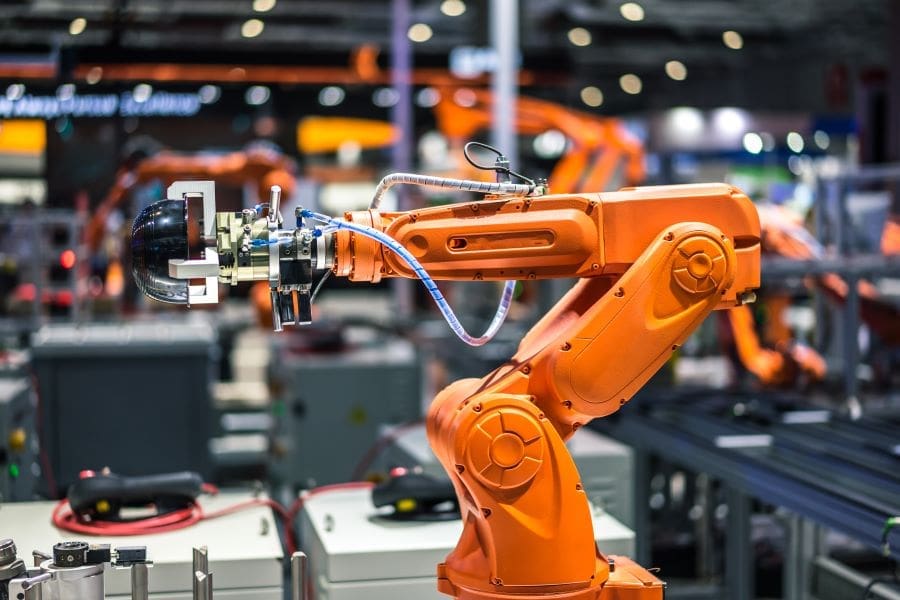
Cobots’ ability to perform multiple tasks and easy reprogrammability make them highly flexible in diverse manufacturing settings. Their lightweight, smaller footprint facilitates seamless integration into various environments. The design of cobots allows them to be lightweight and compact, facilitating easy movement and reconfiguration.
Cobots can learn and adapt their movements under the guidance of human operators, which streamlines their reconfiguration process. Simple programming software enables cobots to be easily reconfigured for a variety of tasks, allowing businesses to consider scalability and flexibility in their operations. This adaptability makes cobots ideal for dynamic manufacturing processes that require frequent changes.
Industrial Robots’ Adaptability
Industrial robots are less flexible and are designed for specific tasks, excelling in operations that require high precision and speed. These robots are more specialized, catering to operations that demand consistency and high throughput. However, reprogramming industrial robots is time-consuming and requires specific knowledge, making them less adaptable to changing manufacturing needs.
The larger and heavier nature of industrial robots makes it more difficult to integrate them into new workspaces. They are usually fixed installations that need a stable setup in predetermined locations, limiting their adaptability. Despite these limitations, industrial robots are essential for tasks that require high accuracy and consistency in production.
Ease of Programming and Integration
Programming and integrating robotic solutions into existing production lines can be a significant consideration for businesses. Cobots and industrial robots differ markedly in this aspect.
While cobots are designed to be user-friendly and accessible to non-experts, industrial robots require specialized programming knowledge and expertise.
Programming Cobots
Intuitive methods like hand-guiding and graphical interfaces make cobots accessible to non-experts for programming. This ease of programming allows companies to quickly adapt cobots to new tasks without extensive training or technical expertise. The programming of cobots generally requires less time and effort compared to traditional industrial robots, contributing to their effective collaboration with human workers in various manufacturing processes.
This simplicity in programming and reconfiguration makes cobots an attractive option for small and medium enterprises that may not have the resources to hire specialized robot programmers. By using cobots, these businesses can achieve automation with lower upfront costs and faster implementation times.
Programming Industrial Robots
Programming industrial robots is more complex and time-consuming compared to programming cobots. These robots often require specialized programming languages that demand significant expertise from the operators. Typically, reprogramming industrial robots for new tasks entails a thorough process under the supervision of knowledgeable experts.
Due to their complexity, programming industrial robots necessitates specialized training and expertise, making it a more challenging and resource-intensive process. Despite these challenges, once programmed, industrial robots can operate autonomously, performing tasks efficiently without the need for continuous human oversight.
Cost Considerations
Cost is a critical factor in choosing between cobots and industrial robots. Collaborative robots offer a more budget-friendly automation option compared to traditional industrial robots, particularly for smaller companies needing flexibility and cost-effectiveness.
Initial costs and ongoing maintenance are key considerations that can impact the overall return on investment.
Initial Costs
The price of cobots can vary widely based on their specifications. Basic models start at around $8,000, making them accessible for small and medium-sized enterprises. Higher-end cobots equipped for complex tasks can exceed $35,000, reflecting their advanced capabilities and versatility. The starting price for cobots can begin around $57,000, while industrial robots typically range from $35,000 to $120,000.
It’s important to note that integration costs for cobots may surpass the purchase price due to the need for additional components and customization. This can include sensors, grippers, and software licenses, which are essential for the cobots to perform specific tasks effectively. Therefore, while cobots might offer lower upfront costs overall, businesses must consider the total cost of ownership.
Maintenance and ROI
Cobots often result in quicker ROI due to their lower upfront costs and minimal maintenance requirements. The integration of cobots requires less specialized training and installation, further enhancing their cost-effectiveness. Ongoing maintenance for cobots includes parts replacement, software support, and preventive care to ensure efficiency, but these costs are generally lower than those for industrial robots.
In contrast, industrial robots might incur higher maintenance costs because of the need for complex safety measures and additional tools. The specialized nature of industrial robots means that they often require professional maintenance services, which can add to the overall cost of ownership.
The performance and durability of industrial robots, however, can justify the investment in operations requiring high precision and labor-intensive tasks.
Performance: Speed and Payload
Performance metrics such as speed and payload capacity are crucial when selecting between cobots and industrial robots. While industrial robots are designed for high-speed operations and can carry larger, heavier loads, cobots are optimized for safety and precision in tasks that require human collaboration.
Understanding these key differences can help businesses choose the right robotic solution for their specific needs.
Cobots’ Performance
Cobots feature lower payload and reach, as well as reduced speed, compared to industrial robots. They are designed to operate at slower speeds and handle lighter loads to ensure safety during human-robot collaboration. Cobots are ideal for tasks that demand precision. They are particularly effective in assembly, machine tending, and quality inspection.
Although cobots are not as powerful or fast as industrial robots, their ability to work closely with humans and adapt to various tasks provides significant advantages. Cobots are particularly valuable in environments where human interaction is necessary, and their performance is optimized for such settings.
Industrial Robots’ Performance
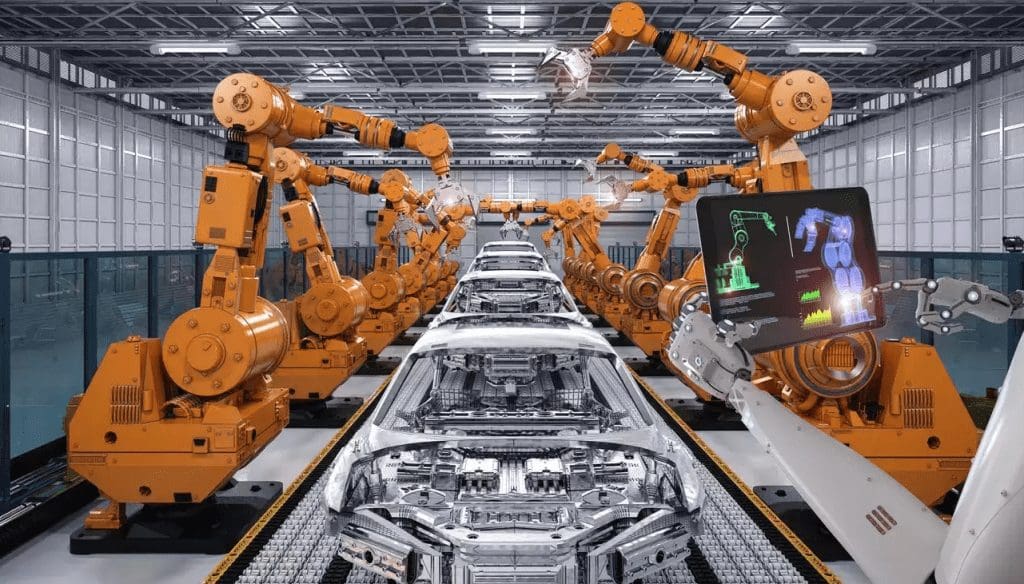
Industrial robots are designed for higher speeds, making them suitable for fast-paced production processes. They have substantial payload capacities that allow them to handle heavy loads during operations. This combination of fast speeds and high payload capabilities makes industrial robots ideal for demanding manufacturing environments where efficiency and throughput are critical.
These robots are typically fixed in place and designed for high-precision tasks performed without human assistance, ensuring consistent quality and performance. For businesses with high-volume production needs, industrial robots offer the necessary power and reliability to maintain productivity.
Collaboration and Human Interaction
Collaboration and human interaction are key considerations when choosing between cobots and industrial robots. Cobots are designed to operate in shared environments, enabling them to adjust their tasks based on human interactions.
Industrial robots, on the other hand, are often isolated from human workers to ensure safety and efficiency in their operations.
Human-Robot Collaboration with Cobots
Cobots are equipped with built-in safety features that allow them to operate safely in close proximity to humans. These features include force-sensing capabilities that detect unexpected forces and halt their motion quickly to prevent injuries. The design of cobots ensures they operate at speeds comparable to human movement, reducing the risk of injury during interaction.
Designed to work alongside humans, cobots eliminate the need for safety barriers, allowing direct interaction during shared tasks. This capability makes cobots ideal for collaborative assembly, quality inspection, and other tasks that benefit from human oversight and intervention.
Minimal Human Interaction with Industrial Robots
Traditional industrial robots can operate independently once they are set up, requiring minimal human intervention. Human interaction is primarily needed for maintenance, upgrades, or error rectifications, allowing these robots to perform repetitive and hazardous tasks efficiently. This independence makes industrial robots suitable for environments where human presence is limited or where tasks are too dangerous for human workers.
The use of safety cages and barriers around industrial robots ensures that they operate without posing risks to human workers. These safety measures are essential for protecting human workers while the robots perform high-speed and high-force operations that could be hazardous without proper precautions.
Workspace and Environmental Requirements
The workspace and environmental requirements for cobots and industrial robots vary significantly. Cobots can function effectively in a variety of environmental conditions, including both clean and dirty settings.
In contrast, industrial robots typically require larger, controlled environments to ensure optimal functionality and safety.
Cobots in Limited Spaces
Cobots are ideal for small productions and limited spaces due to their compact design. Their lightweight, smaller footprint facilitates easier integration with minimal safety infrastructure. This flexibility allows cobots to adapt to different environments easily, making them ideal for small and medium enterprises that may not have extensive floor space.
The ability of cobots to operate in a wider range of environmental conditions, including variable temperatures, further enhances their versatility. This adaptability makes cobots a practical choice for businesses looking to implement automation in diverse and constrained workspaces.
Industrial Robots in Controlled Environments
Industrial robots operate effectively in larger, enclosed, and controlled environments that ensure safety and optimal functionality. These robots require more space for operation, including necessary safety measures such as fences and sensors to protect human workers. The fixed nature of industrial robots means they need a stable setup in predetermined locations, which can limit their flexibility.
Despite these space requirements, industrial robots are essential for high-volume production processes where consistency and efficiency are paramount. Their ability to handle large and heavy materials makes them suitable for demanding manufacturing tasks that require a controlled environment.
Applications in Various Industries
Cobots and industrial robots find applications across various industries, each offering unique advantages. Collaborative robots (cobots) are designed to work alongside humans to enhance safety and improve efficiency, making them suitable for a wide range of sectors.
Industrial robots, with their precision and heavy-duty capabilities, are invaluable in industries that require high-volume production and standardized processes.
Manufacturing Industry
Designed to enhance efficiency, cobots are commonly used in manufacturing for a wide range of tasks. These include assembly, pick and place operations, machine tending, and quality inspection. Their flexibility and ease of programming make them ideal for tasks that require frequent changes and human collaboration.
Industrial robots excel in tasks such as welding, painting, assembling, and moving materials, making them ideal for heavy-duty applications. These robots are particularly suited for repetitive and monotonous tasks that require meticulous precision, such as collaborative assembly and quality checking. Their ability to handle larger materials and perform with high precision makes them indispensable in large-scale manufacturing environments.
Healthcare and Logistics
In healthcare, cobots enhance efficiency in tasks like patient rehabilitation and surgical assistance. Their ability to work closely with humans and adapt to various tasks makes them valuable in improving patient outcomes and streamlining operations. Cobots can also perform tasks such as palletizing with a suitable end-effector, providing flexibility in logistics and other sectors.
Industrial robots streamline logistics by performing high-speed sorting, palletizing, depalletizing, and heavy-duty material handling. These robots reduce labor costs and increase efficiency in logistics operations. Their ability to handle large volumes of materials quickly and accurately makes them essential for logistics and supply chain management.
Deciding Between Cobots and Industrial Robots
Deciding between cobots and industrial robots involves assessing various factors such as task requirements, budget, safety considerations, and future needs. Understanding the specific characteristics of the tasks, the need for human interaction, and the operational context are crucial in making an informed decision.
Both types of robots offer distinct advantages that can be leveraged based on the specific needs of the business.
Assessing Task Requirements
When selecting a cobot or an industrial robot, evaluate the specific tasks that need automation. Additionally, consider factors such as human-robot interaction, precision, speed, workspace, and budget. Cobots are better suited for scenarios requiring flexibility and the ability to adapt to different tasks while working alongside humans. They are easier to program, allowing non-experts to teach them tasks effectively. Conducting a thorough risk assessment before deploying cobots ensures all necessary safety measures are in place.
Industrial robots, on the other hand, are more suitable for automating repetitive tasks with minimal human interaction and high precision. Traditional robots excel in specific tasks that require consistent performance and high throughput.
Both cobots and industrial robots can operate in the same workspace, depending on the tasks involved, allowing businesses to leverage the strengths of both types of robots.
Considering Future Needs
Considering future requirements is crucial to ensuring the chosen robotic solution can adapt and grow with the business. Cobots offer an easily reconfigurable solution, making them suitable for future task automation. Their flexibility allows businesses to adapt to new tasks and changing production needs without significant reprogramming or additional costs.
Industrial robots, while more specialized, can also be integrated into long-term production plans where high precision and heavy-duty operations are required. Ensuring that the chosen robotic solution aligns with future operational goals and potential advancements in technology can help businesses remain competitive and efficient in the long run.
Summary
In summary, both cobots and industrial robots offer unique advantages that can enhance efficiency and productivity in various industries. Cobots are designed for flexibility, safety, and ease of use, making them ideal for tasks that require human-robot collaboration and adaptability. They are cost-effective solutions for small and medium enterprises looking to automate their processes without significant upfront investments. Industrial robots, on the other hand, excel in high-speed, high-precision, and heavy-duty tasks, making them indispensable for large-scale manufacturing and logistics operations.
Choosing between cobots and industrial robots depends on specific task requirements, budget, safety concerns, and future needs. By understanding the key differences and benefits of each type of robot, businesses can make informed decisions that align with their operational goals and ensure long-term success. As technology continues to evolve, the integration of these robotic solutions will play a critical role in shaping the future of industrial automation.
Frequently Asked Questions
What are the main differences between cobots and industrial robots?
The main difference between cobots and industrial robots lies in their design and functionality; cobots are engineered to collaborate safely with humans and offer greater flexibility, whereas industrial robots are built for high-speed, repetitive tasks, often operating independently.
How do cobots ensure safety during operation?
Cobots ensure safety during operation by utilizing integrated sensors to detect human presence and adjust their actions, thereby minimizing injury risks. Additionally, their design includes rounded edges and soft padding to enhance overall safety.
What are the cost considerations when choosing between cobots and industrial robots?
When selecting between cobots and industrial robots, consider that cobots typically require lower upfront investments and maintenance, leading to a faster return on investment. In contrast, industrial robots, although pricier, offer superior precision and durability for demanding applications.
In which industries are cobots commonly used?
Cobots are commonly used across industries such as manufacturing for assembly and quality inspection, healthcare for patient rehabilitation and surgical assistance, and logistics for palletizing and sorting tasks. Their versatility enhances productivity and efficiency in these fields.
How do industrial robots perform in high-volume production environments?
Industrial robots perform exceptionally well in high-volume production environments, as they offer high-speed operations and significant payload capacities, which ensure consistency and efficiency in repetitive tasks.
Related: What is a Cobot? Guide to Collaborative Robots · Applications of Humanoid Robots
Ready to buy? Browse humanoid robots for sale on Robozaps.
Figure 02 review: BMW-deployed humanoid robot with OpenAI integration. Full specs, real performance data & competitive analysis. Expert verdict.
In this comprehensive Figure 02 review, we examine everything about Figure AI's second-generation humanoid robot — from its technical specifications and Helix AI system to real-world performance, pricing, and how it stacks up against competitors like the Tesla Optimus Gen 2 and Unitree G1. Whether you're evaluating the Figure 02 for industrial deployment, research, or simply tracking the humanoid robotics revolution, this review covers every angle with verified specs and the latest 2026 data.
Key Takeaways
- Helix VLA AI system — Figure 02 runs a breakthrough Vision-Language-Action model that controls the entire upper body at 200 Hz, enabling zero-shot manipulation of thousands of unseen objects.
- Commercial-grade hardware — Standing 168 cm (5'6") tall and weighing 70 kg, it carries payloads up to 25 kg with 16 degrees of freedom in its hands alone.
- 5-hour runtime — A 2.25 kWh torso-integrated lithium-ion battery provides 5 hours of continuous operation with 1.5-hour rapid charging.
- Real-world proven — Successfully tested at BMW's Spartanburg plant performing chassis assembly tasks alongside human workers.
- Enterprise pricing — Approximately ~$130,000 (estimated) per unit for commercial lease, positioning it as a premium industrial platform.
- Figure 03 successor announced — The next-gen Figure 03 (October 2025) brings tactile sensors, wider FOV cameras, and 9% less mass, though Figure 02 remains in active deployment.
Figure 02 Complete Specifications
Design and Build Quality
The Figure 02 robot represents a dramatic design evolution from its predecessor, the Figure 01. Where Figure 01 featured exposed chrome elements and visible wiring, Figure 02 adopts a sleek, matte black exterior with all cabling fully integrated into the limbs. This isn't merely cosmetic — the integrated cabling provides significantly better protection against wear and damage during industrial operations.
At 168 cm tall and 70 kg, Figure 02 is deliberately sized to human proportions. This human-scale form factor is a critical engineering decision: it means Figure 02 can navigate environments designed for people — doorways, staircases, workstations, and standard industrial fixtures — without requiring infrastructure modifications. The 70 kg weight provides a low center of gravity that enhances stability during load-carrying tasks.
The structural design prioritizes durability over aesthetics. Custom electric motors are integrated directly with joint drivetrains at each of the 28 degrees of freedom, and internal cabling is routed to minimize wear during repetitive motions. The torso houses both the 2.25 kWh battery pack and the dual GPU compute modules, centralizing the heaviest components for optimal balance.
Build materials include high-strength composites and miniature ball bearings at critical joints, enabling the combination of structural rigidity and smooth articulation that industrial tasks demand. The matte black finish also serves a practical purpose — it reduces glare that could interfere with the robot's own RGB camera perception system.
Helix AI: The Brain Behind Figure 02
The most significant upgrade in Figure 02 isn't physical — it's the Helix AI system. Originally, Figure 02 shipped with AI models developed in partnership with OpenAI. However, in 2025, Figure AI ended that collaboration, stating that large language models were "getting smarter yet more commoditized." The company then developed Helix in-house: a groundbreaking Vision-Language-Action (VLA) model that fundamentally changes how humanoid robots learn and operate.
How Helix Works: System 1 and System 2
Helix uses a novel dual-system architecture inspired by human cognition:
- System 2 (Slow Thinking) — An onboard vision-language model (VLM) running at 7–9 Hz handles high-level scene understanding, language comprehension, and task planning. It processes visual input from all six RGB cameras and interprets natural language commands.
- System 1 (Fast Acting) — A reactive visuomotor policy that translates System 2's semantic understanding into precise motor actions at 200 Hz. This handles real-time adjustments — reacting to a moving object, adapting grip force, or coordinating with a partner robot.
This architecture resolves a fundamental robotics tradeoff: VLMs are general but slow; motor policies are fast but narrow. By decoupling them, Helix gets both speed and generalization.
Key Helix Capabilities
- Zero-shot object manipulation — Figure 02 can pick up virtually any small household or industrial object, including thousands it has never encountered before, simply by following natural language prompts.
- Full upper-body control — Helix is the first VLA to output continuous control of the entire humanoid upper body: wrists, torso, head, and individual fingers.
- Multi-robot collaboration — A single set of Helix neural network weights can run simultaneously on two robots, enabling them to collaborate on shared tasks (e.g., sorting groceries together).
- Single neural network — All behaviors — picking, placing, using drawers, refrigerators, cross-robot coordination — run on one unified set of weights with zero task-specific fine-tuning.
- Fully onboard — Helix runs entirely on the robot's embedded GPUs, requiring no cloud connection for inference.
Helix was trained on approximately 500 hours of diverse teleoperated behavior data, with auto-labeling VLMs generating natural language instruction pairs for each behavior segment.
Hand Dexterity and Manipulation
Figure 02's five-fingered robotic hands are among the most capable in the humanoid robotics industry. With 16 degrees of freedom across both hands, they can perform precise, complex movements that approach human-level dexterity.
The hands are rated for a maximum carrying weight of 25 kg (55 lbs), making them suitable for handling heavy industrial components, packages, and tools. The joint system uses a combination of revolute and spherical joints with miniature ball bearings, providing both the range of motion and the precision needed for fine manipulation.
When paired with Helix AI, the dexterity becomes particularly impressive. The system can adapt grip strength and finger positioning in real-time at 200 Hz, handling objects it has never seen before. In demonstrations, Figure 02 has successfully manipulated delicate glassware, crumpled clothing, scattered small items, and standard industrial fixtures — all without pre-programming for each specific object.
For context, this is a significant capability gap compared to most competitors. The Tesla Optimus Gen 2 has demonstrated improving hand dexterity but hasn't shown the same breadth of zero-shot manipulation. The Unitree G1 focuses more on locomotion than manipulation precision.
Power System and Battery Life
The Figure 02's power system is a 50% improvement over Figure 01, built around a 2.25 kWh lithium-ion battery pack integrated directly into the torso. This placement was chosen for two reasons: it lowers the center of gravity for better stability, and it centralizes weight for more efficient locomotion.
Key battery specifications:
- Capacity: 2.25 kWh
- Chemistry: High-duty industrial lithium-ion cells
- Runtime: 5 hours of continuous active operation
- Charging: ~1.5 hours via autonomous docking and rapid charging
- Lifespan: ~5 years under industrial duty cycles
The 5-hour runtime is competitive for the humanoid robot category. For reference, most humanoid robots in this class offer 2–4 hours of operation. The autonomous docking capability means Figure 02 can manage its own charging schedule during shift-based operations, returning to charge during natural workflow breaks.
Mobility and Locomotion
Figure 02 walks at 1.2 meters per second (4.3 km/h or 2.7 mph) — roughly a brisk human walking pace. While not the fastest humanoid robot on the market, this speed is optimized for safe operation in shared human-robot workspaces.
The 28 degrees of freedom across the full body enable articulation at the head, torso, shoulders, arms, wrists, hips, knees, and ankles. Custom motors at each joint are optimized for the specific torque and speed requirements of that joint position, rather than using a one-size-fits-all motor design.
Figure 02 can walk while carrying its full 20 kg payload capacity, maintaining stability through its IMU, gyroscope, and force sensor array. The integrated cabling design prevents cable snags that plagued earlier humanoid robot designs during extended locomotion.
Sensors and Perception
Figure 02's sensor suite includes:
- 6 × RGB cameras — Positioned for comprehensive environmental awareness, feeding the Helix VLA model
- IMU (Inertial Measurement Unit) — For balance and orientation tracking
- Gyroscope — Motion and rotation sensing
- Force sensors — At key contact points for safe human interaction and precise manipulation
- Touchless human detection sensor — Safety system to detect nearby humans without physical contact
- Microphones — For voice command input and environmental audio sensing
- Speakers — For voice output and communication
All sensor data is processed onboard by the dual NVIDIA RTX GPU modules, which provide approximately 3× the computing power of Figure 01. This enables real-time perception, decision-making, and action execution without cloud latency.
Real-World Deployment: BMW and Beyond
Figure 02's most notable real-world deployment has been at BMW Group's Spartanburg, South Carolina plant. The partnership, announced in January 2024, placed Figure 02 units in the final chassis assembly line, where they performed sheet metal insertion into fixtures — a task requiring both precision and consistent force application.
This BMW deployment is significant because it represents one of the first sustained humanoid robot deployments in a major automotive production environment. The insights from Spartanburg have directly informed Figure AI's software refinements and helped validate Figure 02's durability under industrial conditions.
Beyond BMW, Figure AI has demonstrated Figure 02 in logistics scenarios, including package manipulation and triaging operations. The Helix AI system's ability to handle unseen objects makes it particularly suited to logistics environments where package sizes, shapes, and weights vary constantly.
Figure AI has also built BotQ, a dedicated manufacturing facility announced in March 2025 with a target capacity of 12,000 humanoid robots per year. The company plans to progressively use its own robots to assist in manufacturing additional units — a bootstrapping approach that could dramatically scale production.
Figure 02 Price and Availability
The Figure 02 price is approximately ~$130,000 (estimated) USD per unit for commercial lease and enterprise deployment. This positions it as a premium industrial platform rather than a consumer product.
Key pricing details:
- Unit price: ~~$130,000 (estimated) (enterprise/commercial lease)
- Target market: B2B — manufacturing, logistics, warehousing
- Warranty: Not officially disclosed
- Availability: United States (primary), expanding
- Sales model: Direct enterprise agreements, not consumer retail
For comparison, Tesla's Optimus is targeting a much lower ~$30,000 price point but is not yet commercially available. The Unitree G1 starts at approximately $13,500 but offers significantly fewer AI capabilities. Figure 02's pricing reflects its advanced Helix AI system, proven industrial deployment track record, and premium build quality.
You can explore Figure 02 availability and specifications at robozaps.com/products/figure-02.
Figure 02 vs Competitors: Comparison Table
For a detailed comparison of all major humanoid robots, visit our Best Humanoid Robots guide.
Figure 02 vs Figure 03: What's Changed?
In October 2025, Figure AI introduced the Figure 03, a complete third-generation redesign. Here's how it compares to Figure 02:
While Figure 03 represents clear hardware advances — particularly in tactile sensing and safety features for home use — Figure 02 remains the proven, actively deployed platform. Organizations already using Figure 02 benefit from its established track record and the continuously improving Helix software platform that serves both generations.
Figure AI: Company Background and Funding
Understanding Figure 02 requires understanding the company behind it. Figure AI was founded in 2022 by Brett Adcock, who previously founded Archer Aviation (air taxis) and Vettery (recruitment platform). The company is headquartered in San Jose, California.
Figure AI's funding trajectory has been remarkable:
- May 2023: $70 million (led by Parkway Venture Capital)
- February 2024: $675 million — investors included Jeff Bezos, Microsoft, Nvidia, Intel, Amazon, and OpenAI. Valuation: $2.6 billion.
- September 2025: $1 billion — investors included Intel, Nvidia, Qualcomm, T-Mobile, Salesforce, and Brookfield Asset Management. Valuation: $39 billion.
The jump from $2.6B to $39B valuation in 18 months reflects both the broader humanoid robotics hype cycle and Figure AI's tangible progress: real BMW deployments, the Helix AI breakthrough, and BotQ manufacturing scale-up.
Strengths and Weaknesses
Strengths
- Best-in-class AI: Helix VLA is the most advanced onboard AI system in any commercial humanoid robot, enabling zero-shot manipulation and multi-robot collaboration.
- Proven deployment: BMW Spartanburg provides real industrial validation, not just demos.
- Battery life: 5-hour runtime leads the category.
- Hand dexterity: 16 DOF hands with 25 kg capacity outperform most competitors.
- Onboard compute: No cloud dependency — all inference runs locally on dual NVIDIA RTX GPUs.
- Strong funding: $39B valuation with top-tier investors ensures continued R&D investment.
Weaknesses
- High price: At ~~$130,000 (estimated), it's expensive compared to Tesla's $30,000 target and Unitree's $13,500 G1.
- Limited availability: US-only, enterprise-only — no consumer pathway.
- Walking speed: 1.2 m/s is slower than Unitree G1 (2+ m/s) and Agility Digit (1.5 m/s).
- Already succeeded: Figure 03 is announced, which may affect long-term investment in Figure 02 platform updates.
- No tactile sensors: Unlike Figure 03's 3-gram fingertip sensors, Figure 02 relies on force sensors that are less precise for delicate tasks.
Who Should Consider Figure 02?
Figure 02 is best suited for:
- Manufacturing companies needing flexible automation that can work in human-designed environments without infrastructure changes
- Logistics and warehousing operations handling diverse packages and requiring adaptable manipulation
- Automotive manufacturers looking to supplement human workers in assembly operations
- Research institutions studying humanoid robotics with a commercially viable platform
- Forward-looking enterprises wanting to pilot humanoid robots before the technology reaches mass-market pricing
It is not currently suited for home consumers, small businesses with limited budgets, or applications requiring maximum locomotion speed.
The Future of Figure 02
While Figure 03 is the hardware future, Figure 02's software story is ongoing. The Helix platform continues to receive updates that improve manipulation capabilities, add new task types, and refine multi-robot coordination. Organizations deploying Figure 02 today benefit from these continuous over-the-air improvements.
The BotQ manufacturing facility, targeting 12,000 units per year, will primarily produce Figure 03 but also supports Figure 02 production for existing contracts. Figure AI's stated goal is to eventually use its own robots in the manufacturing process — a recursive scaling approach that could dramatically reduce per-unit costs over time.
The broader humanoid robotics market is projected to grow significantly, with competition from Tesla, Unitree, Agility Robotics, and Apptronik driving rapid innovation. Figure 02's position as a proven, deployed platform gives it a meaningful advantage in enterprise sales, even as newer models emerge.
Verdict: Is Figure 02 Worth It?
The Figure 02 earns a strong recommendation for enterprise buyers. Its Helix AI system is genuinely groundbreaking — the ability to manipulate unseen objects via natural language, coordinate with partner robots, and run entirely onboard sets it apart from every competitor in 2026. The BMW deployment validates that this isn't vaporware; it's a working industrial platform.
The ~$130,000 (estimated) price tag limits its accessibility, and the announcement of Figure 03 raises questions about long-term platform commitment. But for organizations ready to deploy humanoid robots today in manufacturing, logistics, or warehousing, Figure 02 represents the most capable and best-supported option available.
Rating: 4.2 / 5
View Figure 02 on Robozaps | Browse All Humanoid Robots
Frequently Asked Questions
How much does the Figure 02 cost?
The Figure 02 is priced at approximately ~$130,000 (estimated) USD for commercial lease and enterprise units. Figure AI primarily targets B2B customers, with pricing structured around long-term deployment contracts rather than individual consumer sales.
What is the battery life of the Figure 02?
The Figure 02 operates for up to 5 hours of continuous active use on a single charge. Its 2.25 kWh lithium-ion battery pack is integrated into the torso and supports rapid charging in approximately 1.5 hours via autonomous docking.
What AI system does the Figure 02 use?
Figure 02 runs Helix, a Vision-Language-Action (VLA) model developed in-house by Figure AI after ending its OpenAI partnership in 2025. Helix uses a dual-system architecture: System 2 (VLM at 7-9 Hz) for scene understanding and System 1 (visuomotor policy at 200 Hz) for real-time motor control.
Can Figure 02 work alongside humans safely?
Yes. Figure 02 is designed for human-robot collaboration with built-in safety sensors including force sensors, touchless human detection, and IMU/gyroscope systems. It has been safely tested alongside human workers at BMW's Spartanburg manufacturing plant.
How does Figure 02 compare to Tesla Optimus?
Figure 02 focuses on advanced AI autonomy and dexterity with 16 DOF hands and the Helix VLA system, while Tesla Optimus targets mass-market affordability at around $30,000. Figure 02 is further along in real-world industrial deployment, while Optimus remains in limited testing phases. See our full comparison here.
What tasks can Figure 02 perform?
Figure 02 can perform manufacturing assembly, package handling and logistics, grocery sorting, object manipulation, and collaborative multi-robot tasks. Its 16 DOF hands can carry up to 25 kg and manipulate thousands of objects it has never seen before using the Helix AI system.
Is Figure 02 available for purchase?
Figure 02 is available for commercial deployment through enterprise agreements with Figure AI. It is not yet sold directly to individual consumers. You can explore availability at robozaps.com/products/figure-02.
What is the difference between Figure 02 and Figure 03?
Figure 03 (announced October 2025) features tactile fingertip sensors detecting forces as small as 3 grams, double the camera frame rate, 60% wider field of view, 9% less mass, soft safety materials, wireless inductive charging, and a 4× more powerful speaker. Figure 02 remains in active industrial deployment while Figure 03 enters production.
What cameras and sensors does Figure 02 have?
Figure 02 has six RGB cameras, an IMU, gyroscope, force sensors, touchless human detection sensors, microphones, and speakers. All sensor data is processed onboard by dual NVIDIA RTX GPU modules providing 3× the computing power of Figure 01.
Where has Figure 02 been deployed?
Figure 02 has been deployed at BMW Group's Spartanburg, South Carolina manufacturing plant for chassis assembly tasks. Figure AI has also demonstrated logistics package manipulation and triaging capabilities, and is expanding deployment to additional industrial partners.
Related: Figure 01 Review · Figure 02 Release Date, Features, and News · Figure 01 vs Tesla Optimus Gen 2
Ready to explore humanoid robots? Browse all robots on Robozaps.
Humanoid robots in the workplace: manufacturing, logistics & office applications. Real deployments, ROI data & implementation strategies.
Humanoid Robots in the Workplace: The Definitive 2026 Guide to Transforming Efficiency and Productivity
Humanoid robots in the workplace are no longer a futuristic concept—they're actively transforming how businesses operate across manufacturing, logistics, healthcare, retail, and beyond. In 2026, companies like BMW, Amazon, and Mercedes-Benz are deploying bipedal, AI-powered robots on factory floors and in warehouses, fundamentally reshaping productivity, safety, and the economics of human labor. This comprehensive guide explores how humanoid robots are revolutionizing workplaces, which models lead the market, what deployment costs and ROI to expect, and how your organization can prepare for the robotic workforce revolution.
Whether you're a business executive evaluating automation, an operations manager seeking efficiency gains, or simply curious about the future of work, this guide covers everything you need to know about humanoid robots in the workplace in 2026 and beyond.
Why Humanoid Robots Are Entering the Workplace Now
Four converging forces are pushing humanoid robot adoption toward an inflection point in 2026:
1. Unprecedented Advances in AI and Dexterity
Today's humanoid robots can walk, run, jump, and navigate complex terrain with remarkable stability. More importantly, AI-powered fine motor skills now enable precise, human-like hand movements. The Figure 02, for example, uses its Helix AI system to perform intricate assembly tasks that were impossible for robots just two years ago. Similarly, the Astribot S1 demonstrates dexterity that rivals human hands in speed and precision.
2. Simplified Training Through Natural Language
Gone are the days when deploying a robot required months of specialized programming. Modern humanoid robots accept natural language instructions, making robot management feel more like people management. Workers can demonstrate a task once, and AI models generalize the movement to new contexts. Because these robots are human-shaped, they train in the same environments where they'll operate—no special simulation setups required.
3. Rapidly Falling Costs
Between 2022 and 2024, the unit cost of humanoid robots dropped by at least 40%, according to Bain & Company research. The Unitree G1 starts at approximately $13,500—matching the annual cost of minimum-wage labor in the US. Meanwhile, EU labor costs rose 5% from 2023 to 2024 alone. The economic crossover point where robots become cheaper than human workers is arriving faster than anyone predicted. For a full breakdown of current pricing, see our humanoid robot pricing guide.
4. A Global Labor Crisis
The world faces a demographic reckoning. Populations are aging in major industrial economies, fewer working-age people are entering the labor force, and a global shortage of nearly 8 million manufacturing workers is projected by 2030. Add chronic difficulties in hiring for in-person positions, mounting opposition to immigration in high-income nations, and government reshoring incentives through tariffs and domestic subsidies—and the business case for workplace humanoid robots becomes overwhelming.
Key Industries Adopting Humanoid Robots in the Workplace
Manufacturing and Assembly
Manufacturing leads humanoid robot adoption, and for good reason. Factory floors are structured environments with repetitive tasks that benefit enormously from 24/7 automation. BMW has deployed Figure 02 robots at its Spartanburg, South Carolina facility for parts handling and quality inspection. Mercedes-Benz is testing the Apptronik Apollo for heavy material transport on its assembly lines.
Key manufacturing applications include:
- Material handling: Moving parts, components, and finished goods between stations
- Assembly line support: Inserting components, tightening fasteners, and performing sub-assemblies
- Quality inspection: Using computer vision to detect defects at superhuman accuracy
- Bin picking and sorting: Selecting correct parts from mixed containers
- Palletizing and depalletizing: Loading and unloading shipping containers and pallets
Warehousing and Logistics
E-commerce growth has created insatiable demand for warehouse labor. Amazon's fulfillment centers already operate with thousands of wheeled robots, but humanoid robots add a crucial capability: they can navigate multi-level facilities, climb stairs, operate elevators, and use the same equipment designed for human workers.
The Agility Digit was purpose-built for logistics environments. Standing 5'9" with arms designed for tote handling, Digit can pick, pack, and transport goods across warehouse aisles at consistent speeds without fatigue. Agility Robotics opened its RoboFab production facility with capacity for 10,000 Digit robots annually—the first dedicated humanoid robot factory in the world.
Healthcare
Hospitals and elder care facilities face severe staffing shortages. Humanoid robots are stepping in for non-clinical support: transporting medications and supplies, assisting with patient mobility, sanitizing rooms, and providing companionship for elderly residents. The Sanctuary AI Phoenix is pioneering general-purpose intelligence that allows a single robot to handle diverse healthcare support tasks. Learn more in our guide to humanoid robots in healthcare.
Retail and Hospitality
Retail environments demand flexibility—inventory management, customer assistance, shelf stocking, and cleaning all require different skills at different times. Humanoid robots' general-purpose nature makes them ideal for retail applications. UBTECH's Walker S has been deployed in retail showrooms for customer interaction and product demonstrations. For deeper analysis, see our coverage of humanoid robots in retail and humanoid robots in hospitality.
Construction
Construction faces some of the worst labor shortages and highest injury rates of any industry. Humanoid robots are being developed for tasks like drywall installation, painting, site inspection, and material transport. The ability to navigate uneven terrain, climb scaffolding, and use standard power tools makes humanoid form factors particularly valuable here.
Food Service and Preparation
Quick-service restaurants and commercial kitchens are piloting humanoid robots for food preparation, assembly, and serving. The consistency and hygiene benefits are significant—robots don't call in sick, don't require breaks, and can maintain precise portion control across thousands of servings.
Top Humanoid Robots for Workplace Deployment in 2026
The market for workplace humanoid robots has matured rapidly. Here's how the leading models compare:
For comprehensive reviews of each model, visit our best humanoid robots guide, or browse all available humanoid robots on Robozaps.
The Economics: Cost, ROI, and Productivity Gains
Cost Comparison: Humanoid Robots vs. Human Workers
The economic case for humanoid robots in the workplace grows stronger every quarter:
A mid-range humanoid robot like the Figure 02 at $60,000, operating 20 hours per day over a 5-year lifespan, costs roughly $1.64 per hour—including estimated maintenance and energy costs. That's a fraction of even minimum wage in any developed country. For a detailed financial analysis, see our ROI of humanoid robots guide and humanoid robot cost breakdown.
Productivity Multiplier
Beyond cost savings, humanoid robots multiply productivity in ways that purely financial calculations understate:
- 24/7 operation: Three shifts of work from a single unit—effectively tripling output per "employee"
- Zero downtime: No breaks, no vacations, no turnover-related productivity loss
- Consistent quality: Error rates drop to near-zero for repetitive tasks
- Data generation: Every action produces data that drives continuous process improvement
- Scalability: Need to double output? Deploy twice as many robots, instantly trained via shared AI models
ROI Timelines by Industry
Real-World Workplace Deployments in 2025-2026
BMW Spartanburg: Figure 02 in Automotive Assembly
BMW's manufacturing facility in Spartanburg, South Carolina has become the flagship showcase for Figure 02 deployment. The robots handle component insertion, quality verification, and material transport between assembly stations. BMW reported a 15% improvement in line efficiency in areas where Figure 02 robots operate alongside human workers.
Amazon Fulfillment: Agility Digit in Logistics
Amazon has been testing Agility Digit robots in select fulfillment centers for tote recycling—moving empty containers from one area to another. While the robots currently handle a limited set of tasks, the deployment has validated that humanoid robots can integrate with existing warehouse management systems and work safely alongside human associates.
Mercedes-Benz: Apptronik Apollo in Manufacturing
Mercedes-Benz partnered with Apptronik to test Apollo humanoid robots for heavy parts delivery on its production lines. The robots navigate the factory floor autonomously, delivering components weighing up to 25 kg to specific workstations on schedule.
GXO Logistics: Multi-Robot Warehouse Operations
Global logistics provider GXO has piloted multiple humanoid robot models in its warehouses, testing them against specific KPIs for pick rates, error rates, and integration complexity. Early results show humanoid robots performing at 70-85% of human speed for picking tasks, with the gap closing as AI models improve.
Humanoid Robots vs. Cobots vs. Traditional Industrial Robots
Understanding where humanoid robots fit relative to existing automation solutions is crucial for workplace planning. For a deep dive into collaborative robots, see our guide on what is a cobot.
Safety Standards and Regulations
Workplace safety is paramount when deploying humanoid robots. In May 2025, a working group including representatives from A3 (Association for Advancing Automation), Agility Robotics, and Boston Dynamics published the draft ISO 25785-1 standard—the first international safety standard specifically addressing humanoid robots in workplaces.
The standard notably avoids the word "humanoid," instead using the technical descriptor "industrial mobile robots with actively controlled stability"—a deliberate choice that focuses on safety-relevant characteristics rather than appearance.
Key safety considerations for workplace deployment include:
- Speed and force limiting: Robots must reduce speed and force when humans are nearby
- Emergency stop systems: Physical e-stop buttons accessible to all workers
- Collision detection: Force-torque sensors and AI-based proximity awareness
- Operational zones: Defined areas with appropriate safety protocols for each zone
- Risk assessment: ISO 12100-based risk assessment required before deployment
- Cybersecurity: Protecting robot control systems from unauthorized access
Companies must also comply with existing standards including ISO 10218 (industrial robot safety) and ISO/TS 15066 (collaborative robot safety), which apply to humanoid robots operating in shared workspaces.
The Human Impact: Jobs, Skills, and Collaboration
Will Humanoid Robots Replace Human Workers?
The evidence suggests augmentation, not replacement, as the primary near-term dynamic. The World Economic Forum estimates that while 85 million jobs may be displaced by automation by 2030, 97 million new roles will emerge—many involving human-robot collaboration, robot fleet management, AI training, and maintenance.
Key factors tempering job displacement fears:
- Labor shortages already exist: Many positions humanoid robots will fill are currently vacant—there aren't enough humans willing or available to do them
- New roles emerge: Robot fleet managers, AI trainers, human-robot interaction designers, and maintenance technicians are entirely new career paths
- Complex judgment remains human: Creative problem-solving, emotional intelligence, complex decision-making, and relationship building remain firmly human advantages
- Gradual adoption: Even aggressive forecasts project decades before humanoid robots are widespread enough to significantly impact total employment
For deeper analysis of the employment implications, read our coverage of the economic impact of humanoid robots on the job market.
Preparing Your Workforce
Organizations successfully integrating humanoid robots invest in:
- Change management: Communicating clearly about why robots are being deployed and how human roles will evolve
- Upskilling programs: Training workers to supervise, maintain, and collaborate with robots
- New role creation: Establishing positions like robot fleet coordinator, human-robot workflow designer, and AI behavior specialist
- Gradual integration: Starting with pilot programs that let workers experience and shape the human-robot dynamic before full-scale deployment
Implementation Roadmap: Bringing Humanoid Robots to Your Workplace
Phase 1: Assessment (Months 1-3)
- Identify high-value use cases: repetitive tasks, hard-to-staff roles, dangerous activities
- Calculate total cost of ownership vs. current labor costs
- Evaluate facility readiness (floor surfaces, clearance, WiFi coverage)
- Research applicable safety standards and regulations
Phase 2: Pilot (Months 3-9)
- Select 1-2 robot models for evaluation (browse options on Robozaps)
- Deploy in a controlled environment with limited scope
- Measure KPIs: throughput, error rates, uptime, employee satisfaction
- Iterate on workflows and human-robot interaction protocols
Phase 3: Scaling (Months 9-18)
- Expand to additional use cases and departments
- Integrate with existing IT/OT systems (WMS, ERP, MES)
- Develop standardized operating procedures
- Train broader workforce on collaboration skills
Phase 4: Optimization (Ongoing)
- Leverage robot-generated data for continuous improvement
- Share learned behaviors across robot fleet
- Explore adjacent applications as AI capabilities expand
- Plan for next-generation upgrades
Challenges and Limitations in 2026
Despite rapid progress, workplace humanoid robots face real challenges that organizations must plan for. Our challenges in humanoid robotics guide covers these in greater depth.
- Dexterity gaps: Fine manipulation tasks (threading a needle, handling flexible materials) remain difficult, though improving rapidly
- Battery life: Most humanoid robots operate 2-4 hours before needing to recharge, requiring charging infrastructure and scheduling
- Environmental sensitivity: Wet, dusty, or extreme-temperature environments can impair sensors and motors
- Edge cases: Unexpected situations—dropped objects, unusual requests, equipment malfunctions—still challenge AI systems
- Integration complexity: Connecting robots to legacy enterprise systems requires significant IT effort
- Regulatory uncertainty: Standards are still evolving, creating compliance risks for early adopters
- Social acceptance: Some workers may resist robot colleagues, requiring thoughtful change management
The Future of Humanoid Robots in the Workplace
Looking ahead to 2027-2035, several trends will accelerate workplace adoption:
- Cost compression: Tesla's target of $20,000 for Optimus and Unitree's sub-$13,500 pricing for G1 signal that prices will continue falling, making robots accessible to small and mid-size businesses
- Robots-as-a-Service (RaaS): Subscription models ($2,000-$5,000/month) eliminate upfront capital requirements
- Multi-robot coordination: Fleets of humanoid robots working in coordinated teams, managed by a single supervisor
- Cross-industry skill transfer: A robot trained in one factory shares its knowledge with robots in entirely different industries
- Regulatory maturation: Clear standards will reduce adoption friction and liability concerns
Market projections range from $38 billion to over $200 billion by 2035, with manufacturing, logistics, and healthcare driving the majority of deployment. For our complete analysis, see the future of humanoid robots and humanoid robot market size.
Frequently Asked Questions About Humanoid Robots in the Workplace
What are humanoid robots in the workplace?
Humanoid robots in the workplace are bipedal, human-shaped robots powered by AI that perform physical and cognitive tasks alongside human employees. They can navigate human-built environments, use existing tools, and adapt to dynamic work settings without requiring infrastructure modifications. Models like the Figure 02, Agility Digit, and Tesla Optimus Gen 2 represent the current state of the art.
Which industries are adopting humanoid robots first?
Manufacturing, warehousing and logistics, automotive assembly, healthcare, food service, and retail are the earliest adopters. BMW, Amazon, and Mercedes-Benz are already piloting humanoid robots on factory floors and in fulfillment centers as of 2025-2026.
How much do humanoid robots cost for workplace deployment?
Workplace humanoid robots range from $13,500 for the Unitree G1 to over $150,000 for advanced models like the Boston Dynamics Atlas. Between 2022 and 2024, unit costs dropped by at least 40%. See our complete cost guide for detailed pricing.
Will humanoid robots replace human workers?
Humanoid robots are more likely to augment human workers than replace them entirely in the near term. They excel at repetitive, dangerous, or physically demanding tasks, freeing humans for creative, strategic, and interpersonal roles. A global labor shortage of nearly 8 million manufacturing workers projected by 2030 creates demand that robots can help fill.
What tasks can humanoid robots perform in the workplace?
Material handling, assembly line work, quality inspection, warehouse picking and packing, customer service, security patrols, cleaning, food preparation, patient assistance in healthcare, and collaborative tasks requiring human-robot teamwork.
How do humanoid robots compare to traditional industrial robots?
Unlike fixed industrial robots or AGVs, humanoid robots navigate human-built spaces without infrastructure modifications, perform a wide variety of tasks with dexterous hands, and learn new skills through natural language instruction. Learn the differences in our cobot vs. robot comparison.
What are the safety standards for humanoid robots at work?
ISO 25785-1, published in draft form in May 2025, establishes safety standards for "industrial mobile robots with actively controlled stability"—the classification covering humanoid robots. Companies must also comply with ISO 10218 and ISO/TS 15066 collaborative robot standards.
What is the ROI of humanoid robots in the workplace?
Most workplace humanoid robots achieve ROI within 12-24 months. Running 20+ hours daily at approximately $3-8 per hour equivalent cost versus $22-40+ per hour for human labor, the economics are compelling—especially in high-wage markets with chronic labor shortages. See our ROI analysis.
When will humanoid robots become common in workplaces?
Industry analysts project steady growth through 2030 followed by rapid acceleration. Market projections range from $38 billion to over $200 billion by 2035. Early adopters are deploying now, with mainstream adoption expected between 2028-2032.
How can my company prepare for humanoid robots?
Start by identifying repetitive, physically demanding, or hard-to-staff roles. Pilot one or two humanoid robots, invest in employee training for human-robot collaboration, and develop a phased integration roadmap. Explore available humanoid robots on Robozaps to begin your evaluation.
Conclusion: The Workplace Transformation Is Underway
Humanoid robots in the workplace aren't a question of "if" but "when"—and for forward-thinking organizations, "when" is now. The convergence of AI breakthroughs, plummeting costs, demographic pressures, and proven real-world deployments makes 2026 the year to move from observation to action.
Companies that explore use cases today, pilot humanoid robots in controlled settings, and develop human-robot collaboration strategies will hold decisive competitive advantages as the technology scales. Those that wait risk falling behind in an automation race that is accelerating faster than even the most optimistic forecasters predicted.
Ready to explore humanoid robots for your workplace? Browse the full range of humanoid robots available on Robozaps →
For more insights on humanoid robotics, explore our guides on the best humanoid robots of 2026, applications of humanoid robots, and Tesla Optimus alternatives and competitors.
Traditional automakers risk missing the humanoid robot revolution. Which companies are leading, who's falling behind & what it means.
Chinese EV makers like BYD, XPeng, and NIO aren't just dabbling in humanoid robotics—they're charging headfirst into a future that Western automakers seem determined to ignore. This isn't the first time the legacy titans—BMW, Volkswagen, General Motors—have found themselves behind the curve. After forfeiting an early lead in EVs to the likes of Tesla, they now risk losing the robotics race before they've even left the starting line.
Quick Answer: Traditional automakers are at serious risk of missing the humanoid robot revolution. Chinese EV companies—using the same battery, AI, and control technologies that power electric vehicles—are rapidly building humanoid robot divisions. With a projected $7 trillion market by 2050, Western automakers who wait too long will face insurmountable barriers: locked patents, talent shortages, and Chinese-dominated supply chains.
Key Takeaways
- Chinese EV makers lead: XPeng Robotics raised $100M+ in 2024; BYD exploring humanoid manufacturing applications
- EV tech transfers directly: Batteries, motors, AI systems from EVs power humanoid robots
- $7 trillion market by 2050: Early movers will lock up patents, talent, and supply chains
- Legacy automakers absent: BMW, VW, GM show no humanoid robot strategy
- Window closing fast: Same pattern as EV disruption—wait too long and catch-up becomes impossible
How many times can you afford to underestimate the next big thing? Because this time, the cost of inaction could be incalculable.
Why Do EV Technologies Transfer to Humanoid Robots?
EVs didn't just disrupt transportation; they rewrote the playbook for batteries, control systems, and AI-driven software—the same ingredients that power humanoid robots. While traditional automakers celebrate minor EV milestones, Chinese firms are taking these core technologies and applying them to a market poised to redefine manufacturing, logistics, and everyday life.
Meanwhile, legacy automakers remain conspicuously absent, just as they were slow to notice the EV shift until Tesla became too big to dismiss. Will they repeat the same blunder—again?
What Are the Risks of Missing the Humanoid Robot Revolution?
Missing the next wave isn't just about money. Humanoid robots could devastate entire industries or create entirely new ones—and automakers should have a natural edge.
- Manufacturing Disruption
These robots can slash labor costs, streamline assembly, and run 24/7 with minimal downtime. Exactly the sort of next-gen production line legacy automakers have the engineering chops to master—if only they'd wake up. - Logistics Transformation
Who better than a multinational automaker to exploit robots in warehouses and last-mile delivery? Yet the big names are letting Chinese EV innovators perfect the technology first. - Customer Service & Mobility
A fleet of humanoids assisting travelers, handling baggage, or running errands? This isn't sci-fi; it's a multibillion-dollar opportunity waiting to be claimed.
With a projected $7 trillion humanoid robot market by 2050, failing to move quickly could seal their fate. Early-mover patents, specialized talent, and critical IP are quickly consolidating in the hands of Tesla and Chinese EV giants, raising the barriers to entry for latecomers sky-high.
How Long Until the Window of Opportunity Closes?
The costs of staying on the sidelines mount by the day. If the EV revolution has taught us anything, it's that waiting until consumer demand is undeniable is a disastrous strategy. Ask GM or VW how many billions it cost them to retrofit old factories for EVs.
- Tesla: Its Optimus prototype isn't just a flashy demo; it's an early peek at how humanoids can integrate into supply chains and factory floors.
- XPeng: Flush with capital and laser-focused on robotics, it's rapidly building an IP moat that will leave late entrants scrambling to catch up.
Is it really wise to assume that humanoid robotics is just a passing fad? Because the same excuse was used when Tesla first started making waves in the EV space.
What Lessons Aren't Automakers Learning from EVs?
Remember how legacy automakers dismissed Tesla? They chalked it up to a Silicon Valley hype machine—until it gobbled up huge swathes of market share and left them scrambling for electric catch-up. Today, Tesla's market cap dwarfs that of many established automakers combined.
And here we are again, with a similarly disruptive technology on the horizon, and the same complacency on display. Are they betting their entire future on a hunch that humanoid robots won't matter?
What Can Legacy Automakers Do to Compete?
It's not like the Volkswagens and GMs of the world are doomed—yet. Their massive manufacturing capabilities, global distribution networks, and engineering pedigree could be game-changers in humanoid robotics, if they act now. But that means:
- Investing in Robotics R&D
Stop treating robotics as a moonshot and make it a core division, or partner with cutting-edge startups. - Exploiting Manufacturing Edge
Scale humanoid production using existing factory networks—a head start Chinese newcomers would kill for. - Entering Adjacent Markets
Deploy humanoids in after-sales service, logistics, even brand-new consumer segments. - M&A and Talent Grabs
If you can't innovate fast enough internally, buy the expertise. Before Tesla, XPeng, or BYD picks them off.
Anything less is basically a concession slip, handing the keys of future mobility and automation to rivals who aren't afraid of seizing this moment.
The Inevitable Fork in the Road
In an era where automation is about to rewrite the rules of industrial and consumer life, the worst mistake a legacy automaker can make is to stand still. As we shift from a world dominated by cars to one increasingly powered by intelligent machines, the question is simple:
- Will Western automakers step up, invest, and compete?
- Or will they watch Chinese EV/robotics powerhouses define a future they barely understand?
Because let's be blunt: the last thing the West needs is another Kodak or Nokia moment, where past success breeds complacency—and complacency ensures obsolescence.
If the EV transition was a wake-up call, the rise of humanoid robotics is a full-blown fire alarm. Automakers who ignore it risk becoming historical footnotes, overtaken by the Teslas and XPengs of the world—companies who see the future coming and refuse to blink.
Bottom Line
Humanoid robotics isn't just a "potential side hustle." It's the next trillion-dollar frontier in technology, supply chain optimization, and consumer applications. The window for incumbent automakers to pivot is narrow—and closing fast. They can either reshape their destiny or be reshaped by forces beyond their control.
Frequently Asked Questions
Why are Chinese EV companies investing in humanoid robots?
Chinese EV makers like XPeng, BYD, and NIO are leveraging their existing expertise in batteries, electric motors, AI systems, and autonomous software—all technologies that directly transfer to humanoid robotics. They see the $7 trillion projected market as the next logical expansion of their core capabilities.
What legacy automakers are developing humanoid robots?
Currently, no major legacy automakers (BMW, Volkswagen, General Motors, Ford, Toyota) have announced dedicated humanoid robot programs. Tesla is the notable exception among automakers, with its Optimus robot already deployed in Tesla factories.
How big is the humanoid robot market opportunity?
The humanoid robot market is projected to reach $7 trillion by 2050. Applications span manufacturing automation, logistics, healthcare, hospitality, and consumer assistance. Early movers are establishing patents and talent pipelines that will create high barriers for late entrants.
Could traditional automakers catch up in humanoid robotics?
Yes—but only if they act immediately. Their manufacturing scale, global distribution networks, and engineering expertise could be advantages. However, each year of delay allows Tesla, XPeng, and others to consolidate patents, hire top talent, and build supply chain advantages.
Is this similar to how automakers missed the EV revolution?
Exactly. Legacy automakers dismissed Tesla as a Silicon Valley fad until it became too large to ignore. By then, Tesla had locked up battery supply chains, manufacturing expertise, and consumer trust. The same pattern is emerging with humanoid robots—and the window to avoid repeating history is shrinking rapidly.
What industries will humanoid robots disrupt first?
Manufacturing and logistics are the immediate targets—robots working 24/7 in factories and warehouses. Next comes hospitality, healthcare, and retail. Consumer applications for home assistance are projected within 5-10 years as costs decrease.
Related: Tesla Optimus Gen 2 Review · The Future of Humanoid Robots: Innovation and Impact
Ready to buy? Browse humanoid robots for sale on Robozaps.
OpenAI's humanoid robot investments in 1X and Figure AI. Sam Altman's embodied AI vision & what it means for the robotics industry.
Why OpenAI's rumored humanoid robot project could either cement its dominance or expose its greatest vulnerabilities.
OpenAI is reportedly exploring building its own humanoid robot, a move that would combine its industry-leading AI with physical hardware to capture a potential $7 trillion market by 2050. The rumored project represents a strategic crossroads: OpenAI could either become the dominant force in embodied AI by controlling both software and hardware, or it could stumble into the same hardware graveyard that claimed Google's Boston Dynamics investment and Amazon's Astro robot.
Key Takeaways
- $7 trillion market opportunity — The humanoid robotics market could reach this scale by 2050, making it one of the largest technology opportunities in history
- Vertical integration play — Owning both AI software and robot hardware means capturing more value and controlling the entire data feedback loop
- Hardware is brutally hard — Google sold Boston Dynamics, Amazon's Astro flopped; hardware manufacturing requires entirely different capabilities than software development
- Sitting out could be worse — If OpenAI doesn't build robots, competitors like Tesla, Figure, and 1X will embed AI into their hardware and capture the market
- Current investments hedge both ways — OpenAI has invested in Figure and 1X robotics startups while reportedly exploring in-house development
What Is OpenAI's Rumored Humanoid Robot Project?
According to The Information, OpenAI has explored building its own humanoid robot rather than simply licensing its AI to other manufacturers. This would represent a dramatic expansion from pure software into physical hardware.
The logic is straightforward: Why just provide the AI brain when you could own the entire robot? Controlling both hardware and software means capturing more revenue, owning the data feedback loop, and building an unassailable competitive position.
OpenAI already invests in robotics startups like Figure and 1X. Building its own robot would shift from being an investor to a direct competitor.
Why Would OpenAI Enter Humanoid Robotics?
The humanoid robotics market could hit $7 trillion by 2050. Whoever dominates humanoid robots effectively owns the future of physical AI—factories, warehouses, healthcare, and home services.
Owning the hardware and the software creates a king's ransom in data, revenue streams, and market power. It's the same reason Tesla is building Optimus—vertical integration means bigger profits and total ecosystem control.
What Are the Risks of OpenAI Building Robots?
Hardware development has humbled even the biggest tech companies. Manufacturing robots requires supply chain mastery, production expertise, and patient capital that software companies often lack.
- Google's Boston Dynamics Debacle — Google acquired the robotics leader, then sold it citing lack of near-term profitability and "strategic fit"
- Amazon's Astro Failure — The retail giant's home robot received tepid reviews and demonstrated how hard it is to meet consumer hardware expectations
OpenAI has resources, but scaling hardware isn't like training more AI models. It demands manufacturing know-how and patience that have humbled companies with far more experience.
What Happens If OpenAI Doesn't Build Robots?
Playing it safe might be even more dangerous than the hardware risk. If OpenAI bows out of humanoid robotics, it hands over a massive chunk of the AI+hardware future to competitors.
Humanoid robots could dominate factories, elder care, and even home environments. If OpenAI sticks to pure software, its cutting-edge AI gets embedded into someone else's robot—with someone else capturing the profits and brand recognition.
Tesla's Optimus, Figure's robots, and Chinese manufacturers like XPeng are all racing ahead. Second place in this market means watching others define the future of physical AI.
Who Are OpenAI's Main Competitors in Humanoid Robotics?
The humanoid robotics race includes established players and well-funded startups. OpenAI's entry would intensify an already competitive field.
Chinese EV makers like XPeng, NIO, and BYD are quickly moving from cars to humanoids. A wave of new players are all jostling to define what robotic labor means this decade.
What Strategic Options Does OpenAI Have?
OpenAI faces a fundamental choice about its identity: Does it want to be the puppet master, or own the puppets as well?
- Be the Brain Only — Provide AI backbone to any humanoid, collecting licensing and partnership fees. Low overhead, high margin, but less total control
- Be the Brain and the Body — Control both hardware and software, from motors to code. Logistical nightmare, but winning means becoming the unstoppable giant of AI-robotics
OpenAI's current investments in Figure and 1X hedge between these approaches. But rumors suggest leadership may be leaning toward the bolder path.
Frequently Asked Questions
Is OpenAI really building a humanoid robot?
According to reporting by The Information, OpenAI has explored developing its own humanoid robot. The project remains unconfirmed, and OpenAI already invests in robotics startups like Figure and 1X as an alternative approach.
Why would OpenAI want to build robots instead of just providing AI?
Building complete robots means capturing more revenue per unit, owning the data feedback loop, and creating stronger competitive barriers. Software-only companies risk becoming commoditized suppliers while hardware makers capture consumer mindshare and margins.
What robotics companies has OpenAI invested in?
OpenAI has invested in Figure (maker of Figure 01 and 02 humanoids) and 1X Technologies (developing the NEO humanoid robot). These investments give OpenAI exposure to robotics without the risks of building hardware directly.
How big is the humanoid robot market opportunity?
The humanoid robotics market could reach $7 trillion by 2050 according to industry projections. Near-term estimates put the market at $38 billion by 2030, with applications spanning manufacturing, healthcare, hospitality, and home assistance.
Why is hardware so difficult for software companies?
Hardware requires supply chain management, manufacturing partnerships, quality control, inventory management, and regulatory compliance—entirely different skills than software development. Google, Amazon, and others have struggled with robotics for these reasons.
Who would OpenAI compete against in humanoid robotics?
Major competitors include Tesla (Optimus), Boston Dynamics (Atlas), Agility Robotics (Digit), Figure, 1X, and Chinese manufacturers like XPeng and Unitree. The market is rapidly consolidating around well-funded leaders.
When might OpenAI announce a robot product?
No timeline has been publicly confirmed. Given the complexity of hardware development, any OpenAI robot would likely take 2-3 years minimum from decision to prototype, with commercial production taking even longer.
Related: The Role of AI in Advancing Humanoid Robot Technology: A Detailed Look · The Future of Humanoid Robots: Innovation and Impact
Ready to buy? Browse humanoid robots for sale on Robozaps.
China leads humanoid robot production with 80%+ global market share. How AgiBot, Unitree & others are outpacing Western manufacturers.
China installed 276,288 industrial robots in 2023—51% of all global installations—and is deploying AI-powered humanoid robots at a pace that Western nations cannot match. While other countries debate regulations and pilot projects, China's government-backed "Made in China 2025" strategy is already reshaping manufacturing, logistics, and supply chains. The window to respond is closing fast.
China's AI-powered robot revolution isn't some distant forecast. It's unfolding in real time, reshaping manufacturing floors, e-commerce warehouses, and entire supply chains. If you think this is "just business as usual," think again—it's a calculated power play that could tilt the global economic landscape in China's favor.
Key Takeaways
- China leads globally with 51% of all industrial robot installations in 2023 (276,288 units)
- Alibaba and JD.com run warehouses with up to 70% workforce reduction through automation
- Made in China 2025 is a government-backed blueprint for AI and manufacturing dominance
- The U.S. leads in AI investment ($67.2B vs China's $7.8B), but China leads in deployment speed
- Millions of manufacturing jobs could vanish by 2030 as automation accelerates globally
How Many Robots Has China Installed?
China installed 276,288 industrial robots in 2023—51% of all global installations (The Robot Report). Let that sink in. While some nations debate pilot projects or ethical guidelines, China is going full throttle, setting the pace for automation worldwide.
How Fast Is China Deploying Robots?
- Alibaba, JD.com, and others are running around-the-clock operations with near-zero human intervention.
- Warehouses slashed their human workforce by as much as 70%, cutting labor costs and boosting productivity to levels most Western companies can't touch.
What Is China's Government Strategy for AI Robots?
- The "Made in China 2025" initiative isn't just a marketing slogan; it's a blueprint for dominating AI and advanced manufacturing.
- By 2030, automation could inject trillions into China's economy—and if you think other nations will get an equal slice, you're kidding yourself.
How Does China Compare to the U.S. and Europe?
The global power game has clear winners emerging—and hesitant nations risk becoming dependent on China's AI ecosystem.
Bottom Line: Nations that dawdle risk slipping into economic dependency on China's AI ecosystem. Sound far-fetched? Look at how dependent we've already become on Chinese manufacturing and rare-earth elements. AI is just the next frontier.
Is China Racing Past Ethics and Regulation?
China's speed-first approach often leaves ethical and safety concerns in the dust. Meanwhile, the West is caught up in protracted debates about AI bias, privacy, and legal frameworks. Some say caution is wise. Others argue it's a self-imposed handicap, allowing China to sprint ahead.
Who's Accountable When Robots Fail?
- AI-driven mistakes—someone gets hurt, or property is damaged. In much of the world, we're still mired in "Who pays?" debates.
- China? They'll sort it out later—if at all—while reaping the benefits of fast adoption. That's not a moral endorsement; it's a statement of fact.
What Happens to Jobs When Robots Take Over?
- Displaced Workforce: The Oxford Economics study predicts millions of manufacturing jobs could vanish by 2030. How many governments are truly preparing for that humanoid avalanche?
- Upskilling or Bust: By 2025, a huge chunk of workers will need new skill sets just to stay employed. Think your job is safe? You might want to double-check.
- Industry 4.0 Is Already Here: Companies that cling to legacy processes risk extinction—especially as Chinese firms blaze forward with AI integration.
Are We Ready—or Already Left Behind?
- Policy Responses: Will governments invest in workforce retraining, or will they wait until the crisis hits?
- Global Collaboration vs. Fragmentation: Shared standards could level the playing field—but do China and the West even want that, given strategic rivalries?
- Investment Priorities: If you're a business leader and not pouring resources into AI, you're practically handing China your market share on a silver platter.
What Are the Possible Outcomes?
- Balanced Global Approach: Nations agree on AI ethics and governance, fostering more even distribution of benefits. (Idealistic, maybe?)
- Tech Disparity: China and a few other fast movers pull away, leaving hesitant economies scrambling to catch up—or become dependent on AI imports.
The Hard Truth
China's AI robot revolution is already remaking supply chains, boosting productivity, and bolstering its global standing. The window to respond is shrinking. If you think "we'll just wait and see," you're handing the future to China on a platter.
Wake-up call? More like a 5-alarm fire.
What Can You Do About China's AI Robot Dominance?
- Policymakers: Stop bickering over minor issues and craft an ambitious AI strategy. Invest in real workforce development before it's too late.
- Businesses: Automate or die. The choice is stark, but so is the global competition.
- Individuals: If you're not learning new skills, you're signing up to be replaced. AI isn't just a buzzword; it's your potential meal ticket—or pink slip.
The AI wave isn't "coming"—it's here. China is riding it at full speed, and the rest of the world has a crucial decision to make: adapt now or get swept away.
Frequently Asked Questions
How many robots did China install in 2023?
China installed 276,288 industrial robots in 2023, representing 51% of all global robot installations that year. This is more than any other country and reflects China's aggressive automation strategy under "Made in China 2025."
Is China ahead of the U.S. in robotics?
China leads in robot deployment speed and total installations, while the U.S. leads in private AI investment ($67.2B vs China's $7.8B). China's advantage is execution—deploying robots at scale across manufacturing and logistics faster than Western nations.
How has automation affected Chinese warehouses?
Major Chinese e-commerce companies like Alibaba and JD.com have reduced warehouse workforces by up to 70% through robot automation. These facilities now run around-the-clock with minimal human intervention, achieving productivity levels Western competitors struggle to match.
What is Made in China 2025?
Made in China 2025 is a government-backed initiative launched in 2015 to transform China into a global leader in advanced manufacturing, AI, and robotics. It provides subsidies, tax incentives, and strategic direction for companies developing and deploying automation technology.
How many jobs will robots replace by 2030?
Oxford Economics predicts millions of manufacturing jobs globally could be displaced by robots by 2030. The exact number depends on automation adoption rates, but industries like manufacturing, logistics, and customer service face the highest risk of job displacement.
Which Chinese companies lead in humanoid robots?
Leading Chinese humanoid robot companies include Unitree (G1 and H1 robots), XPeng (Iron), AgiBot (A2), Fourier Intelligence (GR series), UBTECH (Walker), and Xiaomi (CyberOne). These companies collectively represent roughly half of all major humanoid robot development globally.
Can Western countries catch up to China in robotics?
Western countries have stronger AI research and higher private investment, but fragmented policies and slower deployment are widening the gap. To catch up, they would need coordinated government strategy, workforce retraining programs, and faster adoption of automation across industries.
Related: Market Size for Humanoid Robots: Trends & Growth Forecast 2031 · The Future of Humanoid Robots: Innovation and Impact · Tesla Optimus Alternatives and Competitors
Ready to buy? Browse humanoid robots for sale on Robozaps.
NVIDIA's humanoid robot strategy: GR00T foundation model, Isaac Sim & Project Digits. How Jensen Huang is powering the robotics revolution.
Inside the Silicon Behemoth's Quest to Rewrite the Rules of AI, Automation, and Our Future with Machines
Nvidia is positioning itself to dominate the humanoid robotics industry through its Jetson Thor platform, Project GR00T AI foundation, and strategic partnerships with leading robot manufacturers. The company's approach—providing the essential hardware and software infrastructure rather than building robots directly—mirrors its successful GPU strategy in AI. With the robotics market projected to hit $165 billion by 2029, Nvidia aims to make its silicon the default foundation for every humanoid robot worldwide.
Key Takeaways
- Jetson Thor launches mid-2025 — Near-supercomputer performance designed specifically for humanoid robot autonomy and real-time decision-making
- Platform strategy, not product — Nvidia provides the essential infrastructure layer that all robotics companies need, creating market lock-in
- $165 billion market by 2029 — Robotics already at $78 billion and accelerating toward humanoid-driven growth
- Key partnerships secured — Figure AI, Boston Dynamics, and others already building on Nvidia's ecosystem
- Project GR00T provides AI foundation — Universal humanoid AI brain enabling rapid development and deployment
What Is Jetson Thor and Why Does It Matter?
Jetson Thor is Nvidia's purpose-built computing platform for humanoid robots, launching in the first half of 2025. It combines high-performance GPU cores, advanced sensor fusion, and power-efficient design specifically optimized for robotic applications.
Unlike conventional GPUs, Jetson Thor handles real-time vision, speech, and decision-making simultaneously. This enables humanoids to move, adapt, and interact with human environments at near-human reaction speeds.
- High-Performance GPU Cores — Real-time vision, speech, and decision-making, all happening faster than you can blink
- Sensor Fusion on Steroids — Unifies camera, LiDAR, and ultrasound data with minimal latency for seamless environmental awareness
- Battery-Sipping Efficiency — Near-supercomputer performance in a robot that can operate for hours without charging
Jetson Thor isn't just incremental improvement—it's Nvidia's bid to become the default standard for any serious humanoid project globally.
Why Is Nvidia's Platform Strategy Different From Competitors?
Unlike Google, Amazon, or Tesla, Nvidia isn't building the robots itself. Instead, it's positioning itself as the irreplaceable hardware and software layer that every robotics company needs to succeed. This platform approach creates ecosystem lock-in similar to what Apple achieved with iOS.
- Comprehensive Software & AI Training — Isaac Sim and Project GR00T let developers model, train, and refine robots in simulation before production
- Cross-Industry Collaborations — Partnerships with Figure AI, Boston Dynamics, and dozens of others expand Nvidia's reach
- Accelerated Go-to-Market — Easier software stacks and validated hardware help manufacturers ship robots faster
Building a humanoid robot without Nvidia's help means betting on an uphill battle. That's how you lock down an entire future market.
How Big Is the Humanoid Robotics Market Opportunity?
The robotics industry stands at $78 billion today and is projected to reach $165 billion by 2029. The humanoid segment specifically could explode to trillions by 2050 as industries from healthcare to hospitality adopt human-shaped automation.
Humanoid robots—once a geeky fantasy—are now serious business. They can fit into human-designed environments without infrastructure overhauls. Nvidia is ensuring these future machines all run on its hardware.
What Are the Societal Implications of Nvidia's Robotics Push?
Nvidia's unstoppable progress raises significant questions about jobs, ethics, and human-robot interaction. These aren't minor speed bumps—they're the moral crossroads of the 21st century.
- Jobs, Jobs, Jobs — Millions of roles from warehouse workers to restaurant staff could be replaced by robots that cost less, don't need breaks, and don't unionize
- Ethical Challenges — When a humanoid damages property or injures someone, who's liable? Privacy and unwanted learned behaviors present ongoing concerns
- Human-Robot Interaction — Real-time sensor fusion and generative AI will make robots feel more natural, but society may not be ready for human-like machines
Tech giants like Nvidia are effectively writing the rulebook for how these challenges get addressed.
What Has Nvidia Already Delivered in Robotics?
Nvidia isn't just announcing plans—it's shipping products and forming partnerships that cement its position.
- Project GR00T (March 2024) — A universal AI "brain" for humanoids combining generative AI with deep reinforcement learning for adaptable robots
- Figure AI Collaboration (August 2024) — Figure 02 humanoid uses Nvidia's platform for advanced dexterity and real-time problem-solving
These are strategic plays to make Nvidia synonymous with advanced robotics, just like it became the default in AI chips.
What's Next for Nvidia and Humanoid Robotics?
With Jetson Thor launching mid-2025, Nvidia is declaring that the age of humanoid robots isn't coming—it's here. The platform approach rivals Apple's iOS ecosystem for creating lock-in and developer loyalty.
This shift is about more than cool gadgets. It's about reshaping factories, hospitals, stores, and homes. How we work, live, and engage with machines could look radically different by 2030.
If Nvidia succeeds, it holds a level of influence that's both exciting and concerning. Controlling the "brains" of a global robot workforce grants enormous economic, technological, and political power.
Frequently Asked Questions
What is Nvidia's Jetson Thor platform?
Jetson Thor is Nvidia's computing platform specifically designed for humanoid robots, launching mid-2025. It combines high-performance GPU cores, advanced sensor fusion, and power-efficient design to enable real-time autonomous decision-making in robotic applications.
How is Nvidia different from companies like Tesla in robotics?
Unlike Tesla, which builds complete robots (Optimus), Nvidia provides the underlying platform—chips and software—that any robotics company can use. This infrastructure approach means Nvidia profits regardless of which robot manufacturer wins.
What is Project GR00T?
Project GR00T, launched in March 2024, is Nvidia's universal AI foundation model for humanoid robots. It combines generative AI with reinforcement learning, allowing robots to learn new tasks without extensive reprogramming.
Which companies are using Nvidia's robotics platform?
Major partners include Figure AI (Figure 02 robot), Boston Dynamics, Agility Robotics, and numerous manufacturing companies. The ecosystem is rapidly expanding as Nvidia's tools become industry standard.
How big will the humanoid robotics market become?
The total robotics market is projected to grow from $78 billion today to $165 billion by 2029. The humanoid segment specifically could reach $38 billion by 2030 and potentially $7 trillion by 2050.
Will Nvidia's robots take human jobs?
The technology enables automation of many roles in warehouses, manufacturing, and service industries. However, new jobs typically emerge around robot maintenance, programming, and supervision. The net employment impact remains debated among economists.
When will Jetson Thor be available?
Nvidia announced Jetson Thor for release in the first half of 2025. Early partners are already developing humanoid robots on the platform ahead of general availability.
Related: The Role of AI in Advancing Humanoid Robot Technology: A Detailed Look · The Future of Humanoid Robots: Innovation and Impact
Ready to buy? Browse humanoid robots for sale on Robozaps.
In 10 years, humanoid robots could be as common as smartphones. Here's why the technology is accelerating & what it means for daily life.
—And If You're Not Ready, You'll Be Left in the Dust
Yes, humanoid robots will become as ubiquitous as smartphones within 10 years. Goldman Sachs projects a $38 billion market by 2035, with 49% annual growth already underway. Manufacturing costs are plummeting from $150,000 to potentially under $20,000 as economies of scale kick in. The same adoption curve that put smartphones in 5 billion pockets is now accelerating humanoid robots into homes, factories, and hospitals worldwide.
Key Takeaways
- $38 billion market by 2035 with 49.21% annual growth rate
- Costs dropping rapidly from $150,000 to mass-market pricing within a decade
- Adoption will mirror smartphones — early skepticism followed by explosive mainstream uptake
- Jobs will transform, not disappear — new industries will emerge as humanoids handle routine tasks
- Early adopters gain competitive advantage in both business and personal productivity
Why Are Humanoid Robots Becoming Mainstream?
If you still think humanoid robots belong in sci-fi flicks, buckle up. In a decade, these walking, talking, and possibly joking contraptions will be a fixture in everyday life—much like smartphones are now.
Think back: fifteen years ago, most of us scoffed at the idea of a "phone" that could also stream video, navigate with GPS, and host half our social life.

"So you're saying I'll have a personal C-3PO in my living room?"
Absolutely.
What Do the Numbers Tell Us?
- $38 Billion Market by 2035 (Goldman Sachs)
- 49.21% CAGR from 2024–2035 (Roots Analysis)
- $150,000 material cost per robot in 2023, but dropping fast (Reuters)
Sure, a humanoid robot costs more than your new phone right now. But if history has taught us anything, it's that early-adopter pricing never lasts. Remember when flat-screen TVs were priced like cars?
How Fast Did Smartphones Reach Mass Adoption?
Let's look at how quickly we embraced the tiny supercomputers in our pockets:
- 4.88 billion people currently own a smartphone (about 60.42% of the global population).
- By 2025, that number could hit 7.33 billion—around 90.33% of humanity (Prioridata, Coolest Gadgets).
A decade ago, these figures would've sounded insane. Now it's just another Tuesday. The same trajectory is set for humanoid robots—except this time, they're bipedal, and they'll be able to do a whole lot more than just take selfies.
Smartphone vs Humanoid Robot Adoption Timeline
Why Do People Think They Don't Need a Robot?
Raise your hand if you once said, "Why would I need the internet on my phone?" The same dismissive attitude is rearing its head again.
But guess what? Convenience and curiosity always win. Today, we rely on our smartphones to pay bills, order groceries, and track our health. Tomorrow, we'll rely on our humanoid companions to take out the trash, brew our coffee, and maybe even help the kids with homework.
Sound Ridiculous?
So did the idea of streaming an HD movie on a 4-inch screen—until Netflix and smartphones changed our entire entertainment landscape overnight.
What Can Humanoid Robots Actually Do?
Yes, humanoid robots will drastically change our daily routines—but it's not just about having a mechanical butler:
- Healthcare Game-Changers: They could assist nurses and take care of repetitive tasks, giving real doctors more time for actual patient care.
- Manufacturing Overhaul: Factories operating 24/7 with minimal errors. Human workers freed up for roles that demand judgment, creativity, and oversight.
- Domestic Lifesavers: Sick of doing laundry? Your humanoid might handle it—and do a better job folding than you ever could.
It's less about turning us into "lazy lumps" and more about channeling our brainpower toward things machines can't do—like genuine creativity and human connection.
Will Humanoid Robots Take Our Jobs?
Whenever you bring up robots, people start talking job losses. Is there a risk? Absolutely.
But historically, major tech leaps create new industries as fast as they displace old ones. Smartphones destroyed some jobs (remember the camera industry meltdown?), but they created an explosion of app developers, mobile marketers, and entire gig economies. Humanoid robots will spark a similar revolution.
What About Ethics, Privacy, and Robot Safety?
We won't shy away from the tough questions:
- Who's liable if a humanoid slips up and injures someone?
- What about privacy when your robot sees every room in your house?
- Could these machines become "too smart"?
Legitimate concerns, sure—but the momentum behind humanoid adoption is huge. Money, innovation, and consumer demand don't wait for perfect regulation. We'll tackle these issues on the fly—much like we did with data privacy in the smartphone age.
How Much Will Humanoid Robots Cost?
Current material costs hover around $150,000 per unit (Reuters), but that's before you factor in economies of scale.
Prices for early smartphone prototypes were sky-high too, and now you can pick up a decent one for under $200. If you think a household humanoid is out of reach, just wait a few years—competition and mass production will slash that price tag.
Companies like Unitree are already selling humanoids for under $20,000.
The Social Status Factor
Humans love showing off the latest tech. The day humanoids become semi-affordable, you'll see them popping up in influencer videos, millionaires' mansions, and your tech-obsessed neighbor's living room.
Before long, not owning one might feel like being the last person you know without a mobile phone in 2008—awkward, inefficient, and hopelessly out of touch.
Ready or Not, Here They Come
It's easy to scoff at the idea of a robotic helper. But the world is changing—fast.
By 2035, the humanoid market could be worth $38 billion, growing nearly 50% every year. That's a juggernaut of an industry. You can either brace for impact or get flattened by it.
Embrace the Inevitable
Whether you like it or not, humanoids are marching into our lives. So the real question is: Will you adapt early and find new ways to thrive? Or will you cling to the past while your neighbors offload their chores to the latest home-based android?
If you're ready for more no-nonsense takes on the future of robotics, AI, and how they'll upend our lives, subscribe to our newsletter.
Frequently Asked Questions
How much will a home humanoid robot cost in 2035?
Based on current cost trajectories, consumer humanoid robots will likely cost between $5,000 and $25,000 by 2035. The Unitree G1 already sells for under $20,000 today, and mass production will drive prices down further—similar to how smartphone prices dropped 60% within a decade of the iPhone launch.
Will humanoid robots replace human workers?
Humanoid robots will transform jobs rather than simply eliminate them. Just as smartphones created app developers, social media managers, and gig economy workers, humanoid robots will create new roles in robot maintenance, programming, supervision, and human-robot collaboration. Routine physical tasks will shift to robots while humans focus on creativity, strategy, and interpersonal work.
Are humanoid robots safe to have at home?
Modern humanoid robots are designed with extensive safety features including collision detection, force limiting, and emergency stop functions. Companies like Figure and Unitree prioritize safety certifications. As with any technology, regulations will evolve alongside adoption to ensure household safety standards.
What can a humanoid robot actually do in my home?
Current and near-future humanoid robots can handle tasks including folding laundry, loading dishwashers, vacuuming, cooking assistance, carrying groceries, elderly care support, and basic home organization. More advanced models can navigate stairs, open doors, and adapt to unstructured environments—capabilities improving rapidly each year.
When will humanoid robots become as common as smartphones?
Industry analysts project humanoid robots will reach mainstream consumer adoption between 2032 and 2035. The $38 billion market projection by 2035 assumes significant household penetration. Early adopters are already purchasing robots like the Unitree G1, with mass-market availability expected within 5-7 years.
Which companies are making humanoid robots for homes?
Leading companies include Figure (backed by OpenAI and Microsoft), Tesla (Optimus), Unitree (G1 and H1), 1X Technologies (NEO), and Sanctuary AI (Phoenix). Competition is driving rapid innovation and price reductions.
How do I prepare for the humanoid robot era?
Start by understanding the technology—follow industry developments, visit Robozaps to see what's available, and consider which tasks in your life could benefit from robotic assistance. Businesses should evaluate workflow automation opportunities now, as early adopters will gain significant competitive advantages.
Related: The Future of Humanoid Robots: Innovation and Impact · How Much Does a Humanoid Robot Cost in 2026? Complete Price Guide
Ready to buy? Browse humanoid robots for sale on Robozaps.
Humanoid robots are entering our world faster than expected. Exploring the ethics, safety concerns & societal impact of human-robot coexistence.
Exploring the Challenges and Opportunities of a Robotic Future
Humanoid robots and advanced AI systems are no longer mere science fiction. From Boston Dynamics' Atlas parkouring around obstacle courses to SoftBank's Pepper assisting customers in retail, we're seeing tangible breakthroughs in robotics that mimic human movements and interactions. Yet as these machines inch closer to everyday life, we can't afford to let the hype (or hysteria) overshadow the realities.
The short answer: We're partially ready. Humanoid robots are already working in hotels, warehouses, and healthcare facilities, but widespread adoption faces 5-10 years of engineering challenges, ethical debates, and regulatory development. The key is proactive engagement—shaping technology rather than letting it shape us unprepared.
Key Takeaways
- Timeline reality: Widespread humanoid adoption is 5-10 years away despite current breakthroughs
- Job impact: 85 million jobs may be displaced by 2025, but 97 million new roles could emerge (WEF)
- Collaboration, not replacement: Robots handle physical tasks while humans provide empathy and strategic thinking
- Policy matters: We need retraining programs, safety nets, and clear liability rules now
- Unique challenge: Unlike past tech shifts, humanoids challenge cognitive roles and emotional boundaries
What Makes Humanoid Robots Different From Previous Technology Shifts?
Every technological leap—from the spinning jenny to the smartphone—sparked anxiety about job displacement and social upheaval. However, humanoid robots and next-gen AI mark a unique turning point. They don't just threaten routine tasks; they challenge our sense of identity by potentially mimicking or surpassing human cognitive and physical abilities.
Humanoid robotics and AI stand apart from previous tech revolutions in two fundamental ways. First, the cognitive leap: rather than automating just physical tasks, AI-driven robots can make decisions, interpret data, and even learn from mistakes. This places them on a trajectory to challenge roles we once considered exclusively "human."
Second, human replication: the uncanny resemblance of humanoid robots to people—complete with facial expressions, speech patterns, and lifelike movements—can blur emotional boundaries. We're grappling with questions of trust, attachment, and moral responsibility in ways that older technologies never demanded.
Where Are Humanoid Robots Already Working?
Humanoid robots aren't just prototypes—they're already deployed across multiple industries handling real tasks.
What Engineering Challenges Still Need to Be Solved?
Despite headway, building robots that seamlessly integrate into human-centric spaces is a massive feat. It requires balancing, vision processing, advanced manipulation, and intuitive human-robot interaction. We're still likely 5–10 years away from widespread adoption of humanoids outside specialized niches.
What Are the Ethical Concerns Around Humanoid Robots?
The rise of humanoid robots raises profound ethical questions that society must address:
- Can machines simulate empathy in caregiving roles without genuine understanding?
- Will algorithmic biases creep in when humanoid robots handle critical decisions?
- Do we risk eroding human agency if we delegate too much autonomy to AI-driven robots?
Will Robots Replace Human Workers or Work Alongside Them?
A monolithic narrative of "robots are coming to replace us" ignores how new technologies can enhance, rather than supplant, human work.
Augmented Healthcare: Human caregivers remain essential for empathy, while robots can handle physically intensive tasks or gather data, freeing nurses and doctors to spend more quality time with patients.
Data-Driven Collaboration: AI-driven humanoids might excel at diagnostics or research compilation, helping human professionals make better-informed decisions.
Creative Partnerships: We're already seeing AI tools that assist in music composition, art generation, and scriptwriting. Humanoid embodiments of these AIs could expand collaboration into new territories.
How Many Jobs Will Automation Create and Destroy?
A recent study by the World Economic Forum found that 85 million jobs could be displaced by automation by 2025, yet 97 million new roles could emerge in the same timeframe. Meanwhile, McKinsey estimates that up to 30% of existing tasks in 60% of occupations can be automated with current technologies. These numbers underscore the idea that while disruption is real, new opportunities are real too.
What Policies Should Governments Implement for Robot Transition?
"Just reskill!" can't be the only rallying cry. We need holistic transition strategies:
Targeted Retraining Programs: Focus on equipping displaced workers with high-demand skills (e.g., AI maintenance, robotics operation, data analysis). This should be a collaborative effort between governments, industries, and educational institutions.
Progressive Safety Nets: Pilot programs like Universal Basic Income (UBI) or wage insurance can cushion those who lose jobs in rapidly automating sectors, preventing socioeconomic crises during transition.
Legislative Oversight: Governments must enact clearer rules around liability, data privacy, and ethical guidelines. For instance, if a humanoid robot in a hospital makes a faulty recommendation, who's accountable—its manufacturer, the hospital, or the AI vendor?
International Cooperation: Humanoid robotics and AI transcend borders. Shared R&D efforts and standardized regulations could expedite responsible innovation and reduce redundant efforts.
How Should We Prepare for Human-Robot Coexistence?
This isn't about stopping the march of innovation; it's about channeling it toward beneficial outcomes. If we merely stand by, automation will happen haphazardly, and workers will bear the consequences. If we over-regulate or fear-monger, we risk stifling breakthroughs that could save lives and spark new industries.
We need more than a binary debate—we need a collective effort from technologists, policymakers, educators, and citizens to guide these advancements ethically and inclusively. Actively shaping technology is the only sure path to a future where robots complement rather than undermine human potential.
Humanoid robots aren't looming in some distant tomorrow—they're already tangibly emerging in labs, factories, and even hotels around the globe. The real question is whether we'll harness this innovation for a more equitable, creative, and resilient society or let it exacerbate our existing problems.
Frequently Asked Questions
How soon will humanoid robots be common in everyday life?
Widespread adoption is likely 5-10 years away. While robots like Digit and Pepper already work in specific settings, engineering challenges around balance, manipulation, and human interaction need solving before humanoids become mainstream in homes and general workplaces.
Will humanoid robots take my job?
It depends on your role. Jobs involving repetitive physical tasks are most at risk, while roles requiring creativity, empathy, strategic thinking, and complex problem-solving will remain human-dominated. The WEF predicts more jobs will be created than destroyed.
What industries are adopting humanoid robots first?
Manufacturing, warehousing, healthcare, and hospitality are leading adoption. Amazon uses Digit for warehouse logistics, Japanese hotels employ Pepper for guest services, and healthcare facilities use robotic exoskeletons for patient rehabilitation.
Are humanoid robots safe to work alongside?
Modern humanoid robots include extensive safety features like force-limiting joints and obstacle detection. However, regulatory frameworks are still developing to establish clear safety standards and liability rules for human-robot collaboration.
Who is responsible if a humanoid robot causes harm?
Liability remains legally unclear. Depending on the situation, responsibility could fall on the manufacturer, the deploying organization, the AI software vendor, or the operator. Governments are actively working on legislation to clarify accountability.
How can I prepare my career for the robot age?
Focus on skills robots can't easily replicate: emotional intelligence, creative problem-solving, complex negotiation, and strategic thinking. Additionally, learning to work alongside robots—programming, maintenance, supervision—creates valuable career opportunities.
What's the difference between industrial robots and humanoid robots?
Industrial robots are specialized machines designed for specific tasks in controlled environments. Humanoid robots are designed to navigate human-centric spaces and interact naturally with people, making them suitable for unstructured environments like homes and offices.
Related: The Future of Humanoid Robots: Innovation and Impact · Challenges in Humanoid Robotics and How to Overcome Them
Ready to buy? Browse humanoid robots for sale on Robozaps.
Will humanoid robots replace 50% of jobs by 2050? Why universal basic income may not be the answer. Economic analysis & alternatives explored.
Why We Don't Need Government Handouts to Thrive in the Age of Automation
Let's get straight to it: humanoid robots will displace half the workforce by mid-century. If that sends a chill down your spine, you're not alone—but I'm here to tell you that panic is the last thing we should be doing. In fact, it's time to celebrate this shift. And no, we don't need Universal Basic Income (UBI) to make it work.
The short answer: Humanoid robots will eliminate millions of jobs by 2050, but UBI isn't the solution—skills investment is. History shows that technological disruption creates more jobs than it destroys when societies invest in education, entrepreneurship, and adaptability rather than dependency-creating handouts.
Key Takeaways
- Scale of change: 60% of tasks could be automated by 2040; humanoid market projected at $7 trillion by 2050
- UBI is flawed: It undermines personal responsibility, is financially unsustainable, and creates dependency
- Better alternative: Invest in retraining programs, vocational education, and entrepreneurial support
- Historical precedent: Agricultural automation moved 40% of workers to new industries without UBI
- Work transforms: Future work will focus on purpose, creativity, and human connection—not survival
Have We Faced This Kind of Disruption Before?
From the steam engine to personal computers, history shows us that whenever a new technology emerges, the same script plays out:
- Skepticism and Fear: "Machines will destroy jobs! Our livelihoods are doomed!"
- Adoption: People realize these machines make life easier, increase productivity, and boost profits.
- Transformation: New industries and roles appear, and the overall economy expands.
Humanoid robots are no exception. Yes, they'll eliminate millions of routine jobs. But they'll also force us to rethink our career paths, push us toward more meaningful work, and unleash creativity in ways we can't yet imagine.
How Big Is the Humanoid Robot Market Going to Get?
The numbers are staggering—and encouraging for those who position themselves correctly:
When you see stats like that, you've got two choices: bury your head in the sand or leverage this inevitability to your advantage.
Why Is Mass Automation Actually a Good Thing?
Goodbye, Mindless Labor: Let's face it: humans have been stuck doing repetitive, soul-crushing tasks for centuries. Why fight to keep those jobs when robots can handle them more efficiently? Liberating people from drudgery opens the door to higher-level tasks—jobs that demand creativity, empathy, and strategy.
Economic Efficiency and Cheaper Goods: With robots taking over manufacturing, construction, and routine healthcare tasks, costs plummet. That means cheaper products, more accessible housing, and more affordable medical services for everyone.
Room for Human Ingenuity: We're brilliant when we have the time and freedom to innovate. The shift from 40% of the workforce in agriculture to less than 2% didn't cause societal collapse; it ignited entirely new industries like manufacturing, tech, finance, and entertainment. History proves that humans always find new ways to create value when the basics are taken care of.
Why Is UBI the Wrong Solution for Automation?
Some people will get left behind if they don't adapt. Entire sectors will face extinction. That's not fear-mongering; it's a statistical fact. But let's be clear: Universal Basic Income is not a silver bullet—and it could even do more harm than good.
If we're serious about addressing displacement, we need to pour resources into education, vocational training, and entrepreneurial support. Empower people to build their own futures instead of relying on government checks.
What Ethical Risks Come With Robot Mass Adoption?
Widening Inequality: Early adopters—big corporations and wealthy nations—will grab the lion's share of profits. If we don't push for fair access to these technologies, the world will bifurcate into haves and have-nots on an even more extreme scale.
Regulating Robotic Intelligence: We're about to have robots interacting intimately with people—caring for the elderly, policing neighborhoods, managing infrastructure. Who's in charge of their behavior? We need crystal-clear regulations to ensure these machines serve humanity, not exploit it.
Ethical Boundaries: Is it okay for humanoids to handle tasks in childcare or healthcare? Probably—but under strict oversight. The goal is to offload routine tasks, not to surrender empathy and compassion to silicon beings.
What Will Work Look Like in an Automated Future?
Imagine a future where your day isn't consumed by data entry or repetitive tasks. Instead, your humanoid handles the busywork while you focus on building relationships, analyzing big ideas, or starting that side business you've been dreaming about.
Work won't be synonymous with survival anymore—it'll be about contribution, creativity, and genuine human connection. Of course, this vision won't manifest overnight, and it won't be evenly distributed. But as robots become mainstream, we get to choose how we navigate this massive transformation.
How Should You Respond to This Disruption?
Humanoid robots will take half our jobs. This is not a doomsday scenario; it's the best news we've had in a long time—if we harness it correctly. Yes, millions of jobs will disappear, but millions of new ones will emerge that we can't even conceive of yet.
What we don't need is a "one-size-fits-all" government handout to solve the problems that come with rapid technological change. We need personal responsibility, upskilling, and entrepreneurial grit to ensure that we don't just survive the wave of automation—we ride it to new heights of human achievement.
Frequently Asked Questions
Will humanoid robots really replace 50% of jobs by 2050?
Research from the World Economic Forum and McKinsey suggests 40-60% of tasks across occupations could be automated by mid-century. However, this doesn't mean 50% unemployment—historically, automation creates new job categories while eliminating old ones.
Why won't Universal Basic Income solve automation unemployment?
UBI creates dependency rather than adaptability. It's financially unsustainable at scale, reduces incentive for personal growth, and doesn't address the psychological need for purposeful work. Skills-based investment is more effective and sustainable.
What jobs will be safe from humanoid robot replacement?
Jobs requiring high emotional intelligence, complex creativity, strategic thinking, and nuanced human judgment will remain human-dominated. Think therapists, artists, executives, negotiators, and innovators—roles where the human element is the value proposition.
How can I future-proof my career against automation?
Focus on uniquely human skills: emotional intelligence, creative problem-solving, leadership, and complex communication. Additionally, learn to work alongside robots—skills in robotics operation, AI supervision, and automation management are increasingly valuable.
What happened to workers when agriculture was automated?
Agricultural employment dropped from 40% to under 2% of the workforce without causing mass permanent unemployment. Workers transitioned to manufacturing, services, technology, and entirely new industries that didn't exist before—without needing UBI.
When will humanoid robots become affordable for businesses?
Industrial humanoids already show ROI within 36 weeks at U.S. minimum wage levels. As production scales—with companies like Tesla and Unitree ramping up—prices will drop significantly through the 2030s.
What's the biggest risk if we don't prepare for robot job displacement?
The biggest risk is widening inequality. Without proactive skills investment and fair technology access, wealthy corporations and nations will capture most benefits while displaced workers fall into long-term unemployment. Preparation, not handouts, prevents this outcome.
Related: The Economic Impact of Humanoid Robots on the Job Market · Humanoid Robots in the Workplace: Transforming Efficiency and Productivity
Ready to buy? Browse humanoid robots for sale on Robozaps.
The uncanny valley explained: why almost-human robots make us uneasy & how manufacturers are solving it. Psychology, examples & solutions.
Our relationship with robots is about to get complicated. As humanoid robots edge closer to human likeness, we're confronting an unexpected psychological barrier—one that could shape the future of human-robot interaction.
Quick Answer: The uncanny valley is a psychological phenomenon where robots that appear almost—but not quite—human trigger feelings of unease or revulsion. Coined by roboticist Masahiro Mori in 1970, it describes the dip in human comfort that occurs when artificial beings look 80-95% humanlike. Robot designers must either stay clearly mechanical or push through to near-perfect human realism to avoid this unsettling zone.
Key Takeaways
- The uncanny valley occurs when robots reach 80-95% human likeness—close enough to trigger human pattern-matching, but imperfect enough to register as "wrong"
- Coined by Masahiro Mori (1970): Japanese roboticist who first documented this acceptance dip
- Design implications: Companies must choose between obviously mechanical (safe) or near-perfect human realism (risky but potentially rewarding)
- Key triggers: Eye movement, facial expressions, and motion are the biggest uncanny valley triggers—not static appearance
- Real-world examples: The Polar Express film, some CGI characters, and ultra-realistic robots like Ameca
What Is the Uncanny Valley?
The uncanny valley is a psychological phenomenon describing how human emotional response shifts as artificial entities become more humanlike. The concept is simple but profound: when robots appear clearly mechanical, we accept them easily. Think of R2-D2 or industrial robot arms—they're obviously machines, and we're comfortable with that.
As robots become more humanlike, our comfort with them initially increases. We anthropomorphize them, finding them cute or endearing. But then something strange happens.
When robots reach a certain threshold of human similarity—looking almost but not quite human—our comfort level plummets. Instead of increasing acceptance, we experience a visceral unease. Small imperfections in appearance or movement that might go unnoticed in more mechanical robots suddenly become deeply unsettling.
Why Do Almost-Human Robots Make Us Uncomfortable?
The uncanny valley triggers a fundamental conflict in human perception. Our brains are wired to read faces and detect subtle social cues—it's how we survived as social animals for millions of years. When a robot looks 90% human, our brain initially categorizes it as human, then rapidly detects inconsistencies.
These inconsistencies create cognitive dissonance. The eyes might move slightly wrong. The skin texture might be too perfect. The timing of blinks might be off by milliseconds. Each discrepancy triggers a subconscious alarm: something is pretending to be human but isn't.
What Famous Examples Demonstrate the Uncanny Valley?
Remember The Polar Express? The film's characters were meant to be photorealistic, but audiences found them disturbing. Their almost-human faces triggered the same psychological response that makes ultra-realistic robots uncomfortable. The eyes seemed dead, the movements slightly off—just enough to remind us that something wasn't right.
In robotics, examples include early android attempts where the realism was impressive but incomplete. Sophia by Hanson Robotics deliberately pushes toward human realism, landing in contested territory. Some find her fascinating; others find her deeply unsettling.
How Are Robot Companies Navigating the Uncanny Valley?
This isn't just about aesthetics. The uncanny valley has profound implications for robotics development. Companies investing millions in humanoid robots face a crucial design challenge: how human is too human?
Some are choosing to sidestep the valley entirely. Boston Dynamics' robots perform incredible athletic feats while maintaining an obviously mechanical appearance. Others, like Hanson Robotics, push toward human realism despite the risks. Each approach reflects different philosophies about human-robot interaction.
Does the Uncanny Valley Matter for Home Robots?
As we move toward a future where robots become increasingly integrated into daily life, understanding and addressing the uncanny valley becomes crucial. It's not just about making robots that work well—it's about making robots that we can work with comfortably.
For home robots, the design choice is critical. A robot helping with chores needs to be accepted by all family members, including those more sensitive to the uncanny effect. Most consumer robot companies are wisely choosing stylized or clearly mechanical designs.
Will the Uncanny Valley Eventually Disappear?
Two factors could reduce the uncanny valley effect over time. First, as robotics technology improves, robots may successfully cross the valley by achieving near-perfect human realism—eliminating the subtle "wrongness" that triggers unease.
Second, as people become more accustomed to humanoid robots in daily life, the novelty and unfamiliarity that amplifies the uncanny effect may diminish. Younger generations growing up with humanoid robots may have higher tolerance.
For now, the valley remains a reminder that human perception is complex and often counterintuitive. As we build machines that increasingly mirror ourselves, we're learning as much about human psychology as we are about robotics.
Frequently Asked Questions
Who coined the term "uncanny valley"?
Japanese roboticist Masahiro Mori coined the term "uncanny valley" (bukimi no tani) in 1970. He proposed it in an essay describing the relationship between human likeness and emotional response to robots, noting the characteristic dip in acceptance as robots approach but don't quite achieve human appearance.
What triggers the uncanny valley response?
Movement and facial expressions are the primary triggers—not static appearance alone. Subtle errors in eye movement, blink timing, lip synchronization, and facial micro-expressions create the strongest uncanny responses. A perfectly realistic still image may look fine, but animation often reveals the uncanny valley.
Why did The Polar Express feel creepy?
The Polar Express aimed for photorealistic human characters but fell into the uncanny valley. The animation captured overall human appearance but failed to replicate subtle eye movements, facial muscle dynamics, and skin texture responses. Audiences subconsciously detected these errors, triggering unease.
Do all people experience the uncanny valley equally?
No—sensitivity to the uncanny valley varies significantly. Some research suggests people with higher empathy or those who work closely with humans (healthcare workers, therapists) may be more sensitive. Age also plays a role, with some studies showing children are less affected than adults.
How do robot companies avoid the uncanny valley?
Most successful humanoid robot companies use one of three strategies: stay obviously mechanical (Boston Dynamics), use stylized humanoid designs that are clearly artificial (SoftBank Pepper), or invest heavily in pushing through to near-perfect realism (Engineered Arts' Ameca). The middle ground—almost-human—is the danger zone.
Is Sophia the robot in the uncanny valley?
Sophia by Hanson Robotics is a controversial case. She sits near the edge of the uncanny valley—some find her fascinating and engaging, while others experience the classic uncanny discomfort. Her creators intentionally push toward human realism, accepting that some people will find her unsettling.
Will the uncanny valley ever be overcome?
Yes, likely through two paths. First, technology improvements will eventually enable robots to cross the valley by achieving near-perfect human likeness, eliminating the subtle errors that trigger unease. Second, cultural familiarity with humanoid robots may reduce sensitivity to the effect over time.
Related: What Is a Humanoid? Definition and Examples · The Evolution of Humanoid Robots from Science Fiction to Reality
Ready to buy? Browse humanoid robots for sale on Robozaps.
AgiBot Lingxi X2 review: affordable humanoid robot from China's leading manufacturer. Full specs, pricing & performance. Is it worth buying?
⚡ Quick Answer
The AgiBot Lingxi X2 is a 1.3-meter compact humanoid robot priced at $30,000–$50,000 for enterprise buyers. It features 28 degrees of freedom, WorkGPT AI, and uniquely can ride bicycles and read medication labels—making it one of 2026's most agile small-form humanoids. — reviewed by Dean Fankhauser, Robozaps
📅 Last updated: March 20, 2026 | Author: Dean Fankhauser, Editor-in-Chief at Robozaps
The AgiBot Lingxi X2 is a compact, AI-powered humanoid robot from Shanghai-based AgiBot, priced around $30,000–$50,000 (estimated) for enterprise customers. Standing just 1.3 meters tall with 28 degrees of freedom, it can walk, run, dance, ride bicycles, and even read medication instructions aloud — making it one of the most agile and versatile small-form humanoids on the market in 2026.
📋 Key Takeaways: AgiBot Lingxi X2
- Height: 1.3m (4'3") — compact design for tight spaces
- Weight: 33.8 kg (74.5 lbs)
- Degrees of freedom: 28 DOF for full-body mobility
- Unique capabilities: Rides bicycles, scooters, hoverboards; reads medication labels
- AI system: WorkGPT + silicon photonic VLM for fast visual processing
- Best for: Service industry, education, healthcare assistance, research
- Availability: Enterprise contact-sales via Robozaps
In the rapidly evolving world of robotics, the AgiBot Lingxi X2 stands out as a remarkable innovation. Developed by AgiBot, founded in 2023 by Peng Zhuihi, this general-purpose humanoid robot blends advanced AI with cutting-edge engineering. Unveiled in early 2025, the Lingxi X2 is not just another machine—it's a compact, agile, and intelligent creation designed for real-world applications. AgiBot has shipped over 5,100 humanoid robots in 2025 according to company reports, making them one of the highest-volume humanoid manufacturers globally.
What Are the AgiBot Lingxi X2's Key Specifications?
The Lingxi X2 measures 1.3 meters tall, weighs 33.8 kg, and features 28 degrees of freedom—making it significantly smaller than full-size humanoids like the Unitree H1 (1.8m) but more agile in confined spaces. This compact design is intentional: at 4 feet 3 inches, the X2 fits environments where taller robots cannot operate effectively, including retail aisles, hospital corridors, and classroom settings.
Under the hood, the Lingxi X2 boasts a suite of proprietary components that set it apart from competitors. The Xyber-Edge cerebellum controller handles precise movement coordination, while the Xyber-DCU domain controller manages high-level decision-making. The intelligent Xyber-BMS power management system optimizes battery usage, and specialized joint modules deliver the flexibility needed for complex movements like bicycle riding.
What Can the AgiBot Lingxi X2 Actually Do?
The Lingxi X2 can walk, run, dance, ride bicycles, ride scooters, balance on hoverboards, and read medication labels aloud—demonstrated in official AgiBot video releases. This makes it one of the most dynamically capable compact humanoids available. The bicycle-riding capability is particularly notable: it requires real-time balance adjustments, pedaling coordination, and steering simultaneously—tasks that challenge even full-size humanoids.
Beyond physical feats, the robot excels at interaction tasks. It uses a Visual Language Model (VLM) enhanced with silicon photonic technology, enabling visual processing in milliseconds. In demonstrations, the X2 successfully read medication instructions aloud and responded to verbal commands—capabilities with clear applications in healthcare and eldercare settings.
According to AgiBot's product documentation, the X2's movement capabilities include:
- Bipedal walking with smooth gait transitions
- Running at moderate speeds
- Dancing with fluid, human-like movements
- Vehicle operation (bicycles, scooters, hoverboards)
- Object manipulation and handoff
How Does the Lingxi X2's AI Technology Work?
The Lingxi X2 uses WorkGPT (AgiBot's proprietary large language model) combined with a silicon photonic Visual Language Model for sub-millisecond visual processing—enabling real-time environment perception that outpaces traditional GPU-based vision systems. This dual-AI architecture separates motion control from cognitive tasks, allowing the robot to "think" and "move" simultaneously without bottlenecks.
The Xyber-Edge controller functions as the robot's cerebellum, fine-tuning balance and coordination across all 28 degrees of freedom. The Xyber-DCU handles high-level decision-making and motion planning. Together, these systems enable the X2 to interpret user commands, perceive its environment, and execute complex task sequences autonomously.
The use of silicon photonic technology in the VLM is particularly significant. Unlike traditional electronic processors, silicon photonics uses light to transmit data, achieving dramatically faster processing speeds with lower power consumption—a technology also being explored by companies like Lightmatter and Luminous Computing. This allows the X2 to process visual information—identifying objects, reading text, recognizing faces—in real-time without the latency issues common in vision-based robotics.
What Industries Can Use the Lingxi X2?
The Lingxi X2 is designed for service industry, education, healthcare assistance, and research applications—with its compact 1.3m height specifically optimized for human-scale environments like retail stores, hospitals, and classrooms. Unlike industrial humanoids built for factories, the X2 targets high-interaction scenarios where approachability and maneuverability matter more than payload capacity.
Service Industry: The X2 can greet customers, guide them through retail environments, and manage reception tasks. Its friendly proportions and interactive AI make it less intimidating than full-size humanoids—similar to how SoftBank's Pepper robot was deployed in retail settings.
Education: The robot can demonstrate robotics concepts, teach programming, and engage students with its dance and vehicle-riding capabilities—turning abstract STEM concepts into memorable demonstrations.
Healthcare: The medication-reading capability suggests applications in patient care: medication reminders, routine monitoring, and assistance for elderly or visually impaired patients. The compact size allows it to operate in hospital rooms and care facilities without blocking hallways or doorways.
Research: AgiBot's open development philosophy and the X2's advanced capabilities make it a valuable platform for robotics researchers exploring bipedal locomotion, AI integration, and human-robot interaction.
For enterprise purchasing inquiries, contact AgiBot through Robozaps—the authorized marketplace for humanoid robot sales.
How Does the Lingxi X2 Compare to Other Compact Humanoids?
The Lingxi X2 costs $30,000–$50,000 (estimated) with 28 DOF, positioning it between the budget-focused Unitree G1 ($16,000, 43 DOF) and full-size industrial humanoids like the AgiBot A2 (contact sales, 40 DOF). Its key differentiator is dynamic mobility: no other compact humanoid has demonstrated bicycle riding, scooter operation, and hoverboard balance in official releases.
The trade-off versus the Unitree G1 is degrees of freedom (28 vs 43) but significantly more advanced AI capabilities with WorkGPT and silicon photonic vision. The X2's compact size is a deliberate design choice—not a limitation—optimized for human-scale environments where larger robots would be impractical.
Frequently Asked Questions About the AgiBot Lingxi X2
How much does the AgiBot Lingxi X2 cost?
The AgiBot Lingxi X2 costs approximately $30,000–$50,000 for enterprise customers, though official pricing has not been publicly disclosed. AgiBot operates on a contact-sales model. For pricing assistance and purchase inquiries, contact Robozaps—the authorized marketplace for AgiBot products.
Can the Lingxi X2 really ride a bicycle?
Yes—video demonstrations from AgiBot confirm the Lingxi X2 can ride bicycles, scooters, and hoverboards. This requires exceptional dynamic balance: real-time coordination of pedaling, steering, and center-of-mass adjustments. The 28 DOF and Xyber-Edge cerebellum controller enable this—making the X2 one of very few humanoids with demonstrated vehicle-riding capability.
What's the difference between the Lingxi X2 and AgiBot A2?
The Lingxi X2 (1.3m, 28 DOF) is a compact service robot; the AgiBot A2 (1.69m, 40 DOF) is a full-size industrial humanoid. The X2 excels in tight spaces and high-interaction scenarios (retail, healthcare, education). The A2 is designed for factory floors and industrial work, with 962+ units already deployed globally. Choose X2 for service; choose A2 for industry.
Is the AgiBot Lingxi X2 available to buy now?
Yes—as of March 2026, the Lingxi X2 is available for enterprise customers on a contact-sales basis. It is not yet offered as a consumer product. For purchase inquiries in North America, Europe, or Asia, reach out through Robozaps' AgiBot page.
What AI system does the Lingxi X2 use?
The Lingxi X2 uses WorkGPT (AgiBot's proprietary LLM) combined with a silicon photonic Visual Language Model. WorkGPT handles natural language understanding and task planning. The silicon photonic VLM enables sub-millisecond visual processing—faster than traditional GPU-based vision systems. This dual architecture lets the robot perceive, understand, and act simultaneously.
How tall is the AgiBot Lingxi X2?
The Lingxi X2 stands 1.3 meters (4 feet 3 inches) tall and weighs 33.8 kg (74.5 lbs). This compact size is intentional—designed for human-scale environments like stores, hospitals, and classrooms where full-size humanoids (1.7m+) would be too imposing or physically unable to navigate.
Where is AgiBot based?
AgiBot is headquartered in Shanghai, China. Founded in 2023 by Peng Zhuihi, the company shipped over 5,100 humanoid robots in 2025, making it one of the highest-volume humanoid manufacturers globally. AgiBot is preparing for a Hong Kong IPO in 2026 and targets tens of thousands of units annually.
What makes the Lingxi X2 different from other small humanoids?
The Lingxi X2's key differentiator is dynamic mobility combined with advanced AI. While other compact humanoids (like the Unitree G1) focus on manipulation tasks, the X2 demonstrates bicycle riding, scooter operation, and hoverboard balance—requiring real-time dynamic control that few robots achieve. The silicon photonic VLM also provides faster visual processing than competitors using traditional GPUs.
Can the Lingxi X2 work in hospitals or healthcare settings?
Yes—the Lingxi X2's medication-reading capability and compact size make it suitable for healthcare environments. Demonstrated use cases include reading medication labels aloud (for visually impaired patients), providing reminders, and assisting with routine monitoring. Its 1.3m height allows navigation through hospital corridors and patient rooms where larger robots cannot operate.
Who should buy the AgiBot Lingxi X2?
Enterprise buyers in service, education, healthcare, and research should consider the Lingxi X2. Ideal use cases include: retail customer service, educational demonstrations, healthcare assistance, and robotics research. It's not designed for industrial factory work (choose the AgiBot A2 instead) or consumer home use (not yet available). Contact Robozaps for enterprise pricing.
The Verdict: Is the Lingxi X2 Worth Buying in 2026?
The AgiBot Lingxi X2 is the best compact humanoid robot for buyers who need advanced AI, dynamic mobility, and service-industry applications—but it's priced for enterprise, not consumers. At $30,000–$50,000 estimated, it's significantly more expensive than the Unitree G1 ($16,000) but offers capabilities no competitor matches: bicycle riding, silicon photonic vision, and WorkGPT natural language AI.
The Lingxi X2 isn't the tallest, cheapest, or most DOF-equipped humanoid available. But AgiBot built it from the ground up—proprietary controllers, AI systems, and joint modules—creating a vertically integrated platform with capabilities competitors cannot easily replicate. The company's track record (5,100+ units shipped in 2025, pending Hong Kong IPO) adds commercial credibility.
Bottom line: For enterprise buyers in service, education, or healthcare who need a humanoid that can both interact naturally and move dynamically, the Lingxi X2 is a compelling choice. For research-focused buyers prioritizing DOF and open-source software, the Unitree G1 remains the value leader. For industrial applications, consider AgiBot's larger A2.
Related: AgiBot A2 Review: Industrial Humanoid with 962+ Units Deployed
Ready to buy? Browse humanoid robots for sale on Robozaps or contact AgiBot directly for enterprise pricing.
Get the latest robotics news delivered to your inbox
Improve your crypto earnings automatically. Use Robozaps to compare rates and rewards.