

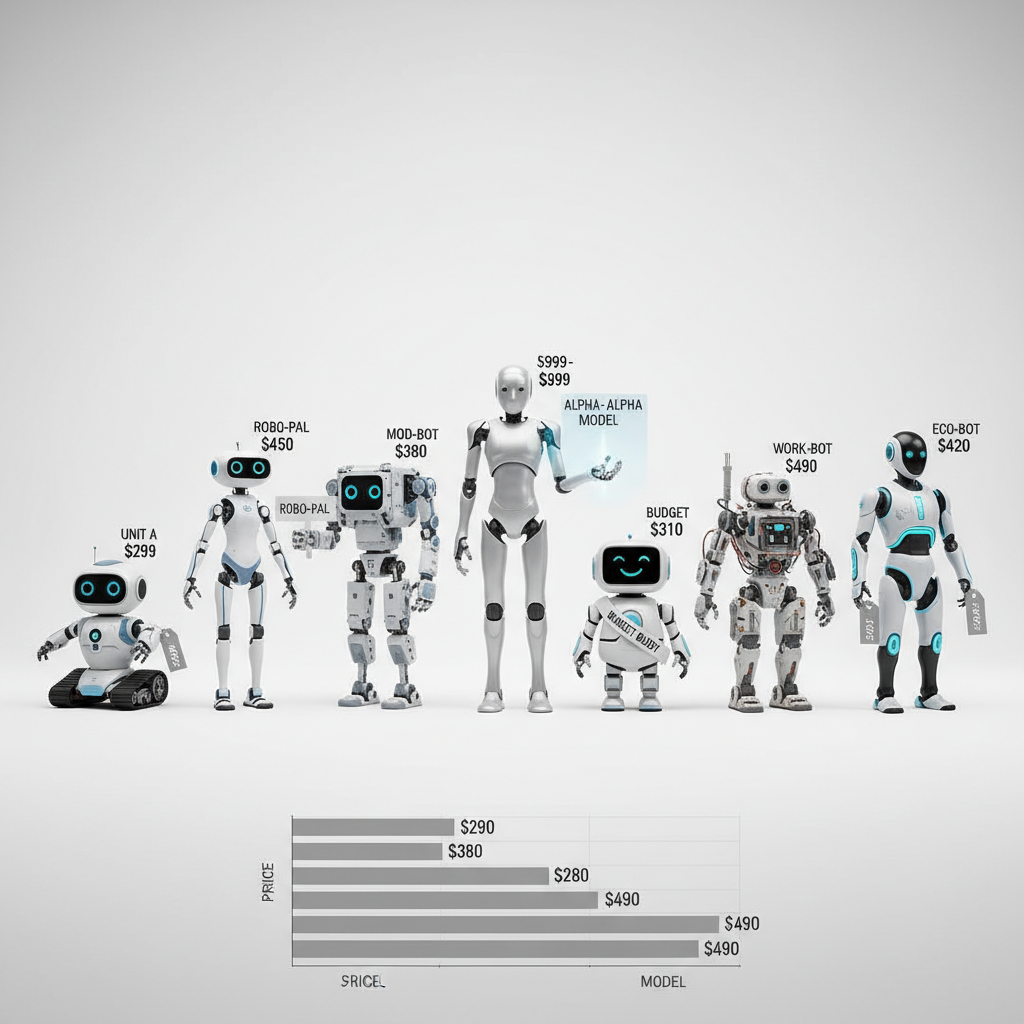
In 2026, humanoid robots have finally broken free from science fiction and entered the real world—but at what cost? From groundbreaking $2,700 prototypes emerging from Chinese labs to $250,000+ industrial powerhouses, the range of affordable humanoid robots has exploded in ways unimaginable just two years ago. Whether you're a startup looking for a budget research platform, a manufacturer seeking cost-effective automation, or simply curious about when you'll be able to afford your own robotic assistant, this comprehensive guide breaks down every affordable humanoid robot available today.
The humanoid robot market in 2026 isn't just about Tesla's Optimus anymore. Chinese manufacturers like Unitree, AgiBot, and dozens of emerging companies have triggered a global price war that's driving costs down at breakneck speed. We've identified over 40 commercially available humanoid robots across four distinct price tiers, from ultra-budget educational models to enterprise-grade systems that cost less than a luxury car.
Complete Price Breakdown: Cheapest Humanoid Robots by Budget Tier
Here's the definitive ranking of the most affordable humanoid robots you can actually buy in 2026, organized by price tiers:
Under $5,000: Ultra-Budget Humanoids
1. Bumi Robot - $1,370 (World's Cheapest)
• Height: 120 cm | Weight: 25 kg | DOF: 18
• Manufacturer: Noetix (Indonesia) | Availability: Limited production
• Use Case: Education, basic research, hobbyist projects
2. Unitree R1 - $4,900
• Height: 122 cm | Weight: 25 kg | DOF: 20
• Features: 7 km/h speed, autonomous recovery, cartwheel capability
• Manufacturer: Unitree Robotics | Availability: Global shipping
• Use Case: AI research, university labs, small business automation
3. KiwiBot Humanoid - $2,700
• Height: 100 cm | Weight: 18 kg | DOF: 12
• Manufacturer: KiwiBot (Colombia) | Availability: South America only
• Use Case: Educational demonstrations, basic service tasks
$5,000 - $20,000: Entry-Level Professional
4. Unitree G1 - $13,500-$16,000
• Height: 132 cm | Weight: 35 kg | DOF: 23-43 (configuration dependent)
• Features: 3D LiDAR, depth cameras, NVIDIA Jetson option
• Manufacturer: Unitree Robotics | Availability: Global
• Use Case: Research platforms, university robotics programs
5. SoftBank NAO - $8,000-$12,000
• Height: 58 cm | Weight: 4.3 kg | DOF: 25
• Features: Advanced emotion recognition, established ecosystem
• Manufacturer: SoftBank Robotics | Availability: Global
• Use Case: Research, autism therapy, educational programming
$20,000 - $100,000: Professional-Grade Systems
6. Tesla Optimus - $25,000-$30,000 (Target Price)
• Height: 173 cm | Weight: 57 kg | DOF: 40+
• Features: FSD-derived AI, Tesla manufacturing scale
• Status: Limited production 2026, consumer availability TBD
• Use Case: Factory automation, eventual consumer applications
7. Fourier GR-1 - $89,000
• Height: 165 cm | Weight: 55 kg | DOF: 40+
• Features: 50kg payload, medical-grade precision
• Manufacturer: Fourier Intelligence | Availability: Global enterprise
• Use Case: Healthcare, rehabilitation, research institutions
$100,000+: Enterprise and Industrial Systems
8. AgiBot A2 Series - $100,000-$190,000
• Height: 175 cm | Weight: 55-69 kg | DOF: 49+
• Features: 200 TOPS AI, 5,168+ units shipped globally
• Manufacturer: AgiBot | Availability: 6 countries including US
• Use Case: Customer service, manufacturing, logistics
9. Agility Robotics Digit - $100,000-$250,000
• Height: 175 cm | Weight: 65 kg | Payload: 16 kg
• Features: Amazon-deployed, RaaS model available
• Manufacturer: Agility Robotics | Availability: Enterprise contracts
• Use Case: Warehouse logistics, package handling
2026 Price Trends: Why Humanoid Robots Are Getting Cheaper
The dramatic price reduction in humanoid robots stems from five key factors:
1. Chinese Manufacturing Scale
Chinese companies have leveraged their electronics manufacturing expertise to drive down component costs. Unitree, for example, produces its own actuators at massive scale, reducing the per-unit cost from $5,000 to under $500 for comparable performance.
2. AI Commoditization
The democratization of large language models and computer vision has eliminated the need for expensive custom AI development. Modern humanoid robots can leverage open-source models and pre-trained vision systems, reducing software development costs by 70-80%.
3. Component Standardization
The industry is converging on standardized components: NVIDIA Jetson for computing, similar LiDAR sensors, and modular actuator designs. This standardization drives down costs through economies of scale.
Budget Tier Analysis: What You Get at Each Price Point
Under $5,000: Educational and Hobbyist
What's Included: Basic bipedal locomotion, simple manipulation, educational programming interfaces, basic sensors (cameras, IMU).
What's Missing: Advanced AI, industrial-grade components, sophisticated manipulation, autonomous navigation.
Best For: STEM education, robotics hobbyists, basic research projects, proof-of-concept development.
Real-World Performance: These robots can walk on flat surfaces, perform simple pick-and-place tasks, and follow basic commands. Don't expect industrial reliability or complex autonomous behavior.
$5,000-$20,000: Entry-Level Professional
What's Included: Advanced sensors (LiDAR, depth cameras), sophisticated AI (basic computer vision, voice recognition), improved construction quality, development SDKs.
What's Missing: Industrial payloads, extended battery life, enterprise-grade reliability, advanced manipulation.
Best For: University research programs, small business customer service, robotics education, prototype development.
Real-World Performance: Capable of autonomous navigation in structured environments, voice interaction, basic object recognition, and simple service tasks. The Unitree G1 represents the sweet spot in this category.
$20,000-$100,000: Professional-Grade
What's Included: Industrial-grade components, advanced AI systems, significant payload capacity, enterprise reliability, comprehensive sensor suites.
What's Missing: Heavy industrial capability, extreme environment operation, specialized industry features.
Best For: Commercial deployments, advanced research, pilot manufacturing programs, customer-facing applications.
Real-World Performance: Capable of real commercial work. Tesla Optimus (when available) and Fourier GR-1 can handle manufacturing tasks, customer service, and complex autonomous operations.
Comparison Table: Top 10 Cheapest Humanoid Robots 2026
FAQ: Cheapest Humanoid Robots 2026
What is the cheapest humanoid robot you can buy in 2026?
The Bumi robot from Indonesian company Noetix is currently the world's cheapest humanoid robot at $1,370. However, for a more capable and widely available option, the Unitree R1 at $4,900 offers significantly better functionality and global shipping.
Which budget humanoid robot offers the best value?
The Unitree G1 at $13,500 provides the best value for most users. It combines advanced sensors (LiDAR, depth cameras), solid construction, educational support, and the option to upgrade to NVIDIA Jetson computing. It's the most popular choice for university research programs.
Are cheap humanoid robots reliable enough for commercial use?
It depends on the price tier. Robots under $10,000 are generally suitable only for education and research. The $13,500-$25,000 range (like Unitree G1, Tesla Optimus) can handle light commercial tasks. For serious commercial deployment, budget at least $50,000-$100,000 for systems like AgiBot A2 or Fourier GR-1.
What's the cheapest humanoid robot for home use?
Currently, no humanoid robot is truly designed for consumer home use. The closest options are the 1X NEO (in beta testing with pricing TBD) and Tesla Optimus (targeting under $20,000 but not yet available). For now, the Unitree G1 at $13,500 could work in a home setting but requires technical expertise to operate.
Will humanoid robot prices continue falling?
Yes, dramatically. Industry experts predict entry-level humanoids will cost under $10,000 by 2027 and possibly under $5,000 by 2030. This is driven by Chinese manufacturing scale, component standardization, and increasing competition. Tesla's mass-market entry will likely accelerate this trend.
What features do you lose with cheaper humanoid robots?
Cheaper robots typically sacrifice: payload capacity, advanced AI capabilities, industrial-grade reliability, sophisticated sensors, enterprise support, and safety certifications. They're best suited for education, research, and light commercial applications rather than heavy industrial work.
The Bottom Line: Humanoid Robots Are Finally Affordable
The democratization of humanoid robotics is happening now, not in some distant future. With options starting at $1,370 for basic capabilities and under $5,000 for surprisingly sophisticated systems like the Unitree R1, the barrier to entry has collapsed. Universities, small businesses, and even ambitious individuals can now afford to experiment with humanoid technology.
The sweet spot for most buyers in 2026 remains the $13,500-$25,000 range, where robots like the Unitree G1 and upcoming Tesla Optimus offer genuine capability without enterprise-level costs. For serious commercial deployment, budgeting $50,000-$150,000 gets you production-ready systems that can deliver real ROI.
The next two years will be transformational. As Tesla scales Optimus production and Chinese manufacturers continue aggressive pricing, we expect the entire market to shift downward by 50-70%. The $10,000 humanoid robot is no longer a question of if, but when—and based on current trends, when is very soon.
Related: How Much Does a Humanoid Robot Cost in 2026? Complete Price Guide · The Most Advanced Humanoid Robot You Can Buy Right Now · Best Humanoid Robots
Ready to buy? Browse humanoid robots for sale on Robozaps.


