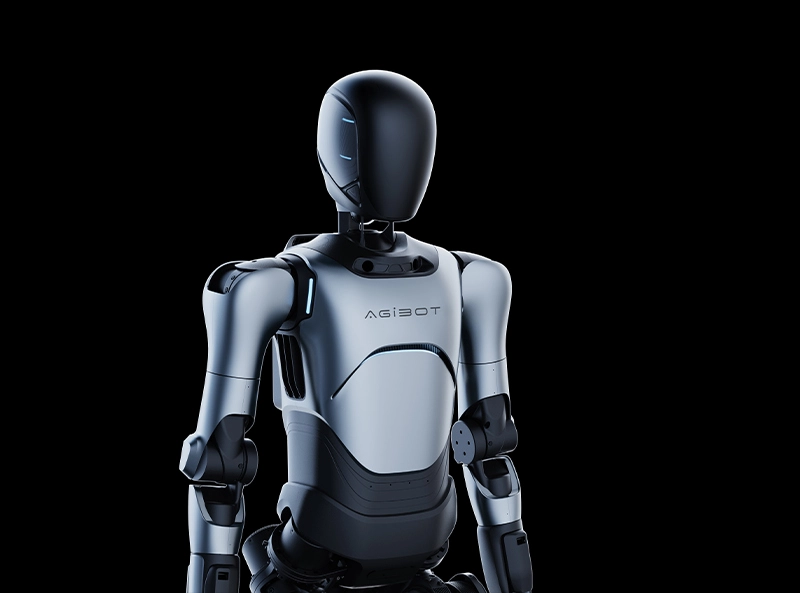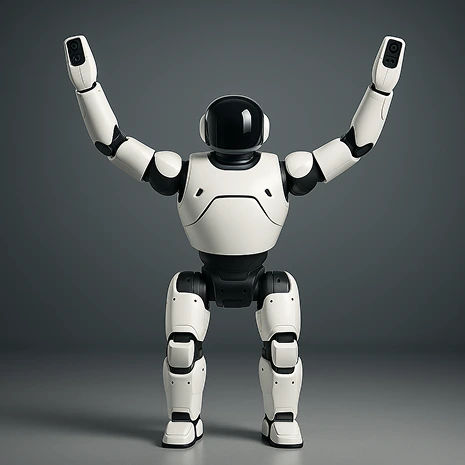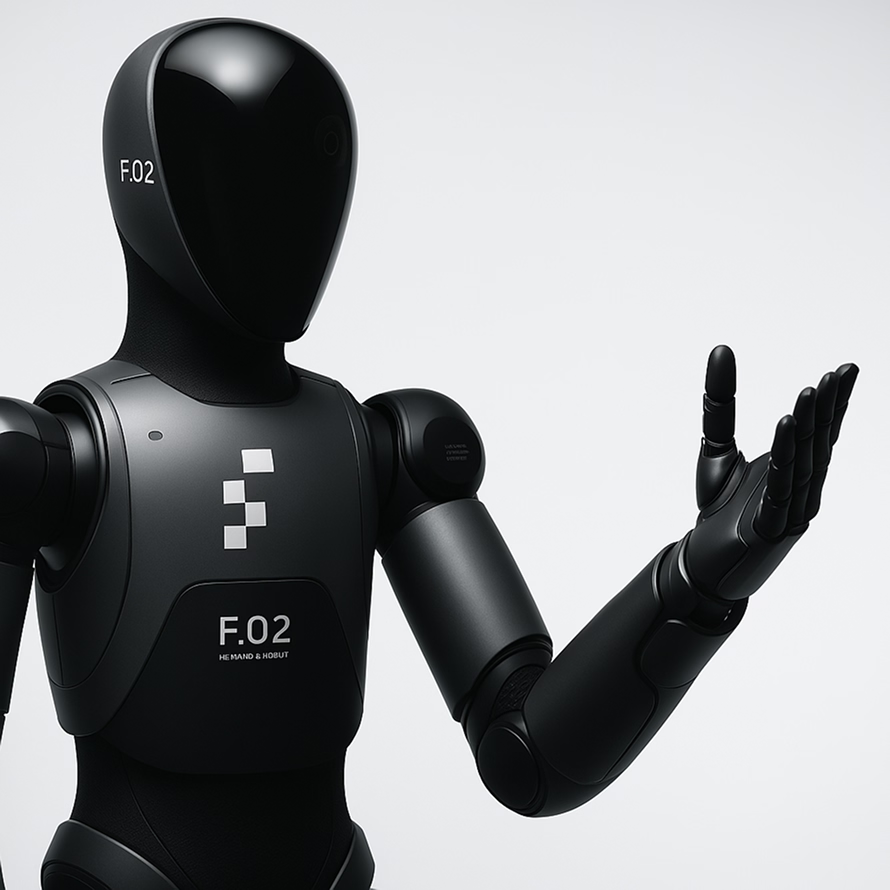
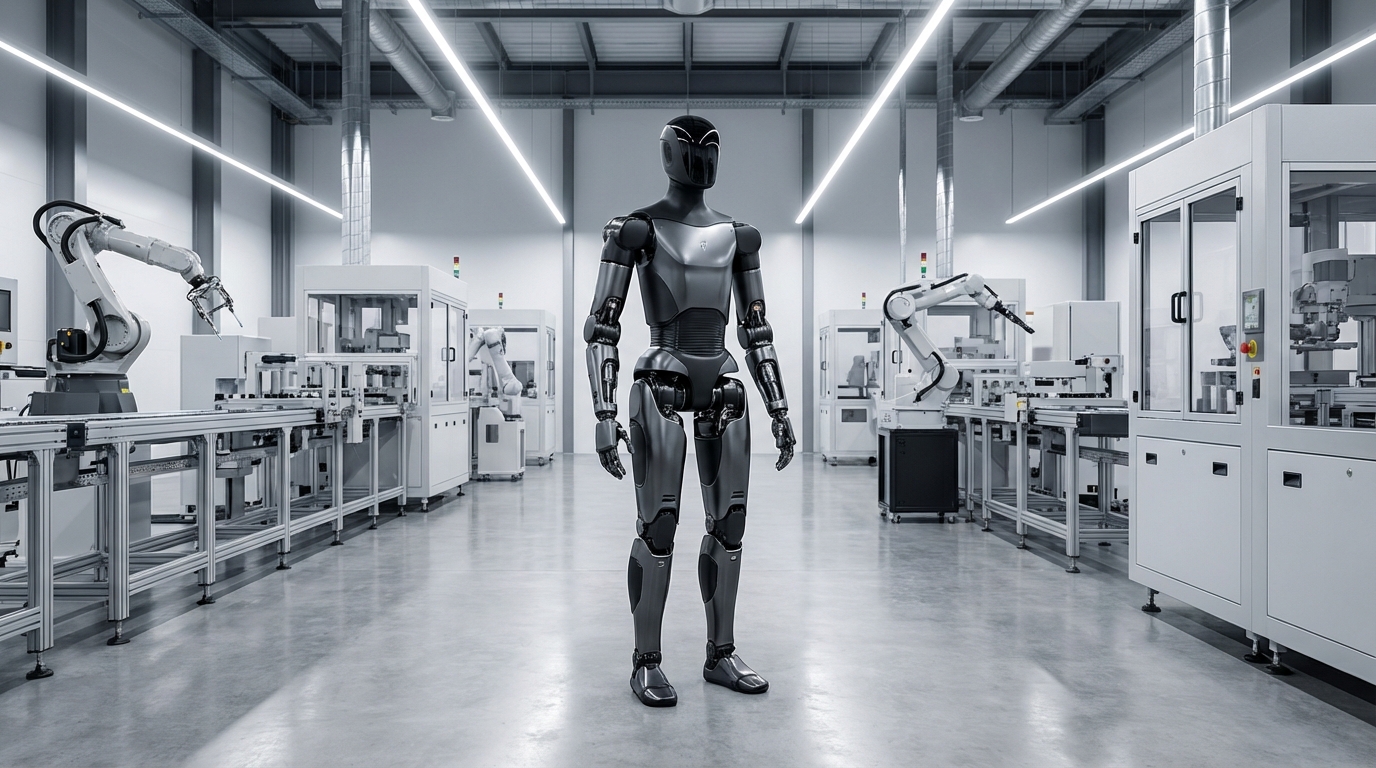
The Figure 01 changed the trajectory of humanoid robotics when it debuted in 2023. Built by Figure AI — a startup now valued at $39 billion after raising over $1.75 billion in total funding (including a $675M Series B from Microsoft, NVIDIA, OpenAI, and Jeff Bezos, and a $1 billion Series C in September 2025 from Intel, NVIDIA, Qualcomm, T-Mobile, Salesforce, and Brookfield) — the Figure 01 was the company's proof-of-concept humanoid designed for real-world commercial labor. In this Figure 01 review, we break down its full specifications, real-world capabilities, OpenAI-powered AI system, limitations, and how it compares to its successors, the Figure 02 and the newly announced Figure 03, as well as competitors like the Unitree G1 and Tesla Optimus.
Key Takeaways
- The Figure 01 stands 5 feet 6 inches (1.68m) tall, weighs 132 lbs (60 kg), can carry 44 lbs (20 kg), and runs for approximately 5 hours on a single charge.
- Originally powered by OpenAI's vision-language models, Figure 01 could understand spoken instructions, describe what it sees, reason about tasks, and execute multi-step actions autonomously. Figure AI ended the OpenAI partnership in 2025, developing its own proprietary Helix AI.
- Figure 01 was deployed at BMW's Spartanburg plant in South Carolina for manufacturing tasks, marking one of the first real-world factory deployments of a general-purpose humanoid.
- Figure AI has since launched the Figure 02 (with 16 DOF hands, Helix AI, and onboard compute) and announced Figure 03 for residential environments, targeting 2026 for advanced home autonomy.
- Figure AI opened BotQ, a manufacturing facility designed to produce 12,000 humanoid robots per year, with plans to use its own robots to build more robots.
- The Figure 01 is not available for individual purchase — it's deployed through enterprise partnerships. Estimated per-unit cost ranged from $30,000 to $150,000.
Figure 01 Full Specifications
Here's the complete spec sheet for the Figure 01 humanoid robot, verified against Figure AI's published data and third-party analyses:
At 5'6" and 132 lbs, the Figure 01 was designed to operate in spaces built for humans — standard doorways, aisles, staircases, and workstations. Its 44-lb payload capacity makes it suitable for manufacturing tasks like picking, placing, and carrying components. The 5-hour battery life was a standout feature in 2023–2024, exceeding most competitors at the time.
Figure 01 AI Capabilities: The OpenAI Integration
What separated the Figure 01 from every other humanoid robot in 2024 was its AI. Figure AI partnered with OpenAI to integrate advanced vision-language models directly into the robot's decision-making pipeline. The results were demonstrated in a viral March 2024 video that showed Figure 01:
- Conversing naturally: A human asked the robot what it could see on a table. Figure 01 correctly identified an apple, a plate, and a drying rack, then explained its reasoning.
- Planning multi-step tasks: When asked to give the human "something to eat," Figure 01 identified the apple as the only edible item and handed it over.
- Learning from observation: The robot learned to make coffee by watching a human perform the task once, then replicated the sequence autonomously.
- Real-time speech: Full-speed conversation with natural language understanding — not pre-scripted commands.
This wasn't teleoperation or pre-programmed behavior. The OpenAI model processed camera feeds and audio in real-time, generated a plan, and controlled the robot's body to execute it. Figure AI CEO Brett Adcock described it as "the first time a humanoid robot could truly reason about its environment and act on that reasoning."
The underlying system used a vision-language-action (VLA) architecture — the same family of models pioneered by Google DeepMind's RT-2. In 2025, Figure AI ended its OpenAI collaboration, with the company stating that large language models are "getting smarter yet more commoditized." Figure AI developed its proprietary Helix VLA system, which now powers the Figure 02 and future models, running on dual onboard GPUs with System 2 handling high-level planning at 7-9 Hz and System 1 providing low-level motor control at 200 Hz.
Real-World Deployment: BMW Spartanburg
In January 2024, Figure AI announced a commercial agreement with BMW to deploy Figure 01 robots at BMW's Spartanburg manufacturing plant in South Carolina — one of BMW's largest global factories, producing over 1,500 vehicles per day.
The deployment started with specific manufacturing tasks:
- Sheet metal insertion: Figure 01 picked up body panel components and inserted them into fixtures — a repetitive, ergonomically challenging task.
- Material transport: Moving parts bins and components between workstations.
- Quality inspection support: Using its camera system to assist in visual quality checks.
The BMW partnership initially focused on testing and validating Figure 01 in real manufacturing conditions. While Figure 01 proved the concept, it was its successor — the Figure 02 — that later achieved a 400% efficiency gain in BMW factory tasks during its 2025 deployment, specifically inserting sheet metal parts into chassis assemblies. The partnership validated Figure AI's approach of building a general-purpose robot that learns tasks rather than requiring task-specific engineering.
This BMW partnership was a landmark moment for the humanoid robotics industry. It proved that a general-purpose humanoid could add value in a real automotive manufacturing environment — not just in controlled lab demos.
Figure 01 Design and Build Quality
The Figure 01's industrial design reflects its purpose as a commercial work tool rather than a research curiosity:
- Human-proportioned frame: At 5'6" and human-like proportions, Figure 01 works naturally at standard workstations, shelves, and equipment designed for human operators.
- Custom electric actuators: Every joint uses proprietary actuators designed for the torque, speed, and efficiency profiles needed for industrial tasks. No hydraulics — fully electric for cleaner, quieter operation.
- Dexterous hands: Multi-fingered hands with individual finger control and force sensing. Capable of grasping objects of varying sizes, from small fasteners to large parts bins.
- Modular architecture: Designed for field serviceability. Components can be swapped without returning the robot to the factory.
- Safety considerations: Rounded edges, compliant surfaces on contact points, and software-limited force output to enable human-proximate operation.
The robot's aesthetic is deliberately industrial — matte black and gray panels, exposed cable routing where necessary, and functional rather than decorative design. This is a tool, not a toy.
Figure 01 vs Figure 02 vs Figure 03: The Evolution
Figure AI has iterated rapidly. Here's how the three generations compare:
The biggest evolution across generations: Figure 01 relied on OpenAI's cloud-based AI; Figure 02 runs proprietary Helix AI on onboard chips; and Figure 03 adds the ability to control two robots simultaneously and handle unpredictable home environments. The Helix VLA system can pick up nearly any small household object, even those it hasn't seen before — a massive leap from Figure 01's more constrained capabilities.
Figure 01 vs Competitors: How It Compares in 2026
The humanoid robot market has exploded since Figure 01's debut. Here's how it stacks up against the current field:
The Figure 01's key legacy is proving that a general-purpose humanoid could work in real factory conditions. While the hardware specs were competitive for 2023–2024, the AI integration was the real differentiator. By 2026, the Figure 02 has taken over as Figure AI's active platform, and competitors like AgiBot A2 (49 DOF, 200 TOPS AI) and Apptronik Apollo (25 kg payload, Mercedes deployment) have raised the bar.
For buyers looking for an affordable humanoid robot available today, the Unitree G1 starting at $16,000 is the most practical option. For enterprise manufacturing deployments, Figure 02 and Apollo lead the field. See our full ranking of the best humanoid robots in 2026.
Figure 01 Strengths and Weaknesses
Strengths
- Pioneered OpenAI-powered humanoid AI — first robot to demonstrate real conversational reasoning and autonomous task planning
- 5-hour battery life outperformed most competitors at launch
- 20 kg payload handles real manufacturing components
- Human-height form factor (5'6") works in standard human environments
- BMW deployment validated commercial viability in automotive manufacturing
- Fully electric — cleaner, quieter, and lower maintenance than hydraulic systems
- Modular design for field serviceability
- Task learning from observation — watch once, replicate autonomously
Weaknesses
- Not available for individual purchase — enterprise-only through Figure AI
- First-generation hardware now retired, superseded by Figure 02 and Figure 03
- Walking speed of 1.2 m/s is slower than Unitree H1 (3.3 m/s) or Tesla Optimus
- Limited hand dexterity compared to Figure 02's 16 DOF hands
- Relied on external compute for full AI capability — not fully edge-processed
- OpenAI dependency — partnership ended in 2025 as Figure built proprietary AI
- No public SDK or developer access — closed platform
- High estimated cost ($30K–$150K) compared to Unitree G1 ($16,000)
- Indoor industrial use only — no outdoor or rough terrain capability
Figure AI: Company Background and Funding
Understanding Figure 01 requires understanding Figure AI, one of the most well-funded robotics startups in history:
- Founded: 2022 by Brett Adcock (previously founded Archer Aviation, valued at $2.7B, and Vettery)
- Headquarters: San Jose, California
- Total funding: Over $1.75 billion across three rounds
- Series B (Feb 2024): $675 million from Microsoft, NVIDIA, OpenAI Startup Fund, Jeff Bezos, Intel Capital — $2.6B valuation
- Series C (Sep 2025): $1 billion from Intel, NVIDIA, Qualcomm, T-Mobile, Salesforce, Brookfield Asset Management — $39 billion valuation
- Employees: 180+ engineers across AI, mechanical engineering, and robotics
- BotQ Factory: Announced March 2025 — manufacturing facility designed to produce 12,000 humanoid robots per year, with plans to use Figure robots to help build more Figure robots
- Production target: Figure AI plans to ship 100,000 humanoid robots over the next 4 years (announced January 2025, Forbes)
The $39 billion valuation makes Figure AI one of the most valuable robotics companies in the world. With Microsoft, NVIDIA, Qualcomm, and Salesforce backing, Figure AI has access to cloud compute, edge AI chips, enterprise distribution, and CRM infrastructure that smaller competitors cannot match.
Who Is the Figure 01 For?
The Figure 01 is relevant for:
- Enterprise manufacturers evaluating humanoid robots for assembly, material handling, and logistics
- Robotics researchers studying the evolution of AI-powered humanoids
- Technology executives benchmarking humanoid capabilities for future adoption
- Investors tracking the humanoid robotics market trajectory
The Figure 01 is NOT for:
- Individual consumers or hobbyists — no retail availability
- Researchers needing open SDK access — the platform is closed
- Budget buyers — the Unitree G1 at $16,000 is the affordable option
- Home use — Figure 03 targets residential environments in 2026, or try the 1X NEO
Figure 01 Timeline: From Concept to Retirement
Understanding the Figure 01's significance requires context of its rapid development:
- 2022: Figure AI founded by Brett Adcock. Company announces mission to build a general-purpose humanoid robot.
- March 2023: Figure 01 prototype revealed. First walking demos shown. Media attention surges.
- October 2023: Figure 01 demonstrated performing autonomous tasks — making coffee, sorting objects. OpenAI partnership announced.
- January 2024: BMW commercial agreement signed for Spartanburg plant deployment.
- February 2024: Series B funding at $2.6 billion valuation — $675M+ raised from Microsoft, NVIDIA, OpenAI, Jeff Bezos.
- March 2024: Viral demo video showing Figure 01 conversing with humans, reasoning about objects, and executing tasks autonomously via OpenAI integration.
- August 2024: Figure 02 launched with upgraded hardware (16 DOF hands, 6 cameras, onboard compute). Figure 01 transitions to legacy status.
- Early 2025: Figure AI ends OpenAI collaboration, citing commoditization of LLMs. Develops proprietary Helix VLA AI.
- February 2025: Helix (VLA model) introduced — 35 DOF, dual-GPU system, capable of controlling two robots simultaneously.
- March 2025: BotQ factory announced — 12,000 humanoid robots/year production capacity.
- September 2025: Series C: $1 billion raised, $39 billion valuation.
- 2026: Figure 02 active at BMW. Figure 03 entering residential pilot testing. Figure 01 fully retired but recognized as the breakthrough that launched it all.
From founding to $39 billion valuation in under 4 years — Figure AI's trajectory is unprecedented in robotics, and the Figure 01 was the vehicle that started it all.
Our Verdict on the Figure 01
The Figure 01 was a historic product. It demonstrated that a general-purpose humanoid robot could understand language, reason about its environment, plan multi-step tasks, and execute them in a real factory — not just a research lab. The BMW deployment was proof that the concept works commercially.
However, by 2026, the Figure 01 has been fully retired. The Figure 02 improves on every dimension: better hands (16 DOF), proprietary Helix AI, onboard compute, and expanded deployment. And the Figure 03 / Helix platform takes it further with residential capabilities and multi-robot coordination. The Figure 01 is best understood as the breakthrough prototype that launched Figure AI from a $0 startup to a $39 billion company in under 4 years.
For anyone looking to buy a humanoid robot today, the Figure 01/02 aren't options for individual purchase. The Unitree G1 starting at $16,000 is the most accessible humanoid you can actually buy and receive. For enterprise deployment, contact Figure AI directly or explore alternatives like the Apptronik Apollo or AgiBot A2.
Robozaps Rating: 7.8/10 — Groundbreaking AI integration on a capable platform, but now retired and superseded by Figure 02/03. A historic first-generation product.
Browse humanoid robots for sale on Robozaps
Frequently Asked Questions About the Figure 01
What are the Figure 01 specs?
The Figure 01 stands 5'6" (168 cm), weighs 132 lbs (60 kg), carries up to 44 lbs (20 kg), walks at 2.7 mph (1.2 m/s), and operates for approximately 5 hours per charge. It has 40+ degrees of freedom and was powered by OpenAI's vision-language AI models.
How much does the Figure 01 cost?
The Figure 01 was not publicly priced. Industry estimates placed it between $30,000 and $150,000 per unit for early enterprise deployments. It was never available for individual purchase — only through commercial partnerships with Figure AI.
Can you buy a Figure 01?
No. The Figure 01 has been retired and superseded by the Figure 02. It was deployed exclusively through enterprise partnerships (e.g., BMW). For a humanoid robot you can actually buy today, see the most advanced humanoid robots for sale or the Unitree G1 starting at $16,000.
What is the difference between Figure 01 and Figure 02?
The Figure 02 improves on the Figure 01 with 16 DOF dexterous hands (vs simpler grippers), proprietary Helix AI (vs OpenAI integration), 3 onboard NVIDIA RTX AI chips (vs external processing), 6 RGB cameras with 360° coverage, 25 kg payload (vs 20 kg), and a larger 2.25 kWh battery. The Figure 02 achieved 400% faster task completion at BMW. Read our full Figure 02 review.
Is Figure 01 better than Tesla Optimus?
They target different markets. Figure 01 was deployed in real manufacturing before Optimus reached that stage. Optimus aims for mass-market pricing under $20,000, while Figure 01/02 targets enterprise. As of 2026, neither is available for public purchase. For a detailed comparison, see our Figure 01 vs Tesla Optimus analysis.
What AI does the Figure 01 use?
The Figure 01 originally used OpenAI's vision-language model (VLM) for real-time perception, reasoning, and task planning. In 2025, Figure AI ended the OpenAI partnership and developed its proprietary Helix vision-language-action AI system, which now powers Figure 02 and Figure 03 with dual-GPU onboard processing.
Where was the Figure 01 deployed?
The Figure 01 was deployed at BMW's Spartanburg manufacturing plant in South Carolina, USA. It performed tasks including sheet metal part insertion, material transport, and quality inspection support. Its successor, Figure 02, achieved 400% faster task completion on certain operations at the same facility.
How does Figure 01 compare to Unitree G1?
The Figure 01 is larger (168 cm vs 132 cm), heavier (60 kg vs 35 kg), and has a much higher payload (20 kg vs 2–3 kg). However, the Unitree G1 costs $16,000 and ships to anyone globally, while the Figure 01 was enterprise-only with estimated costs of $30K–$150K. For a full breakdown, see our Figure 01 vs Unitree G1 comparison.
What is Figure AI's current valuation?
Figure AI's valuation reached $39 billion after its $1 billion Series C round in September 2025. Investors include Intel, NVIDIA, Qualcomm, T-Mobile, Salesforce, and Brookfield Asset Management. This makes Figure AI one of the most valuable robotics companies in the world.
Does Figure AI still use OpenAI?
No. Figure AI ended its OpenAI collaboration in 2025, stating that large language models are "getting smarter yet more commoditized." Figure now uses its proprietary Helix vision-language-action AI system, which runs on onboard GPUs and can control two robots simultaneously.
Related: Figure 01 vs Tesla Optimus Gen 2 · Figure 01 vs Unitree G1 · Figure 02 Review · Best Humanoid Robots 2026 · Humanoid Robot Cost Guide
Ready to buy? Browse humanoid robots for sale on Robozaps.